BCaBA Exam: Current Format and a Practical Study Plan
If you search for “BCaBA exam,” you may want a quick number, a 6th-edition study guide, a practice test, or a realistic answer to a harder question: what should I do with my study time? The current exam information gives you the structure. A useful preparation plan then turns that structure into retrieval, application, and review instead of a long list of definitions.
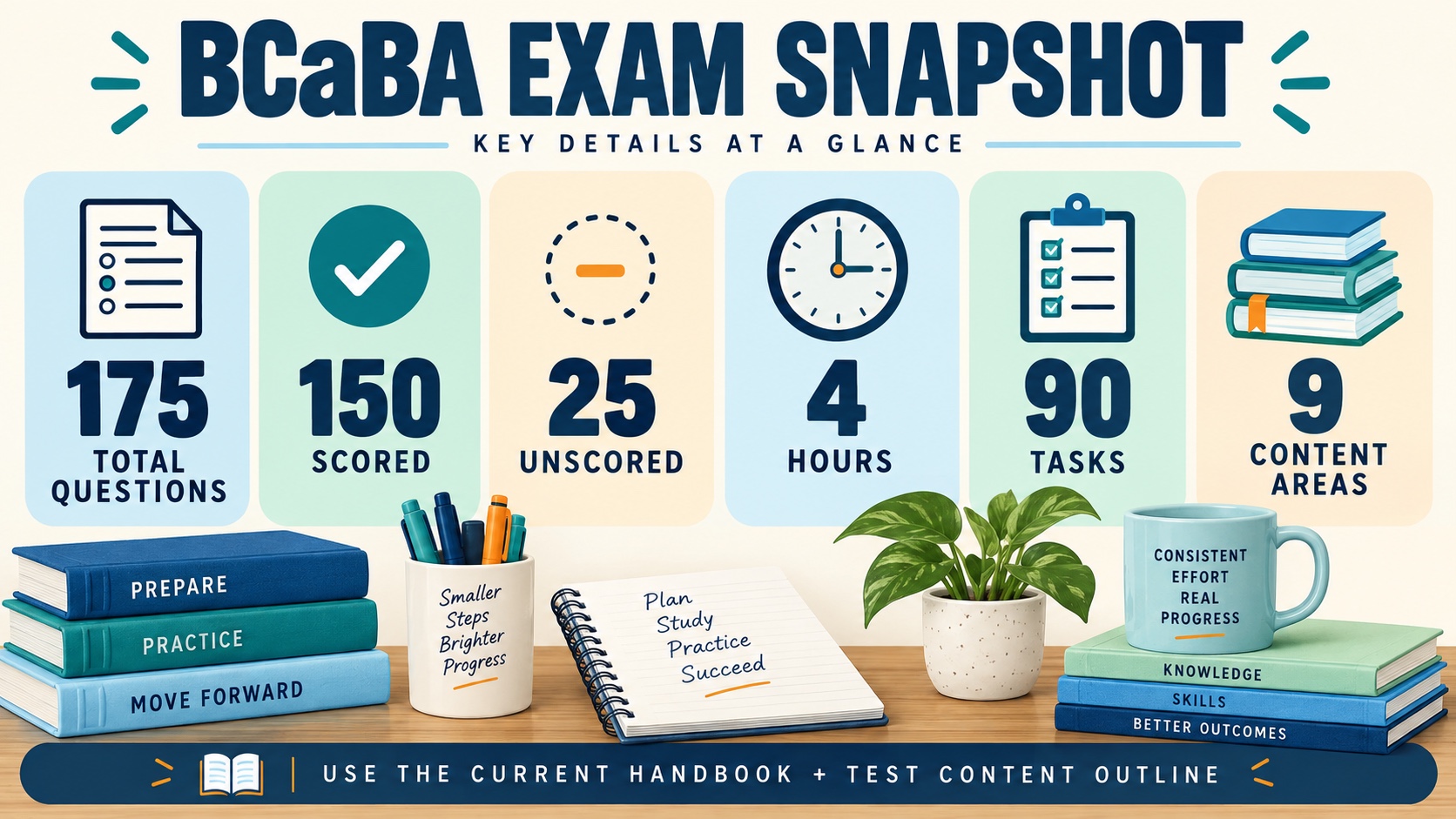
The current BCaBA examination includes 150 scored questions and 25 unscored pilot questions. You have four hours to complete the exam, each question has four possible answers with one correct answer, and the current Test Content Outline (6th ed.) organizes 90 tasks across nine content areas. The official handbook says all questions are equally weighted and the result is based on overall performance, not a separate pass/fail result for each domain.
This guide explains the current format, shows how to allocate practice by the official rounded domain weights, and gives you a review loop for learning from missed or uncertain questions. It does not reproduce official exam items, predict a score, or guarantee certification. Keep the current BACB handbook, outline, ethics code, and application information as your source of truth.
Table of Contents
What effective BCaBA exam prep is really training
The exam does not only ask whether you have seen a term before. It can require you to distinguish similar concepts, select a measurement that matches the question, interpret a pattern of data, identify an ethical boundary, or choose a behavior-change procedure that fits the stated context. A learner can recognize a definition in a study guide and still hesitate when the same idea appears inside a longer scenario.
That is why useful preparation has two layers:
- Knowledge: foundations, concepts, measurement, design, ethics, assessment, intervention, behavior change, and supervisory relationships.
- Decision fluency: identifying what the question is asking, locating the evidence in the stem, choosing one answer, and explaining why the other options are weaker.
Reading is valuable when it repairs a real gap. It becomes less valuable when it replaces retrieval. A strong study block usually includes a short review, a small set of original practice questions, and a written explanation of at least one decision. The goal is not to make every session feel like a test. The goal is to make your reasoning visible enough to improve.
Use the official outline as a map, not as a reason to divide every minute equally. Higher-weight domains deserve more practice time, while repeated errors in a smaller area may deserve a temporary adjustment. Your diagnostic pattern tells you where the plan needs to bend.
Current BCaBA exam structure and the 6th edition
The current official materials identify the BCaBA Test Content Outline (6th ed.) as the examination boundary. The current handbook describes:
- 175 total questions: 150 scored and 25 unscored pilot questions.
- Four hours: the stated completion time for the examination.
- Four answer choices: one correct answer for each question.
- 90 tasks: organized across nine content areas.
- Overall performance: the result is not described as a separate outcome for each content area.
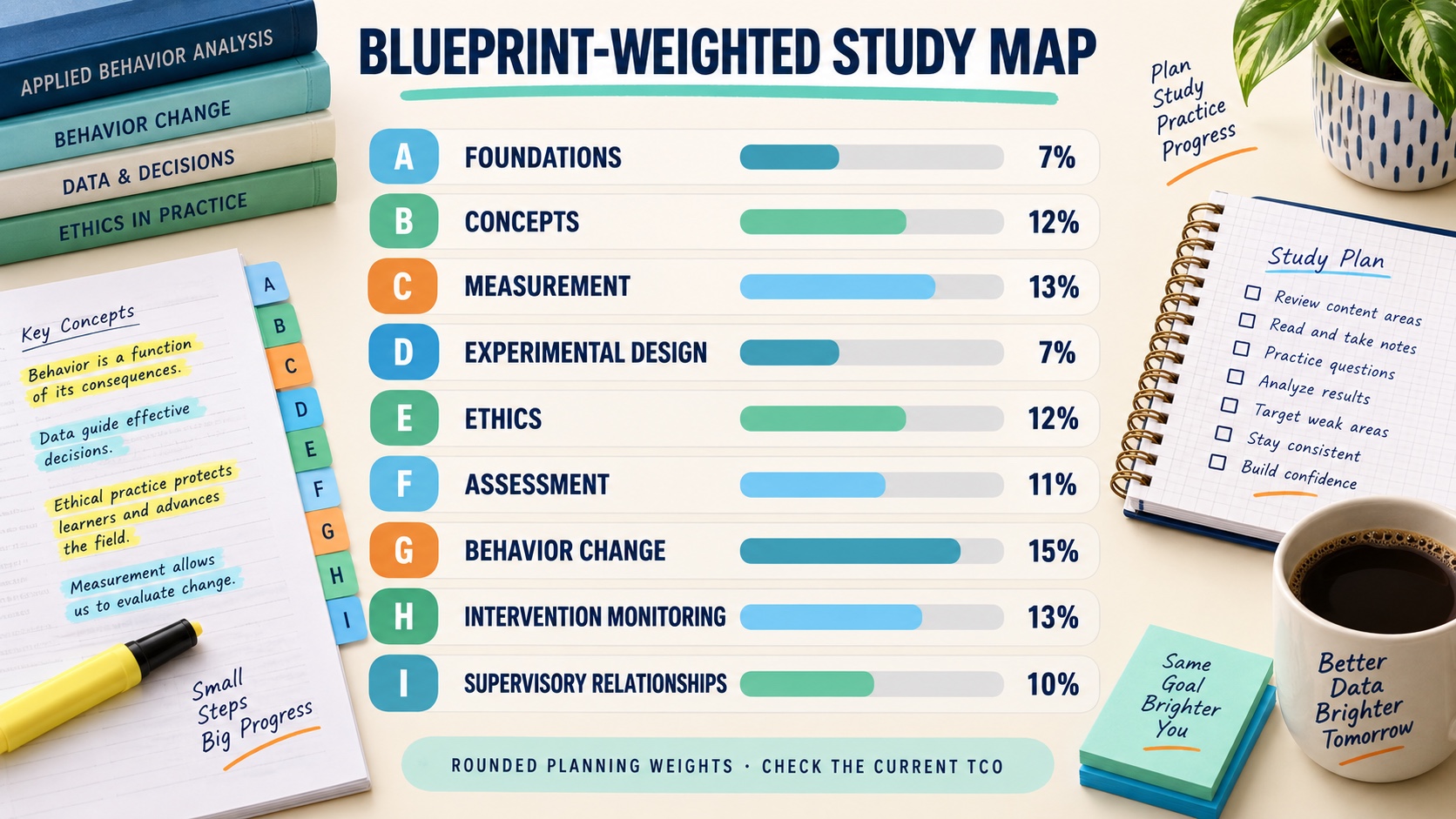
The current rounded content-area weights provide a practical starting point for your study calendar:
- A. Behaviorism and Philosophical Foundations — 7%.
- B. Concepts and Principles — 12%.
- C. Measurement, Data Display, and Interpretation — 13%.
- D. Experimental Design — 7%.
- E. Ethical and Professional Issues — 12%.
- F. Behavior Assessment — 11%.
- G. Behavior-Change Procedures — 15%.
- H. Intervention Development and Monitoring — 13%.
- I. Supervisory Relationships — 10%.
These are rounded planning weights. They are not a promise about the exact order, wording, or personal experience of a live examination form. Use the official TCO for the actual task descriptions. Also keep BCaBA examination preparation separate from BCaBA CEUs, fieldwork, ongoing supervision, and recertification maintenance. Those topics connect to the credential but answer different questions.
Build a blueprint-weighted study plan
Take a diagnostic set before making a detailed calendar. The diagnostic does not need to predict whether you will pass. Its purpose is to reveal what kind of help you need. Mark each uncertain or incorrect item as one of four types:
- Knowledge gap: you did not know the concept, definition, or professional rule.
- Discrimination gap: you knew the terms but confused two similar choices.
- Application gap: you knew the rule but could not use it in the scenario.
- Process gap: you misread, rushed, changed a sound answer, or failed to use the evidence in the stem.
Then give each content area two planning signals: its official rounded weight and your error pattern. Start roughly near the official distribution, and move extra study blocks toward repeated application or discrimination errors. This keeps your plan anchored to the examination without pretending that every BCaBA candidate needs the same number of weeks or hours.
Give every study block one job. A Measurement block might compare frequency, duration, and latency, then ask you to choose the best measure for three short scenarios. An Ethics block might ask you to identify the stakeholders, the relevant professional responsibility, and the information still needed before acting. A Supervisory Relationships block might ask you to distinguish a training responsibility from a service-delivery decision. The session is complete when you can explain the decision, not simply when you reach the last page.
Use practice questions as a review loop
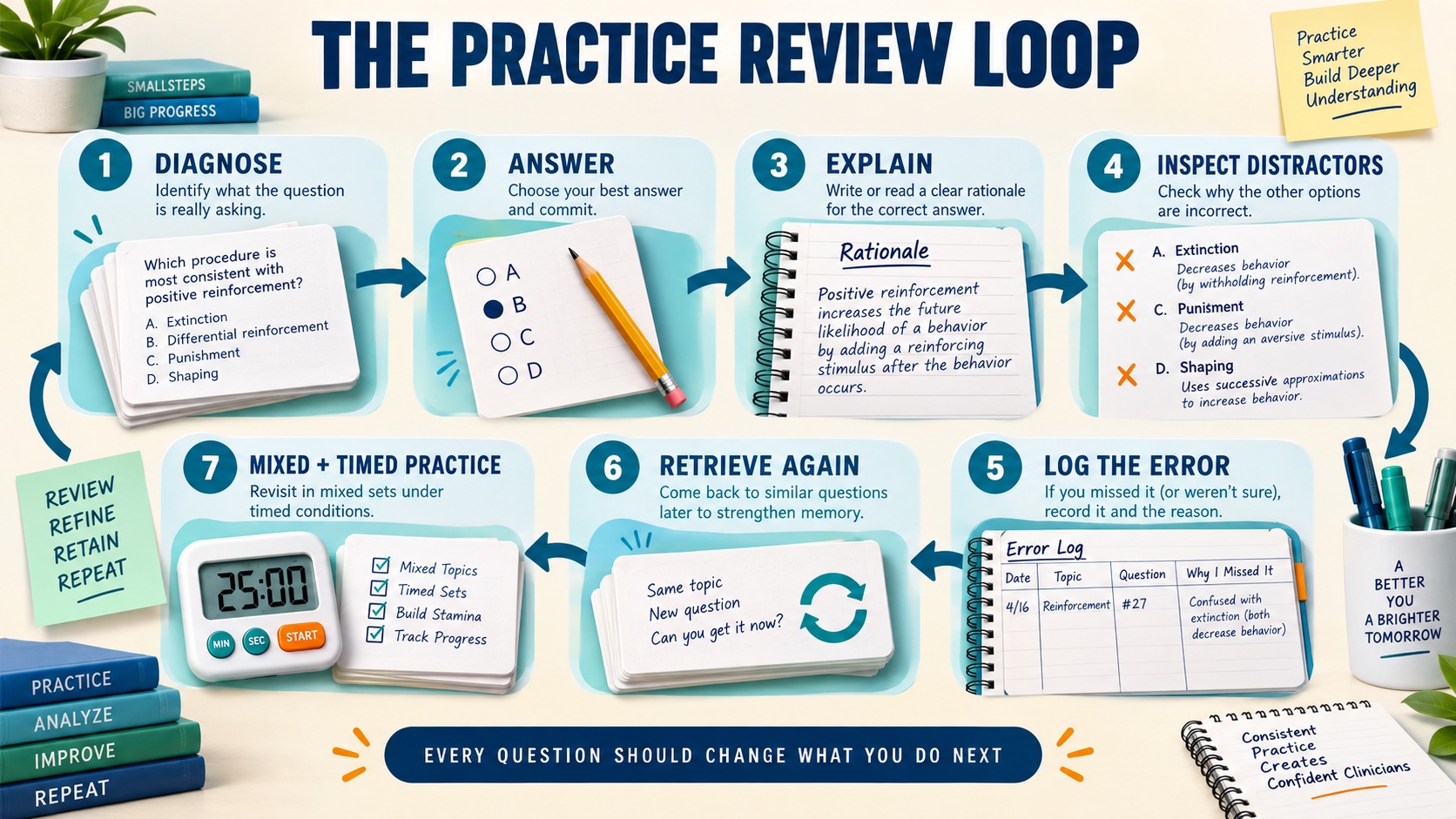
Practice questions are most useful when they change what you do next. Try this seven-step loop:
- Diagnose the task. Before staring at the choices, state what the scenario is asking you to decide.
- Answer and commit. Choose one option within a reasonable time limit. Do not turn every item into an open-book search.
- Explain your choice. Use the evidence in the stem, not only a familiar phrase.
- Inspect the distractors. Identify the fact, assumption, or scope boundary that makes each alternative weaker.
- Log the error. Record whether the problem was knowledge, discrimination, application, or process.
- Repair the gap. Revisit a targeted Theory Block, draw a comparison, reread the relevant source, or ask a qualified instructor or supervisor about the distinction.
- Retrieve later. Close the explanation and answer a new item about the same distinction after a delay.
A rationale should do more than reveal the correct letter. It should explain the measurement logic, functional relation, design choice, ethical responsibility, or supervisory boundary that makes one option best. If the explanation never addresses why the distractors fail, it may not provide enough learning value for the time you spend reviewing it.
When you use a third-party question bank, check the edition label, rationale quality, correction process, and statement of scope. The BACB says it cannot endorse specific study guides or preparation materials. A page that says its questions are “exactly like the exam” is making a marketing claim, not giving you official access.
An adaptable study rhythm
Here is one example of an eight-week rhythm. It is a template, not an official BCaBA requirement. Extend it when your diagnostic shows broad gaps or your available study time is limited. Compress it only if you can preserve time for rationale review and mixed practice.
- Week 1 — Diagnose and organize. Complete a manageable mixed set, build an error log, and gather the current handbook, TCO, Ethics Code, and training notes.
- Weeks 2–3 — Build foundations. Rotate through foundations, concepts, measurement, assessment, and ethics. Use short question sets to expose discrimination gaps.
- Weeks 4–5 — Apply and compare. Add experimental design, behavior-change procedures, intervention monitoring, and supervisory relationships. Increase mixed sets so you must identify the task without a domain label.
- Week 6 — Repair recurring errors. Re-test the distinctions that keep appearing in your log. Write one clean comparison for each repeated confusion.
- Week 7 — Practice under time. Use longer mixed sets. Practice pacing, flagging, and returning to uncertain questions without letting one hard item consume the block.
- Week 8 — Rehearse and taper. Use a full-length practice experience only if you can review it carefully. Finish by repairing the most important gaps instead of collecting new resources.
At the end of each week, answer three questions: Which domain improved? Which error type repeated? What is the next smallest useful study action? This keeps the calendar responsive to your learning rather than turning it into a checklist that can no longer explain why you are doing each activity.
Common preparation traps
Copying BCBA numbers into a BCaBA plan
BCBA and BCaBA exams share broad behavior-analytic territory but do not have the same question counts, task counts, domain labels, or weights. Start with the BCaBA Handbook and BCaBA TCO.
Memorizing without application
Knowing a definition is a beginning. Ask what the concept predicts, what evidence would support it, what measurement would capture the relevant event, and what a practitioner should do next within scope.
Using old-edition material without checking it
Older notes may contain useful science, but they should not be treated as a current exam map. Confirm the edition, task wording, ethics source, and handbook boundaries before making them the center of your plan.
Chasing one mock score
A practice score describes one set under one set of conditions. Review the item-level pattern, including answers you guessed correctly. A correct answer with weak reasoning can still reveal a future problem.
Treating preparation marketing as BACB endorsement
Original study material can be helpful without being BACB material. Look for transparent edition labeling, explanations, error reporting, and a clear statement that the resource is unofficial. No study product can guarantee a certification result.
A practical learner scenario
Imagine that Priya spends two weeks reading a review guide and highlighting terms. On a mixed diagnostic, she recognizes many phrases but misses questions that require selecting a measure, interpreting a pattern, or distinguishing a professional responsibility from a tempting shortcut. Her result is frustrating, but the error pattern is useful: the main gap is application and discrimination, not a total absence of knowledge.
Priya changes the next week. Each session begins with a short targeted review, followed by ten original scenario questions. For each missed item, she writes the evidence in the stem, explains why the selected distractor was tempting, and names the feature that makes the best answer stronger. Two days later, she completes a new mixed set without domain labels.
Her notes become shorter but more useful. Instead of copying every definition, she records comparisons such as direct versus indirect measurement, a descriptive statement versus a functional conclusion, a behavior-change procedure versus a broader intervention decision, and a supervision responsibility versus a task that belongs to another role. The practice does not make the exam predictable. It makes her next study decision clearer.
For additional learning, you can use ABA Study Online’s BCaBA Theory Blocks, work through free BCaBA practice questions, sample the clearly labeled free mock-exam preview, search the ABA definition library, browse free ABA resources, or continue short review sessions in the ABA Study Online app. These links support study; they do not replace the official application, examination, supervision, or maintenance rules.
FAQ and official sources
How many questions are on the BCaBA exam?
The current BCaBA Handbook describes 175 total questions: 150 scored questions and 25 unscored pilot questions.
Is the BCaBA exam based on the 6th edition?
Yes. The current BCaBA examination materials identify the BCaBA Test Content Outline (6th ed.) as the current outline. Recheck the official handbook and outline when you schedule because candidates test under the current edition that applies to their authorization and appointment rules.
How long is the BCaBA exam?
The current handbook states four hours to complete the examination. Use timed practice to learn your pace, but do not treat one practice pace as an official readiness threshold.
How many practice questions should I do?
Choose a volume that leaves enough time to review rationales and repair errors. A smaller set reviewed carefully can be more useful than a large set whose explanations you never inspect. Increase set length as you move toward mixed and timed practice.
Does a practice-test score predict whether I will pass?
No single unofficial practice score can make that guarantee. Use the result to identify domain and error patterns, then adjust your study plan.
What should I read first?
Start with the current BCaBA Handbook, the BCaBA Test Content Outline (6th ed.), the BACB Ethics Code resources, and materials from your training. The BACB outline index and examination-information page are useful for checking current boundaries.