BCaBA Exam Study Guide: Build a Current, Evidence-Based Plan
A useful BCaBA exam study guide should do more than collect definitions. It should help you work from the current Test Content Outline (TCO), connect concepts to entry-level assistant behavior-analyst decisions, practice with original questions, and turn mistakes into a specific next review action. The guide should also tell you which edition and official sources it follows.
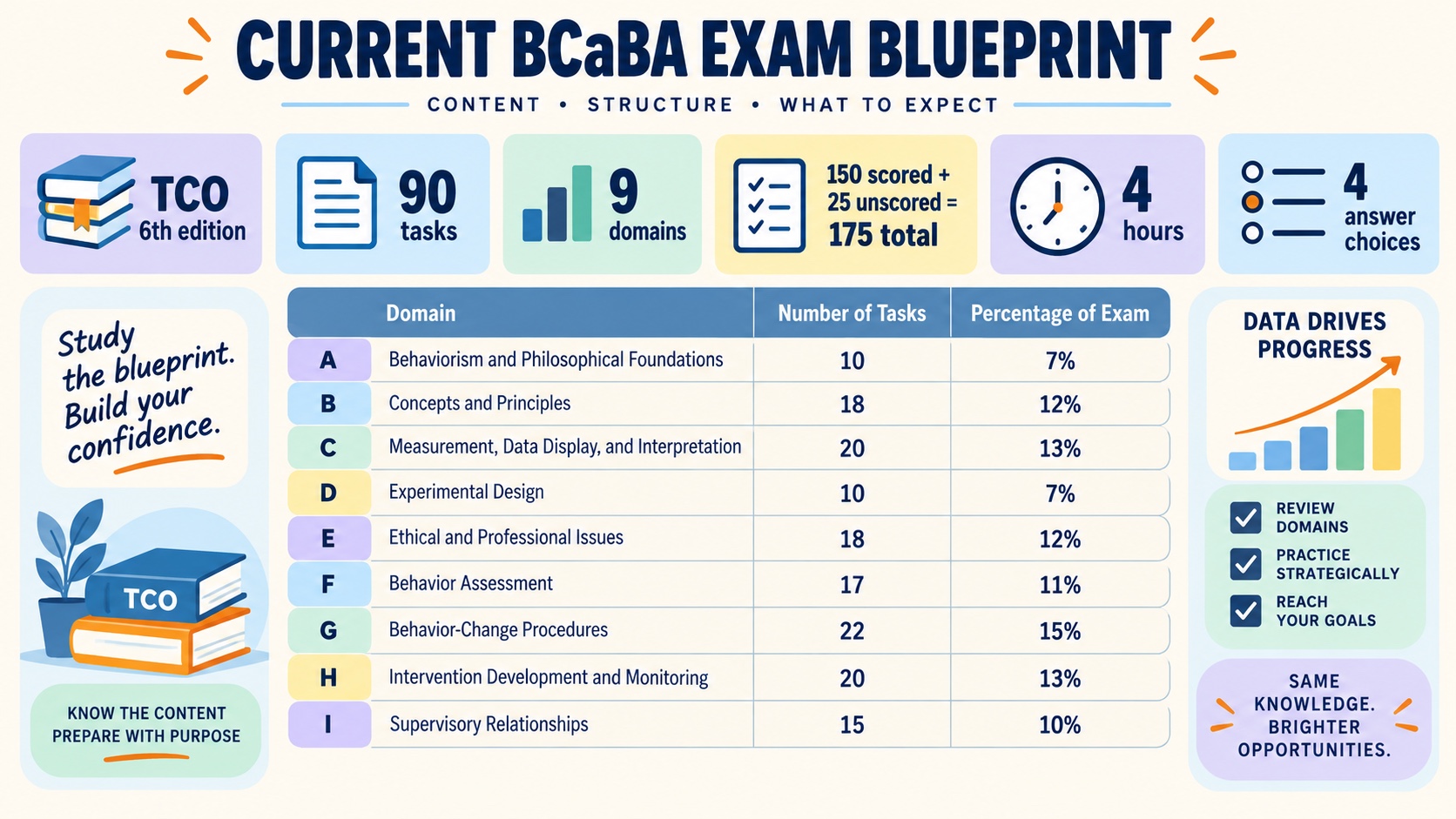
For the current BCaBA examination, the BACB identifies the BCaBA TCO 6th edition as the blueprint. The public Handbook describes 150 scored questions plus 25 unscored questions, 175 questions delivered, four hours, four answer choices with one correct answer, and an overall examination result rather than a separate pass mark for each domain. Those facts should shape your study plan, but they do not turn any independent guide into official BACB content.
Table of Contents
What a BCaBA study guide should do
Think of a study guide as a route through evidence, not as a substitute for the sources that control the exam. A good guide should help you:
- Locate the current boundary. It names the TCO edition, the Ethics Code, and the training material it expects you to use.
- Retrieve the concept. You can define a term in plain language and identify what makes a similar term different.
- Apply the concept. You can use a short scenario, graph, observation description, or supervision situation to decide what matters.
- Explain the decision. The answer rationale identifies the evidence, not just the correct letter.
- Repair the error. A missed question leads to a smaller review task, such as comparing two measurement systems or revisiting one ethical boundary.
This approach prevents a common study trap: reading an entire guide from beginning to end and assuming recognition equals mastery. Recognition is useful, but the exam and entry-level practice also require discrimination, application, data interpretation, and professional judgment. A guide should give you repeated opportunities to move from “I have seen this word” to “I can identify the relevant feature in a new situation.”
The current BCaBA exam boundary
Use the official documents to anchor your plan:
| Exam feature | Current study implication |
|---|---|
| TCO | BCaBA Test Content Outline, 6th edition; 90 tasks organized into 9 domains |
| Questions | 150 scored plus 25 unscored questions; 175 questions delivered |
| Time and choices | Four hours; four answer choices with one correct answer |
| Scoring boundary | Questions are equally weighted and the result is based on overall performance, not separate domain pass marks |
The difference between scored and unscored questions matters for planning, but it does not give a learner a way to identify which questions are unscored. Treat every practice item as a learning opportunity. A free or paid question set should state its own scope honestly and should never claim that it contains live, recalled, leaked, or reconstructed BACB questions.
How to organize the nine domains
The nine domains are not nine separate exams. They are broad areas of knowledge and skills that should connect during study. The current rounded blueprint distribution is:
| Domain | Rounded questions / share | Useful study emphasis |
|---|---|---|
| A. Behaviorism and Philosophical Foundations | 10 / 7% | Goals of science, assumptions, radical behaviorism, and ABA dimensions |
| B. Concepts and Principles | 18 / 12% | Contingencies, stimulus control, reinforcement, punishment, verbal behavior, and generalization |
| C. Measurement, Data Display, and Interpretation | 20 / 13% | Measurement choices, displays, patterns, and interpretation limits |
| D. Experimental Design | 10 / 7% | Design logic, demonstrations of control, and threats to interpretation |
| E. Ethical and Professional Issues | 18 / 12% | Ethics, competence, consent, confidentiality, and professional boundaries |
| F. Behavior Assessment | 17 / 11% | Assessment questions, observation, preference information, and functional assessment participation |
| G. Behavior-Change Procedures | 22 / 15% | Teaching and behavior-change procedures, prompting, reinforcement, and maintenance |
| H. Intervention Development and Monitoring | 20 / 13% | Selection, implementation, monitoring, and adjustment of interventions |
| I. Supervisory Relationships | 15 / 10% | Feedback, communication, performance support, and supervision boundaries |
Use the percentages to distribute attention, not to create nine isolated folders. For example, measurement and data interpretation should appear in your assessment and intervention practice, while ethics should be considered when you review consent, confidentiality, competence, or supervision scenarios. The map is a planning aid; it is not a set of separate passing thresholds.
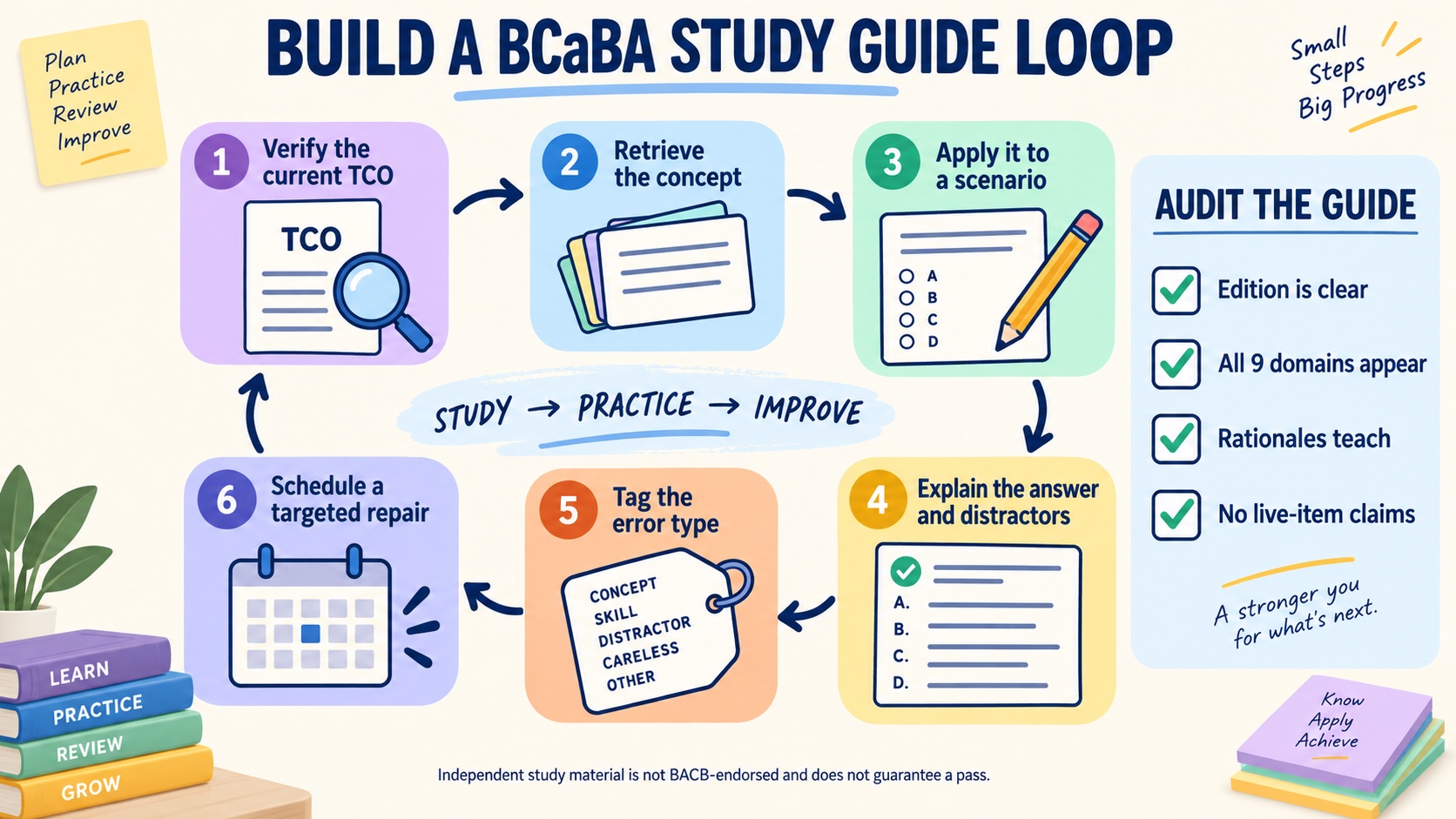
A repeatable study cycle
A practical study session can fit on one page:
- Choose one task or contrast. Examples include frequency versus rate, negative reinforcement versus punishment, or descriptive assessment versus functional analysis.
- Retrieve before rereading. Write what the term means, what it does not mean, and what evidence would identify it in a scenario.
- Apply it to a new example. Use a short case, data display, or procedure rather than copying the definition.
- Practice with an explanation. For each option, state why it fits or fails. A correct answer without reasoning is weak evidence.
- Record the error type. Mark concept, measurement, data interpretation, procedure, ethics, or role boundary.
- Schedule a delayed repair. Revisit a small set after a delay, then mix the repaired task with a neighboring concept.
This cycle also makes a study guide easier to evaluate. If a resource gives you pages to read but no way to retrieve, apply, explain, and correct, it may be a reference book, not a complete preparation system.
How to pace the plan
A study guide becomes more useful when it tells you what to do on an ordinary week. One workable pattern is to use the first session for retrieval and definitions, the second for applied scenarios or data displays, the third for ethics and role boundaries, and the fourth for mixed practice. A short fifth session can review the error log rather than introducing a new chapter.
Keep the sessions small enough to explain your choices. If you miss several questions in a row, pause and identify whether the problem is a missing concept, a reading error, an unsupported assumption, or a supervision boundary. Taking another full-length set immediately may produce more numbers but not better information. A targeted repair set is often easier to interpret.
As the exam appointment approaches, add timed blocks gradually. Timing practice should preserve the same habits used during untimed review: read the condition, locate the evidence, compare the options, and record uncertainty. Speed without reasoning can make a familiar term feel fluent while leaving the underlying discrimination weak.
How to audit a study guide
Before spending time or money on a guide, check five things:
- Edition: Does it clearly identify the BCaBA TCO 6th edition and explain when the content applies?
- Coverage: Does it represent all nine domains, including ethics, assessment, data, intervention monitoring, and supervision?
- Explanations: Does it explain the cue and the distractors, or only show an answer letter?
- Role accuracy: Does it keep assistant behavior-analyst responsibilities and supervision boundaries clear?
- Integrity: Does it identify questions as independent study material and avoid “real,” “leaked,” or “recalled” exam language?
Also check whether “free” means a complete open set or only a short preview. Either model can be legitimate, but the page should disclose the scope. A transparent guide is easier to use because you know whether you are doing a focused drill, a domain review, or a timed rehearsal.
How to handle the 2027 transition
The BACB has published 2027 BCaBA requirements, with significant eligibility and maintenance changes beginning January 1, 2027. Keep that transition separate from exam-study content. A requirements change does not automatically mean that the current BCaBA TCO 6th edition has become a “7th edition.” When your application timing is close to the transition, read the current BCaBA Handbook, the official 2027 requirements page, and any transition guide that applies to your situation.
For study purposes, keep using the TCO edition identified by the current official examination materials. If the BACB changes the exam blueprint, update the study guide’s edition, domain map, examples, and review date together. Do not update only the headline while leaving old task labels inside the questions.
FAQ and official sources
What should I use as my main BCaBA study guide?
Start with the current BCaBA TCO, the Ethics Code for Behavior Analysts, and the materials from your qualifying training. Add independent explanations and original practice questions only after checking their edition, coverage, and role boundaries.
How many questions are on the BCaBA exam?
The current public format describes 150 scored plus 25 unscored questions, for 175 questions delivered in four hours. Use the current Handbook and Examination Information page for the latest official format.
Can a practice score predict my result?
No. A practice score is evidence from one independent set, not an official result or a separate domain pass mark. Use it to identify the next repair task.
Does the 2027 change automatically require a new study guide edition?
Not automatically. Eligibility and maintenance changes are different from a new exam TCO. Check the official transition guidance and current Handbook before deciding whether your study materials need replacement.
For connected study, use the BCaBA learning path, free BCaBA questions, ABA glossary, and ABA Study Online app as independent learning layers. They do not replace official BACB documents or determine eligibility.