BCaBA Exam Questions: How to Practice With the Current 6th Edition
If you are looking for BCaBA exam questions, a long question bank is not automatically a good study tool. Useful questions should match the current BCaBA Test Content Outline (TCO), present enough scenario evidence to support one best answer, stay within assistant behavior-analyst role boundaries, and explain why the distractors do not fit.
The current BCaBA examination is based on the TCO 6th edition. This guide explains the exam boundary, shows how to use the nine content areas as a coverage map, and gives you a repeatable way to review original practice questions. Independent practice questions are not live, recalled, leaked, or official BACB examination items.
Table of Contents
What useful BCaBA exam questions should test
The BCaBA examination assesses knowledge and skills expected of an entry-level assistant behavior analyst. A useful question may ask you to identify a concept, interpret a measurement display, recognize an experimental-design feature, choose a behavior-change procedure, or select an ethical and professionally appropriate action. It should give you enough information to make a reasoned choice without requiring a hidden fact or a supervisor-level decision.
Look for these qualities:
- Current TCO mapping: the question can be connected to a named domain and task in the 6th edition.
- Observable evidence: the stem includes the behavior, condition, measurement, consequence, or professional context that matters.
- One best answer: the choices are meaningfully different, and the correct choice follows from the evidence rather than a trick in the wording.
- Distractor reasoning: the explanation says why the other choices are wrong, too broad, premature, or outside the role.
- Role accuracy: the question does not ask a BCaBA to act independently where BCBA supervision, consultation, or approval is required.
For example, a measurement question should tell you enough about the observation rule to distinguish frequency, duration, latency, or an interval measure. A supervision question should identify the relationship and the decision that needs consultation. A question that simply asks you to memorize a word without an applied distinction may be useful for a first vocabulary pass, but it should not be the whole study method.
The current BCaBA exam boundary
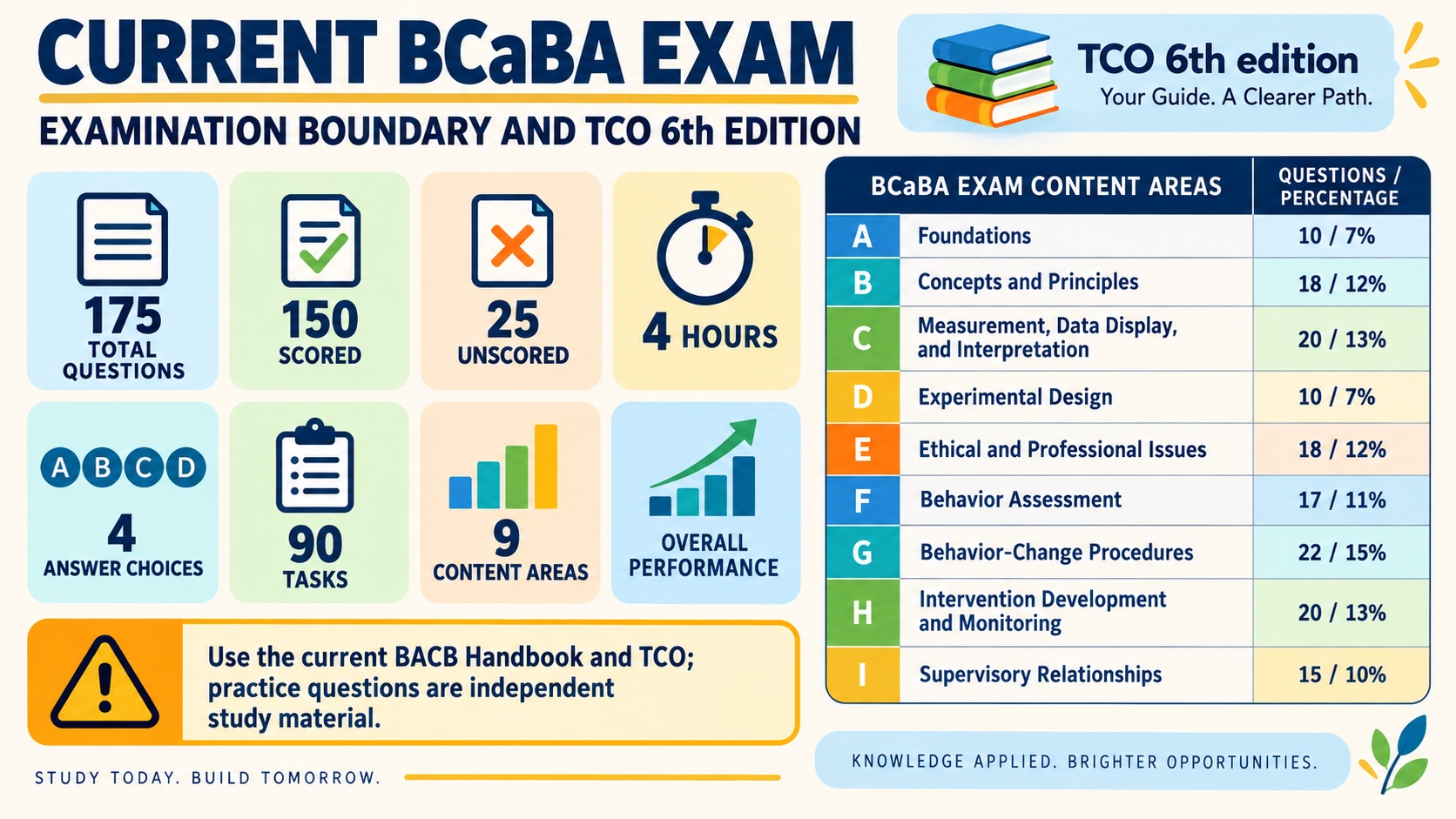
The current BCaBA Handbook states that the examination includes 150 scored questions and 25 unscored questions, for 175 multiple-choice questions total. Each question has four possible answers and one correct answer, and candidates have four hours. The examination is based on the current TCO edition; the current BCaBA TCO is the 6th edition.
| Exam detail | Practice implication |
|---|---|
| 175 total questions | Use a full mock only when you want timed-rehearsal information; do not treat every practice session as a four-hour test. |
| 150 scored + 25 unscored | A practice site cannot identify which official questions are unscored. Focus on the task and reasoning. |
| Four choices, one correct | Review why three distractors fail instead of memorizing only a letter. |
| Four hours | Use timed practice later, after you can explain the content without rushing. |
| Overall performance | The Handbook does not describe separate pass marks for each content area. |
The BACB recommends reviewing the current TCO, the Ethics Code for Behavior Analysts, and materials gathered during training. It does not endorse specific study guides or other preparation materials, and buying study material does not guarantee a passing result. The Handbook contains retired sample questions to illustrate format; an independent site should write original scenarios and label them honestly.
Use the nine domains as a coverage map
The TCO organizes 90 tasks into nine content areas. The rounded distribution can help you notice an under-practiced area, but it is not a set of separate passing scores. Start with the task you need to understand, then use the domain to organize your review.
| Domain | Questions / rounded share | What to look for in practice |
|---|---|---|
| A. Behaviorism and Philosophical Foundations | 10 / 7% | Goals of behavior analysis, assumptions, radical behaviorism, and dimensions of ABA |
| B. Concepts and Principles | 18 / 12% | Contingencies, stimulus control, motivating operations, verbal behavior, and generalization |
| C. Measurement, Data Display, and Interpretation | 20 / 13% | Measurement selection, displays, patterns, and interpretation of data |
| D. Experimental Design | 10 / 7% | Design features, comparison logic, and threats to interpretation |
| E. Ethical and Professional Issues | 18 / 12% | Ethics, professional conduct, cultural responsiveness, and boundaries |
| F. Behavior Assessment | 17 / 11% | Assessment purpose, measurement, preference or skill information, and participation |
| G. Behavior-Change Procedures | 22 / 15% | Reinforcement, prompting, shaping, chaining, extinction, and other procedures |
| H. Intervention Development and Monitoring | 20 / 13% | Plan components, implementation, monitoring, and data-based adjustment |
| I. Supervisory Relationships | 15 / 10% | Communication, feedback, supervision, and appropriate escalation |
After a short mixed set, tag each miss with both a domain and an error type. “I forgot the definition” needs a different repair from “I selected a procedure before checking the measurement,” “I misread the graph,” or “I chose an action outside the BCaBA role.” This is more useful than treating every wrong answer as the same kind of problem.
Build a question set that answers one study question
Instead of opening a random bank every time, decide what you want the next set to tell you. A coverage set samples several domains and shows where your knowledge is uneven. A concept set stays with one distinction, such as negative reinforcement versus negative punishment. An application set uses short scenarios and asks what evidence supports the next action. A timed set answers a pacing question and should be used after you understand the content well enough to review mistakes productively.
Keep the sets small enough to review. Ten carefully tagged questions can reveal whether the problem is vocabulary, discrimination, data interpretation, or professional judgment. If you complete fifty questions but never revisit the explanations, you may only be measuring endurance. When the set includes mixed difficulty, record whether a miss came from not knowing the concept or from overlooking a cue in a longer stem. Those are different skills and need different practice.
A useful question bank also makes its scope visible. It should tell you whether an item is testing the TCO, an Ethics Code distinction, a measurement calculation, a graph-reading skill, or a general study example. “ABA question” is too broad to guide review. A domain and task label gives the learner a next place to look in training notes or the official outline.
Review each question in six moves
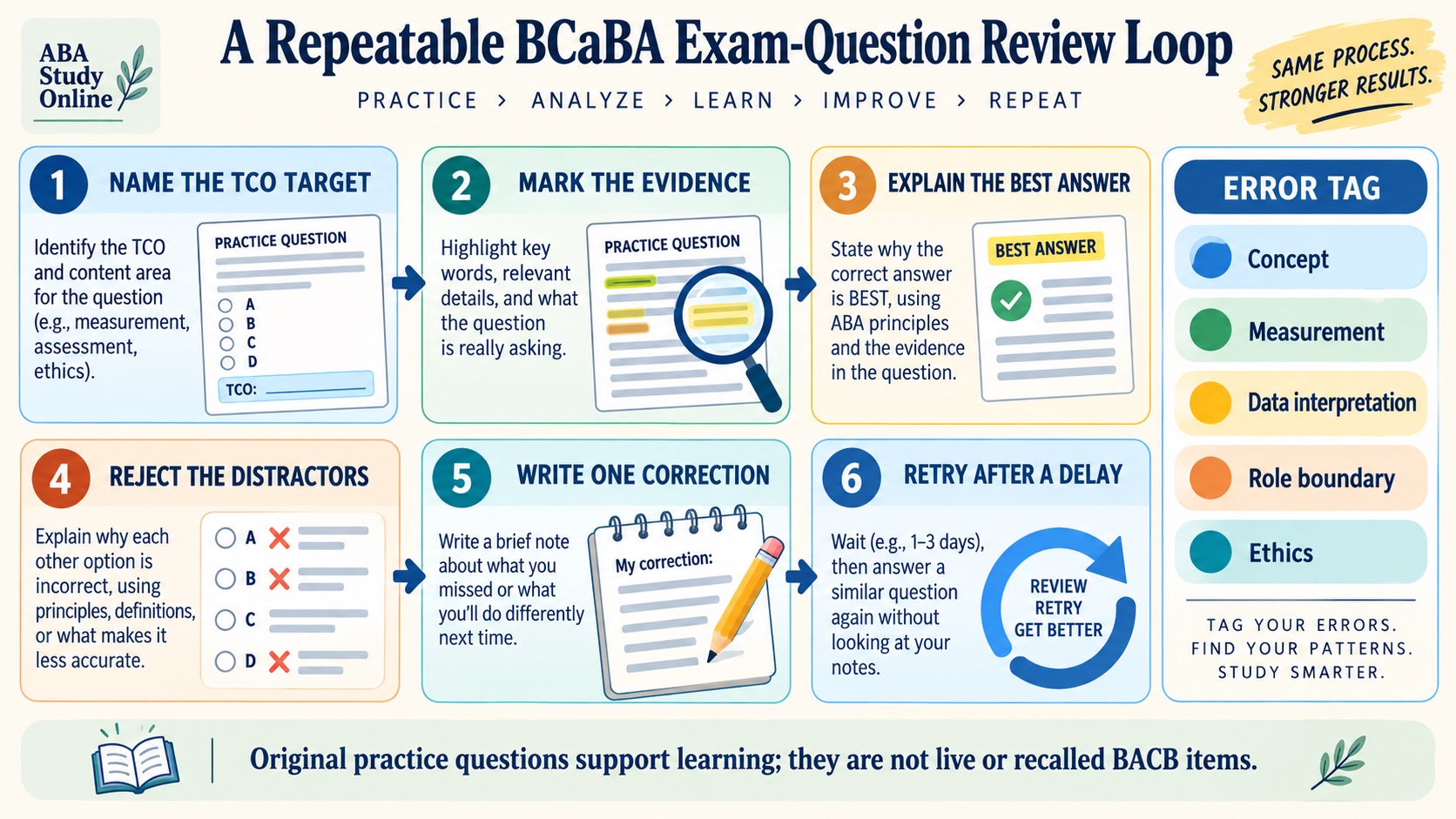
Use this routine whether you answered correctly or incorrectly:
- Name the target. Write the TCO domain and the skill or distinction the question is testing.
- Mark the evidence. Underline the data pattern, antecedent, consequence, measurement rule, role relationship, or ethical fact that controls the decision.
- Explain the best answer. State what the assistant behavior analyst should identify, implement, document, or bring to supervision.
- Reject each distractor. Note whether it confuses two terms, ignores evidence, changes the goal, jumps ahead, or exceeds the role.
- Write one correction. Turn the miss into a contrast, worked example, or short rule that you can retrieve later.
- Retry after a delay. Revisit the concept without opening the answer key. If you can choose but cannot explain, keep it in the repair set.
Consider a fictional question about a graph that rises after a procedure change. A useful review does not stop at “the trend increased.” It asks what was measured, whether the change was introduced systematically, what alternative explanations remain, and what the BCaBA should do within the supervision structure. The purpose is not to recreate a BACB item; it is to practice reading evidence and connecting it to a TCO task.
Spot outdated or unsafe question sets
Edition confusion. A resource that uses an old task-list label without identifying the current BCaBA TCO should be checked before you build a study plan. Do not substitute the BCBA or RBT outline for the BCaBA outline.
“Real exam questions” claims. The BACB treats examination content as confidential. Avoid any resource that says it provides live, recalled, leaked, or reconstructed items. Original scenarios and clear rationales are safer and more educational.
Answer keys without reasoning. A letter alone cannot show whether you missed the measurement, concept, evidence, or professional boundary. Prefer a rationale that addresses the stem and the distractors.
Role drift. A BCaBA works under BCBA supervision. A question that expects independent diagnosis, unsupervised treatment-plan authorship, or a decision reserved for a supervisor is teaching the wrong boundary, even if its vocabulary sounds advanced.
Score promises. A practice percentage is a snapshot from one question set. It does not prove eligibility, predict a BACB result, or replace training, fieldwork, supervision, application, or the official examination.
FAQ and official sources
How many questions are on the current BCaBA examination?
The current BCaBA Handbook lists 175 multiple-choice questions: 150 scored and 25 unscored. Candidates have four hours, and each question has four possible answers with one correct answer.
Which BCaBA edition should my questions follow?
Use the current BCaBA Test Content Outline, 6th edition. The Handbook says candidates test under the current TCO edition, so check the live BACB source if a new edition is announced during your authorization period.
Are independent BCaBA exam questions the same as the real exam?
No. Independent questions should be original learning material. They may practice the same knowledge or task described by the TCO, but they should not claim to reproduce official, live, recalled, or confidential BACB items.
Does each domain have its own passing score?
The current Handbook states that questions are equally weighted and the result is based on overall examination performance, not separate performance in each content area. Use the domain distribution to plan coverage, not to invent domain cut scores.
Where can I continue practicing?
Use the current BCaBA Handbook and BCaBA TCO for the official boundary. For independent study, use the BCaBA practice questions, BCaBA learning path, ABA glossary, and ABA Study Online app as learning layers, not as official BACB content.