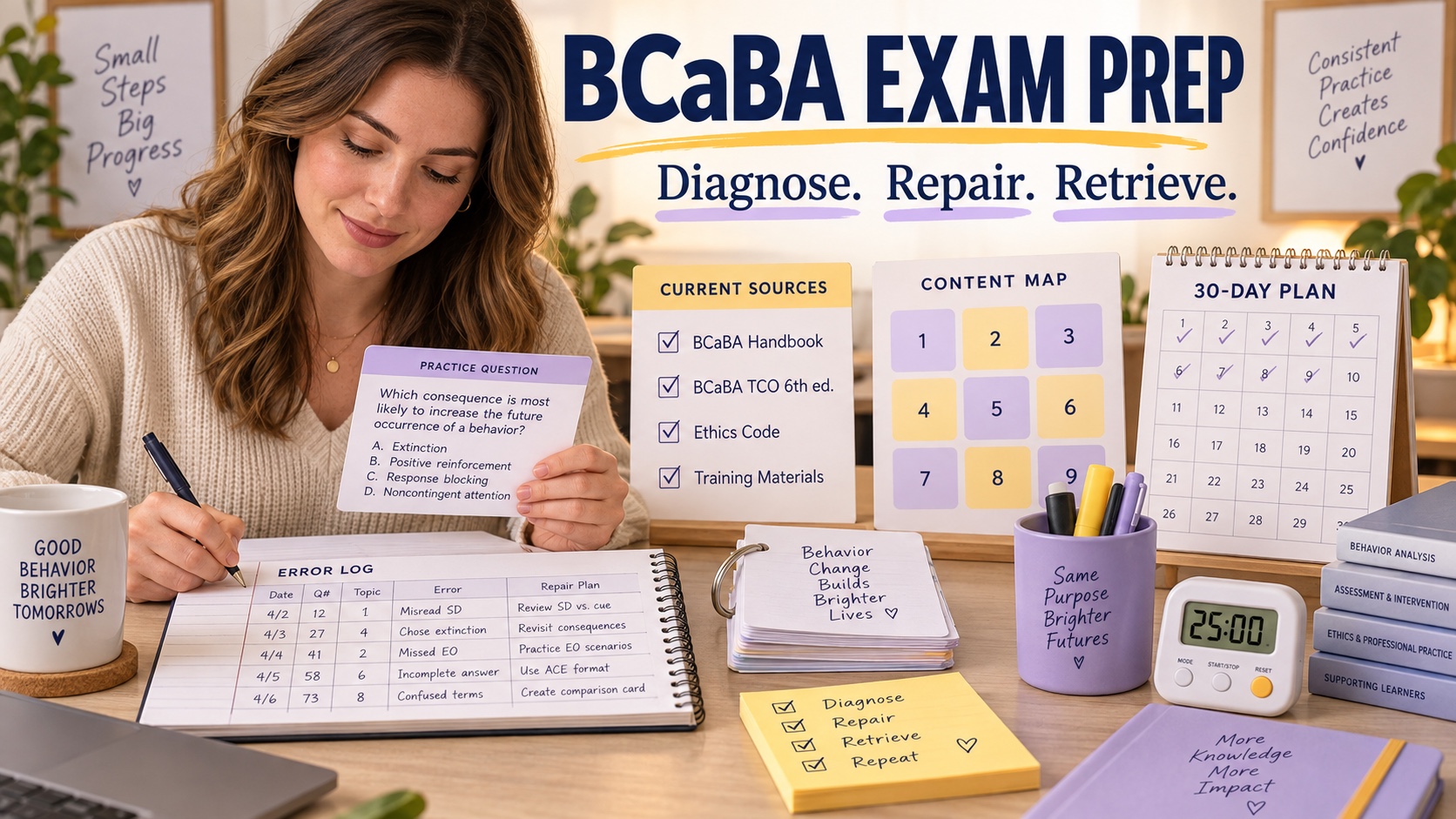
BCaBA Exam Prep: Build a Study Loop That Adapts
If you are looking for BCaBA exam prep, you probably do not need another pile of notes. You need a way to decide what to study today, what a missed question is actually telling you, and when to move from a focused review block to mixed or timed practice. The most useful plan starts with the current official outline, then lets your own error pattern determine the next step.
This guide builds that loop. It uses the current BCaBA examination boundary for orientation, but it does not reproduce secure BACB questions, decide your eligibility, or promise a certification result. Keep the current BCaBA Handbook, Test Content Outline, Ethics Code, and training materials as the source of truth for official questions.
Table of Contents
Start with the current BCaBA exam boundary
The current official materials identify the BCaBA Test Content Outline (6th ed.) as the examination-content boundary. The current BCaBA Handbook describes 150 scored questions and 25 unscored pilot questions, four hours, four possible answers with one correct answer, and 90 tasks organized across nine content areas. The Handbook also states that questions are equally weighted and the result is based on overall performance rather than a separate pass/fail result for each content area.
The rounded content map gives you a starting point for coverage:
- A. Behaviorism and Philosophical Foundations — 7%.
- B. Concepts and Principles — 12%.
- C. Measurement, Data Display, and Interpretation — 13%.
- D. Experimental Design — 7%.
- E. Ethical and Professional Issues — 12%.
- F. Behavior Assessment — 11%.
- G. Behavior-Change Procedures — 15%.
- H. Intervention Development and Monitoring — 13%.
- I. Supervisory Relationships — 10%.
Use those percentages as a coverage check, not as nine separate score targets. A smaller area can still expose a major gap, and a higher-weight area may need less time if your diagnostic already shows strong application. Also keep exam preparation separate from BCaBA eligibility, fieldwork, ongoing supervision, continuing education, and recertification. Those requirements belong to the current Handbook and related BACB resources.
Build a preparation stack you will actually use
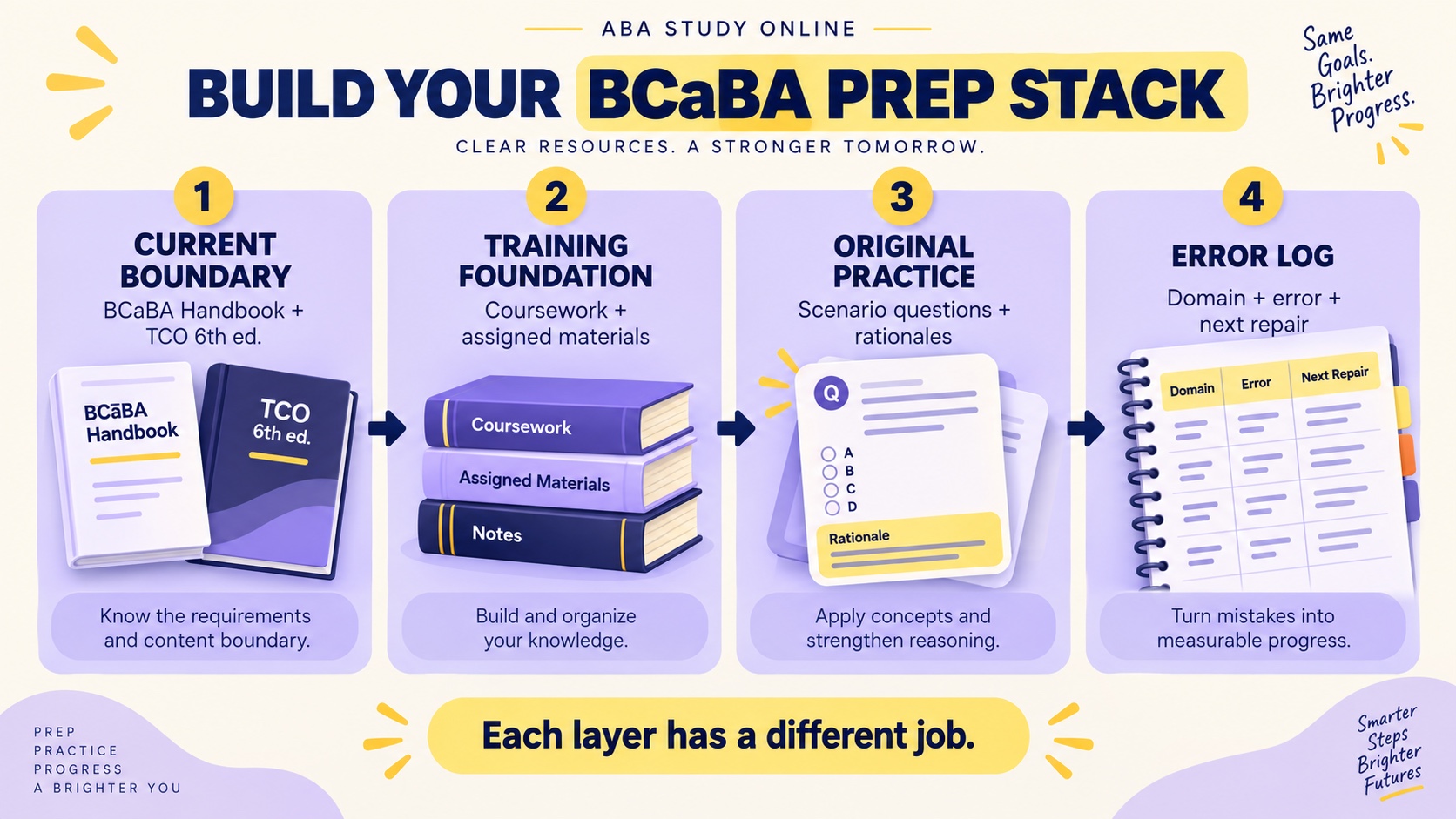
A preparation stack is not the same thing as owning every resource that appears in a search result. It is the small group of materials that work together:
- Official boundary: keep the current BCaBA Handbook and 6th-edition TCO available. Use the BACB Ethics Code resources when a question involves professional conduct or ethical decision-making.
- Training foundation: return to your coursework, assigned texts, lectures, or supervisor-supported materials when a question exposes a real content gap.
- Original practice: use questions that ask you to apply a concept and explain why the alternatives are weaker. Label independent questions as unofficial.
- Personal record: keep an error log with the domain, the controlling evidence, your error type, and the next repair action.
Each layer has a different job. The TCO maps what the examination assesses. The Handbook explains certification and examination boundaries. Training material gives depth. Practice reveals how well you can use the ideas in a scenario. The error log turns that evidence into a new decision. When one resource is asked to do all four jobs, study often becomes either passive reading or score chasing.
Take a diagnostic before making a calendar
Before you choose a four-week, eight-week, or longer schedule, take a manageable mixed set. It does not need to predict whether you will pass. Its purpose is to show which kind of support your next study block needs. Mark your confidence before checking the rationale so you can separate a misconception from a lucky answer.
Give each missed or guessed item one primary error tag:
- Knowledge gap: you did not know the definition, procedure, relationship, or professional rule.
- Discrimination gap: you knew the terms but confused close alternatives, such as two measurement systems or two reinforcement arrangements.
- Application gap: you knew the concept in isolation but could not select it when the scenario added data, context, or a role boundary.
- Process gap: you misread the stem, rushed, changed a supported answer, or spent too long on one item.
The tag should change your next action. A knowledge gap may need a short reading and retrieval check. A discrimination gap needs a comparison that puts the two choices side by side. An application gap needs new scenarios. A process gap needs question-reading or pacing rehearsal. Recording everything as “wrong” gives your calendar no way to respond intelligently.
Turn each question into a repair loop
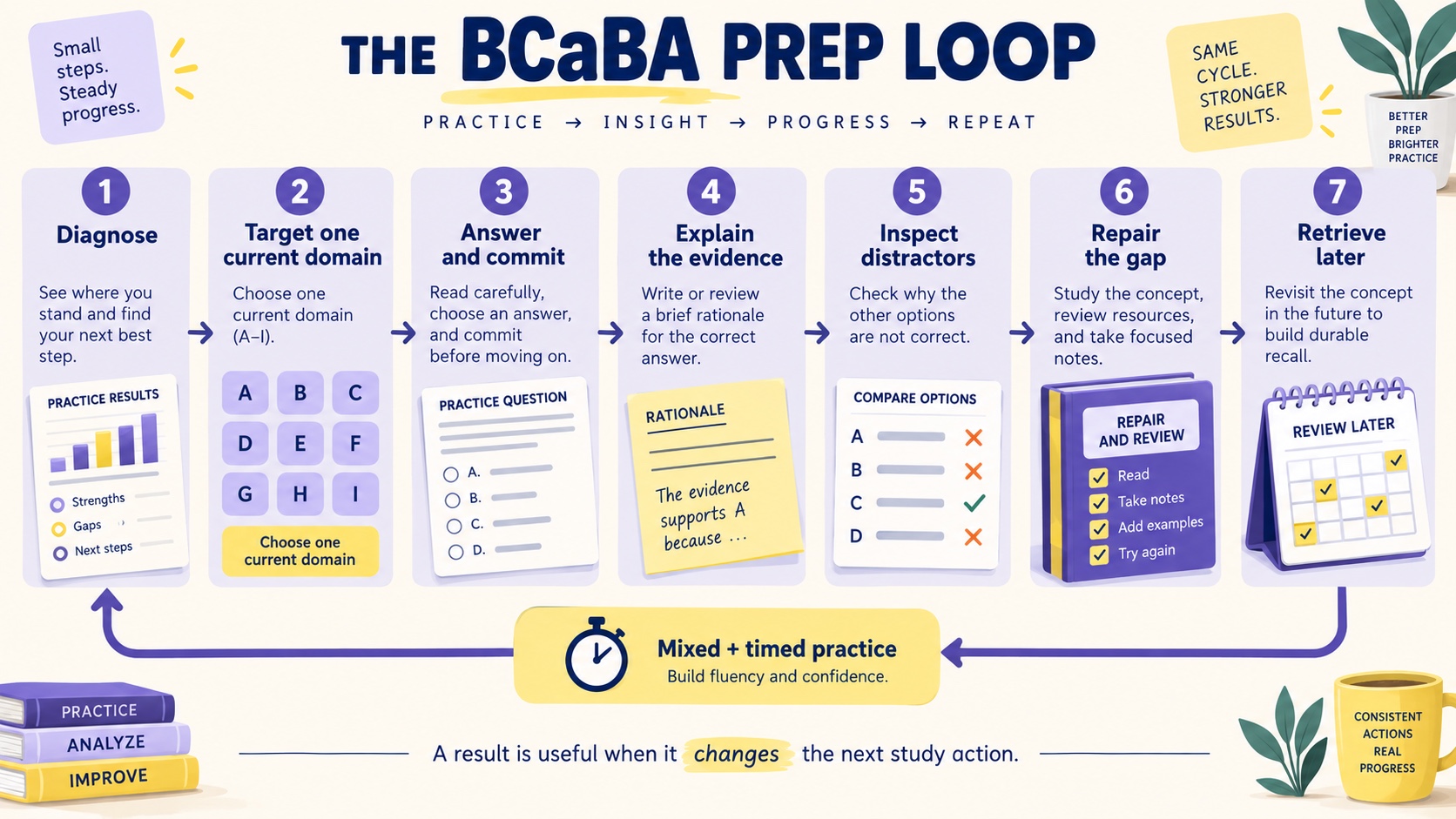
A good practice session is not finished when you see the answer key. Use this seven-step loop:
- Name the task: say whether the item asks you to identify, measure, interpret, compare, select, or act.
- Commit to one answer: choose within a reasonable time limit before opening your notes.
- Point to the evidence: write one sentence connecting the best answer to the facts in the scenario.
- Inspect the distractors: identify the feature that makes each alternative weaker, too broad, out of scope, or unsupported.
- Apply an error tag: record knowledge, discrimination, application, or process.
- Repair the smallest gap: review one targeted source section, draw a comparison, or discuss the boundary with a qualified instructor or supervisor.
- Retrieve later: answer a new item about the same distinction after a delay rather than copying the original wording.
For example, suppose a scenario describes a learner’s behavior across unequal observation windows. If you choose a measure because its name feels familiar, your repair should ask what quantity the measure represents, what observation opportunity exists, and why the alternatives do not fit. Then change one feature in a new scenario. That is more useful than rereading the same definition until it feels recognizable.
Use the domain map to organize the loop, but do not force every question into a labeled block forever. Targeted practice helps you repair a gap. Mixed practice checks whether you can recognize the relevant concept when the domain is not announced. Both are needed.
Move from targeted practice to timed rehearsal
A flexible 30-day rhythm can keep the process concrete without pretending that every candidate needs the same number of hours:
- Days 1–3 — Source check and baseline: save the current official documents, complete a manageable mixed set, and create the error log.
- Days 4–12 — Targeted repair: rotate through the domains that appear in your error pattern. Give each session one decision to improve, not an unlimited reading list.
- Days 13–20 — Mixed application: remove domain labels, use new scenarios, and review guessed-correct items as well as wrong answers.
- Days 21–26 — Timed blocks: practice longer sets, flag uncertain items, and protect time for rationale review afterward.
- Days 27–30 — Rehearse and adjust: use a longer practice experience only when you can review it carefully, then repair the two or three recurring gaps instead of collecting another resource.
At the end of each week, ask: Which domain improved? Which error type repeated? What is the smallest next action that will produce better evidence? If your timed result drops, check fatigue, reading speed, ambiguity, and content gaps before concluding that you need a different product. A calendar is useful when it responds to data.
Avoid the prep habits that waste time
Mixing BCaBA and BCBA blueprints
The credentials share behavior-analytic foundations, but their task counts, domain labels, question counts, and weights are not interchangeable. Start with the BCaBA Handbook and TCO.
Reading instead of retrieving
Reading can repair a gap, but it cannot show whether you can recall and apply the distinction. Close the source, explain it from memory, and test it with a new scenario.
Using old-edition material without a date check
Older notes may contain useful science, but they should not silently define your current exam map. Check the edition, task language, Ethics Code, and Handbook before building a long plan.
Chasing a score without reviewing reasoning
A practice percentage describes one set under one set of conditions. Review the evidence and error type, including answers that were correct only because you guessed.
Trusting “guaranteed” or “exact exam” language
The BACB does not endorse specific study guides, and secure examination content must not be reproduced. Look for original questions, clear rationales, current-edition labeling, and an honest unofficial-resource boundary.
Choose the next study action
When your error log is clear, choose the smallest useful next step. Use a Theory Block when the concept itself is unclear. Use a short question set when you need application. Use a domain set when the pattern is concentrated. Use a mixed set when you want to see whether you can identify the relevant concept without a label. Use a longer timed set only when review is part of the plan.
ABA Study Online can support those different moments. The website provides free BCaBA questions and explanations for depth and discovery. The app can support shorter return sessions with practice, flashcards, progress, audio review, and tools. These are independent educational resources; they do not replace BACB eligibility, supervision, examination, or maintenance rules.
Start your next BCaBA prep block
Begin with free BCaBA questions, review the rationale, and use the error pattern to choose your next study action. When you want a shorter return session, continue the loop in the ABA Study Online app.
Try free BCaBA practice questions See the ABA Study Online app
FAQ and official sources
How many questions are on the current BCaBA exam?
The current BCaBA materials describe 150 scored questions and 25 unscored pilot questions, for 175 questions in the four-hour examination experience.
Is the BCaBA exam based on the 6th edition?
Yes. The current BCaBA Handbook and TCO identify the BCaBA Test Content Outline (6th ed.) as the current examination-content boundary. Recheck the official materials when your authorization and appointment are planned because candidates test under the TCO edition that applies to those rules.
How long should BCaBA exam prep take?
There is no single official number of weeks or hours for preparation. Use a baseline, classify your gaps, choose a sustainable rhythm, and preserve time for rationale review and later retrieval.
Does a practice score predict whether I will pass?
No. An unofficial score is evidence about one practice set. Use it to identify patterns and plan the next action, not as an official score report or guarantee.
What should I read first?
Start with the BCaBA Handbook, the BCaBA Test Content Outline (6th ed.), the BACB Ethics Code resources, and materials from your training. Use the BACB Examination Information page and TCO index to recheck current boundaries.