BCaBA Exam Passing Score: What the BACB Actually Reports
If you are searching for the BCaBA exam passing score, you may be hoping for one number: “How many of the 175 questions do I need to answer correctly?” The current BACB scoring information does not give candidates a single raw correct-answer number to memorize and apply to every exam form.
The useful answer is more precise. BACB establishes the passing standard through a modified Angoff, criterion-referenced process, and different exam forms are psychometrically equated. A scaled score communicates the result, while the raw number of correct answers is not the public cutoff to use for planning. That is why an old forum percentage, a practice-test score, or an annual pass rate cannot be presented as the current BCaBA passing score.
Table of Contents
Short answer: is there one BCaBA passing score?
Do not rely on a single public “X out of 175” cutoff. BACB establishes the passing score for the relevant examination form through a criterion-referenced process, equates forms, and reports results using its scoring system. The official current sources do not provide one raw correct-answer number that every BCaBA candidate can use.
This does not mean the exam is graded randomly or against the people testing beside you. Criterion-referenced means the pass/fail decision is tied to a defined standard of entry-level knowledge, not to a fixed percentage of the testing group. A whole group could pass, or a whole group could fail, depending on each person’s performance relative to the standard.
It also does not mean you should ignore practice percentages. A practice result can show that a content area needs work. It simply cannot be relabeled as “the BACB passing score.”
What the current BCaBA exam includes
BACB’s Examination Information page currently lists the BCaBA examination as a four-hour, in-person, multiple-choice examination with 175 questions. Each question has four possible answers and one correct answer. The current content reference is the BCaBA Sixth Edition Test Content Outline listed by BACB.
The question count helps you plan time and practice, but it does not turn the exam into a simple arithmetic target. Some questions may be scored differently within the examination form or handled through the equating process. The important study target is competence across the current TCO, not reaching an unofficial number copied from a previous candidate’s post.
Use the 175-question figure for logistics: pacing, concentration breaks, and full-length practice. Use the TCO for coverage: concepts, applications, and decision-making across the listed domains. Those are two different planning layers. A realistic study plan therefore asks both “Can I sustain exam-day pacing?” and “Can I explain the reasoning behind the content?” instead of turning the question count into a guessed pass percentage.
How BACB sets the passing standard
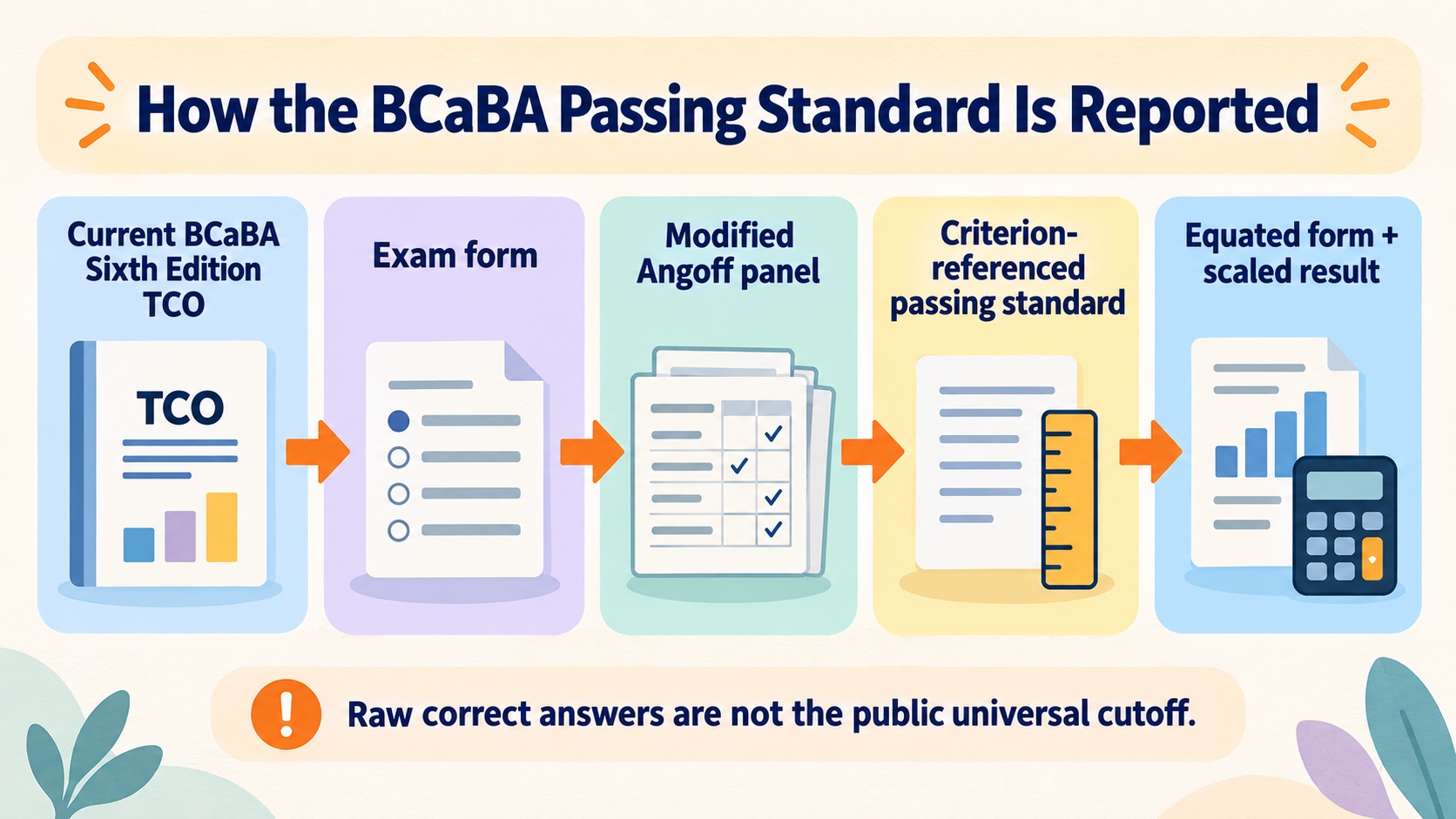
BACB describes the modified Angoff method as the process used to establish the passing score for a base examination form. A panel of BACB-certified subject-matter experts considers the knowledge expected of a minimally competent candidate. The recommended standard is then approved through BACB’s governance process.
New base forms can be created when the content changes significantly or on the examination-development schedule. BACB maintains a large question pool and uses psychometric equating so that different forms can be compared even when their item difficulty is not identical. This is the reason the raw number of correct responses required can vary by form and why an old “passing percentage” should not be recycled as a current universal rule.
Scaled scores are a mathematical transformation of performance onto a reporting scale. They make results from different forms easier to interpret against the same passing standard. Scaling does not change who passes or fails, and it does not turn a practice quiz into an official scaled score.
Four numbers candidates often confuse
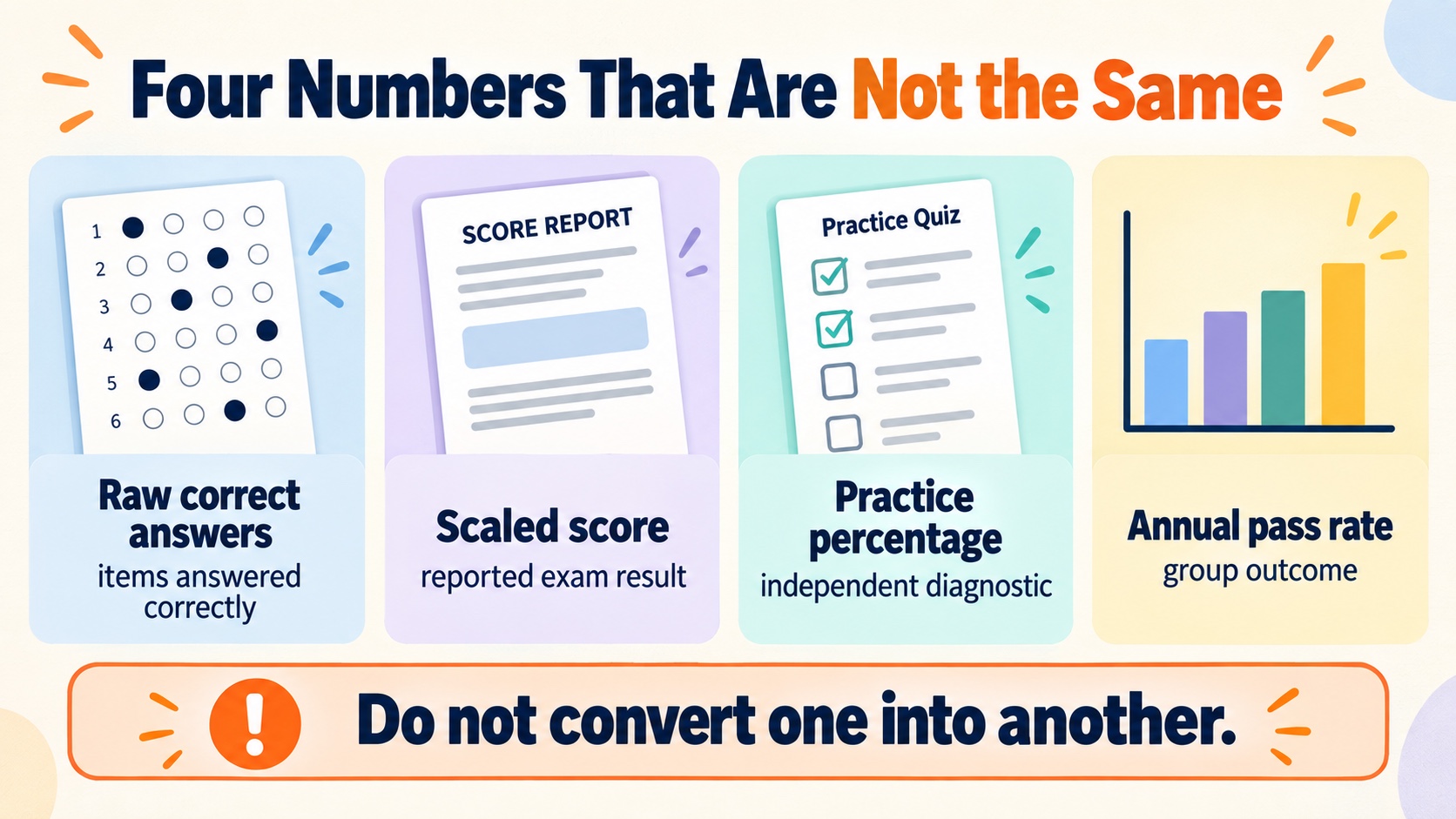
- Raw correct answers: the number of items answered correctly. BACB does not give candidates a universal raw cutoff to use across forms.
- Scaled score: the reported transformed score used with the exam’s passing point. It is not the same as a percentage correct.
- Practice percentage: the share correct on an independent quiz or mock exam. It is diagnostic evidence, not a BACB result.
- Pass rate: the share of a defined group that passed during a defined year. It is not the number of questions required for one candidate.
For example, if an independent mock exam reports 78%, you can ask which domains produced the errors, whether the questions match the current BCaBA TCO, and whether you can explain the reasoning. You cannot conclude that 78% is the BACB passing standard or that a 78% mock result guarantees a pass.
How to use a score report or practice result
If you pass, use the official result as the result. Do not try to reverse-engineer a raw cutoff from a scaled score or compare your score with another candidate’s number. If you fail, the BACB provides performance information intended to guide future study. Treat that report as a starting point, not as a complete diagnosis of every skill.
Build a three-part review loop:
- Map the evidence: note the content areas or tasks shown on the official report and compare them with the current BCaBA TCO.
- Study broadly: do not study only the areas that appeared weak on one report. BACB cautions that the number of items connected to a task can be small, so the result may not represent your complete understanding.
- Practice with feedback: use questions, explain why each option is correct or incorrect, and track repeated errors rather than chasing one target percentage.
The ABA Study Online BCaBA learning path and BCaBA practice questions can support this review loop. They are independent study resources, not BACB score reports, official exam forms, or a promise of passing.
BCaBA passing-score FAQ
What percentage do I need to pass the BCaBA exam?
Do not use one universal percentage as the official answer. BACB establishes a criterion-referenced passing standard for the relevant form, equates forms, and reports results through its scoring system. The current official pages do not give a single raw percentage to memorize.
Is the BCaBA exam passing score 75%?
Old newsletters or forum posts may mention historical passing-score studies, but those numbers should not be presented as the current universal cutoff. Use the current BCaBA Handbook and Examination Information pages instead.
Does a 60% BCaBA pass rate mean I need 60% correct?
No. A pass rate describes how a defined group performed during a defined reporting period. It is not a raw exam cutoff or a candidate’s required percentage correct.
Does the number of correct answers vary?
BACB explains that different forms can require different raw numbers of correct answers because of form difficulty and equating. That is one reason the raw number is not the public planning target.