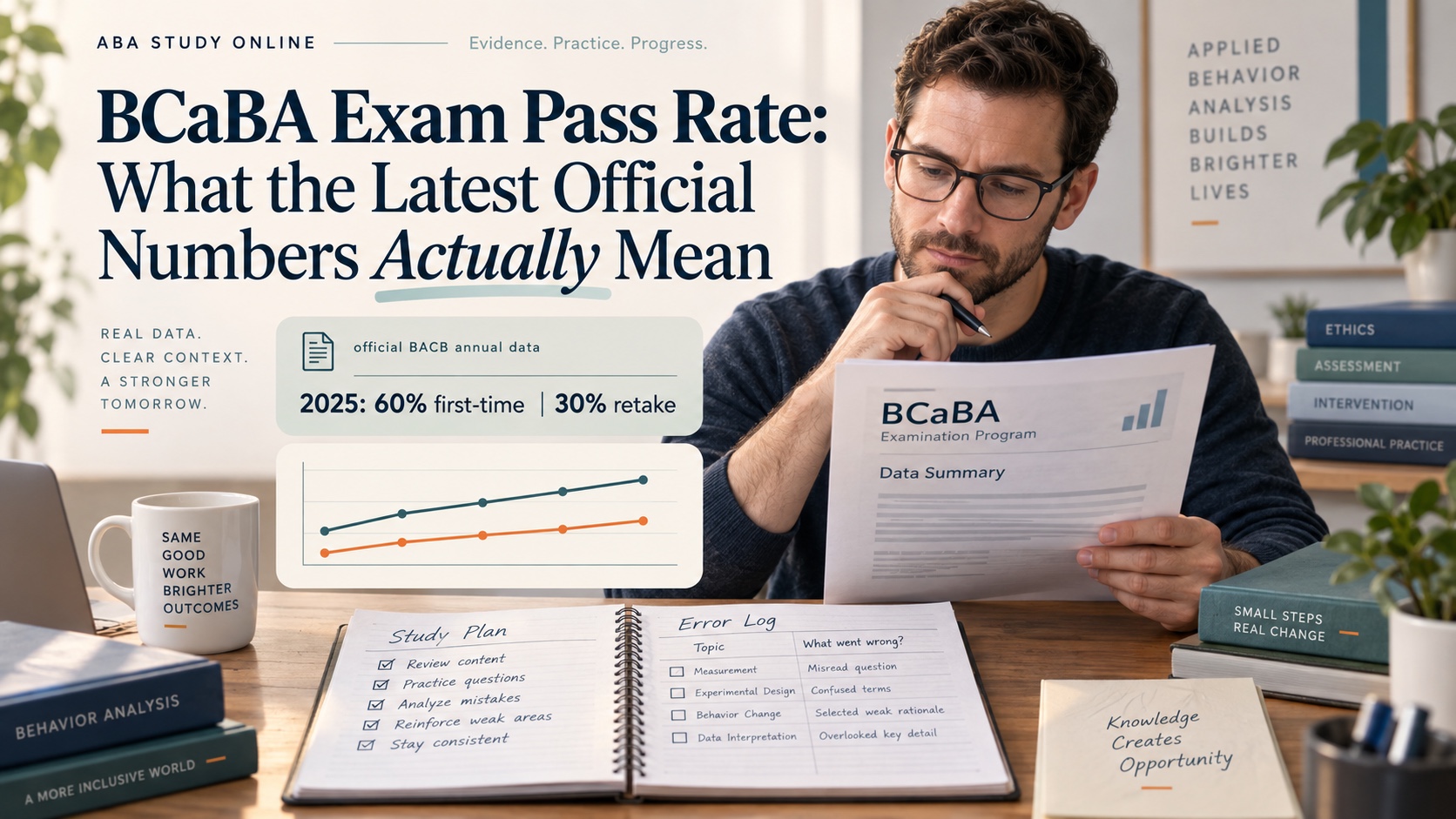
BCaBA Exam Pass Rate: What the Latest Official Numbers Actually Mean
If you are searching for the BCaBA exam pass rate, you probably want a number you can use. The latest annual data currently displayed by the BACB report a 60% first-time pass rate and a 30% retake pass rate for the 2025 BCaBA examination data. Those numbers describe defined groups tested during that year. They are not the percentage of questions you must answer correctly, a personal probability, or a guarantee.
The useful question is therefore not only “Is the rate high or low?” It is “Which year, which candidate group, and which denominator am I reading?” This guide explains the current BCaBA data, shows the multi-year context, and turns the statistic into a responsible study decision.
This is independent educational information. It is not a BACB score report, an eligibility decision, or a prediction of an individual examination result.
Quick answer: BACB’s currently displayed 2025 annual data report that 60% of 1,196 first-time BCaBA examination candidates passed, while 30% of 1,019 retake candidates passed. Read each percentage with its year and group. A pass rate is a group statistic; it is not the official passing score, the number of correct answers you need, or a personal prediction.
The latest BCaBA pass-rate data
The BACB Examination Information page and the BACB Annual Data Report currently show this five-year BCaBA testing picture:
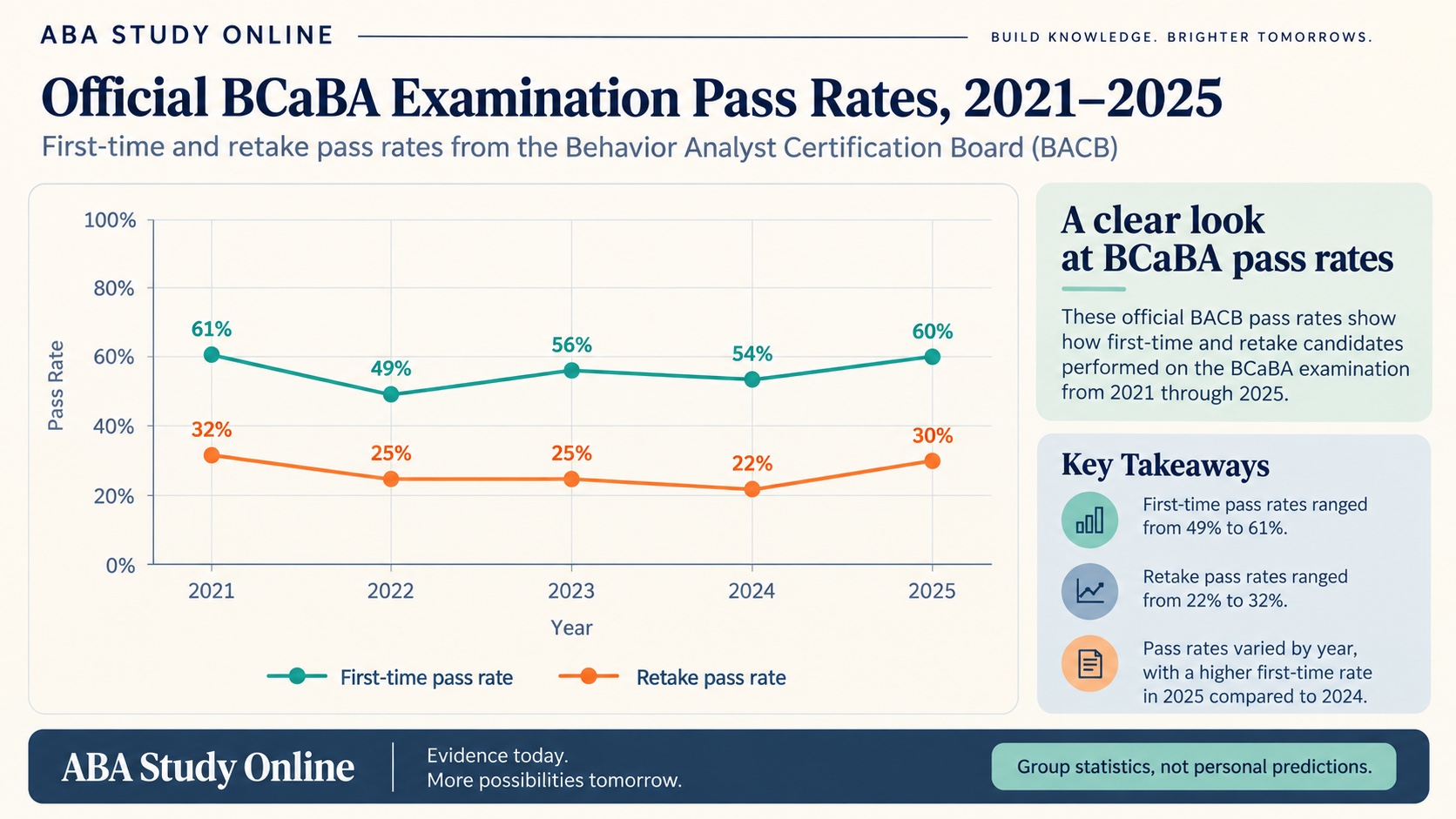
| Reporting year | First-time candidates tested | First-time passing | Retakes tested | Retakes passing |
|---|---|---|---|---|
| 2021 | 2,130 | 61% | 1,275 | 32% |
| 2022 | 1,190 | 49% | 949 | 25% |
| 2023 | 931 | 56% | 855 | 25% |
| 2024 | 1,011 | 54% | 1,040 | 22% |
| 2025 | 1,196 | 60% | 1,019 | 30% |
The 2025 figures are the latest annual figures displayed on the BACB pages checked for this article on September 26, 2026. Because annual reports can be updated, attach the year to the number when you quote it: “2025 BCaBA first-time pass rate,” not simply “the BCaBA pass rate.”
The table also shows why a single combined percentage can be misleading. First-time and retake candidates are reported separately, and the number tested in each group changes from year to year. If you combine groups without preserving their denominators, you lose the distinction the official report is designed to show.
First-time candidates versus retakes
“First-time” and “retake” are not two difficulty levels of the same person. They are reporting groups with different testing histories. A first-time candidate may be taking the examination for the first time in the reporting period. A retake candidate has already taken it and is returning under the current process. The official table separates them so readers do not mistake a retake percentage for a first-attempt percentage.
In 2025, the first-time group included 1,196 candidates and the retake group included 1,019. The first-time rate was 60%; the retake rate was 30%. That contrast is useful as context, but it does not tell you why any individual candidate passed or did not pass. Candidates differ in coursework, supervision, preparation, testing history, and circumstances that the annual table does not measure.
It is also important not to read the retake rate as a label for a person. A retake candidate may have changed their preparation, received additional support, or experienced a different testing situation. The statistic describes the group’s result in that year; it does not describe a fixed trait of every person in the group.
What a pass rate is not
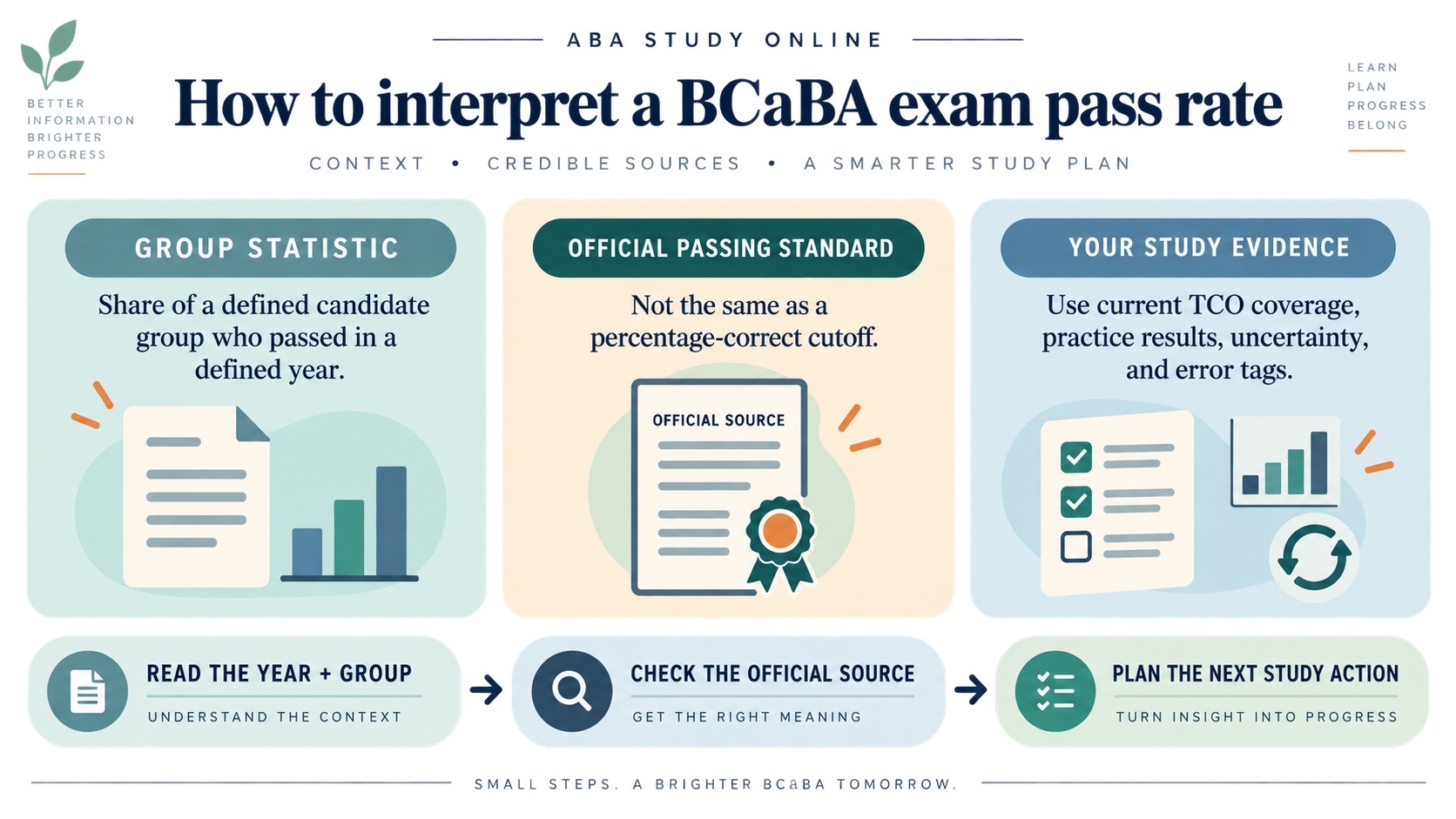
A pass rate is the percentage of a defined group who passed during a defined reporting period. It is not a raw passing score. If the report says 60%, that does not mean a candidate must answer 60% of questions correctly.
The BACB’s examination information explains that examination passing standards use a criterion-referenced process. An independent practice set may report a percentage correct, but that percentage is not interchangeable with an official BACB result. Avoid study pages or social posts that turn an annual pass rate into a statement such as “you need to get 60 questions right.”
A pass rate is also not a personal probability. Saying “the rate is 60%, so I have a 60% chance” treats a group description as if it were an individualized forecast. A more honest use is: “The statistic tells me that many candidates need a deliberate plan, and I should use my own practice evidence to find gaps.”
How to read the 2021–2025 trend
Across the displayed years, the BCaBA first-time rate moved from 61% in 2021 to 49% in 2022, then 56%, 54%, and 60% through 2025. The retake rate moved from 32% to 25%, stayed at 25%, fell to 22%, and rose to 30%. Those are useful descriptions of what the report displays.
They are not enough to identify a cause. The table does not, by itself, tell you whether the change came from candidate preparation, program composition, testing volume, policy changes, study resources, or another factor. A careful article should say “the rate increased” rather than “the exam became easier,” unless a separate source directly supports that causal claim.
Use the trend as a planning signal. If you are studying now, do not wait for the next annual report to tell you what to do. Start with the current BCaBA Test Content Outline, use scenario-based practice, review uncertain answers, and track recurring errors by domain. Your own preparation evidence is more actionable for tomorrow’s study block than an unexplained change in a group statistic.
Overall data versus university-program reports
The BACB also publishes university examination pass-rate reports for first-time BCBA and BCaBA candidates in qualifying university training programs. Those reports answer a different question from the overall annual examination table. The university report uses program-level inclusion rules and does not publish data for programs with fewer than six first-time candidates in a year.
The BACB university pass-rate page recommends evaluating each program’s rate on its own and warns readers not to compare a program pass rate directly with the overall examination pass rate. The populations and reporting purposes differ. A program rate may help someone research a training option, but it should not be used as a universal ranking or as proof that every graduate will have the same result.
If you are comparing programs, ask what the report includes, how many first-time candidates were counted, which year is represented, and whether the program’s coursework and student-support context fit your needs. Look at curriculum, supervision, cost, schedule, modality, and support alongside the number.
Turn the statistic into a study decision
Use the pass rate for context, then switch to evidence you can act on. A simple three-step response works:
- Check the source boundary: Confirm the current year, candidate group, official handbook, and BCaBA Test Content Outline.
- Run a diagnostic set: Answer original questions across domains without immediately looking up the answer. Mark uncertain correct answers as well as incorrect ones.
- Repair a pattern: Tag the error—measurement, assessment, intervention, ethics, supervision, or concept discrimination—then study one distinction and retry a new scenario later.
For a full current test orientation, use the BCaBA test guide. For a mock evaluation, use the BCaBA mock-exam guide and treat the result as diagnostic evidence. For short practice, the BCaBA exam-question resource can support a repeatable answer-review loop. None of these independent resources can translate a group pass rate into a guaranteed outcome.
Common mistakes
- Quoting 60% without the year: Say 2025 BCaBA first-time pass rate.
- Mixing first-time and retake groups: Keep the denominators and labels visible.
- Treating pass rate as passing score: A group percentage is not the number of questions you need correct.
- Calling the statistic a personal probability: Use your practice errors and current source alignment for personal planning.
- Claiming the trend proves difficulty changed: Describe the numbers without inventing a cause.
- Ranking programs from one number: Read the inclusion rules and compare program context responsibly.
- Using an old third-party chart as current: Link to the live BACB data page and record the reporting year.
FAQ
What is the latest BCaBA exam pass rate?
The latest annual figures currently displayed by BACB are for 2025: 60% for first-time BCaBA candidates and 30% for retake candidates. The groups included 1,196 and 1,019 candidates, respectively.
Does a 60% BCaBA pass rate mean I need 60% correct?
No. A pass rate is the share of a defined group who passed. It is not a raw percentage-correct cutoff or the official passing standard.
Why is the retake rate different from the first-time rate?
The two rates describe different candidate groups with different histories. The annual table does not establish a single reason for the difference, so avoid assigning a cause without additional evidence.
Can the pass rate predict whether I will pass?
No. Use it as context. For personal preparation, rely on the current BCaBA outline, current official rules, practice with explanations, and a specific error-repair plan.
Can I compare a university’s BCaBA pass rate with the overall rate?
Not casually. BACB says the university reports have different populations and inclusion rules and should be evaluated on their own rather than compared directly with the overall examination rate.