BCaBA Definition: Role, Supervision, and the RBT–BCBA Relationship
The BCaBA definition is easiest to understand when you place the credential inside the behavior-analysis service structure. BCaBA stands for Board Certified Assistant Behavior Analyst. The BACB describes it as an undergraduate-level certification in behavior analysis. A BCaBA may provide behavior-analytic services only under the supervision of a BCBA, and BCaBAs may supervise the work of RBTs when the applicable requirements and role boundaries are met.
That definition answers what the credential is, but not every question about a person’s job, state licensure, payer enrollment, fieldwork, or scope of competence. Use this page to build the vocabulary first, then check current BACB Handbooks, ethics requirements, employer policies, supervisor direction, and applicable law before making a practice or certification decision.
Table of Contents
The plain-language BCaBA definition
A BCaBA is a certified assistant behavior analyst at the undergraduate level. The credential signals that the person has met the BACB’s current eligibility and examination requirements for that certification. It does not mean the person is a BCBA, and it does not turn an assistant-level role into independent behavior-analytic practice.
The word “assistant” describes a supervised professional level, not a person who is merely a classroom helper. A BCaBA can have meaningful behavior-analytic training and responsibility. The key boundary is the supervision relationship: BCaBA services are provided under BCBA supervision, and the work must stay within the person’s training, competence, assignment, and the rules that apply in the setting.
The credential also should not be confused with a degree title. Someone can study behavior analysis without holding BCaBA certification, and a person’s job title may not perfectly describe their certification status. When the distinction matters, verify the current credential and the applicable records rather than relying on a résumé phrase alone.
Where BCaBA fits beside RBT and BCBA
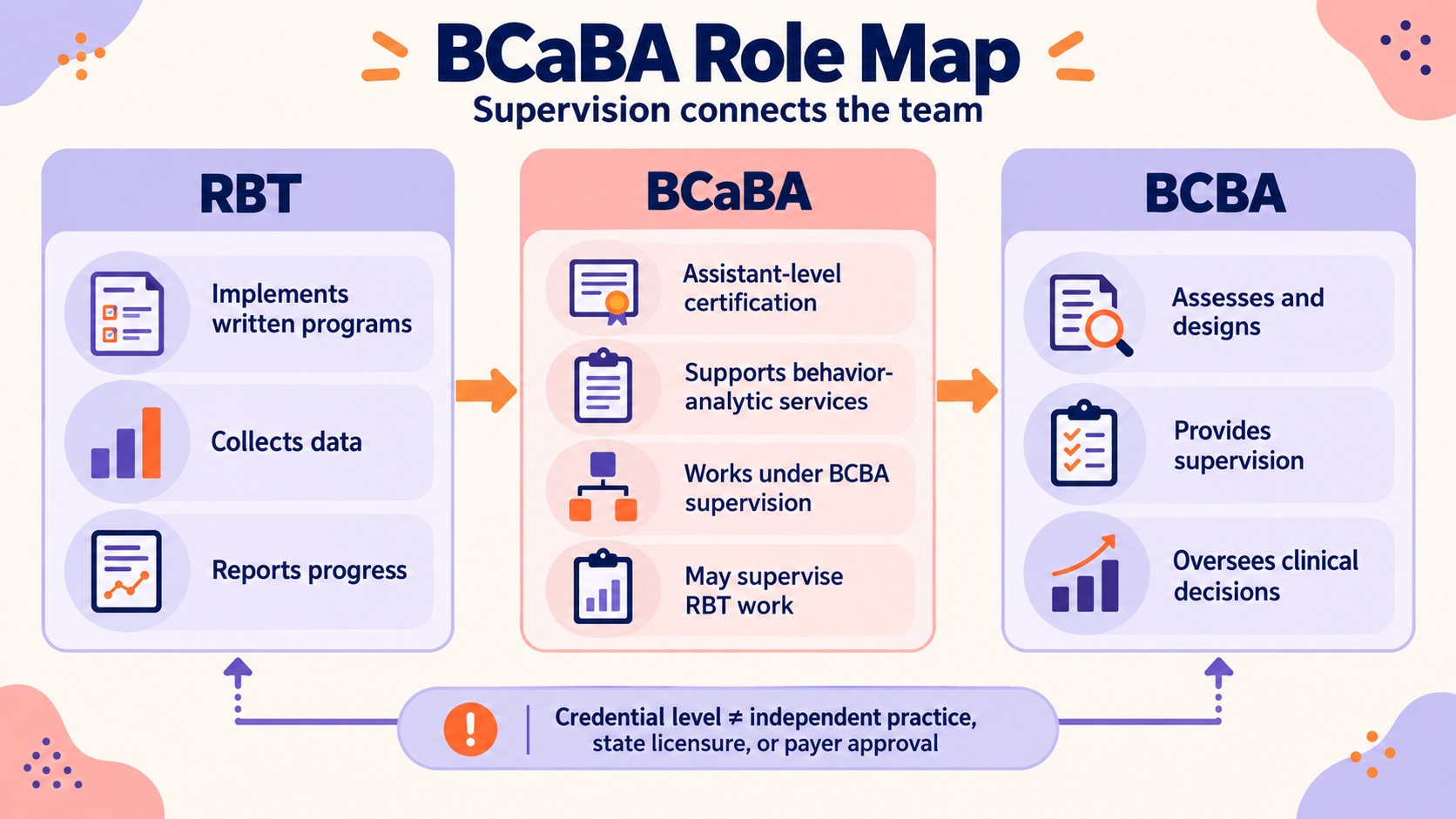
Think of the three common BACB certification tracks as related but non-interchangeable roles:
- RBT: a behavior technician credential focused on implementing behavior-analytic services under supervision and training. An RBT does not independently design a treatment plan just because the person has experience with a procedure.
- BCaBA: an undergraduate-level assistant behavior analyst credential. A BCaBA works under BCBA supervision and may supervise RBT work when the supervision arrangement and requirements support it.
- BCBA: a behavior analyst credential with a higher education and practice level. The BCBA role includes responsibility for assessment, intervention design, supervision, and decisions within the person’s scope of competence.
This is a role map, not a statement that every workplace uses identical staffing patterns. State licensure, payer rules, employer policies, service agreements, and client needs can change what a person is permitted or assigned to do. The certification relationship is the starting point for the question, not the entire answer.
Why BCBA supervision is part of the definition
Supervision is not an optional extra word attached to BCaBA. It is part of the credential’s practice boundary. The BACB’s public BCaBA page says that BCaBAs may provide behavior-analytic services only under BCBA supervision. That means a complete role question asks who the supervising BCBA is, what the supervision arrangement requires, how responsibilities are documented, and what the BCaBA is trained and authorized to do in the specific setting.
Supervision also does not mean that every decision is made by someone else while the BCaBA does nothing independently. An assistant analyst may perform substantial behavior-analytic work within the supervisor’s direction and the person’s competence. The safe distinction is between carrying out or contributing to assigned work and claiming independent authority outside the supervision relationship.
For study purposes, watch the wording in a question. “Under the supervision of a BCBA” is a role boundary. “May supervise RBTs” is a possible responsibility that still depends on the relevant supervision requirements and workplace arrangement. “Independent practitioner” points to a different certification level and should not be assigned to the BCaBA simply because the person has been working for a long time.
What a BCaBA may do in a service system
Within training, competence, supervision, and the applicable service arrangement, a BCaBA may contribute to assessment activities, help implement or monitor behavior-analytic programs, review data, support skill-acquisition or behavior-reduction procedures, communicate observations to the supervising BCBA, and provide direction or training to RBTs when that responsibility has been assigned and documented.
The exact task is less important than the decision boundary around it. A BCaBA should know the purpose of the task, the procedure to follow, the data to collect, the person to contact when the case changes, and the limits of the role. A new or high-risk situation may require consultation, additional training, or a supervisor’s direct involvement even if the task looks similar to something the BCaBA has done before.
Do not infer practice authority from a single task. For example, collecting data does not by itself make a person responsible for interpreting every clinical decision. Training an RBT on a written procedure does not automatically mean the BCaBA owns the treatment plan. Contributing to an assessment does not erase the supervisory structure. Keep task, responsibility, and authority as separate columns in your notes.
What BCaBA does not automatically mean
- Not a BCBA: BCaBA and BCBA are separate certifications with different education and practice boundaries.
- Not independent practice: certification does not remove the BCBA supervision requirement.
- Not automatic state licensure: BACB certification and state authorization can be separate questions.
- Not automatic payer enrollment: billing, contracts, and credentialing depend on the relevant payer and jurisdiction.
- Not automatic competence for every case: the person’s training, experience, supervision, resources, and the client’s needs still matter.
- Not a guarantee of a job title: employers may use different titles, so verify the credential and assigned duties.
How to study the term for an exam
Build a four-line retrieval card: credential level, supervision boundary, possible relationship to RBT work, and the closest contrast with BCBA. Then add one non-example. “BCaBA works under BCBA supervision” is a useful starting point; “BCaBA can independently approve any intervention because the person passed the exam” is a useful non-example.
Next, practice the distinction in a short scenario. If the question asks who can supervise an RBT, identify the credential and the applicable supervision context. If it asks who is responsible for designing or changing a behavior plan, look for the described supervisory role and current requirements rather than choosing the highest-sounding job title. Use the current BCaBA TCO and Handbook for official content boundaries; this page is a study aid, not an official exam document.
BCaBA definition FAQ
What does BCaBA stand for?
BCaBA stands for Board Certified Assistant Behavior Analyst. The BACB describes it as an undergraduate-level certification in behavior analysis.
Can a BCaBA work without a BCBA?
The BACB states that BCaBAs may provide behavior-analytic services only under BCBA supervision. The exact supervision arrangement and any state or employer rules must also be checked.
Can a BCaBA supervise an RBT?
BCaBAs may supervise the work of RBTs, but the assignment must fit the current supervision requirements, training, competence, employer structure, and service setting.
Is a BCaBA the same as an assistant teacher?
No. BCaBA is a professional behavior-analysis certification. A workplace may use many job titles, but the credential has a specific meaning and a BCBA supervision boundary.