BCaBA CEU Requirements: How to Track 20 Credits and Prepare for 2027
When someone searches for “BCaBA CEU,” they may be asking a simple number question, looking for an online or free learning event, or trying to understand what the 2027 requirements mean for recertification. The useful answer has to do more than list a number. It should help you decide whether a particular activity, category, date, and record belong in your certification cycle.
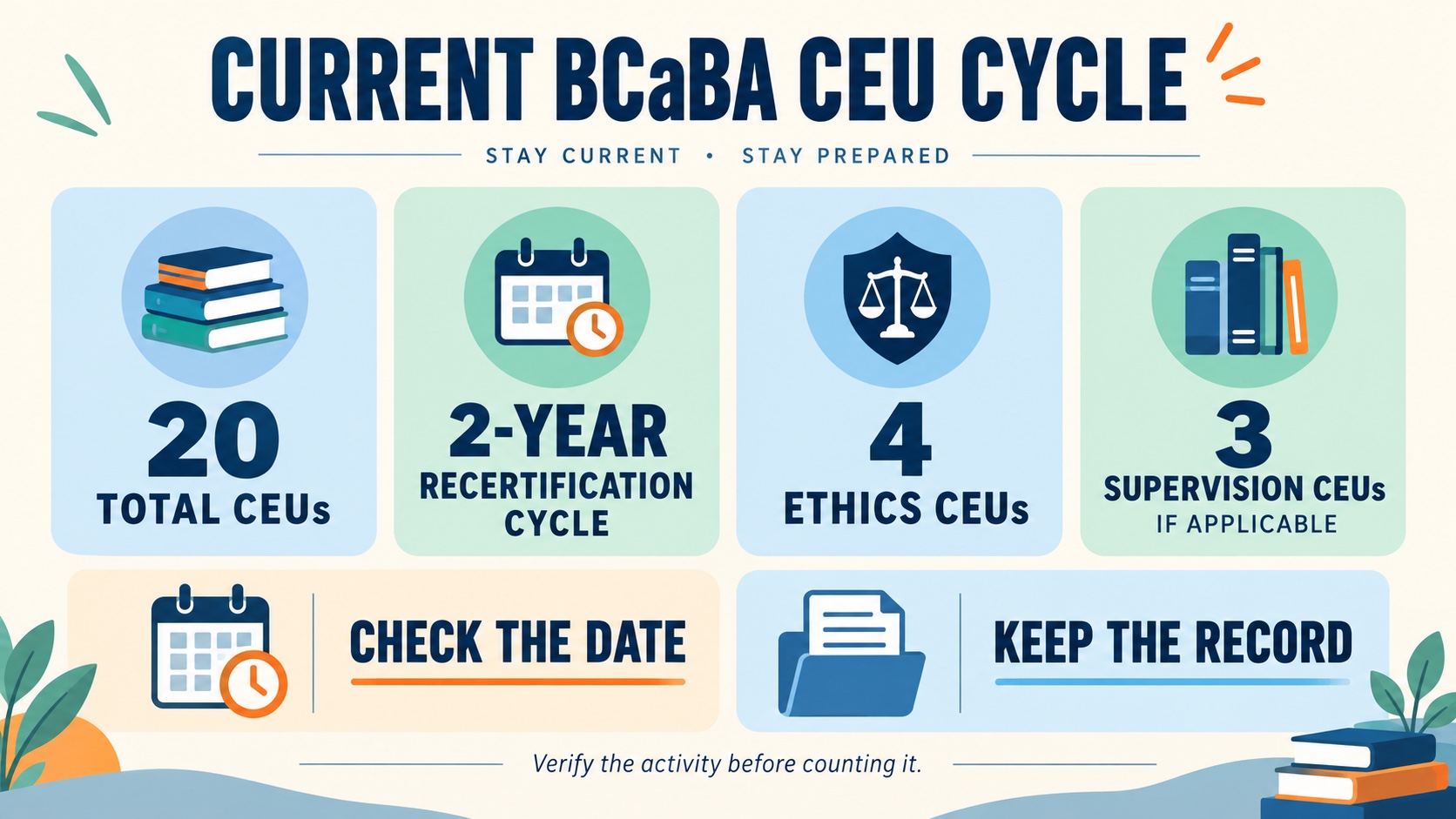
Under the BACB’s 2027 BCaBA Requirements, a BCaBA must obtain 20 continuing education units (CEUs) in each 2-year recertification cycle. That total includes 4 ethics CEUs and 3 supervision CEUs for supervisors. The same official document says these maintenance figures remain unchanged from the 2022 continuing-education requirements. Other 2027 rules do change, so the safest plan is to separate the CEU question from the eligibility, fieldwork, and ongoing-supervision changes.
This guide gives you a practical way to screen an opportunity before counting it. It is educational information, not an individualized recertification decision. Check the current BCaBA Handbook, your BACB Portal, and the official provider registry for the requirements and records that apply to you.
Table of Contents
What a BCaBA CEU search is really asking
“Does this count?” is usually the question behind the search. A free video, a conference session, a recorded webinar, a university class, and a supervision workshop may all be educational, but they do not automatically produce the same kind of record or belong to the same CEU category.
Separate the decision into three parts:
- Access: Is the activity free, paid, live, recorded, or available only through membership?
- Eligibility: Does the activity fit a current BACB pathway and category, and is the provider authorized when authorization is required?
- Documentation: Can you retain the information needed to report the activity accurately for your cycle?
Price answers only the first question. A free activity can be excellent professional learning without being a BCaBA CEU. A paid activity still needs the right provider, content, participation, category, and documentation. That is why an article that promises a permanent list of “free BCaBA CEUs” can become unreliable quickly: provider status, event dates, credit categories, and certificate procedures can change.
The better habit is to use event lists as leads and a verification method as the durable resource. Before you count an activity, write down what it is, who offered it, when you completed it, what category it claims, and what record you received.
Current BCaBA CEU requirements
The current maintenance snapshot is short enough to remember:
- 20 total CEUs in each 2-year recertification cycle.
- 4 ethics CEUs within that cycle.
- 3 supervision CEUs for BCaBAs who have the applicable supervision responsibility.
- Cycle-specific timing: the activity must be earned in the cycle to which you are applying it.
- Record keeping: keep the supporting documentation and report information accurately through the current BACB process.
Your cycle is connected to your own recertification date, not simply to January through December. That matters when an event is close to a renewal boundary. Put the activity date beside the event title in your tracker rather than filing everything under the year in which you downloaded a certificate.
Do not build a plan that treats 20 as one undifferentiated bucket. Reserve space for ethics, and add the supervision category when it applies. A person who waits until the last few months may discover that a collection of general learning events does not fill the category-specific requirement they actually need.
Also avoid assuming that an unused CEU automatically moves into the next cycle or that a missed requirement can be repaired by adding an old activity later. The current handbook controls those details. If your record is close to a deadline, check the official source directly rather than relying on a remembered rule or an old blog post.
What an activity and its record need to show
The BCaBA Handbook describes broad activity routes that include Learning, Teaching, and Scholarship. Learning events are the path most people mean when they search for an online CEU, but the handbook also describes other activities with their own eligibility and documentation rules.
Learning
Learning can include qualifying behavior-analytic events offered by an Authorized Continuing Education Provider, as well as other handbook pathways such as certain coursework or BACB activities. The event description should make it possible to understand what you are learning, how participation is verified, how credit is calculated, and what record you will receive.
Do not treat a certificate of attendance as a universal substitute for every required record. Save the certificate, but also keep the event title, date, provider information, credit amount, category, and any completion evidence the activity requires. If an event is recorded, confirm how the provider defines completion rather than assuming that pressing play is enough.
Teaching
Teaching is not the same as attending a course. A qualifying teaching activity may require documentation from the provider or university that identifies the instruction and time involved. If you are using teaching as a CEU route, follow the handbook’s documentation rules for that route instead of converting informal mentoring or a casual presentation into credit.
Scholarship
Scholarship can include qualifying behavior-analytic publication or peer-review work described by the handbook. Ordinary blog writing, reading articles, posting on social media, or creating study notes should not be relabeled as scholarship CEUs without checking the actual criteria. The attractive part of a broad category is also where a tracker can become inaccurate if the activity is not matched to the source definition.
For any route, keep one row per activity. Useful columns include the provider, activity title, date, route, category, amount, certificate location, cycle, and verification status. A row marked “needs verification” is more honest—and more useful—than adding an uncertain number to your completed total.
Ethics and supervision CEUs need a closer check
Ethics and supervision are category requirements, not just words that can be added to the title of a general course.
For ethics, read the provider’s description carefully. A general ABA course that briefly mentions an ethics code is not automatically an Ethics CEU. The activity needs to fit the current ethics-content definition and the provider’s category documentation. Look for a description that makes the ethics or cultural/contextual-responsiveness focus clear, rather than relying on a single sentence or a keyword in the event title.
For supervision, distinguish at least three ideas:
- Supervision CEUs: the category-specific continuing education requirement for applicable supervisors.
- Ongoing supervision: the supervision arrangement under which a BCaBA practices.
- Supervision training or fieldwork supervision: other training and certification pathways described in BACB resources.
These ideas can appear on related pages, but they are not interchangeable credits. If you need supervision CEUs, confirm that the activity is documented in the required category. If you are planning fieldwork or ongoing supervision, use the relevant BCaBA Handbook section and forms instead of assuming that a supervision-themed webinar satisfies every supervision obligation.
The BACB Authorized Continuing Education page and verification registry are useful starting points for checking provider status. The registry also makes an important distinction: authorization as an ACE Provider does not mean the BACB endorses or approves every individual CEU event or its content. You still have to inspect the event.
A practical BCaBA CEU tracking scenario
Imagine that Maya is a BCaBA halfway through her recertification cycle. She has completed 8 general Learning CEUs and finds a free recorded webinar described as “ethics for behavior professionals.” The page looks useful, but it does not identify the provider number, credit category, completion check, or certificate procedure.
Maya does not add the webinar to her completed total yet. She makes a temporary row with five questions:
- Is the provider currently verifiable through the official registry?
- Does the individual event identify its CEU amount and category?
- Does the content description show that ethics is the focus rather than a brief reference?
- What participation or knowledge check is required?
- What certificate or record will be available, and does the date fit her cycle?
After checking, Maya learns that the event is valuable free education but is not documented as an Ethics CEU. She may still watch it for learning, but she continues looking for a verified ethics event. That decision protects the accuracy of her tracker without dismissing the educational value of the webinar.
She also notices that she will supervise an RBT during the cycle. She creates a separate supervision line in her plan rather than counting a generic leadership course. Her tracker now distinguishes general Learning, Ethics, and Supervision, with a source or record attached to every completed entry.
A step-by-step verification workflow
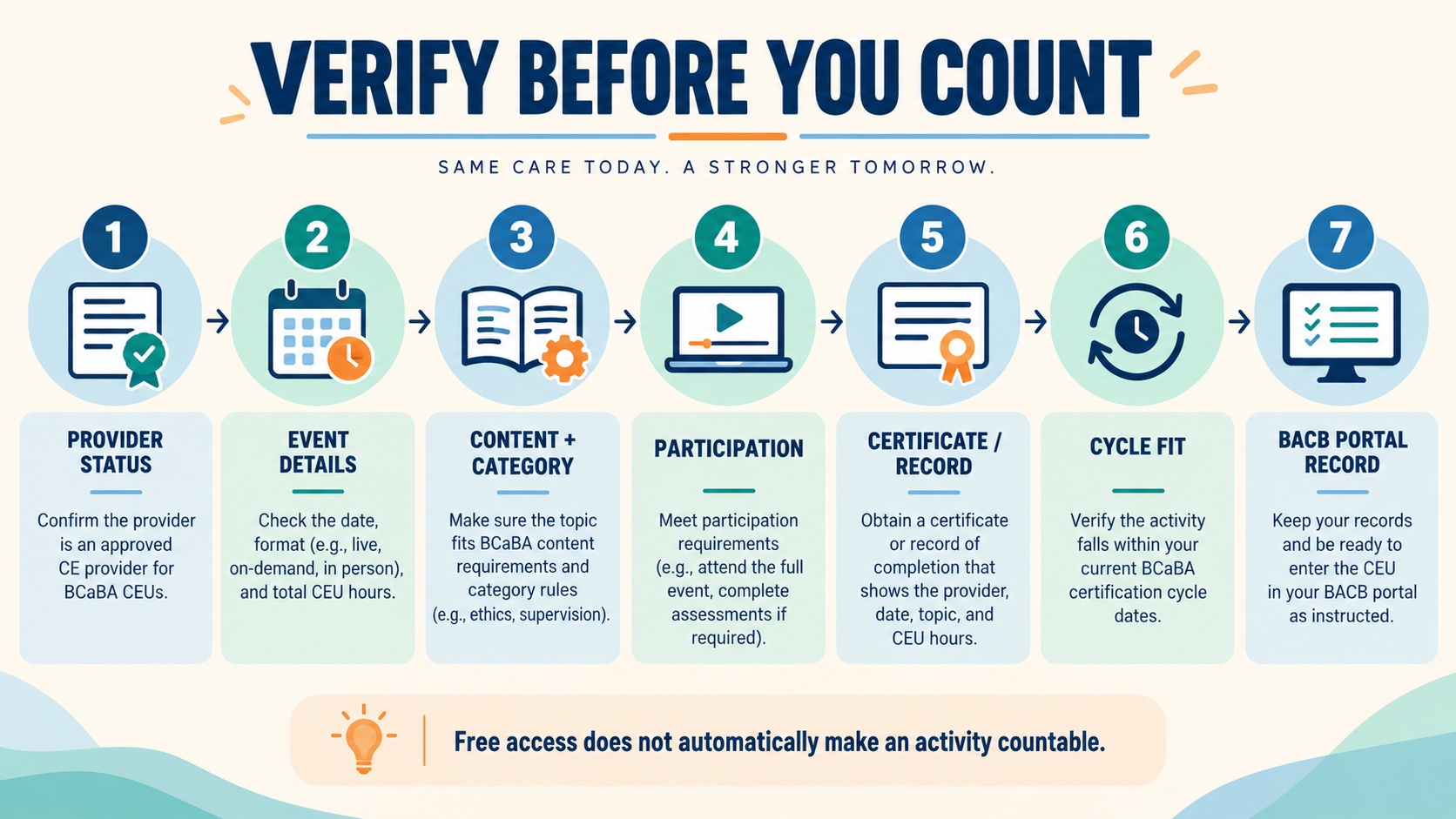
Use this sequence before counting a BCaBA CEU opportunity. It is a planning checklist, not an individualized compliance determination.
- Check the source of the event. Start with the official BACB Authorized Continuing Education Providers page and verification registry when ACE authorization is relevant. Treat badges, old roundups, and social-media posts as leads rather than proof.
- Verify the specific event. Record the title, format, date, credit amount, and category. Provider status alone does not answer whether one event fits your need.
- Read the content description. Confirm that the topic is behavior-analytic and that an ethics or supervision label reflects the main content when you need that category.
- Check participation. Find out whether you must attend live, stay for a minimum period, complete a knowledge check, answer questions, or meet another completion condition.
- Confirm the record. Know what you will receive before spending the time. Save the certificate or other record, plus the event page or confirmation that explains the credit.
- Match the date to your cycle. Put the activity in the cycle in which it was earned. Do not count one activity twice or move it simply because the certificate was downloaded later.
- Record and review. Enter the information through the current BACB process and keep a durable copy. Reconcile the tracker with your category totals before renewal rather than waiting for the final week.
For a two-year cycle, a monthly review is usually easier than a last-minute search. Divide the remaining total across the months left, reserve a place for ethics, add supervision if it applies, and mark uncertain activities separately. The goal is not to collect the largest number of links. It is to build a record that you can explain and verify.
How the 2027 changes fit the CEU question
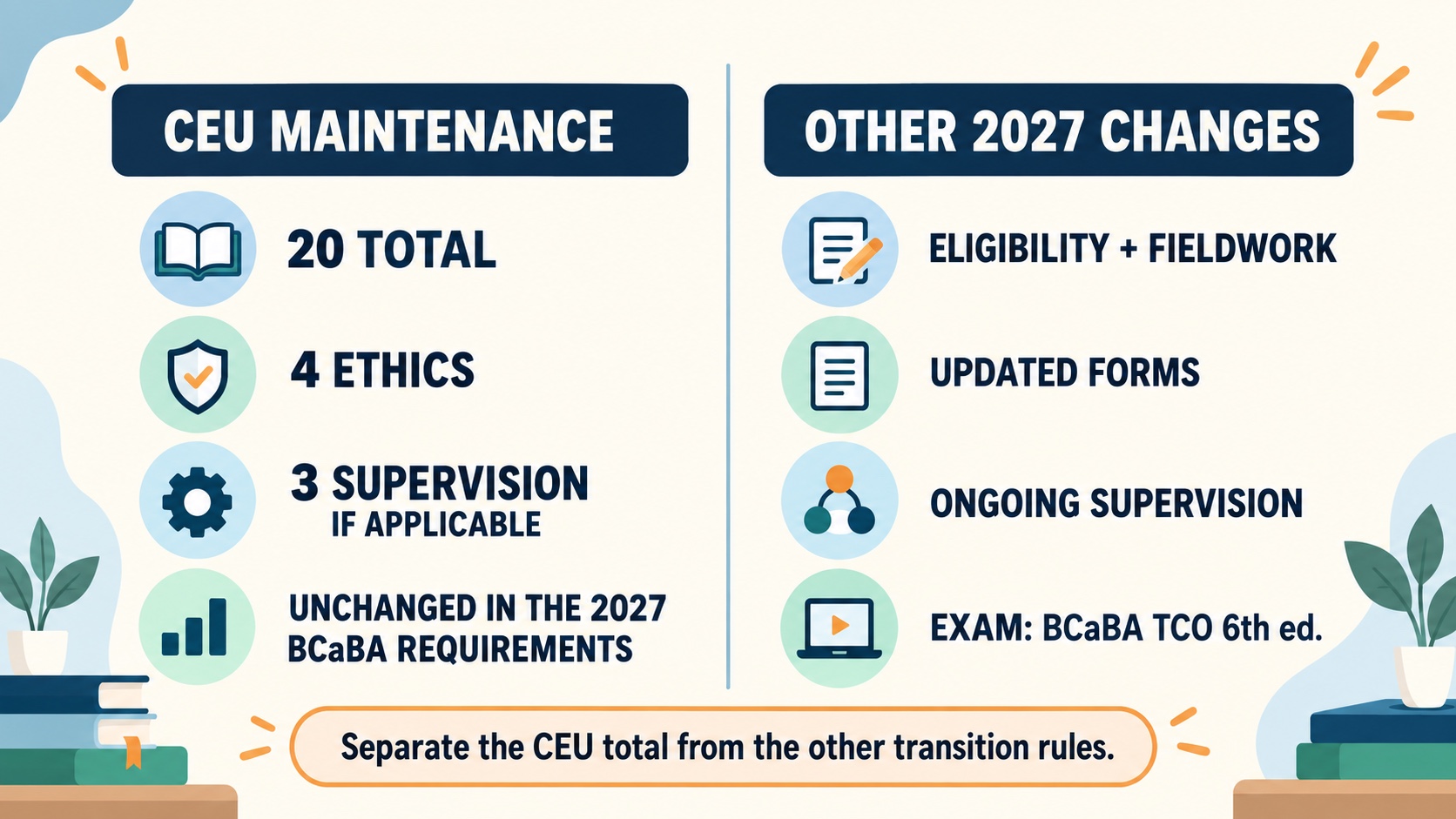
The BACB’s official 2027 BCaBA Requirements document is important, but it does not say that the BCaBA CEU maintenance total becomes a new number. It lists the same maintenance snapshot: 20 CEUs in a 2-year cycle, including 4 ethics CEUs and 3 supervision CEUs for supervisors. The document says these continuing-education requirements remain unchanged from 2022.
At the same time, January 1, 2027 brings other certification changes. The official BCaBA document includes new eligibility and fieldwork details, updated forms for applications after the transition date, and the BCaBA examination boundary based on the Test Content Outline (6th ed.), which went into effect January 1, 2025. It also points to ongoing supervision requirements and the current handbook.
Keep those topics in separate columns in your planning system:
- Maintenance CEUs: 20 total, including 4 ethics and 3 supervision for applicable supervisors.
- Eligibility and fieldwork: a separate set of 2027 application requirements, hours, forms, and supervisor conditions.
- Examination: the applicable BCaBA Test Content Outline boundary, not a claim that 2027 creates a “7th edition” BCaBA exam.
- Ongoing supervision: a practice and supervision obligation described in the BCaBA Handbook, not a substitute label for supervision CEUs.
If a transition date affects your own application or recertification, check the current official announcement and handbook. A general SEO article can explain the map, but your cycle dates, application status, and supporting records determine which requirements you must follow.
Common mistakes and FAQ
How many CEUs does a BCaBA need?
The official 2027 BCaBA Requirements state 20 CEUs in each 2-year recertification cycle, including 4 ethics CEUs and 3 supervision CEUs for supervisors. Confirm the current handbook and the requirements that apply to your cycle.
Can a free webinar count as a BCaBA CEU?
It can, but free access does not decide that. Verify the provider, individual event, content/category, participation requirement, record, and cycle date before counting it.
Are BCaBA CEUs the same as BCBA CEUs?
No. The credentials have different maintenance totals and category requirements. Do not copy a BCBA tracker into a BCaBA cycle without checking the BCaBA Handbook and official requirements.
Does every event from an ACE Provider count as an ethics CEU?
No. ACE Provider status is a provider authorization, not a guarantee that every event is an Ethics CEU. The individual event must meet the applicable content and documentation requirements.
Can I use an old list of BCaBA CEU providers?
Use it only as a lead. Provider status, event dates, credit categories, and completion procedures can change. Recheck the official registry and the individual event.
Does ABA Study Online award BACB CEUs?
Not through this educational page. ABA Study Online can provide study explanations, practice questions, definitions, and app-based review, but it should not be represented as an ACE Provider or as awarding BACB credit unless that status is separately verified and clearly established.
For background learning, you can continue to the BCaBA Theory Blocks, practice with free BCaBA questions, search the ABA Definition Search, browse free ABA resources, or use the ABA Study Online app. These destinations support learning; they are not a substitute for verifying a BACB CEU event.