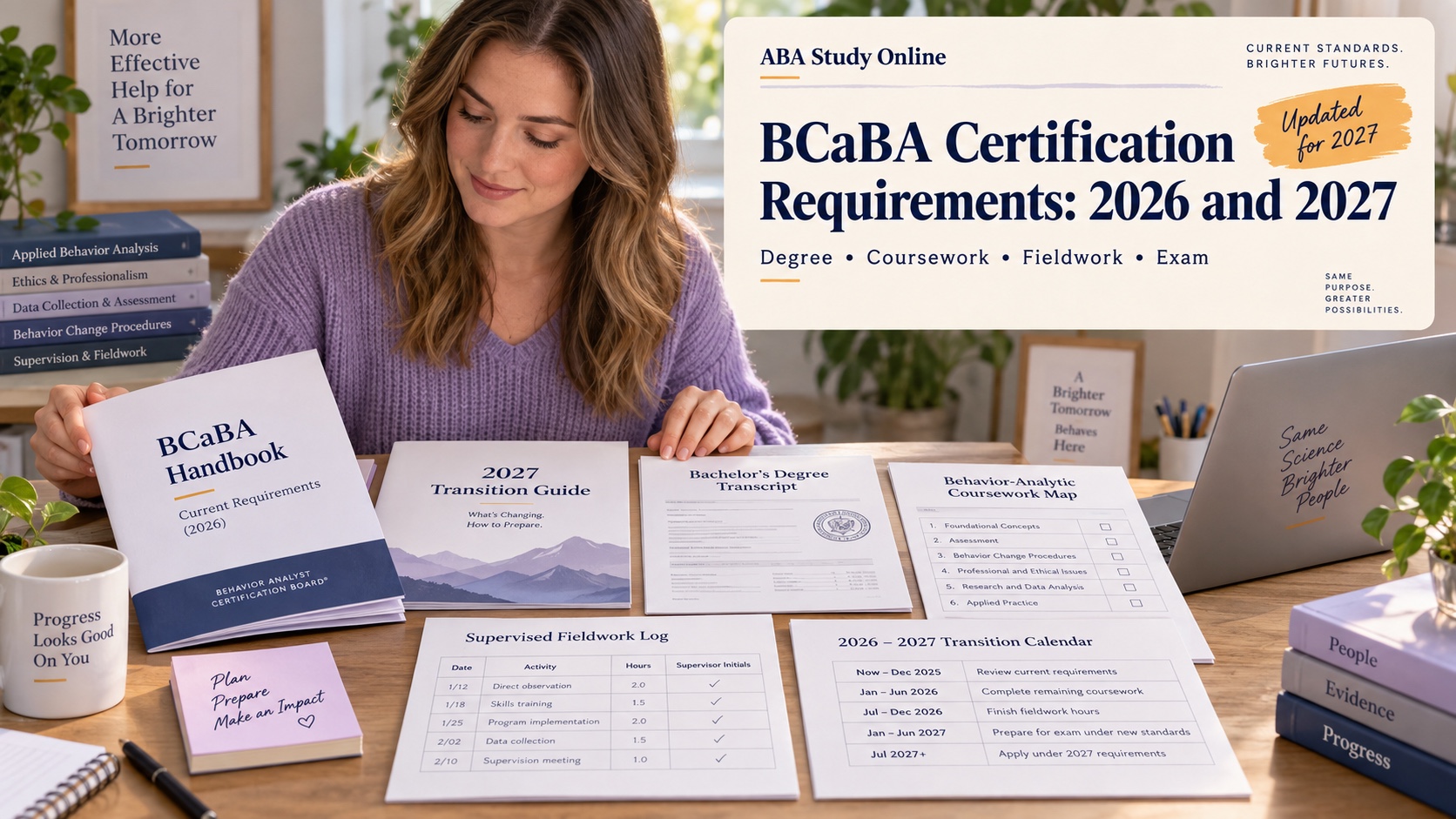
BCaBA Certification Requirements: 2026 and 2027
If you are comparing BCaBA certification requirements, start with the date of your application. The current BACB BCaBA Handbook and the 2027 requirements share the same broad sequence—degree, behavior-analytic content, supervised fieldwork, application, and examination—but some coursework and fieldwork details change on January 1, 2027.
The short answer is that BCaBA certification is an undergraduate-level BACB certification. A BCaBA provides behavior-analytic services under BCBA supervision and may supervise RBT work when the applicable requirements are met. This guide separates the current requirements from the 2027 transition so you can build the right record instead of mixing two versions of the rules. The current BACB BCaBA Handbook controls your individual application.
Table of Contents
What BCaBA certification means
The Board Certified Assistant Behavior Analyst (BCaBA) is a bachelor’s-level certification in behavior analysis. The credential is not the same as BCBA certification. The BACB describes BCaBAs as professionals who may provide behavior-analytic services only under the supervision of a BCBA. A BCaBA may also supervise RBTs when the BCaBA meets the applicable supervision and training requirements.
That role boundary affects your planning. Passing the BCaBA examination is necessary, but it is not the whole process. You need an eligible degree and behavior-analytic content, qualifying supervised fieldwork, an accurate application, an approved examination authorization, and continuing requirements after certification. A university course, a fieldwork log, or a practice test can support one part of the process; none of them independently creates certification.
The current BCaBA eligibility pathways
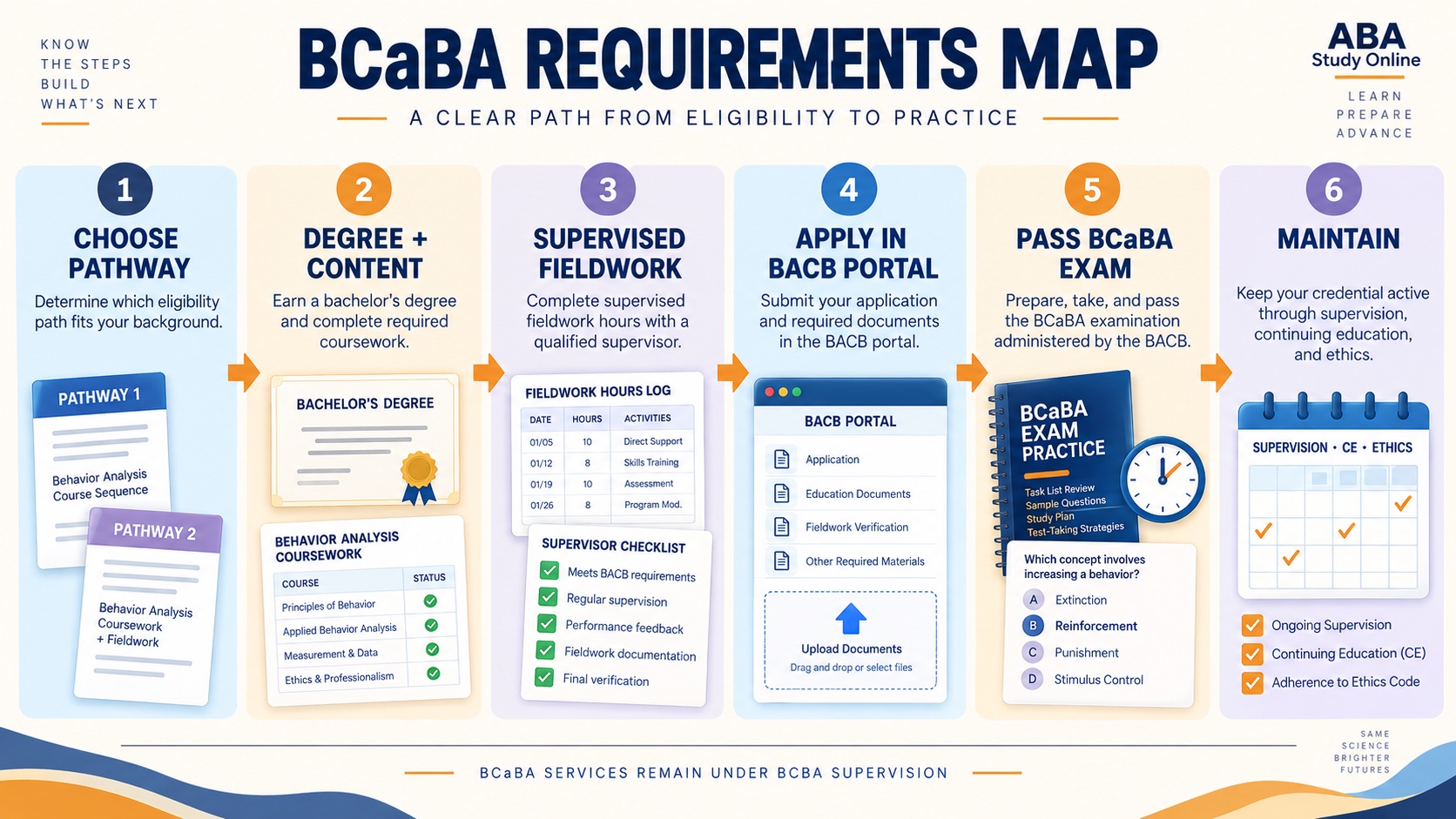
Under the June 2026 BCaBA Handbook, applicants can qualify through one of two pathways. Both require supervised fieldwork and a passing BCaBA examination. The difference is how the degree and behavior-analytic content are established.
| Pathway | Degree and content | What else is required |
|---|---|---|
| Pathway 1: ABAI-accredited program | Bachelor’s degree or higher from an ABAI-accredited program. For the current pathway, the degree must have been earned in 2015 or later while the program was accredited. | Supervised fieldwork, an application with official records, and the BCaBA examination. |
| Pathway 2: behavior-analytic coursework | Bachelor’s degree or higher from a qualifying institution in any field, plus acceptable behavior-analytic coursework completed through a qualifying institution with a Pathway 2 Program Contact. | Coursework attestation and official transcripts, supervised fieldwork, application, and the BCaBA examination. |
For Pathway 1, verify the specific degree program and degree level in the ABAI accredited-program directory. Accreditation is program-specific; a university’s general reputation or a nearby non-accredited program is not enough. For Pathway 2, ask the institution who serves as the current Program Contact and how the coursework attestation will be completed. The BACB relies on official records, not only a student’s course summary.
Current coursework and fieldwork requirements
Current Pathway 2 coursework
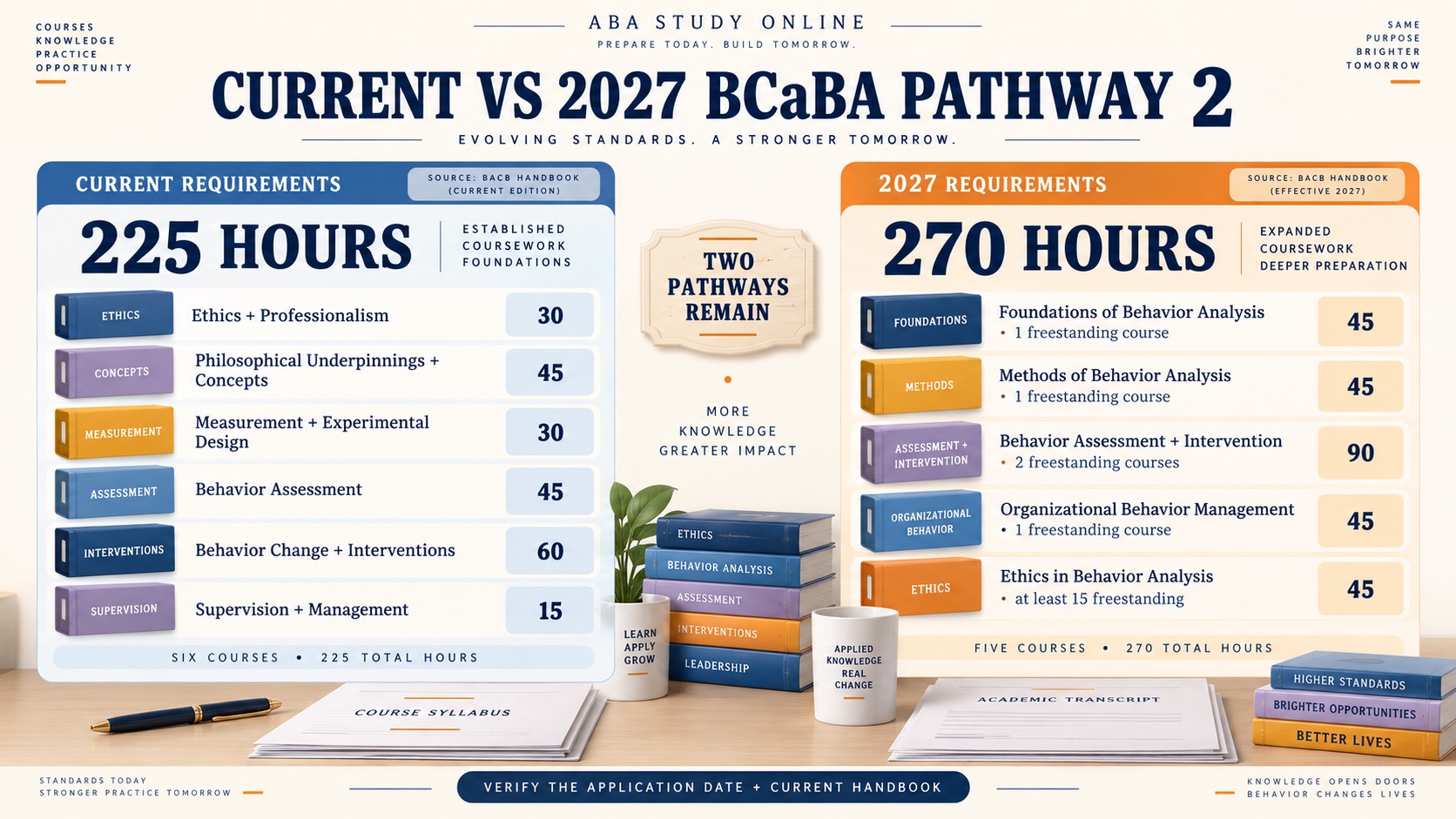
For an application submitted under the current requirements, the June 2026 Handbook lists 225 hours of behavior-analytic content. The coursework must be undergraduate level or higher, completed at the qualifying institution where you were enrolled, earned within 10 years of the application year, completed for academic credit, passed with at least a C or a passing grade, and completed at an institution with a Pathway 2 Program Contact.
| Current content area | Hours |
|---|---|
| Ethics Code, code-enforcement system, and professionalism | 30 |
| Philosophical underpinnings; concepts and principles | 45 |
| Measurement, data display, interpretation, and experimental design | 30 |
| Behavior assessment | 45 |
| Behavior-change procedures; selecting and implementing interventions | 60 |
| Personnel supervision and management | 15 |
| Total | 225 |
The current Handbook says at least 15 ethics hours must be taught in one or more freestanding courses. When you apply, plan to submit official transcripts for qualifying courses; if you transferred schools, you may need records from each institution. A course title that sounds relevant is not a substitute for the institution’s attestation and the BACB’s content rules.
Current supervised fieldwork
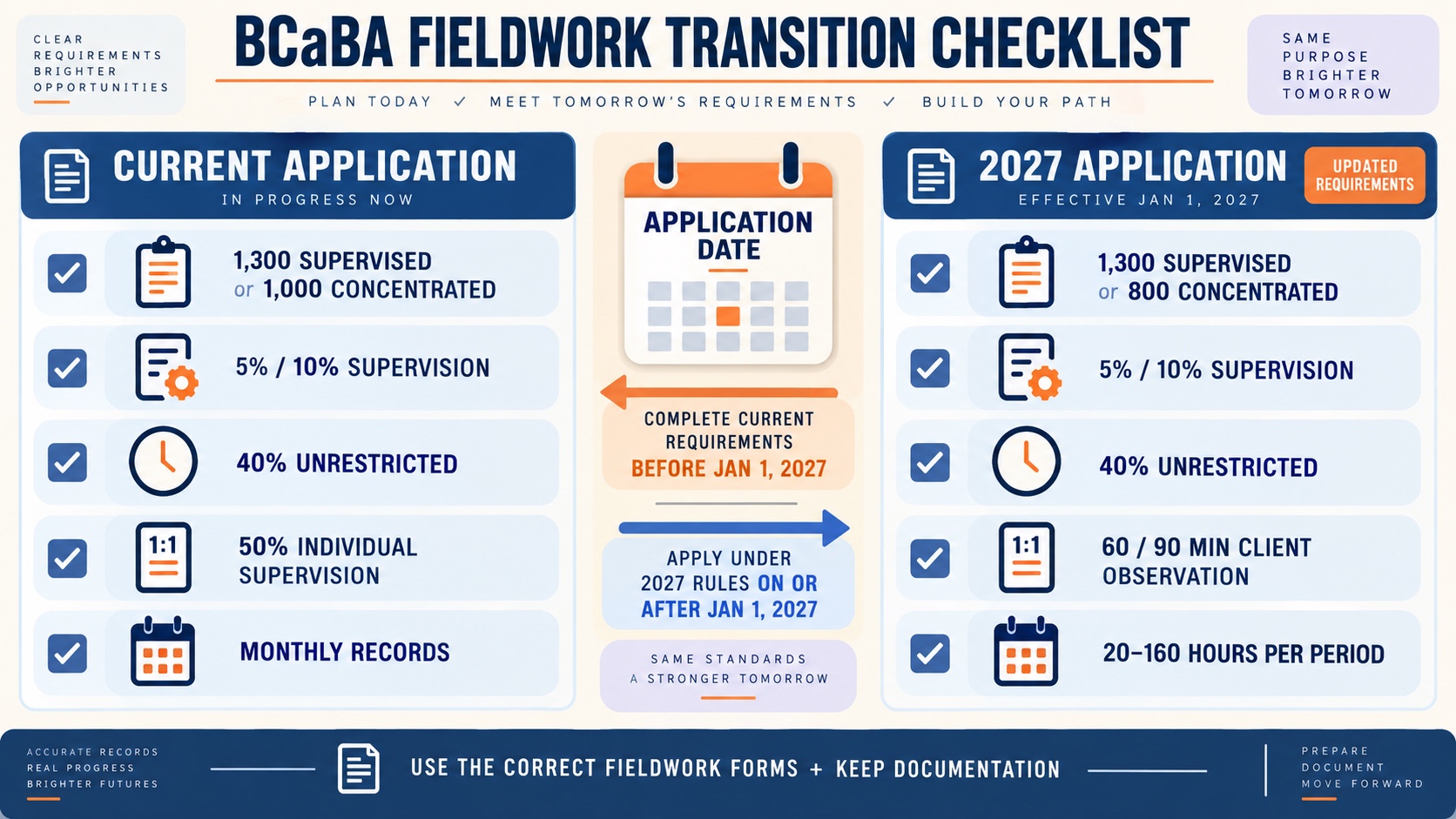
Current fieldwork is completed in applied behavior analysis under the ongoing guidance of a qualified BCBA supervisor. The overview lists either 1,300 hours of Supervised Fieldwork or 1,000 hours of Concentrated Supervised Fieldwork. The more concentrated option has the higher supervision percentage. Across the current fieldwork rules, at least 40% of total hours must be unrestricted activities, at least 50% of supervised hours must be individual rather than group supervision, and a monthly documentation system is required.
Do not treat every hour in a behavior-analytic workplace as qualifying fieldwork. The task, supervisor, observation, supervision contact, documentation, and unrestricted/restricted classification must all fit the current rules. The BACB may audit fieldwork, and applicants need to retain records such as contracts, Monthly Fieldwork Verification Forms, documentation systems, and audit logs when required.
Application, examination, and maintenance
Once your pathway, coursework, and fieldwork are ready, complete the BCaBA Certification Application in your BACB Portal account and select the pathway under which you are applying. The Handbook warns that selecting the wrong pathway may require a new application and payment. Your portal information, application, official identification, transcripts, and other records should use matching personal information.
After submitting the application, follow the current payment and transcript instructions. Official transcripts must be sent by the institution in the manner the BACB specifies; they are not simply replaced by an applicant-uploaded course list. The Handbook also describes a supplemental-document window after payment and a staff review period. Because processing times and fees can change, check the current Handbook and the BACB application-processing page before payment.
After the application is approved, you receive instructions for scheduling the BCaBA examination with Pearson VUE. The current examination is based on the BCaBA Test Content Outline, 6th edition: 150 scored questions plus 25 unscored questions, four hours, four answer choices with one correct answer, 90 tasks, and nine content areas. Results are based on overall examination performance, not a separate pass cutoff for each domain. If a new outline becomes active during an authorization period, the current Handbook says candidates must test under the new edition.
Certification continues after the exam. A BCaBA must follow the current Ethics Code, ongoing supervision rules, continuing-education requirements, and two-year recertification cycle. Keep the certification boundary visible: BCaBA certification does not make the certificant an independent BCBA, and a study resource cannot replace required supervision or official BACB documentation.
What changes for BCaBA applications in 2027
The BACB’s 2027 BCaBA materials say there are still two eligibility pathways. The change is in the content and fieldwork rules attached to the pathways, not in a change from “two pathways” to a new seven-edition exam. If you are applying on or after January 1, 2027, read the 2027 requirements and transition guidance together with the current Handbook.
Pathway 2 coursework changes from 225 to 270 hours
The 2027 Pathway 2 structure contains five content blocks totaling 270 hours:
- Foundations of Behavior Analysis: 45 hours in one freestanding course.
- Methods of Behavior Analysis: 45 hours in one freestanding course.
- Behavior Assessment and Intervention: 90 hours across two freestanding courses.
- Organizational Behavior Management: 45 hours in one freestanding course.
- Ethics in Behavior Analysis: 45 hours, with at least 15 hours in a freestanding course.
This is why a student should not simply add a few hours to an old transcript and call the record “2027 ready.” The course structure, freestanding-course requirement, content descriptions, Pathway 2 Program Contact, and official transcript evidence need to be checked together. The transition guidance specifically recommends reviewing standalone course gaps for applicants whose coursework began under the older requirements.
Fieldwork overview also changes
The 2027 overview lists 1,300 hours of Supervised Fieldwork or 800 hours of Concentrated Supervised Fieldwork. It keeps the 5% and 10% supervision percentages, at least 50% individual supervision, and at least 40% unrestricted activities, while specifying 20–160 fieldwork hours per supervisory period and cumulative client observations of 60 minutes for Supervised Fieldwork or 90 minutes for Concentrated Supervised Fieldwork. Use the 2027 forms and the detailed Handbook rules for the records that match your application date.
The practical date gate is important. BACB transition guidance says that if you do not apply and meet the current requirements before January 1, 2027, you will need to meet the new requirements taking effect on that date. The BACB’s public transition notice describes December 31, 2026 as the deadline for a complete application—including payment and required documents—to be reviewed under the current requirements. Confirm the current notice before relying on that date for your own record.
Common planning mistakes
- Using BCBA rules for BCaBA: the credentials have different degree levels, role boundaries, examination blueprints, and fieldwork details.
- Calling a bachelor’s degree “ABAI-approved” without checking the program: verify the specific accredited program and the degree date.
- Assuming 225 hours works for every 2027 Pathway 2 application: the 2027 structure totals 270 hours and adds freestanding-course requirements.
- Counting workplace hours without a fieldwork system: hours need qualified supervision, required contacts, observations, records, and the correct restricted/unrestricted classification.
- Studying the exam before checking eligibility: the examination follows an approved application and authorization; a practice test cannot create eligibility.
- Using old forms after the transition: save the version and date of every fieldwork and coursework document you use.
A BCaBA requirements checklist
- Write your intended application date at the top of your planning sheet.
- Choose Pathway 1 or Pathway 2 after checking the specific degree program, institution, and Program Contact.
- Map every required content hour and keep official transcripts or attestation records.
- Set up a supervised fieldwork system before collecting hours; record contacts, observations, supervision, unrestricted activities, and signatures on time.
- Check the current or 2027 fieldwork forms that match your application date.
- Complete the BACB application, payment, official transcript request, and any supplemental documents in the order the Handbook specifies.
- Use the current BCaBA TCO and Ethics Code for study, then schedule the authorized examination.
- Plan for supervision, continuing education, ethics, and recertification after passing.
For independent study, the BCaBA learning path can organize the concepts, free BCaBA practice questions can rehearse applied decisions, and the ABA Definition Search can clarify terms such as fieldwork, unrestricted activity, pathway, and supervision. The free resources library and ABC Data Sheet tool can support practice, but neither replaces the BACB’s official forms or an approved fieldwork system.
BCaBA FAQ and official sources
Can I become a BCaBA with any bachelor’s degree?
Under Pathway 2, a bachelor’s degree or higher from a qualifying institution may be in any field, but you also need acceptable behavior-analytic coursework and supervised fieldwork. Under Pathway 1, the degree must come from a qualifying ABAI-accredited program and meet the date rules.
Is the BCaBA exam changing to a 7th edition in 2027?
The official 2027 BCaBA requirements describe eligibility, coursework, fieldwork, and maintenance changes. The current BCaBA examination is based on the 6th-edition TCO, effective January 1, 2025. Do not label a future edition as official until the BACB publishes it.
Can I use my 2026 coursework for a 2027 application?
It may count only if it satisfies the 2027 requirements and the transition rules. Because the 2027 Pathway 2 structure changes, compare your transcript and course syllabi with the current BACB guidance rather than assuming the old 225-hour map transfers automatically.
Where can I verify the current BCaBA rules?
Start with the BCaBA Handbook, then check the 2027 BCaBA Requirements and the transition guidance if your application crosses January 1, 2027. Use the BACB BCaBA page for the current role and certification route.
Requirements are easiest to manage when every claim has a version, a source, and a document attached. Keep the official BACB handbook beside your BCaBA study plan, and use ABA Study Online’s BCaBA learning path for independent review rather than as a substitute for the application rules.