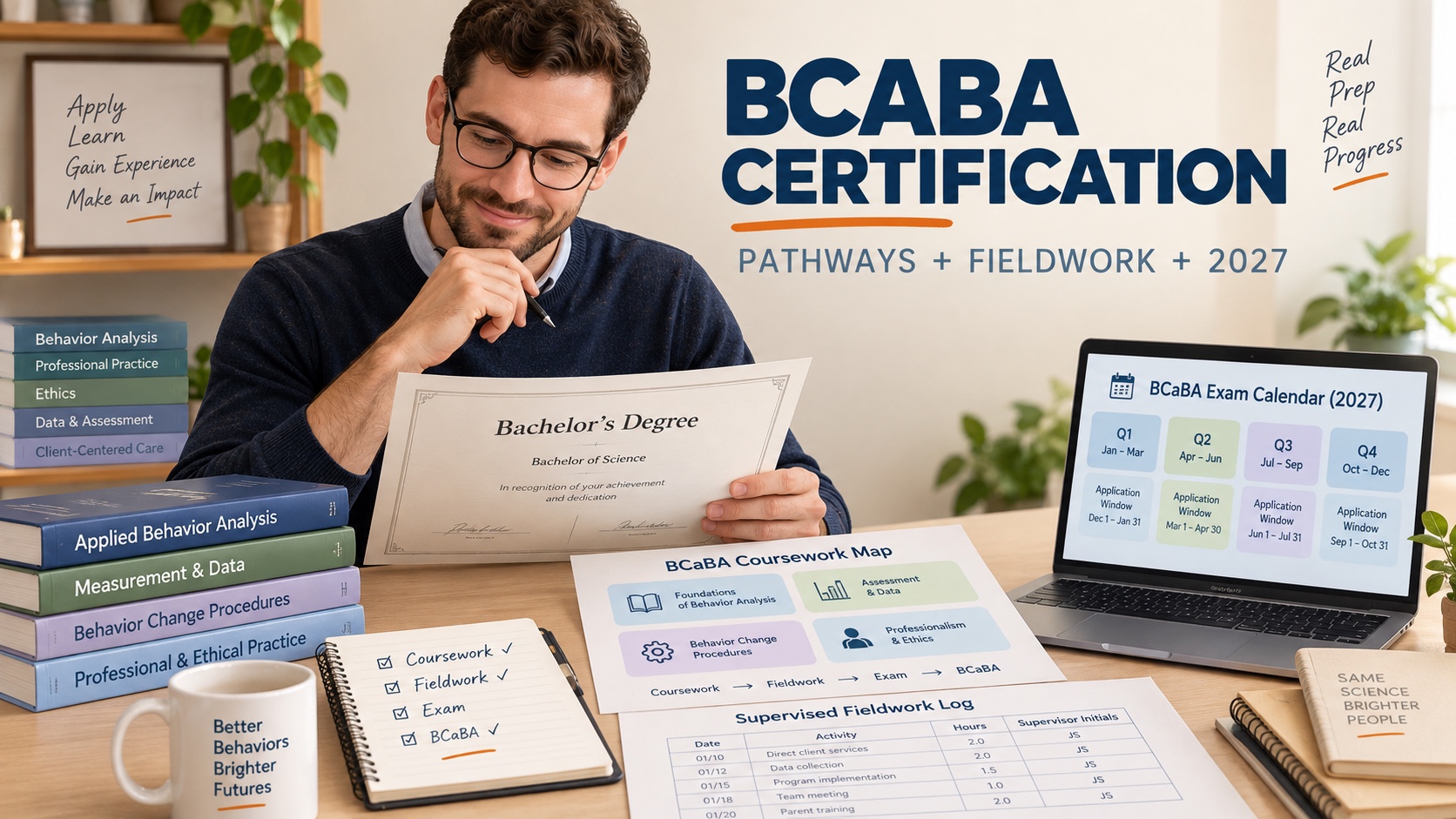
BCaBA Certification: Pathways, Fieldwork, and the 2027 Requirements
If you are searching for board certified assistant behavior analyst BCaBA certification, you may be trying to work out where to begin. Is a bachelor’s degree enough? Do you need a specific major? How many supervised fieldwork hours are required? What happens to the rules in 2027? A clear way to think about the credential is as a connected sequence: choose an eligibility pathway, complete the required education and supervised fieldwork, apply through the BACB process, and pass the BCaBA certification examination.
The BCaBA is an undergraduate-level behavior-analysis certification. According to the BACB, BCaBAs provide behavior-analytic services under the supervision of a BCBA, and BCaBAs may supervise RBT work within the applicable requirements. Certification is not granted simply because someone has taken ABA classes or worked in a clinical setting. The exact degree, coursework, fieldwork, application, examination, ethics, and maintenance requirements must be checked against the current BCaBA Handbook and the rules in effect when you apply.
Table of Contents
What BCaBA certification means
“BCaBA” stands for Board Certified Assistant Behavior Analyst. The word assistant is important: the credential is not the same as BCBA certification, and a BCaBA does not practice independently in the same way a BCBA does. The BACB describes BCaBA practice as occurring under the supervision of a qualified BCBA. The exact workplace scope can also depend on state law, payer rules, employer policies, and the supervisor’s direction.
The certification route has four learning-and-verification pieces:
- Degree: you need the degree required by the pathway you choose.
- Behavior-analytic content: the pathway may require an ABAI-accredited program or qualifying coursework.
- Supervised fieldwork: you apply knowledge in behavior-analytic settings while a qualified supervisor monitors and develops your work.
- Examination: after meeting the applicable eligibility requirements and receiving an approved determination, you take the BCaBA examination.
After certification, there are also ongoing obligations such as ethics compliance, continuing education, supervision, and recertification. Therefore, a useful plan does not stop at “pass the test.” It includes how you will document the pathway before you apply and how you will maintain the credential afterward.
The two eligibility pathways
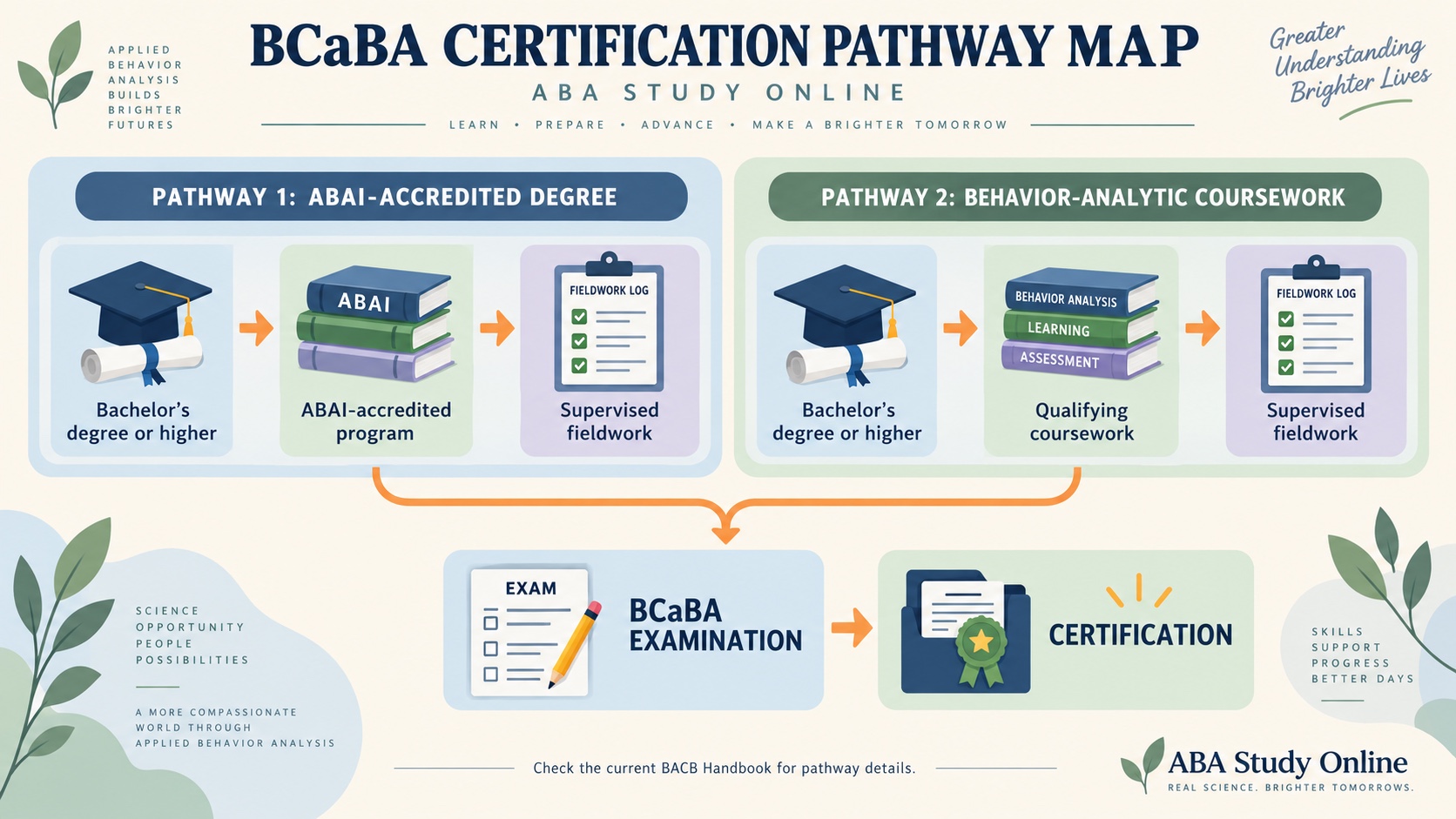
The current BCaBA Handbook presents two main eligibility pathways. Both require a degree, behavior-analytic content, supervised fieldwork, and passing the BCaBA examination. The difference is how the academic preparation is established.
| Pathway | Degree and academic preparation | What to verify |
|---|---|---|
| Pathway 1: ABAI-accredited degree | Bachelor’s degree or higher from an ABAI-accredited behavior-analysis program, with behavior-analytic content and supervised fieldwork. | Confirm that the program was accredited during the period in which the qualifying degree was earned and keep the program documentation. |
| Pathway 2: Behavior-analytic coursework | An acceptable bachelor’s degree or higher from a qualifying institution, plus qualifying undergraduate behavior-analytic coursework and supervised fieldwork. | Confirm the institution, the Pathway 2 Program Contact, the required content areas, instructional hours, grades, and coursework attestation process. |
Pathway 2 is not simply “take a few ABA electives.” The coursework must meet the BACB’s current content and documentation rules. The 2027 summary describes content areas including foundations of behavior analysis, methods of behavior analysis, behavior assessment and intervention, organizational behavior management, and ethics in behavior analysis, with a total of 270 instructional hours. Check the current Handbook and your program contact rather than using a general course list from an old website.
Pathway 1 also deserves careful verification. A school can offer behavior-analysis courses without the degree program being ABAI accredited. Accreditation, degree date, and the program’s status during the relevant period are separate facts. Save official program information and ask the program or BACB when the record is not clear.
Current supervised fieldwork requirements
Under the current handbook, a BCaBA trainee completes either 1,300 hours of supervised fieldwork or 1,000 hours of concentrated supervised fieldwork. The concentrated option has a higher supervision percentage. Both options require a qualified supervisor, a one-calendar-month supervisory period, documentation, client observation, individual supervision, and unrestricted activities.
| Current fieldwork item | Supervised fieldwork | Concentrated supervised fieldwork |
|---|---|---|
| Total hours | 1,300 | 1,000 |
| Hours per supervisory period | 20–130 | 20–130 |
| Supervisor contacts per period | 4 | 6 |
| Client observation | 1 per period | 1 per period |
| Supervision | 5% of hours | 10% of hours |
| Individual supervision | At least 50% of supervised hours must be individual | |
| Unrestricted activities | At least 40% of total supervised fieldwork hours | |
“Unrestricted” does not mean “anything done at work that feels advanced.” The activity should represent behavior-analytic tasks connected to the work of a BCaBA and should be classified with the supervisor. Examples in the Handbook include client observation and data analysis, developing programs, training staff or caregivers on behavior-analytic procedures, and meeting with clients about services. Keep enough detail in the log for the supervisor to evaluate the activity category.
Before supervision begins, the trainee and supervisor must develop and sign a written contract. A strong contract identifies responsibilities, training objectives, appropriate activities, the circumstances under which forms may not be signed, termination procedures, employer permission when applicable, ethics commitments, and record-retention expectations. The contract is not a substitute for monthly supervision. It is the foundation that makes the monthly system understandable.
Every month, record dates, start and end times, fieldwork type, supervisor, activity category, contact type, observation details, and a short summary of feedback. The current Handbook states that the BACB may audit fieldwork. A clean record protects the trainee and gives the supervisor a way to catch a problem before the final application.
What changes in 2027
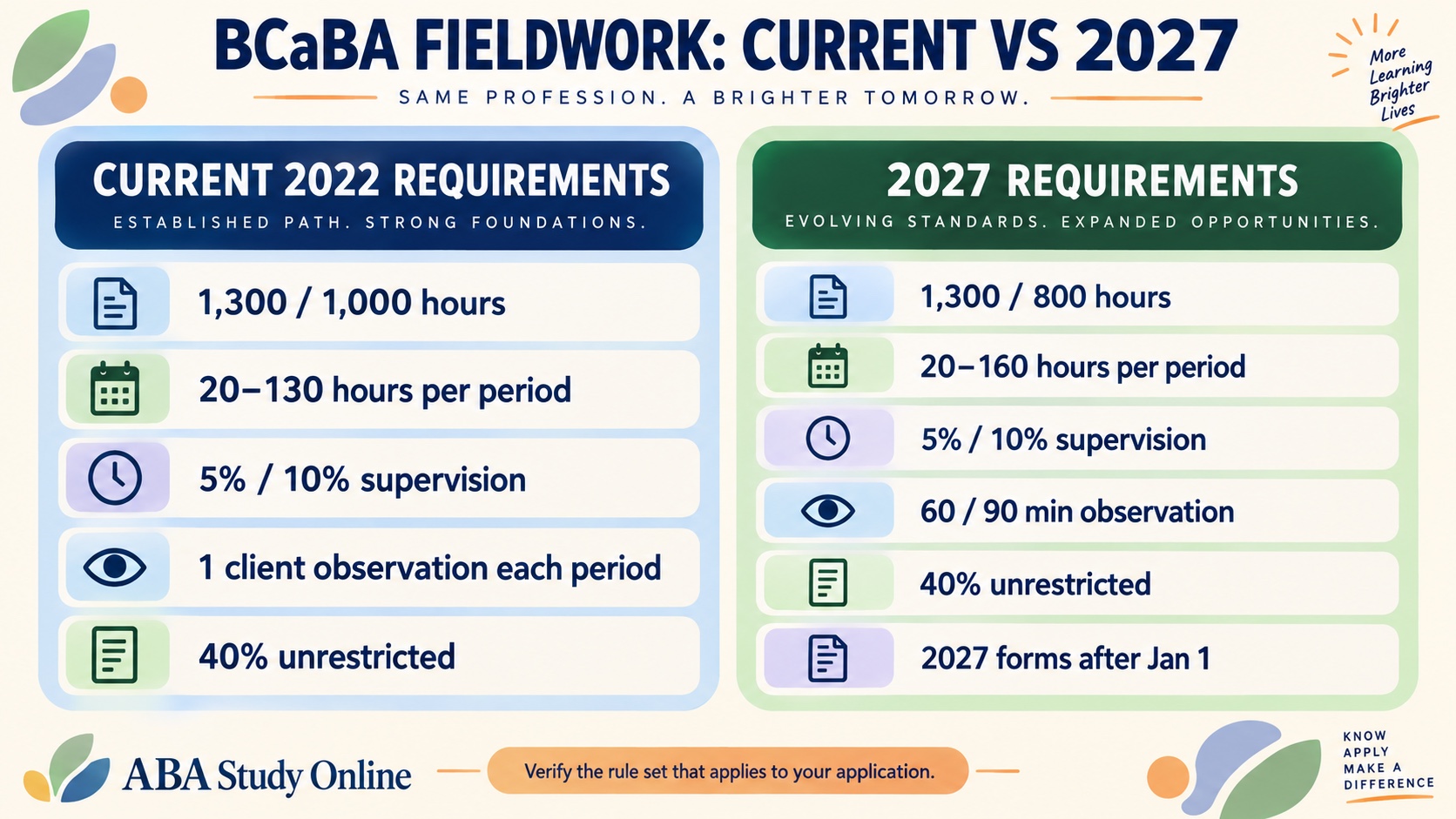
The BACB has published BCaBA changes that take effect on January 1, 2027. The high-level transition summary keeps two pathways and keeps the standard fieldwork total at 1,300 hours, but changes the concentrated option and some period-planning details.
| Planning item | Current 2022 requirements | 2027 requirements |
|---|---|---|
| Standard / concentrated hours | 1,300 / 1,000 | 1,300 / 800 |
| Supervision percentage | 5% / 10% | 5% / 10% |
| Hours per period | 20–130 | 20–160 |
| Client observation | 1 observation each period | 60 / 90 cumulative minutes each period |
| Unrestricted activities | At least 40% | At least 40% |
| Forms | Use the current forms that apply to the application | 2027 monthly and final forms are required for applications after January 1, 2027 |
The table is a planning summary, not a personalized transition decision. The BACB states that a complete application, including payment and required documents, must be received by December 31, 2026 to be reviewed under the current 2022 requirements. That date matters because “I started fieldwork before 2027” is not automatically the same as “my application will be reviewed under the current rules.” If your degree, coursework, forms, or application timing is unusual, verify the pathway directly with BACB.
The examination also needs a date label. The 2027 BCaBA requirements document says applicants must pass the BCaBA Test Content Outline, 6th edition, which took effect January 1, 2025. That does not mean every study page online is current. When you choose study materials, check the edition, the publication date, the content areas, and whether the material is clearly labeled as independent preparation rather than official BACB content.
The BCaBA certification examination
After you meet the applicable eligibility requirements and receive an approved determination, you must take and pass the BCaBA certification examination. BACB’s examination information currently lists a four-hour, computer-based examination with 175 questions administered in person at authorized Pearson VUE testing sites. The official BCaBA Handbook and current Test Content Outline control the details that matter for preparation.
Study planning should follow the content outline, not a random list of popular ABA terms. Break your preparation into concept knowledge, measurement and data interpretation, assessment, behavior-change procedures, intervention development and monitoring, ethical and professional issues, and supervisory relationships. Then practice reading a scenario, identifying the relevant task, ruling out attractive but incorrect answers, and explaining why the selected answer fits the facts.
The official exam report is also easy to misunderstand. Candidates who pass receive notice that they passed. Candidates who do not pass receive performance information by primary content area. A practice score from an independent website is not the same as an official result and should not be described as a prediction or guarantee. Use practice questions to find gaps, then return to the content outline, coursework, supervision feedback, and authoritative references.
How to plan your certification route
Build a dated certification folder before you accumulate a large number of hours. The first page should state the intended pathway, degree evidence, coursework evidence, target application date, current or 2027 rule set, supervisor, fieldwork type, and examination edition. Put the official source link beside each requirement. This makes it easier to detect when a template from another track, such as BCBA or RBT, has accidentally been used.
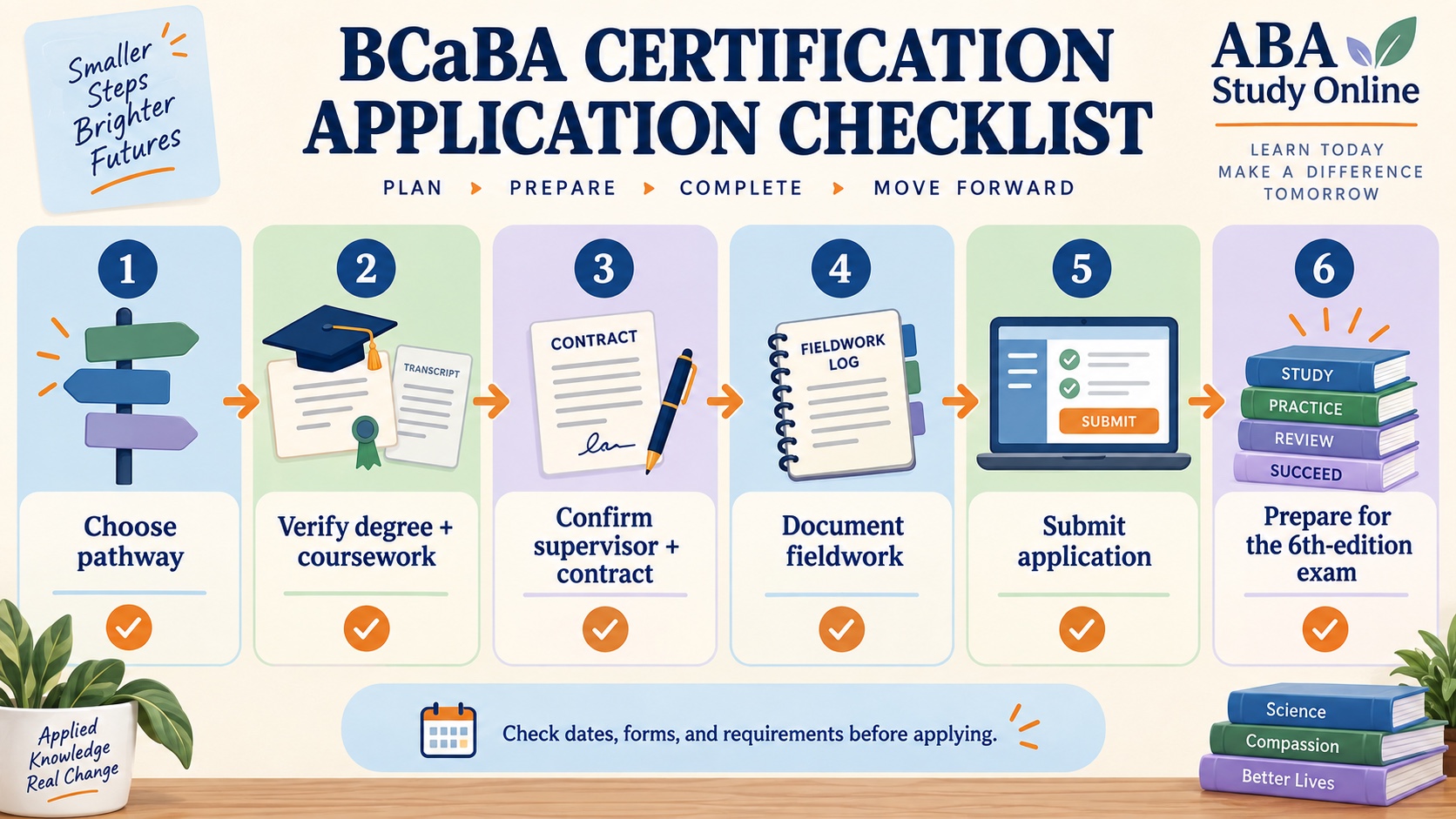
- Choose the pathway: confirm whether your degree program or coursework evidence supports Pathway 1 or Pathway 2.
- Verify academic records: save transcripts, accreditation information, course descriptions, grades, and any required attestation pathway.
- Confirm fieldwork supervision: check the supervisor’s BCBA status, required training, contract, contact plan, observation plan, and record system.
- Review every supervisory period: calculate hours, supervision percentage, individual supervision, unrestricted activity, observation, and signatures before moving to the next period.
- Prepare for the examination: use the current BCaBA Test Content Outline, practice applying concepts, and keep official rules separate from study advice.
- Check the application date: if the 2027 transition affects you, verify the complete-application deadline and the correct monthly and final forms with BACB.
For learning support, the BCaBA learning track can organize the concepts, the BCaBA practice questions can support retrieval and scenario practice, the ABA glossary can clarify terminology, and the ABC data sheet tool can give you a way to practice objective documentation. These are educational resources, not official BACB approval or an eligibility determination.
Common misunderstandings
A bachelor’s degree automatically qualifies you. The degree must fit the selected pathway, and Pathway 2 adds specific coursework and documentation requirements.
Work experience automatically becomes fieldwork. Fieldwork must occur under the applicable supervision and documentation rules. A job title or setting does not decide whether every hour counts.
BCaBA and BCBA requirements are interchangeable. They are different credentials with different degree levels, pathways, hours, examination content, and supervision context. Keep separate trackers and separate study materials.
The 2027 update is a new “7th edition” BCaBA exam. The BACB’s 2027 summary identifies the BCaBA Test Content Outline 6th edition as effective January 1, 2025. Requirements, forms, and eligibility changes should not be relabeled as a new exam edition without an official BACB announcement.
Passing the exam means the credential is permanent. BCaBA certification has maintenance requirements, including continuing education, ongoing supervision, ethics obligations, and a two-year recertification cycle. Treat the credential as an ongoing professional responsibility.
FAQ and official sources
Is BCaBA certification the same as being an assistant to a BCBA?
No. BCaBA is a BACB certification with defined eligibility and maintenance requirements. The role must still be practiced under BCBA supervision, but the credential is not simply an informal workplace title.
How many hours are required for BCaBA fieldwork?
Under the current 2022 requirements, the high-level options are 1,300 supervised hours or 1,000 concentrated supervised hours. Under the 2027 summary, the options are 1,300 or 800 hours. Other requirements also apply, so do not plan from the total alone.
Can I use BCBA practice questions for the BCaBA exam?
Some foundational concepts overlap, but the certification tracks are not interchangeable. Use the current BCaBA Test Content Outline and BCaBA-specific practice material as the primary study map.
Where should I verify the current rules?
Start with the BCaBA Handbook, the BACB’s 2027 BCaBA Requirements, the Examination Information page, and the Recent and Upcoming Changes page. Those sources should be rechecked before an application or publication update.
BCaBA certification becomes easier to plan when you keep the pathway, fieldwork, application, and examination connected. Choose the correct academic route, verify every fieldwork period, label current and 2027 rules by date, and use the current BCaBA examination outline for study decisions. That process gives you a clearer record without turning a general article into a personal eligibility ruling.