
BCaBA, BCBA, or BCBA-D? How the Credentials Differ
If you are searching for BCaBA, BCBA, or BCBA-D, the short answer is that these labels do not describe three interchangeable versions of the same credential. A BCaBA is an undergraduate-level certification. A BCBA is a graduate-level certification. A BCBA-D is a doctoral designation that can be added to an active BCBA; it is not a separate certification with a separate scope of practice.
The right comparison depends on the role you want, the level of education you plan to complete, and the supervision structure in which you expect to work. This guide gives you a clean decision map. It does not decide personal eligibility, state licensure, payer enrollment, or admission to a university program. When a requirement affects your application, use the current BACB handbook for the credential you are pursuing.
Table of Contents
The quick comparison
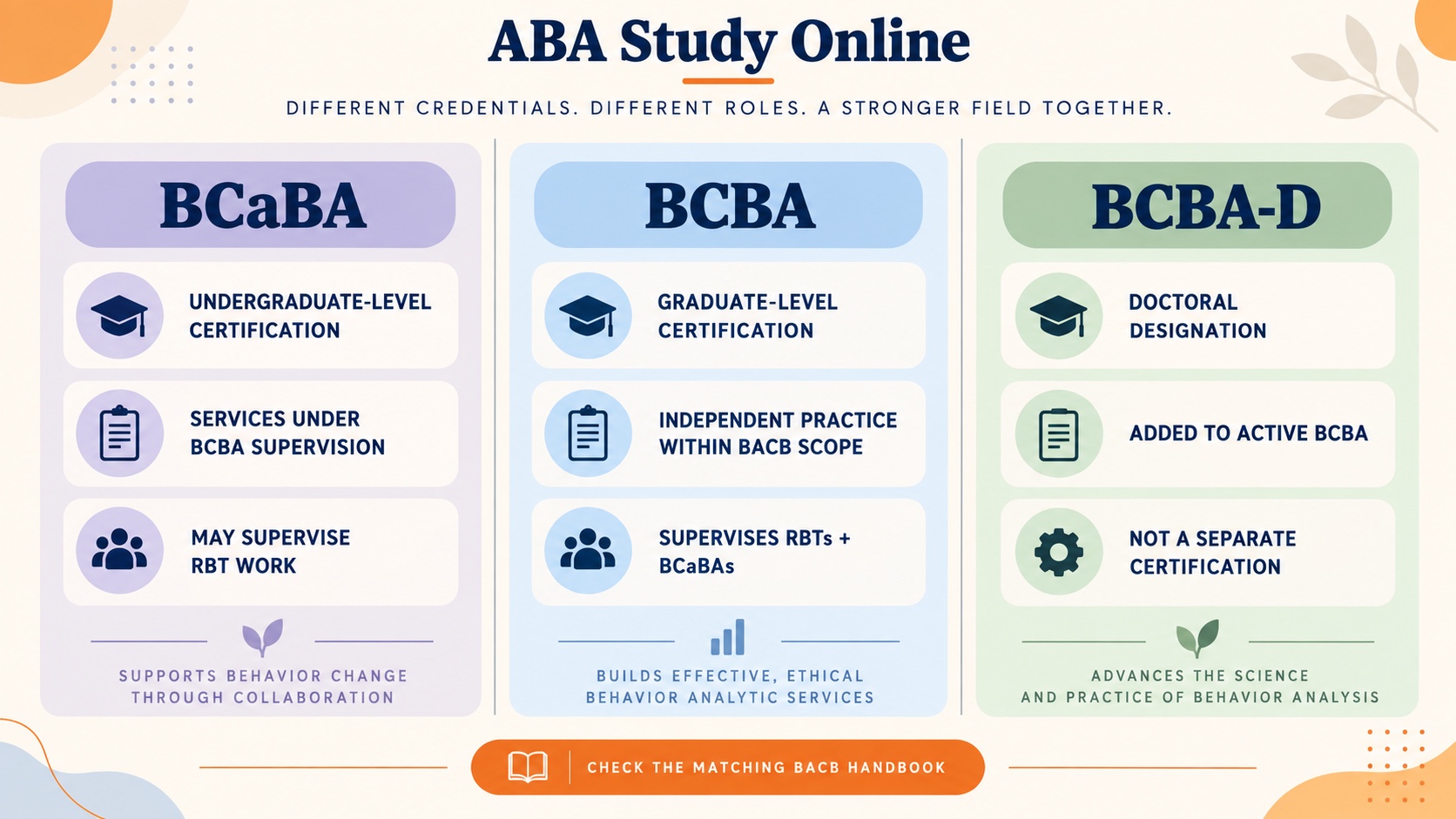
Use the table as an orientation tool, not as a replacement for a handbook. The word “assistant” in BCaBA describes a certification level and supervision relationship; it does not mean that a BCaBA is an untrained helper. The word “doctoral” in BCBA-D describes a designation; it does not create a fourth BACB certification.
| Credential | Education level | Practice boundary | What it is |
|---|---|---|---|
| BCaBA | Undergraduate-level | Provides behavior-analytic services under BCBA supervision; may supervise RBT work within the applicable rules. | A BACB certification. |
| BCBA | Graduate-level | Can provide behavior-analytic services independently under the BACB credential framework and supervise RBTs, BCaBAs, and other implementers. | A BACB certification. |
| BCBA-D | Doctoral or postdoctoral behavior-analytic training in an eligible route | Functions in the same capacity as a BCBA and remains subject to BCBA maintenance requirements. | A doctoral designation added to an active BCBA, not a separate certification. |
What BCaBA means
BCaBA stands for Board Certified Assistant Behavior Analyst. The BACB describes it as an undergraduate-level certification in behavior analysis. A BCaBA may provide behavior-analytic services, but the current BCaBA Handbook states that those services must be provided under the supervision of a BCBA. That supervision boundary is the central practical difference between BCaBA and BCBA.
BCaBAs may also supervise the work of RBT certificants when the applicable requirements are met. That does not make a BCaBA a BCBA, and it does not authorize independent BCBA-level practice. A job title, a bachelor’s degree, or experience in an ABA setting does not by itself establish BCaBA certification.
If you are planning the BCaBA route, keep four questions separate:
- Which current education or coursework pathway applies to you?
- How will your supervised fieldwork be completed and documented?
- Which BCaBA application and examination rules are in effect when you apply?
- What will ongoing supervision and maintenance look like after certification?
The BCaBA certification guide and becoming-a-BCaBA roadmap go deeper into those steps. This comparison page should help you decide whether those are the resources you need next.
What BCBA means
BCBA stands for Board Certified Behavior Analyst. The BACB describes it as a graduate-level certification. On the BACB’s current BCBA page, BCBAs are described as independent practitioners who can provide behavior-analytic services and supervise the work of RBTs, BCaBAs, and other professionals who implement behavior-analytic interventions.
“Independent” does not mean that a BCBA can ignore ethics, competence, documentation, state law, payer rules, or the needs of a client and family. It means that BCBA certification is the higher-level BACB certification in this comparison and is not defined by ongoing BCBA supervision in the way BCaBA practice is. Local licensure and employment rules may add requirements beyond BACB certification.
You do not have to earn a BCaBA first in order to pursue BCBA certification. Some people choose BCaBA as an earlier professional credential or as part of their experience, but the BCBA application has its own education, behavior-analytic coursework or program-content, fieldwork, application, examination, and maintenance requirements. A BCaBA certificate cannot be used as a substitute for a BCBA eligibility route.
For a detailed preparation route, use the BCBA learning path and then verify the current BCBA Handbook. For exam content, use the TCO that matches the credential and the examination date. Do not combine BCaBA and BCBA study material simply because many terms appear in both outlines.
What BCBA-D means
BCBA-D stands for Board Certified Behavior Analyst–Doctoral. The BACB’s current BCBA page is explicit: BCBA-D is not a separate certification and does not grant privileges beyond BCBA certification. A person with the designation functions in the same capacity as a BCBA and must meet the BCBA maintenance requirements.
That means a doctoral degree alone does not make someone a BCBA-D. The person must already hold active BCBA certification and must satisfy one of the current BCBA-D eligibility options with the required evidence. Depending on the route, the record may involve an eligible doctoral program, dissertation evidence, doctoral coursework or mentorship, publications, or qualifying postdoctoral experience. The exact options and documents are time-sensitive.
Think of the labels this way:
- Degree: an academic award issued by an educational institution.
- Certification: a credential with its own eligibility, examination, ethics, and maintenance system.
- Designation: an additional notation attached to an existing certification when the designation requirements are met.
The existing BCBA-D meaning and requirements guide covers the detailed designation application. Here, the key answer is simply that BCBA-D is not a separate exam or a higher practice license.
How to choose the right path
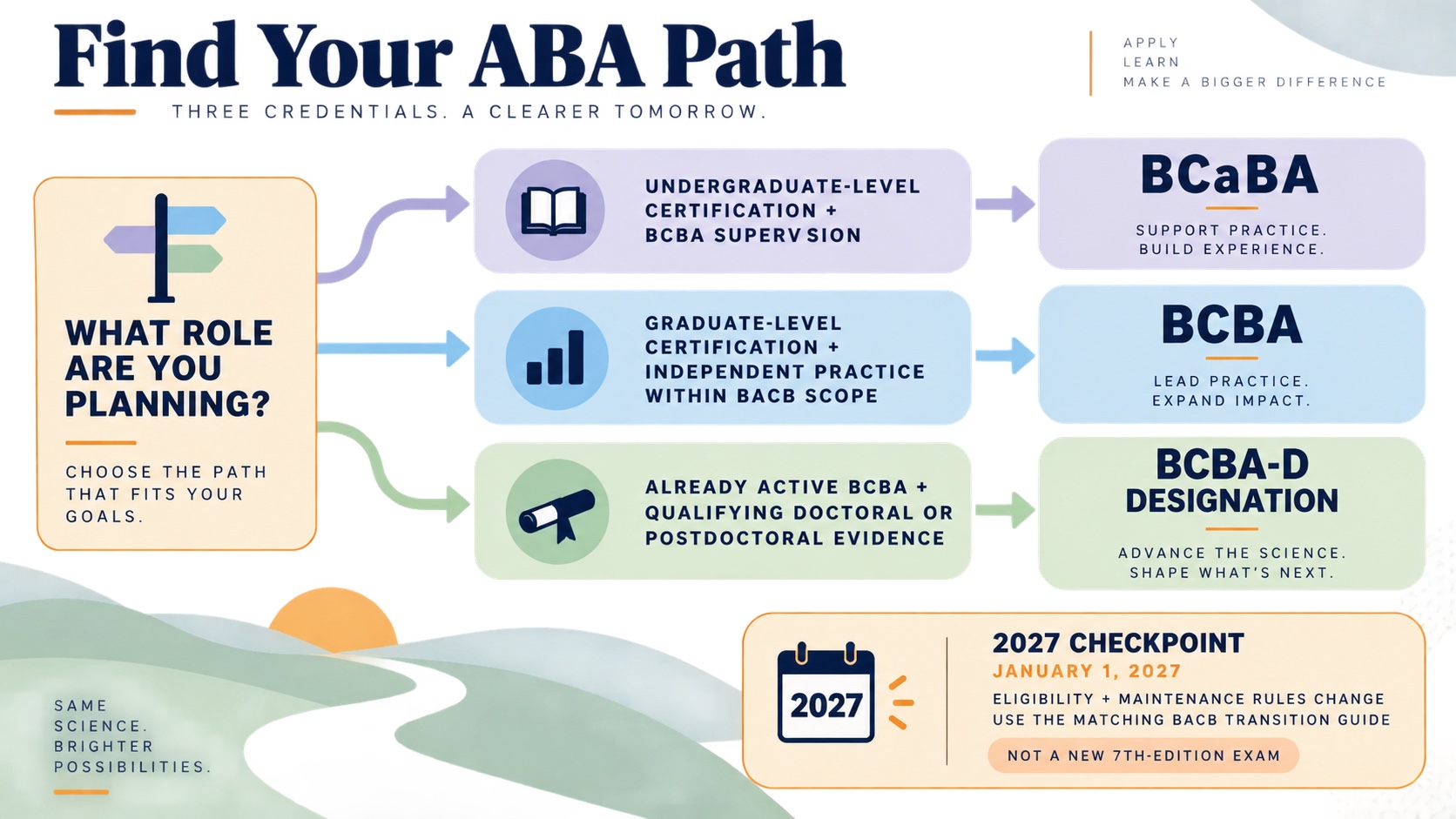
Start with the work relationship you expect, not with the letters that sound most advanced. If you want an undergraduate-level certification and understand that services will be provided under BCBA supervision, BCaBA may be the relevant comparison. If your plan requires graduate-level BCBA certification and the associated independent-practice role, research the BCBA pathway. If you are already an active BCBA and are evaluating doctoral or postdoctoral evidence, then BCBA-D is a designation question—not a new entry-level route.
Use this decision sequence:
- Name the target role. Are you planning supervised assistant-level practice, graduate-level analyst practice, or a doctoral designation after BCBA certification?
- Check the education level. A bachelor’s-level plan and a graduate-level plan lead to different handbooks and evidence requirements.
- Map the supervision relationship. BCaBA services require BCBA supervision. BCBA-D does not remove or expand the BCBA scope.
- Open the matching handbook. Use the official BCaBA Handbook, BCBA Handbook, or BCBA-D section instead of a generic checklist.
- Separate certification from local practice rules. A BACB credential does not automatically answer every state, employer, payer, or licensure question.
How the exams differ
BCaBA and BCBA are separate certifications, so they have separate certification examinations. The BACB’s current Examination Information page lists both examinations as four hours long. It lists 175 questions for the BCaBA examination and 185 questions for the BCBA examination. The same page says that examinations are computer-based and delivered in person at authorized Pearson VUE testing sites.
Those numbers are useful for orientation, but they are not a reason to treat one exam as a shortened version of the other. The credential, handbook, test content outline, eligibility route, and scope of practice remain distinct. BCBA-D does not have a separate BCBA-D examination because it is a designation attached to BCBA certification.
For preparation, label every practice set by track. A BCaBA learner should use the current BCaBA TCO and handbook. A BCBA learner should use the current BCBA TCO and handbook. General ABA concept notes can support both tracks, but a mixed quiz should not be presented as an official BACB exam or as a substitute for track-specific preparation.
What changes in 2027
The BACB has announced significant BCaBA and BCBA eligibility and maintenance changes taking effect on January 1, 2027. That date matters when your application, fieldwork records, education, or maintenance cycle crosses the transition. The BACB’s transition notice says that a complete application, including payment and required documents, must be received by December 31, 2026 to be reviewed under the current 2022 requirements.
Do not turn that update into the wrong keyword answer. The 2027 changes are not a “7th edition” BCBA or BCaBA exam by themselves. They concern requirements such as education, coursework, supervised fieldwork, continuing education, supervision, and application planning. The current BACB content-outline index should still be used for the examination content that applies to your credential and exam date.
BCaBA and BCBA also have different 2027 documents. Use the BCaBA transition materials for a BCaBA application and the BCBA materials for a BCBA application. If you are asking about BCBA-D, do not copy a BCaBA or BCBA transition table into the designation decision; read the BCBA-D section of the current BCBA Handbook as well.
Common comparison mistakes
- Calling BCBA-D a fourth certification: the BACB calls it a doctoral designation added to BCBA.
- Assuming BCaBA means unsupervised practice: BCaBA services are provided under BCBA supervision.
- Assuming BCaBA is required before BCBA: the BCBA route has its own eligibility requirements.
- Using a degree as proof of certification: a degree may be part of an eligibility route, but it is not the certification itself.
- Calling 2027 a new exam edition: first separate certification-rule changes from examination content-outline changes.
- Ignoring local requirements: BACB certification does not automatically resolve state licensure, payer, employer, or scope questions.
FAQ and official sources
Is BCaBA higher than BCBA?
No. BCaBA is an undergraduate-level certification, while BCBA is a graduate-level certification. The roles have different education, supervision, and practice boundaries.
Is BCBA-D higher than BCBA?
BCBA-D communicates qualifying doctoral or postdoctoral training, but the BACB states that it is a designation, not a separate certification, and it does not grant privileges beyond BCBA certification.
Can a BCaBA become a BCBA?
Some BCaBAs later pursue BCBA certification, but the BCBA application must meet the BCBA requirements in effect at that time. BCaBA certification alone does not replace the BCBA degree, coursework, fieldwork, application, examination, or maintenance requirements.
Which credential should I study for?
Study for the credential you are actually pursuing. Use the BCaBA study path for BCaBA preparation, the BCBA study path for BCBA preparation, and the ABA Definition Search when you need to clarify shared terminology. Free practice can support learning, but it does not determine eligibility or grant a BACB credential.
Verify the current rules in the BACB BCaBA Handbook, the BACB BCBA page, the BACB Examination Information page, and the official 2027 transition notice. The best next step is the one that matches your credential, your education level, and the supervision relationship you will actually use.