BAS Study for the BCBA Exam: How to Use Third-Party Prep Materials Wisely
If you searched for “BAS study ABA”, you are probably looking for Behavior Analyst Supervisor study materials used by people preparing for the BCBA exam. In this context, BAS is not a new BACB certification, a separate official examination, or a replacement for the Board’s own documents. It is a third-party preparation resource that may combine a study guide, practice questions, mock exams, explanations, review sessions, and a structured study schedule.
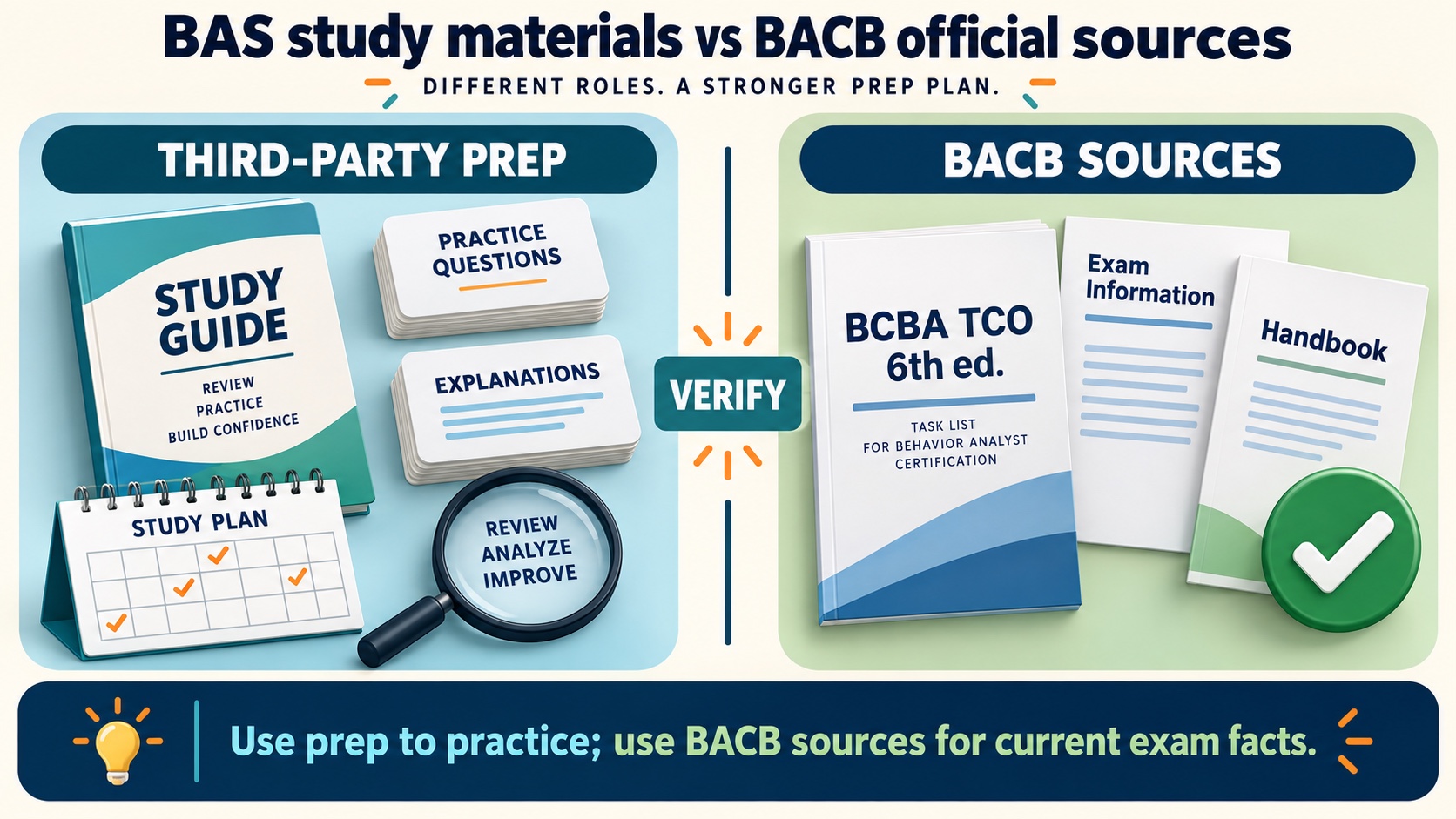
That distinction matters because a prep provider and the BACB answer different questions. A provider can help you practice recognizing concepts and analyzing scenarios. The BACB controls the current examination information, the test content outline, candidate requirements, and official terminology. The safest study plan uses both roles deliberately: use third-party practice to find and work on gaps, then use current BACB sources to verify what the exam covers and what the rules actually say.
Quick answer: BAS usually refers to Behavior Analyst Supervisor, a third-party BCBA preparation provider. Its study materials can be useful for practice, question dissection, and feedback. They should not be described as BACB-issued materials, official exam questions, or proof that you are ready to pass. Begin by identifying the current BCBA Test Content Outline, then use practice results to choose the concepts you need to revisit.
What BAS-style preparation may include
The current Behavior Analyst Supervisor BCBA Exam Prep page describes several types of preparation for the 6th-edition exam context. The page lists full-length mock exams, mini-mocks organized by Test Content Outline domains, explanations for answer options, a printable study guide, review events, and other learning resources. Offerings and access periods can change, so readers should check the provider’s live page for current details rather than relying on an old review or screenshot.
These features serve different learning jobs:
- A study guide gives you a sequence for reviewing definitions, principles, examples, and distinctions. It is most useful when you actively create your own examples rather than only rereading pages.
- Domain mini-mocks can show whether a weak score is concentrated in measurement, assessment, intervention, ethics, or another area. A domain score is a study signal, not an official prediction.
- Full mock exams let you practice pacing, attention, question interpretation, and switching between content domains. They are valuable after you have enough content knowledge to learn from the mistakes.
- Answer explanations are strongest when they explain why the best answer fits the facts and why the alternatives do not. Do not memorize an explanation without checking the underlying concept.
- Review sessions or question breakdowns may model how to identify the controlling detail in a scenario. That skill is different from memorizing a list of terms.
A good resource is therefore not judged only by how difficult it feels. It should help you connect a question to a concept, identify the evidence in the scenario, explain the decision, and transfer the reasoning to a new example. A very difficult question can still be a poor teaching question if its wording is unclear or its rationale is unsupported.
BAS materials versus official BACB information
The BACB’s official pages should be your anchor whenever the question involves the actual certification examination. The current BCBA Test Content Outline (6th ed.) describes the content that appears on the BCBA examination beginning in 2025. It organizes 104 tasks into nine domains, including behaviorism and philosophical foundations, concepts and principles, measurement, experimental design, ethics, assessment, behavior-change procedures, intervention selection, and personnel supervision and management.
The BACB Examination Information page is the current source for the testing format and basic examination details. It states that BACB examinations use multiple-choice questions with four possible answers and one correct answer. It also lists the BCBA examination as four hours and 185 total questions, delivered in person through Pearson VUE. If a third-party page gives different dates, lengths, question counts, or eligibility statements, compare it with the current BACB page before you update your notes.
This does not make third-party study materials unhelpful. It simply gives them the right job. A BAS study guide can organize learning and a BAS mock can create retrieval practice. Neither can change the BACB requirements, guarantee a passing result, or authorize the use of copyrighted examination content. Be especially cautious with pages promising actual leaked questions, a guaranteed pass, or a score that supposedly converts directly to the BACB result.
Why the 185-question numbers need context
You may see two numbers while comparing study resources: the BACB examination information page lists 185 BCBA questions, while the 6th-edition TCO says the exam includes 175 scored questions and 10 unscored pilot questions. Those statements describe different parts of the same testing picture. The total number of questions is not the same as the number used for scoring.
A practice provider may also use an 185-question mock format to help you rehearse a full sitting. That does not mean the mock is an official BACB form, that its questions are drawn from the real exam, or that its percentage is a BACB passing score. Keep three records separate:
- Practice format: how many questions the third-party quiz presents and how it delivers feedback.
- Official exam facts: the current total, time, delivery, and content information published by the BACB.
- Your learning evidence: which concepts you can explain, apply, and transfer after review.
A practical BAS study loop
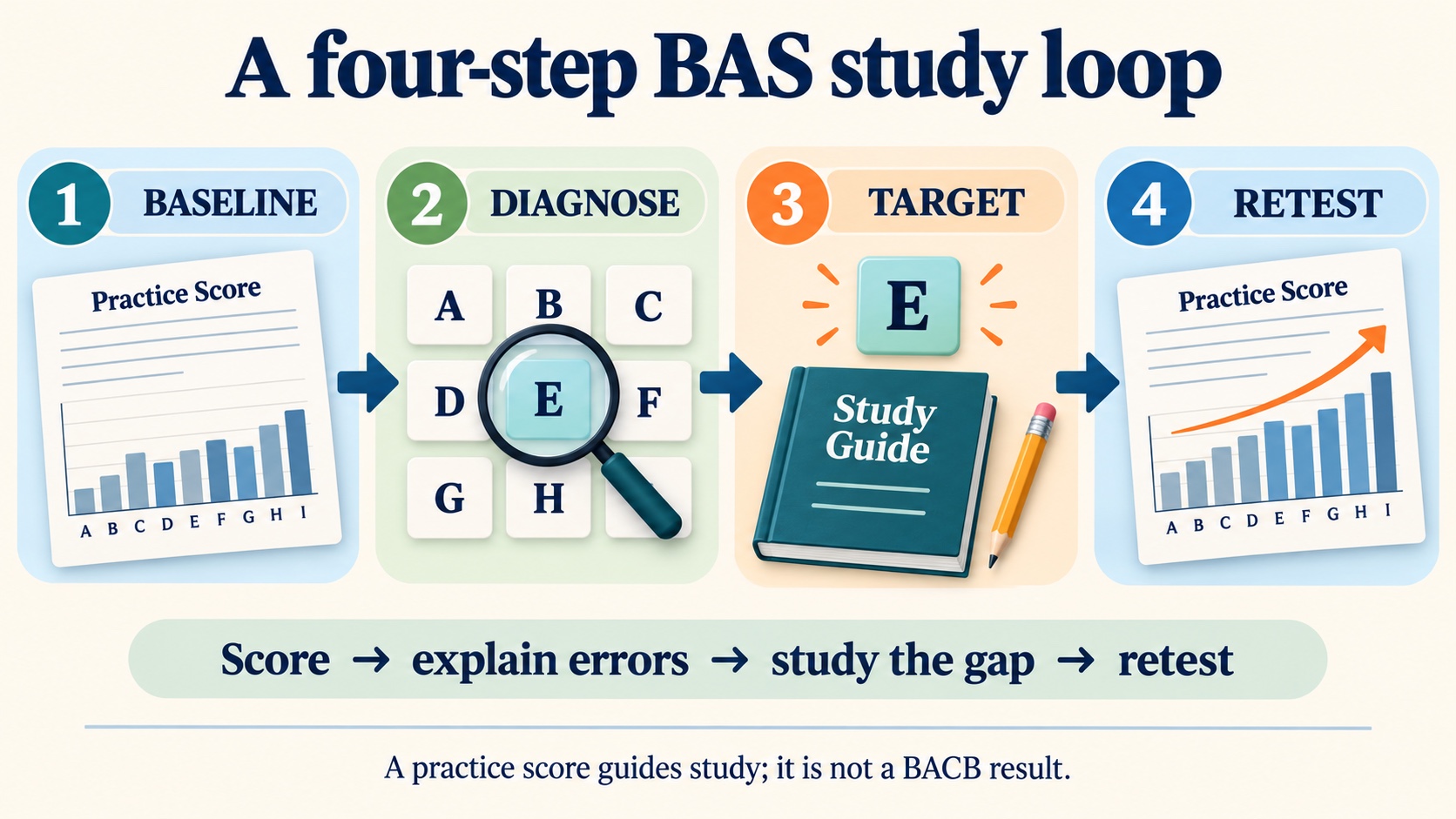
Use a mock exam as a diagnostic rather than a verdict. The following loop works whether you use BAS or another reputable study system:
- Take a baseline under realistic conditions. Use a timed or untimed mode intentionally, record the mode, and note whether you changed answers or used outside notes. The purpose of a baseline is to describe your starting point, not to produce a perfect score.
- Sort errors by reason. A missed question may reflect a definition gap, a measurement error, a failure to notice a qualifier, confusion between two procedures, or a rushed reading mistake. Mark the reason instead of labeling every miss “I do not know ABA.”
- Map the gap to the TCO. Identify the domain and task family involved. Read the current TCO wording and a trusted textbook or course explanation. If the question concerns ethics, law, eligibility, or testing rules, also check the current BACB source.
- Practice a transfer example. Write or solve a new scenario using the same principle with different facts. Explain why the best answer fits and why the close alternatives do not. This step turns recognition into usable reasoning.
- Retest after targeted study. Return to a new set of questions later, not immediately after memorizing the answer. Compare the explanation quality and error pattern, not only the percentage.
How to learn from missed questions
Imagine that a practice item asks you to choose a measurement procedure for a behavior that varies in duration and frequency. You select a count because the behavior is easy to see, but the explanation says the decision should account for the critical dimension. Your review should not stop at “duration was correct.” Ask what the question was measuring, what information the procedure preserves or loses, and what environmental limits affect the choice. Then create a new example in which rate, latency, duration, or an interval procedure would be more defensible.
Now imagine an ethics scenario in which two answers both sound respectful. The decisive detail may be confidentiality, competence, a multiple relationship, cultural responsiveness, or a legal requirement. First identify the principle and the facts. Then open the current BACB ethics source or handbook section. If the answer depends on a state licensing rule or employer policy, record that boundary instead of presenting a universal ABA rule.
Finally, consider a question you answered correctly for the wrong reason. These are important review items. Confidence based on a lucky guess can hide a future error. For every uncertain answer, write one sentence that states the rule, one sentence that applies it to the facts, and one sentence that distinguishes the closest distractor. Your goal is not to imitate a protected question; it is to build flexible professional reasoning.
Common mistakes to avoid
- Treating BAS as an official BACB source: use the provider for preparation, and the BACB for current certification facts.
- Equating difficulty with accuracy: hard questions are not automatically realistic or educational.
- Chasing a magic percentage: a third-party score is not a BACB passing score or eligibility determination.
- Studying only the weakest number: review the reason for the error and whether you can transfer the concept to new facts.
- Using old edition language: verify that your resources match the current BCBA 6th-edition TCO and current BACB examination information.
- Buying based on a guarantee alone: compare explanations, source transparency, update practices, accessibility, timing, and fit with your study habits.
- Copying or sharing purported real exam content: use original practice questions and respect examination security and copyright boundaries.
For a broader study path, continue to the BCBA learning path or use the BCBA practice-question hub. Those resources can help you organize concept review without replacing the current BACB documents.
FAQ
What does BAS stand for in ABA exam prep?
In this search context, BAS commonly refers to Behavior Analyst Supervisor, a third-party provider of BCBA preparation resources. The acronym can mean other things in other fields, so confirm the page and product before drawing conclusions.
Is the BAS study guide an official BACB guide?
No. A BAS guide is third-party preparation material. It may be organized around the current BCBA TCO, but it is not issued by the BACB and does not replace the official TCO, handbook, examination information, or ethics resources.
Does a BAS mock score predict my BCBA result?
No practice score can guarantee or directly calculate a BACB result. Use the score to locate gaps, analyze the reasons behind errors, and check whether you can explain and transfer the relevant concepts.
Should I use BAS before reading the BCBA TCO?
Read the current TCO early enough to understand the domains and task language. Then use a study guide or mock to add structure and practice. Return to the TCO whenever a resource uses different terminology or seems to make a claim about exam coverage.
Can I use third-party practice questions for RBT or BCaBA preparation?
You can use appropriate practice resources for those tracks, but do not assume that a BCBA-oriented BAS resource covers the RBT or BCaBA exam. Match the resource to the correct current BACB outline and handbook.