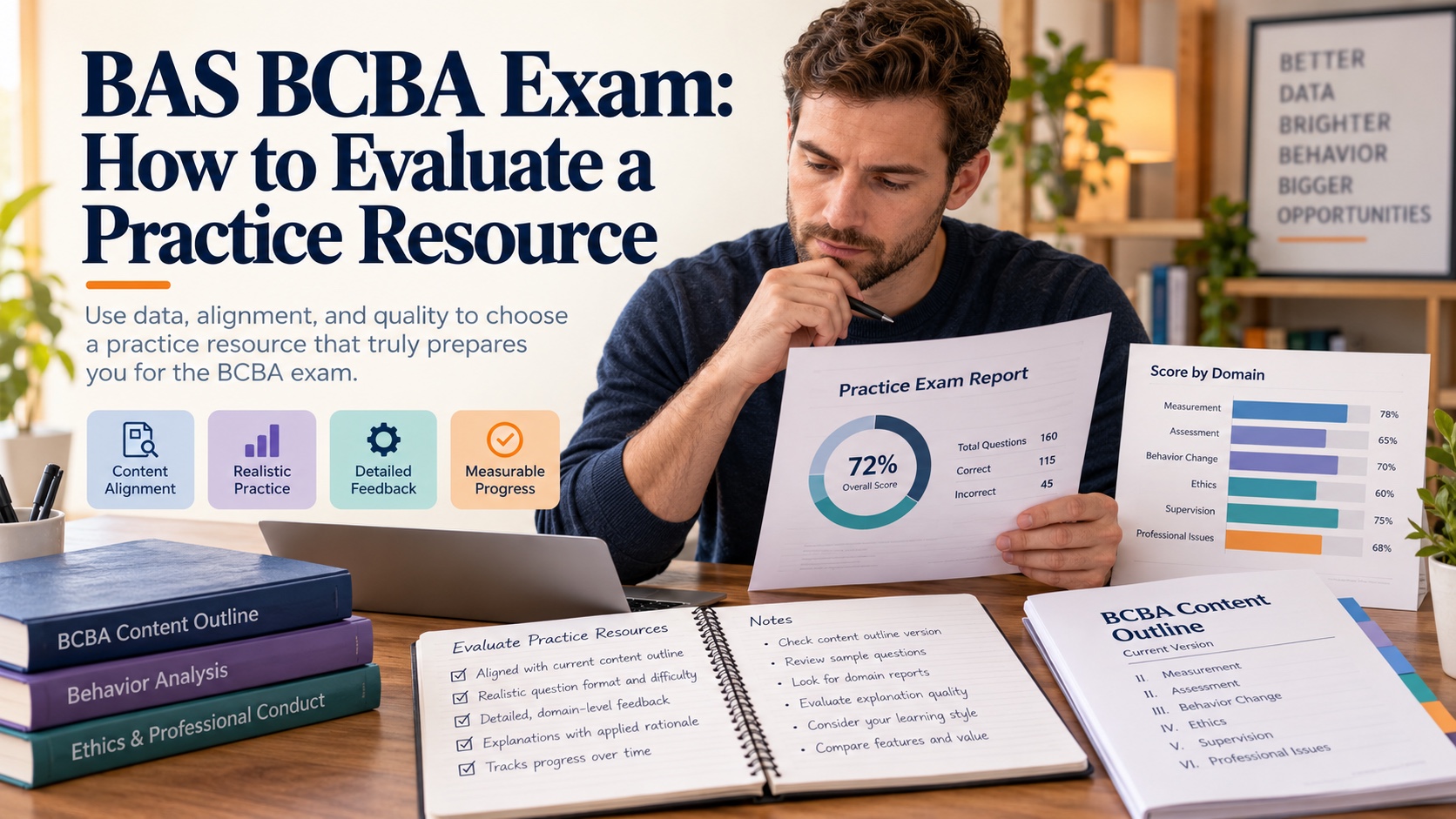
BAS BCBA Exam: How to Evaluate a Practice Resource
When someone searches for the BAS BCBA exam, “BAS” commonly refers to a commercial BCBA practice-resource context such as Behavior Analyst Study/ABA Exam Review. The useful question is not whether a practice score looks impressive. It is whether the resource helps you learn the current content, apply concepts to scenarios, understand mistakes, and choose your next study action.
The official boundary stays with the BACB. The BCBA examination, current content outline, handbook, application rules, and examination policies come from BACB sources. A commercial mock exam is independent practice. It is not an official BACB score, a secure exam form, an endorsement, or a guarantee that you will pass.
What a BAS BCBA practice resource is
A practice resource may include mock exams, practice questions, videos, study guides, or explanations. Its role is to create opportunities for retrieval and applied reasoning. It should help you notice whether you can identify the relevant facts in a scenario, distinguish close procedures, interpret data, and justify a decision.
Do not assume that a branded practice product has access to official secure questions. A responsible resource should describe itself as preparation support and should explain its source alignment without claiming that it reproduces confidential exam content. The current BACB Handbook also warns learners that the BACB does not endorse specific study guides and that buying materials does not guarantee passing.
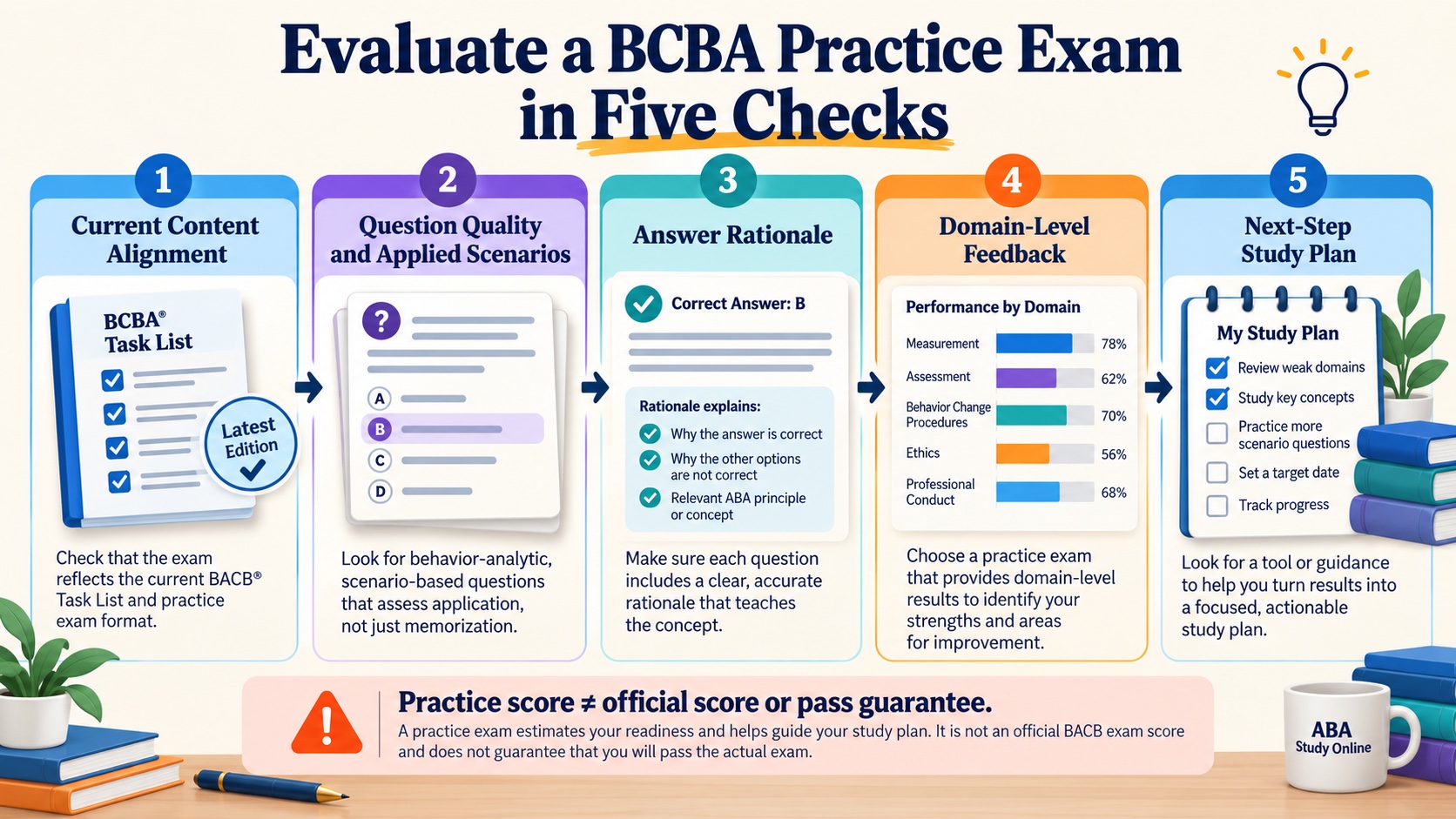
Five checks before relying on it
- Current content alignment. Compare the resource with the current BCBA test-content materials. Look for the domains and task emphasis that apply to your exam timeline. A large question count does not compensate for missing or outdated scope.
- Applied question quality. A useful question gives enough context to make a behavior-analytic decision. It should test more than recognition of a familiar word. Look for scenarios involving measurement, assessment, behavior-change procedures, ethics, supervision, and professional judgment where appropriate.
- Rationale quality. The answer explanation should say why the best option fits and why the distractors do not. It should identify the decisive fact rather than repeat the answer letter.
- Domain-level feedback. A single overall percentage hides the location of a weakness. Domain or topic feedback can help you decide whether to review a concept, practice data interpretation, or work on discrimination between similar procedures.
- Next-step usefulness. A score should lead to a plan. The resource is more useful when it helps you save errors, review explanations, and return to weak areas after a delay.
How to use the score
After a practice attempt, separate four groups: correct and explained, correct but guessed, incorrect because of a concept gap, and incorrect because of reading or pacing. The last three groups deserve review, even if the overall percentage looks comfortable. A guessed answer can become a reliable skill only when you can explain the controlling facts and rule.
Use the domain report as a map, not a verdict. A lower domain percentage may reflect unfamiliar wording, a small sample, or a topic that genuinely needs work. Review the missed item, locate the relevant source concept, write a short correction, and answer a new scenario later. Do not repeatedly retake the same form until the score rises through memory alone.
It is also worth checking the resource’s practical conditions. Can you pause and review an explanation? Does it let you save a question without treating the saved item as a prediction? Are the examples varied enough to test transfer, or do they repeat the same wording pattern? Does the report separate knowledge from pacing? These details matter because the best practice tool is the one that changes what you do next.
If you are comparing BAS with another provider, use the same questions for both. Compare source dates, content mapping, applied scenarios, explanation quality, feedback, accessibility, and cost. Do not compare only the advertised question count or a testimonial. A smaller resource with transparent limits may be more useful than a larger resource that gives no way to understand an error.
Remember that a difficult form is not automatically a better form. Difficulty can come from unclear wording, irrelevant details, or a distractor that depends on an unstated assumption. Practice should stretch your reasoning while still teaching a defensible decision. When an item feels unfair or ambiguous, record the concern, compare it with the source concept, and decide whether the problem belongs in your study plan or in the resource’s quality review.
This habit keeps a branded practice page in its proper place: a tool for learning, not a substitute for the credentialing authority. It also gives you a record of why you chose the next study step and when you plan to revisit it with a different example and a fresh explanation each week.
What no practice exam can tell you
A practice exam cannot authorize your BCBA application, schedule the official examination, or tell you that you will pass. It cannot reveal the secure questions used on the BACB examination. It also cannot replace supervision, graduate coursework, fieldwork, or professional competence requirements.
Be cautious with claims such as “identical to the real exam,” “guaranteed pass,” or “official questions” unless the claim is supported by a current authoritative source and permitted use. Similar vocabulary and a timed format may make a practice session useful, but they do not prove equivalence to a high-stakes examination.
A better review loop
- Check that the form’s scope matches the current BACB source.
- Complete the practice under a defined time and distraction plan.
- Record the answer, confidence, rationale, and error type.
- Review the concept and explain why each distractor failed.
- Schedule a delayed retry using a new question or varied scenario.
- Update the study plan by domain rather than chasing the overall score.
For another independent review route, use the ABA Study Online BCBA learning path for concepts, BCBA practice questions for retrieval, and the mock-exam area for a clearly labeled practice simulation. Keep the official BACB materials beside every study resource.
FAQ
Is BAS the official BCBA exam?
No. In this query, BAS refers to a commercial practice-resource context. The official BCBA certification examination is administered through the BACB’s credentialing process and its authorized testing arrangements.
Can a BAS score predict whether I will pass?
No practice score can guarantee or precisely predict an official result. Use it to identify content and reasoning gaps, then repair those gaps with current-source study.
Should I use one mock-exam provider only?
Not necessarily. One resource may be useful for explanations while another provides different scenario variation. The important checks are current alignment, question quality, rationale, feedback, and whether the resource improves your next study decision.