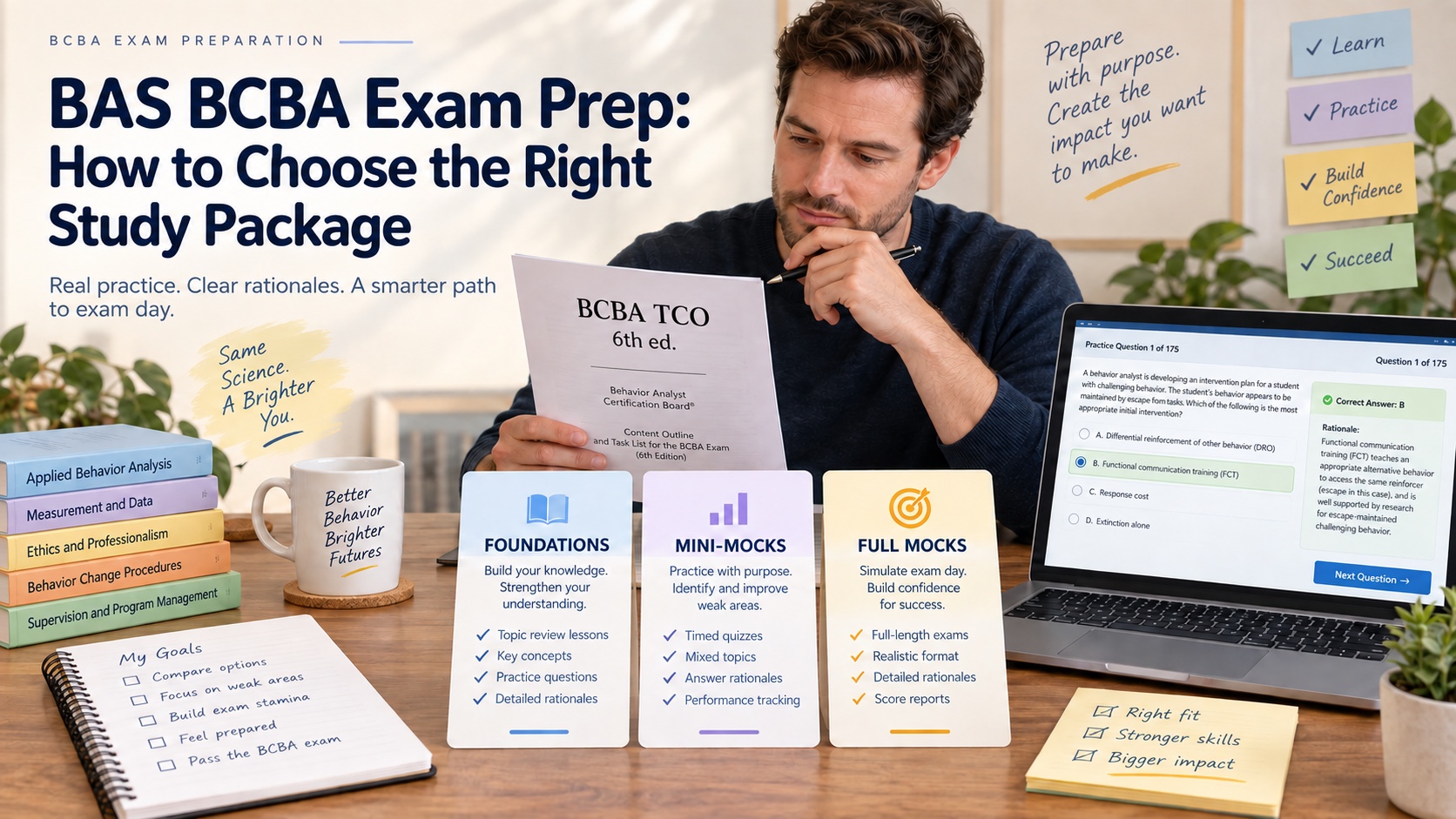
BAS BCBA Exam Prep: How to Choose the Right Study Package
If you are searching for BAS BCBA exam prep, you may be comparing Behavior Analyst Supervisor’s study packages, mock exams, lessons, and question-review resources. The current provider page presents BAS as a third-party preparation system for the BCBA examination in the 6th-edition Test Content Outline context. It lists package tiers that combine different amounts of instruction, mini-mocks, full mocks, explanations, review events, and access time.
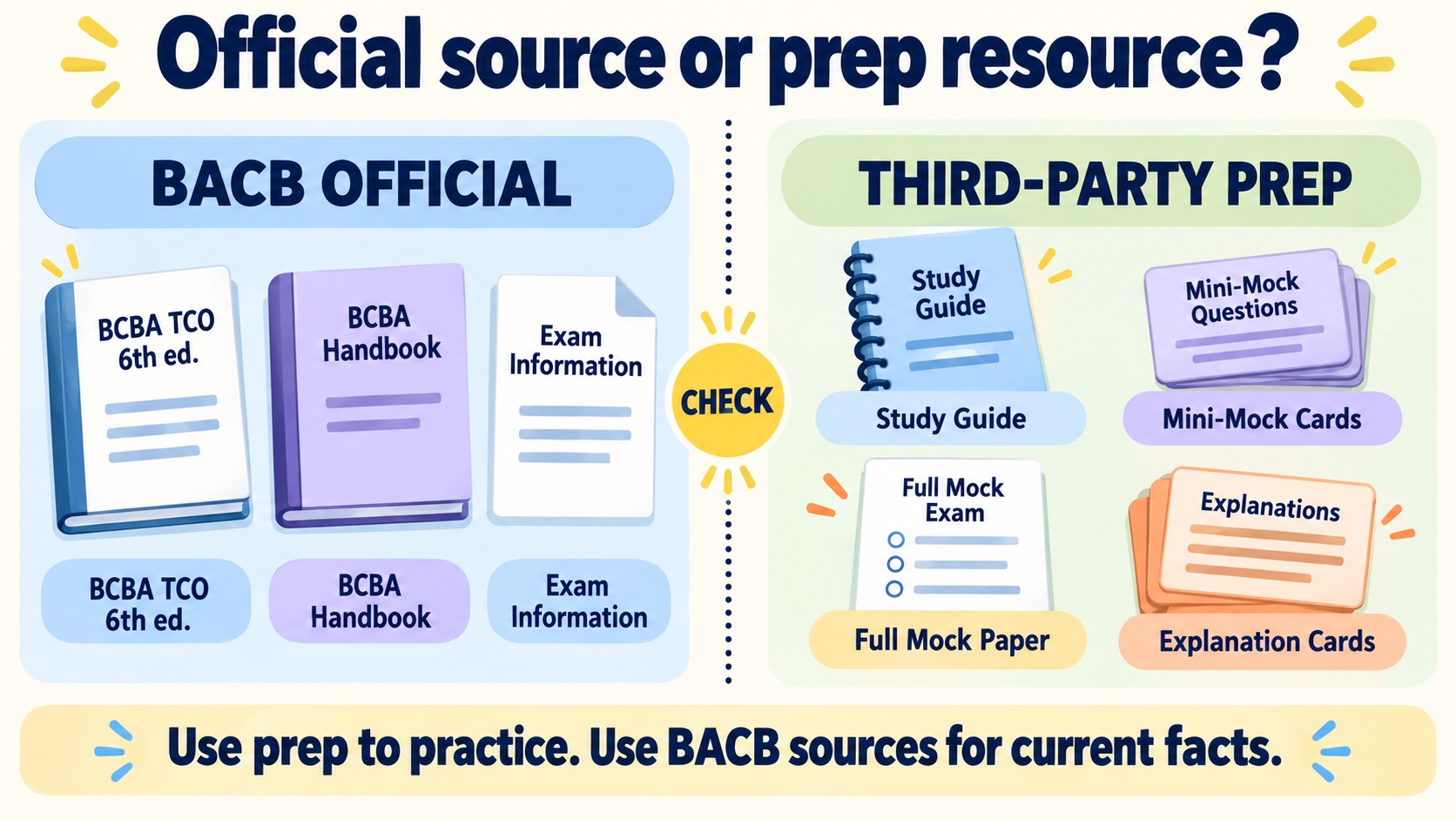
The practical question is not simply “Is BAS good?” A better question is: Which learning job do I need the resource to do, and how will I verify that it is aligned with the current official exam documents? The BACB controls the certification examination and does not endorse a particular study guide. A third-party package can organize practice, but it cannot replace the current TCO, Handbook, Ethics Code, or your graduate training.
Quick answer: BAS BCBA exam prep refers to a third-party preparation system that currently includes 6th-edition study and practice options. The provider page lists TCO-oriented instruction, domain mini-mocks, mixed mini-mocks, full mock exams, explanations, study-guide material, and different package access periods. Use those features to structure practice, but use BACB documents to verify current exam facts. No package or mock score is an official BACB result or a guaranteed pass.
What the current BAS page lists
Package details can change, so treat the provider’s live page as the source for current prices, access windows, and included features. At the time of research, the page describes two broad package levels as well as individual practice options.
- Content instruction: the package descriptions include BCBA/BCaBA TCO training, practical examples, domain review, and targeted lessons.
- Domain practice: mini-mocks are organized around TCO domains so a learner can practice one content area before moving to mixed questions.
- Mixed practice: randomized questions require you to identify the relevant concept before choosing a procedure or interpretation.
- Full mock exams: longer sets rehearse pacing, switching between domains, and maintaining attention over a complete session.
- Answer explanations: the page emphasizes explanations for answer choices, which is important when two options appear plausible.
- Review events and recordings: live or recorded breakdowns may provide a model for dissecting complex scenarios and identifying the controlling detail.
- Study-guide material: a printable guide can support notes, examples, and a consistent sequence of review.
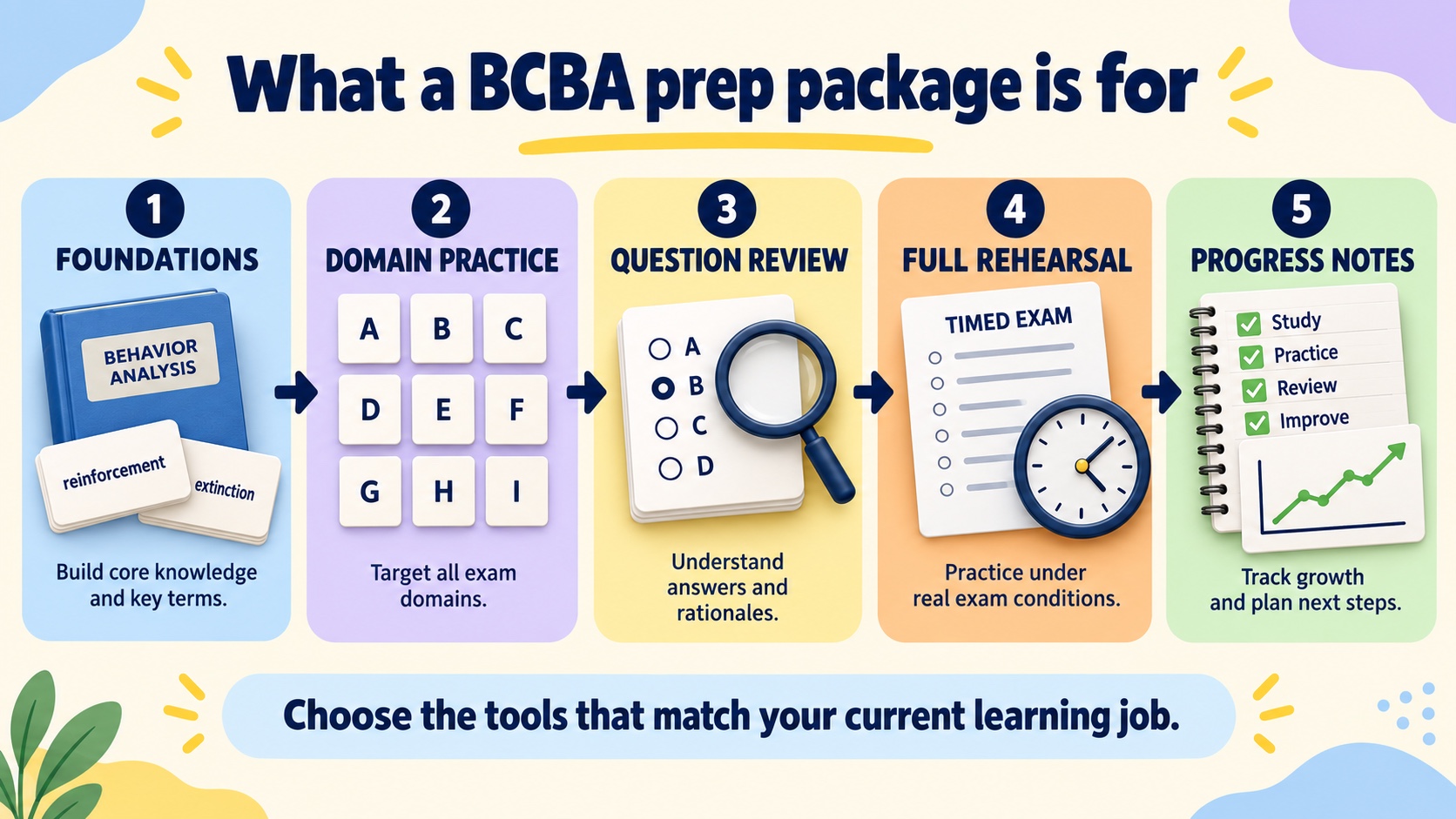
These components are not interchangeable. A full mock measures a different skill from a content lesson. A mini-mock helps diagnosis, while a question breakdown may teach a reasoning routine. A package is valuable only when you use the component for the job it actually serves.
The official BACB boundary
The current BCBA Test Content Outline (6th ed.) is the official content map for the BCBA examination beginning in 2025. It contains 104 tasks across nine domains: behaviorism and philosophical foundations; concepts and principles; measurement, data display, and interpretation; experimental design; ethical and professional issues; behavior assessment; behavior-change procedures; selecting and implementing interventions; and personnel supervision and management.
The TCO describes 175 scored questions and 10 unscored pilot questions. The current BCBA Handbook and BACB Examination Information page provide the wider exam context: four hours, multiple-choice questions with four possible answers and one correct answer, and an in-person Pearson VUE delivery format. The handbook also says the BACB does not endorse specific study guides or preparation materials, and that purchasing study materials does not guarantee a pass.
That boundary does not make a third-party prep package irrelevant. It tells you how to evaluate it. Ask whether the material uses current TCO language, whether its rationales are clear, whether it helps you apply concepts, and whether it marks provider claims as provider claims. Do not assume that a product’s use of “6th edition” means the BACB reviewed or authorized the product.
Choose a package by learning job
Start with a short inventory of your current need. The answer may point to a smaller package or a different resource rather than the largest bundle.
If your foundation is uneven
Choose instruction and a study guide that help you define, compare, and apply concepts. You should be able to create a simple example, a contrasting example, and an example in which the tempting answer is wrong. Reading more pages is not enough if you cannot explain the distinction without looking.
If you know the material but miss scenarios
Prioritize answer explanations and question-dissection practice. For each item, identify the facts that control the decision, the words that limit the answer, and the reason the distractors fail. A resource that gives only the correct letter will not solve this learning problem.
If one or two domains remain weak
Use domain mini-mocks as a diagnostic. Count errors by task family and write the reason for each miss: knowledge gap, measurement discrimination, assessment logic, intervention fit, ethics boundary, or reading error. Then return to the relevant TCO tasks and your training materials.
If pacing and stamina are the concern
Use full-length practice after you have enough content knowledge to learn from the result. Rehearse the time limit and device conditions you expect, but do not treat the practice percentage as a BACB passing score. Pacing practice should reveal when attention, answer-changing, or fatigue starts to affect your decisions.
A purchase-fit checklist
- Edition: Does the product clearly identify the current BCBA TCO (6th ed.) rather than using outdated task-list language?
- Coverage: Can you see how the nine domains and their tasks are represented over time?
- Rationales: Does the explanation address why the close alternatives are less appropriate?
- Feedback mode: Can you choose between immediate feedback, delayed feedback, and timed practice for the learning job you have?
- Access: Does the access window match your exam date and realistic weekly schedule?
- Accessibility: Are the text, audio, video, downloads, and support options usable for the way you study?
- Boundaries: Does the provider avoid claiming BACB endorsement, access to secure questions, or a guaranteed result?
- Evidence: Can you distinguish product descriptions and testimonials from independent evidence about your learning?
Price can matter, but it should come after fit. A large package that you cannot finish may be less useful than a smaller resource you use consistently with a high-quality error log. Compare the total time you can study, the type of feedback you need, and whether you already have access to a textbook, graduate-course notes, supervision, or other practice resources.
A four-week study workflow
A package becomes easier to evaluate when it sits inside a clear workflow:
- Week 1 — map and baseline: read the current BACB TCO, take a defined mixed set, and mark each answer as confident or uncertain.
- Week 2 — targeted repair: choose two weak domains. Review the relevant tasks, create examples, and complete domain practice with explanations.
- Week 3 — transfer: mix domains and explain why the best answer fits the facts. Add a short timed session to notice pacing issues.
- Week 4 — rehearsal and decision: complete a longer practice session, review the error pattern, and decide what still requires instruction, consultation, or more practice before exam day.
Adjust the calendar to your real timeline. If a score changes, record what changed in the study condition. A higher number after memorizing the same items is weaker evidence than improved reasoning on new scenarios. Keep the official source list beside your notes so rules and exam details do not become detached from their publication date.
How to review difficult questions
Consider an original question in which a behavior analyst must select an intervention after reviewing assessment data. A tempting answer may be technically familiar but poorly matched to the function, client preference, contextual fit, or social validity information in the scenario. The review task is to name the controlling fact and explain why the other procedure does not fit the complete situation.
For a measurement question, ask whether the procedure captures the critical dimension of behavior and whether the data will support the intended decision. For an experimental-design question, identify the independent and dependent variables, the design logic, and the threat to internal validity. For an ethics question, identify the affected person, relevant boundary, competence limit, confidentiality concern, or cultural variable before choosing an action.
Also review “correct but uncertain” items. Write a one-sentence rule, a one-sentence application, and a one-sentence contrast with the nearest distractor. This creates an explanation you can transfer to a new scenario instead of preserving a fragile answer memory.
Common mistakes
- Buying the biggest package automatically: more components do not fix an undefined learning problem.
- Confusing product language with BACB language: verify exam facts in the current TCO and Handbook.
- Using an old edition: check the edition, update date, and task wording before building a study calendar.
- Treating a provider score as official: practice results diagnose study needs; they do not predict or determine certification.
- Skipping rationales: the explanation and distractor analysis are often more valuable than the percentage.
- Studying only vocabulary: the BCBA exam requires applied judgment across measurement, assessment, intervention, ethics, and supervision.
- Sharing purported live questions: protect examination security and use original practice content.
For a broader free study route, use the BCBA learning path and BCBA practice-question hub. ABA Study Online resources are educational study aids, not BACB materials or a promise of a particular examination outcome.
FAQ
What is included in BAS BCBA exam prep?
The current provider page lists combinations of TCO-oriented instruction, domain mini-mocks, mixed mini-mocks, full mock exams, answer explanations, study-guide material, review events, and different access periods. Confirm the live page for current package contents and pricing.
Is BAS BCBA exam prep official?
No. It is third-party preparation. The BACB’s TCO, Handbook, examination information, and Ethics Code remain the official references. The BACB does not endorse specific study guides.
Does a BAS practice score tell me whether I will pass?
No. An independent mock score is evidence from one practice condition. Use it to identify gaps and improve reasoning, not as a direct conversion to a BACB result or a guarantee.
Should I buy full BCBA prep or only mock exams?
Choose based on the learning job. If you need foundations or structured instruction, mock exams alone may leave the gap untouched. If you understand the content but need pacing and scenario practice, a focused mock option may be enough. Check explanations and access time before deciding.
What edition should I study for the BCBA exam?
The current BACB BCBA Handbook and TCO identify the BCBA Test Content Outline (6th ed.) as the basis for the current examination. Always verify the current BACB page before your exam because future outline changes can have their own effective date.