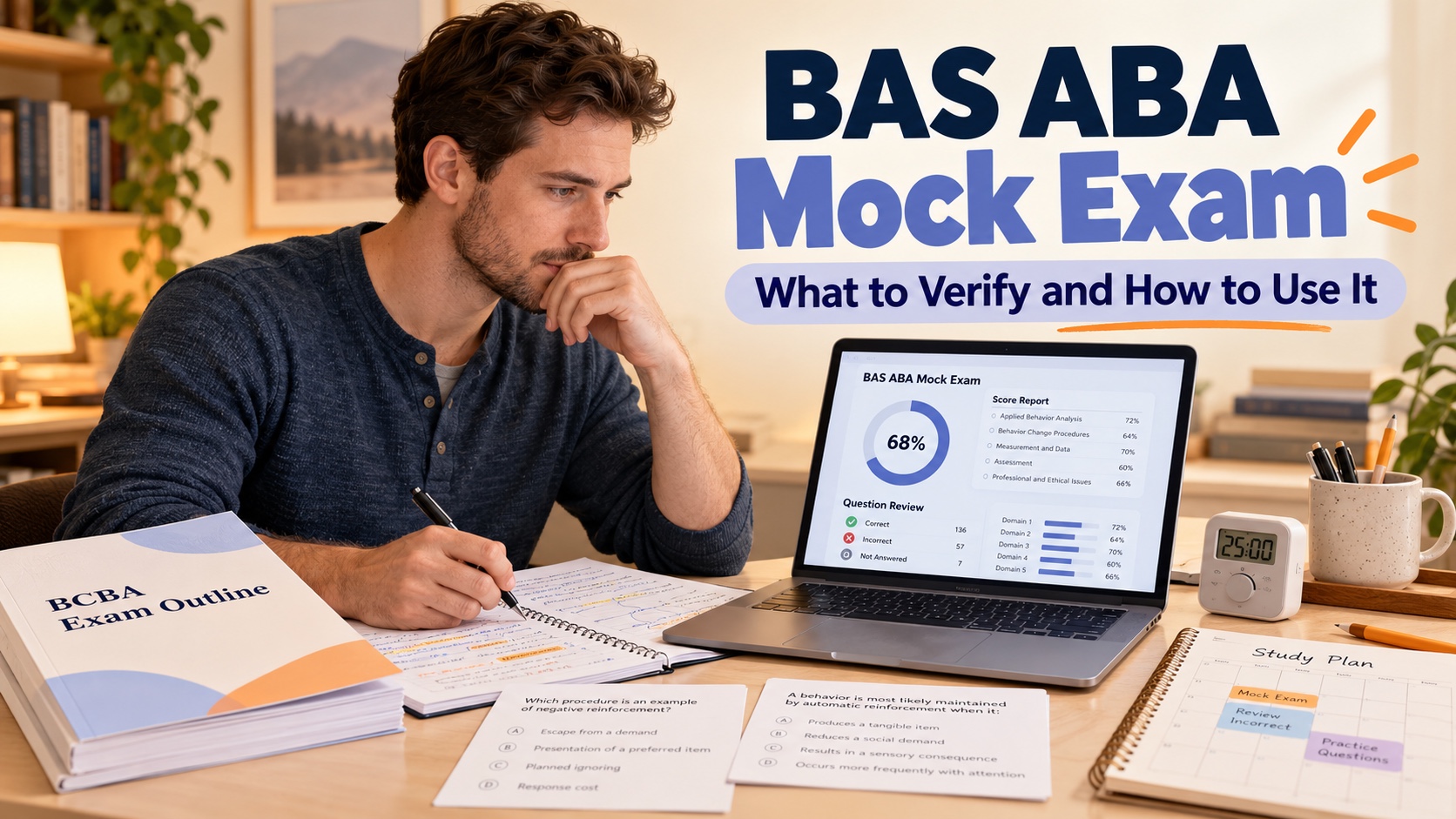
BAS ABA Mock Exam: What to Verify and How to Use It
If you searched for a BAS ABA mock exam, you are probably looking for the Behavior Analyst Study practice resource that learners often call “BAS mocks.” You may want to know whether it is close to the BCBA exam, whether it is unusually difficult, or whether it is worth adding to your study plan.
The short answer is that BAS should be treated as an independent practice resource, not as an official BACB examination. Before you buy or rely on it, verify the current product page for its edition, format, access, price, and feedback features. Then use the result as diagnostic evidence: identify what you missed, repair the underlying skill, and practice again later.
Quick answer
A BAS ABA mock exam is best understood as third-party BCBA practice. Search results and learner discussions commonly associate “BAS mocks” with Behavior Analyst Study, and some learners describe the questions as challenging or wordy. Those comments can help you anticipate the experience, but they do not establish a product specification or prove that the questions are identical to the official exam.
Check the provider’s current listing for the facts that matter: which BCBA Test Content Outline edition is named, how many questions and forms are included, whether the test is timed, how explanations are delivered, how long access lasts, and whether the score report breaks performance down by content area. If the page does not make a detail clear, treat it as unknown rather than filling the gap with a forum claim.
What “BAS” means in this search
The phrase is easy to misread. “ABA” describes the field, while “BAS” is used as a shortened brand reference in BCBA study conversations. It is not the name of a BACB credential, a BACB examination edition, or an official score category. A searcher may also type “BAS ABA mock exam” while comparing several commercial mock products, so the page needs to answer both the brand question and the larger practice question.
That distinction protects your study time. A commercial practice provider can write useful scenarios, explanations, and review tools, but it cannot grant certification or change the eligibility rules. It also cannot promise that a particular percentage on its mock will transfer to your official result. Use the product to learn how you reason under pressure, not to borrow authority it does not have.
The official BCBA baseline
The BACB’s current examination-information page says that the BCBA examination is four hours and contains 185 multiple-choice questions: 175 scored questions and 10 unscored questions. It is delivered in person through Pearson VUE. The current BCBA materials identify the 6th Edition Test Content Outline as the examination blueprint, with nine content domains.
This baseline gives you a fair comparison point. A third-party mock may use a similar question count, domain labels, or time limit, but that does not make it official. The wording, item-writing process, difficulty, score scale, unscored-question treatment, and security conditions can still be different. “Based on,” “aligned with,” “exam-like,” and “similar to” are product descriptions; none means “written or approved by BACB.”
The official sources should answer official questions: eligibility, application, scheduling, testing rules, accommodations, and the current outline. A BAS product page should answer product questions: what you receive, how the interface works, how feedback is shown, and how you can use the result. Keeping those jobs separate is more reliable than asking any commercial mock to explain certification policy.
What to verify before using a BAS mock
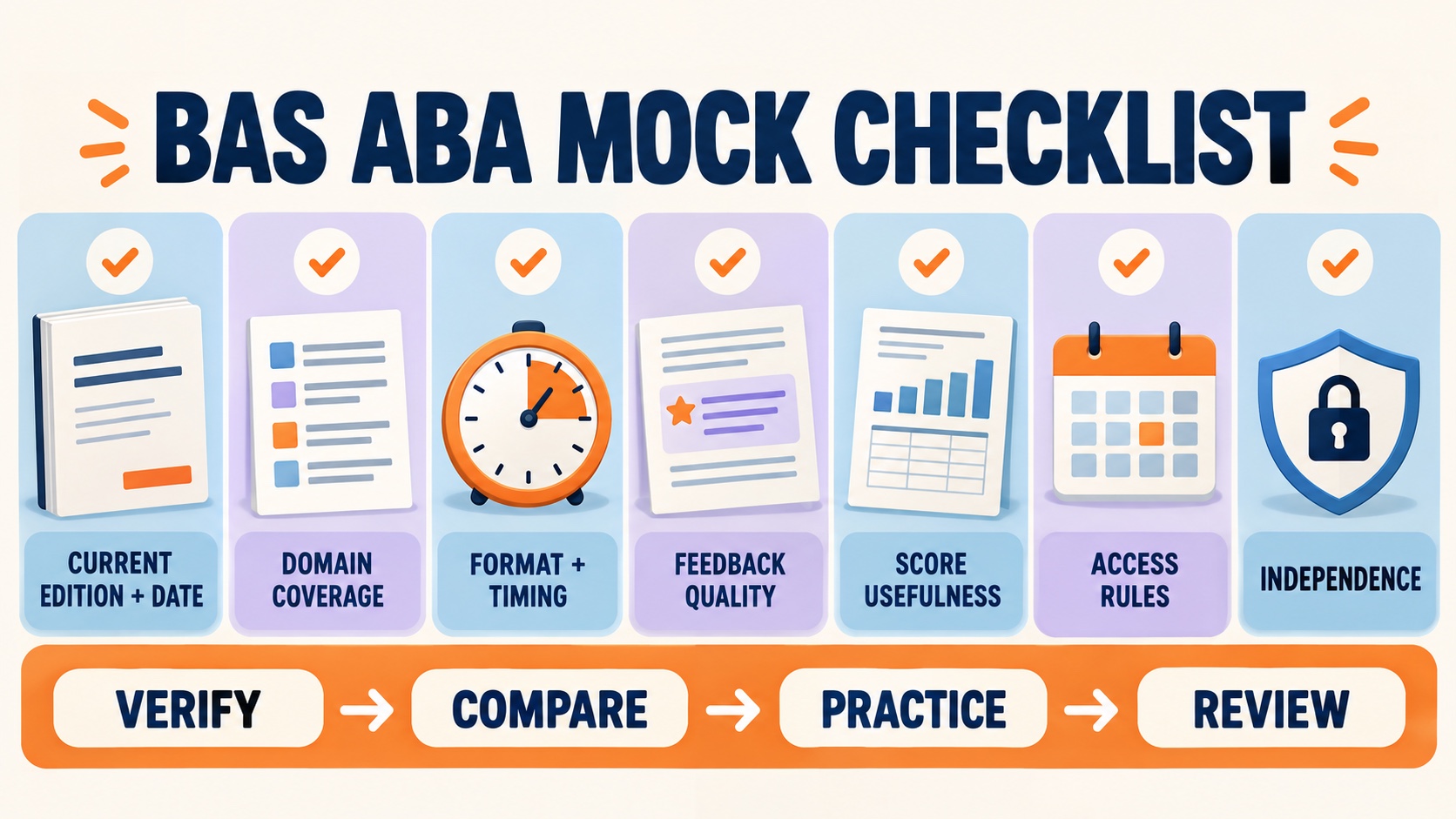
Use this checklist on the live provider page before purchasing or building a study schedule around the resource:
- Edition and date: Does the listing name the current BCBA Test Content Outline, and does it say when the material was updated?
- Blueprint coverage: Are all nine domains represented in a deliberate way, or is the product simply a large collection of mixed questions?
- Practice format: Is it a full-length timed mock, a mini mock, a domain quiz, a recorded review, or a bundle of different formats?
- Feedback quality: Does each explanation show why the best answer fits the stem and why the distractors are weaker?
- Score usefulness: Can you see content-area patterns, missed questions, confidence errors, or only one overall percentage?
- Access rules: Confirm attempts, pause and resume behavior, expiration, device requirements, and whether you can revisit explanations.
- Independence: Look for a clear statement that the resource is independent of BACB and does not contain official exam questions.
- Next action: Decide where the result will lead: a concept lesson, a small question set, an error log, or a delayed retest.
Do not let an attractive question count replace this checklist. A smaller mock with careful rationales may teach more than a larger one that only reports a percentage. Conversely, a very detailed explanation is not automatically correct; compare technical claims with your current training materials, the official outline, and authoritative ABA sources.
Why a hard mock is not automatically a better mock
Learners often describe BAS questions as difficult, dense, or unusually demanding. That perception may be useful if you are preparing for long scenarios and want to practice slowing down. It is not enough to conclude that the resource is “the closest to the real exam.” Difficulty can come from many places: long stems, subtle discriminations, unusual distractors, unfamiliar examples, or content that is not balanced to the official blueprint.
A mock is doing its job when it gives you interpretable information. After an item, you should be able to identify the relevant domain, the decision in the stem, the concept that separates the best answer from the distractors, and the reason your own choice was attractive. If the explanation merely says which letter is correct, you may have a score but not a learning signal.
Also watch your emotional interpretation. A low score on a difficult commercial mock can feel like a verdict, especially after a long study day. Instead, ask whether the error came from knowledge, discrimination, reading, timing, calculation, or confidence. The same percentage can require completely different repairs.
How to turn the result into a study plan
Start with a baseline under conditions you can describe. Record the form, date, timing, breaks, and whether you looked anything up. Do not compare a timed attempt with an untimed attempt as if they were the same measurement.
Next, review every missed and uncertain item—not only the wrong answers. For each one, record four fields: the domain or task, your chosen answer, the best answer, and the reason for the error. Useful tags include “concept not known,” “confused two procedures,” “missed a qualifying detail,” “overlooked the data,” “changed a correct answer,” and “ran out of time.”
Choose a small repair task for each pattern. Read a focused explanation, draw the distinction in your own words, answer two or three new scenarios, or explain why each distractor is weaker. If the problem is pacing, practice a shorter timed set and test a concrete pacing rule. If the problem is reading, underline the client, behavior, context, and question demand before looking at the options.
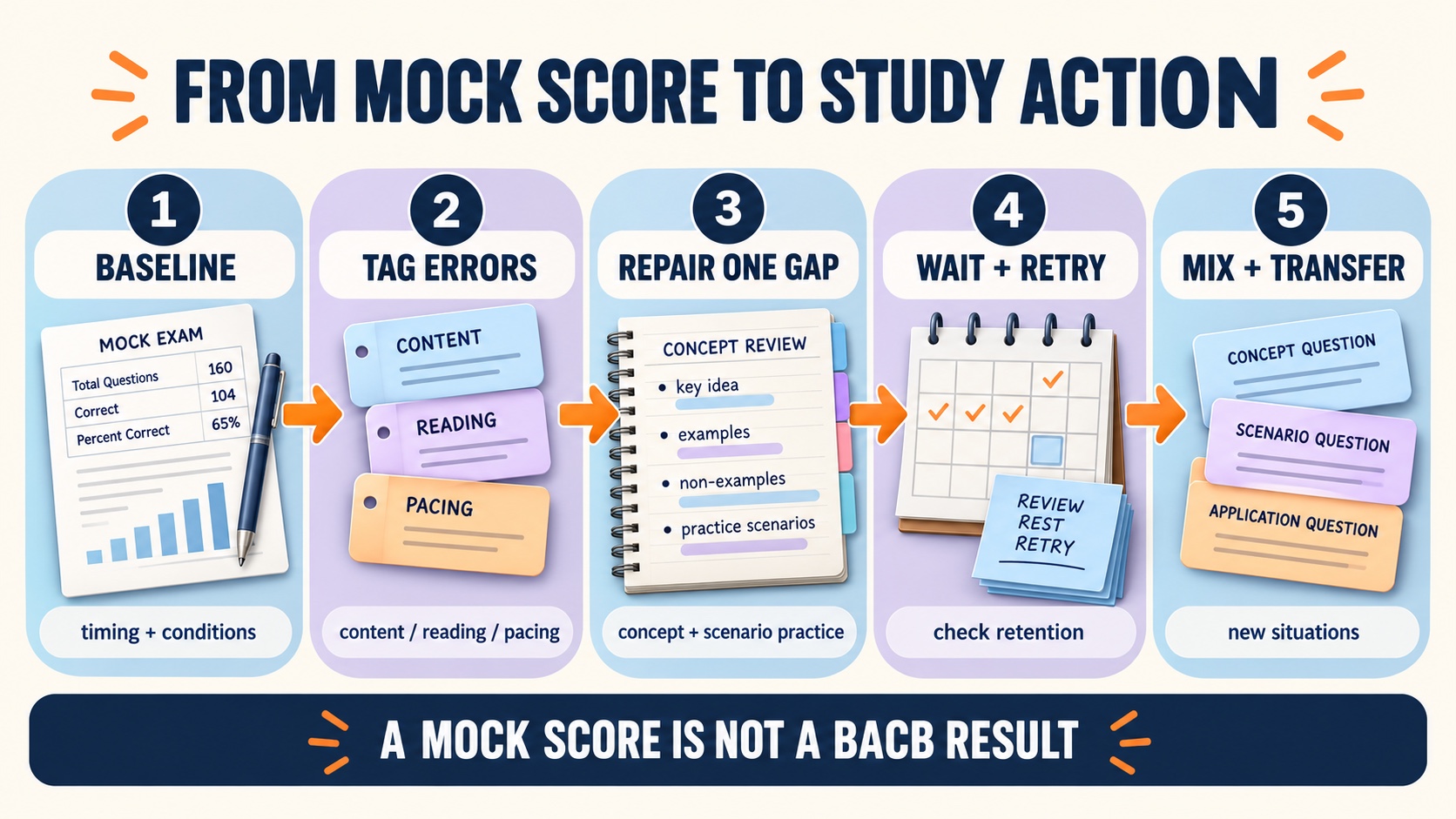
Wait before repeating similar material. A delayed retry tests retention better than immediately recognizing the same answer. Then add mixed questions from other domains so a correct answer transfers beyond the original wording. The goal is not to make one mock score look better; it is to make your decisions more accurate across new scenarios.
Who may benefit—and who should wait
A BAS mock may fit a BCBA candidate who already knows the core vocabulary, wants a demanding scenario practice session, and is prepared to review explanations carefully. It may also fit a retaker who needs to diagnose whether the main problem is content, discrimination, pacing, or test anxiety.
It may be the wrong first step if you have not read the current outline, are still learning basic concepts, or need short guided practice. Start with the official blueprint, focused concept lessons, and smaller question sets when a full-length result would only make the gaps feel larger. A free preview can help you inspect the interface, but a short sample is not a readiness assessment.
For ABA Study Online, the most useful follow-up is a connected loop: free explanations and questions on the website, a mock on the website, and app-based review for spaced practice and error repair. That route keeps mock exams in their proper role while helping a learner do something with the result.
FAQ
Is the BAS ABA mock exam an official BACB exam?
No. Treat BAS as an independent practice resource. The BACB’s own examination-information page and current handbook control official exam rules, not a third-party mock.
Is BAS harder than the real BCBA exam?
Learners may describe a resource as harder or more wordy, but those are subjective reports. A commercial mock cannot establish that it is psychometrically equivalent to the official exam. Use difficulty as a practice feature only if the feedback helps you learn.
What should I check before buying a BAS mock?
Check the current outline edition, update date, number and type of forms, timing, domain coverage, explanations, score reporting, access rules, and independence statement. Recheck price and availability on the provider’s live page because those details can change.
What score should I get before taking the BCBA exam?
There is no universal commercial-mock percentage that guarantees an official pass. Look for stable performance across mixed, blueprint-relevant practice and make sure your eligibility and application steps are handled through the BACB.
Sources and next steps
- BACB Examination Information
- BACB BCBA Handbook
- BACB BCBA Test Content Outline, 6th ed.
- Behavior Analyst Study — verify current product details directly
- ABA Study Online mock exams
- ABA Study Online BCBA practice questions
- ABA Study Online app review loop
Build your next practice step
Use ABA Study Online’s independent website mock exams and free practice resources to establish a baseline, review explanations, and choose focused follow-up work. Our materials are unofficial and independent of the BACB; they do not guarantee a pass or replace official certification requirements.