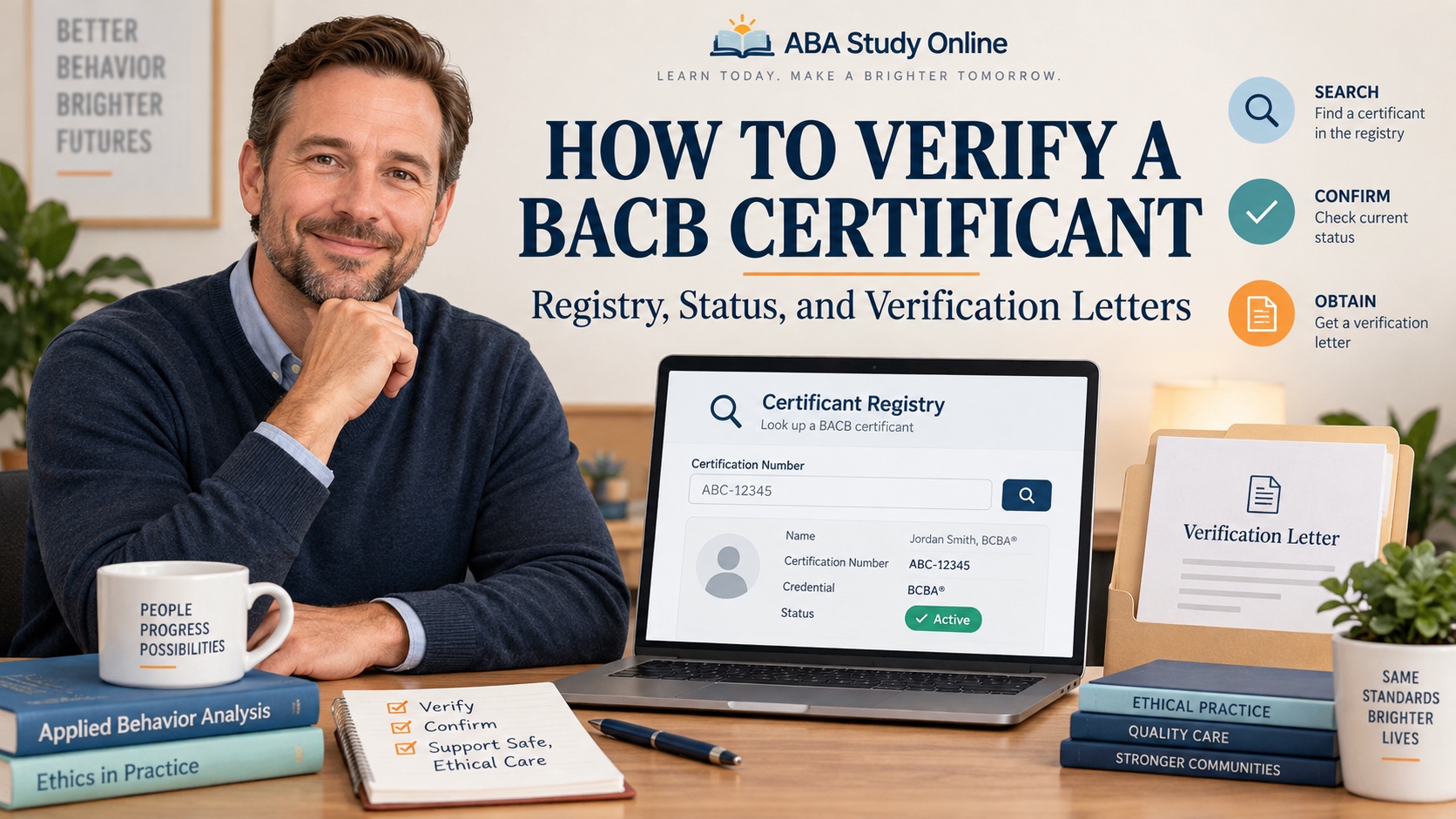
How to Verify a BACB Certificant: Registry, Status, and Verification Letters
If an employer, family, funder, or licensing office needs to confirm a behavior analyst’s credential, the safest starting point is the official BACB Certificant Registry. The registry is designed to show whether a person holds a BACB certification and whether reportable disciplinary actions are associated with that certification. It is not the same as a state license lookup, an employment reference, or a guarantee that a provider is the right fit for a particular service.
This guide explains how to use the official resource, what to record from the result, and when a written verification letter may be useful. ABA Study Online does not verify certificants itself; always use the current BACB page and registry for the actual check.
Table of Contents
Short answer: where do you verify a BACB certificant?
Use the BACB Verify BACB Certification page and open the online Certificant Registry. Search by the information you have, select the appropriate certification level, and review the result shown by BACB. The registry is the primary resource for a quick status check and is updated daily according to BACB’s verification guidance.
Do not rely on a screenshot, a résumé line, a social-media profile, or a certificate image as the only evidence. Those items may be outdated or incomplete. The official registry is the source that should anchor the verification record.
What the Certificant Registry shows
The registry can help you confirm the person’s name, certification type, certification number, status, location information, and relevant dates. BACB also says the registry can indicate whether reportable disciplinary actions are associated with the certification. The exact fields and display may change as BACB updates its systems, so treat the live registry—not an old tutorial—as the current interface.
Certification level matters. A BCBA, BCaBA, RBT, or BCBA-D record represents a different credential and different role boundary. Confirm that the result matches the role the person claims. A record for one credential does not automatically verify another credential or a state license.
Step-by-step verification
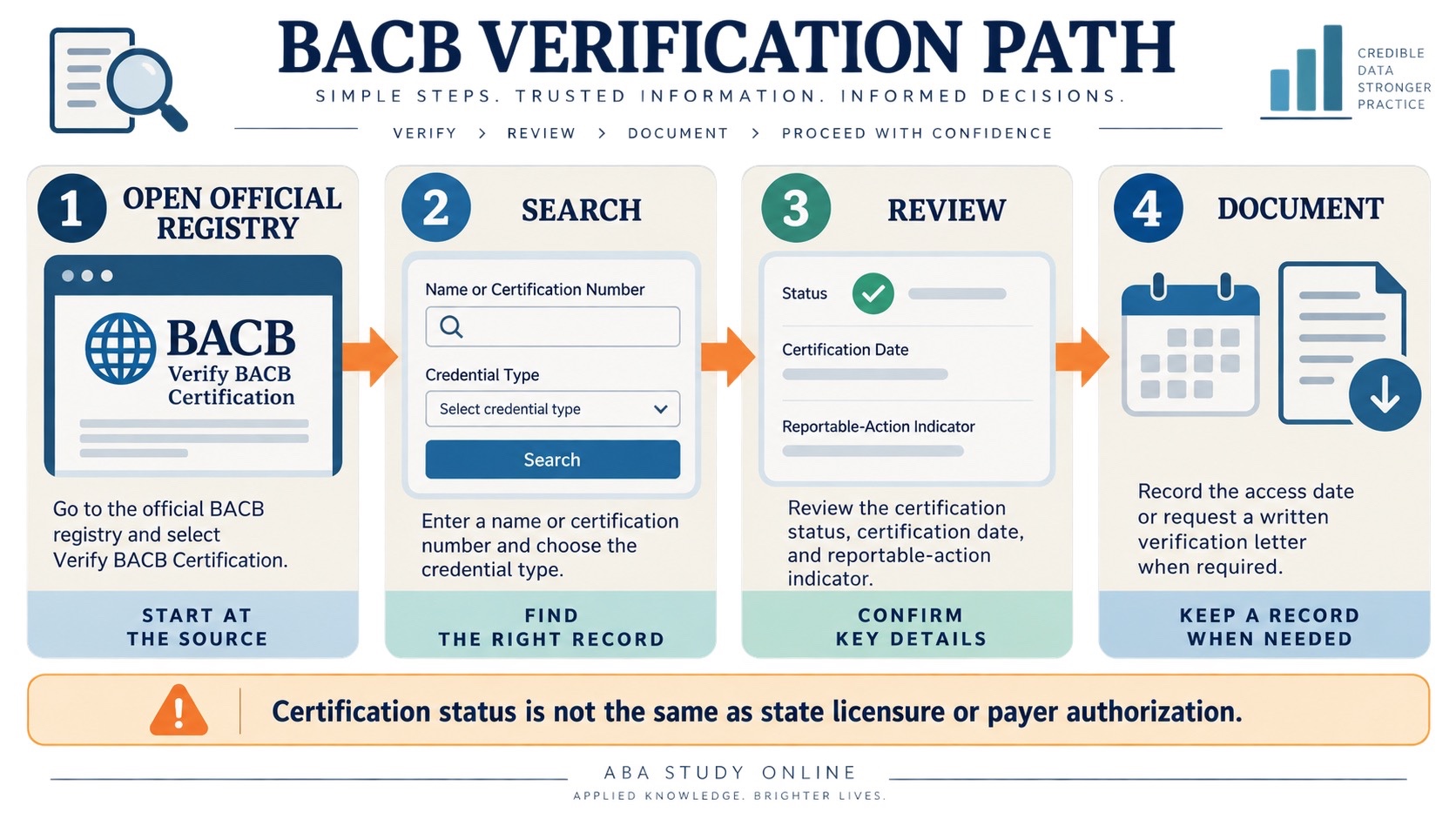
- Start at BACB. Navigate from the official Verify BACB Certification page rather than an unfamiliar third-party directory.
- Choose the search route. Use a general search when you know the name, or use a certification number when the person or organization provides one.
- Select the certification type. Check whether the search concerns an RBT, BCaBA, BCBA, or BCBA-D.
- Review the whole record. Compare the name, status, certification number, location, and date information with the request you received.
- Record the access date. A registry result is time-sensitive. Note when you checked it and save the official result according to your organization’s privacy policy.
- Escalate when necessary. If a funder, licensing board, or employer needs an official letter, follow BACB’s verification-letter process rather than editing a screenshot.
A simple verification record
If you are checking a provider for a family, an employer, or a funding file, keep the record narrow and useful. Write down the person’s name as displayed, certification level, certification number if shown, status, the date you accessed the registry, and the official URL you used. If the result includes a disciplinary-action indicator, record that the indicator was present and follow the linked BACB information; do not copy more personal information than your organization needs.
Then compare the result with the question you actually need to answer. “Is this person currently listed as a BCBA?” is a registry question. “Can this person practice in my state?” may require a separate state license search. “Can this provider bill my plan?” may require payer or employer confirmation. Keeping those questions separate prevents a valid certification result from being stretched into a claim BACB did not make.
If the name does not appear, check spelling, certification type, and the possibility that the record is new. Do not create a second conclusion from a failed search. Contact BACB through its current support route or ask the certificant for the information the receiving organization needs.
For a high-stakes decision, use the registry as one documented verification step and preserve the date of the check for your records.
This small habit makes later audits easier when status or policy changes.
How to interpret the result
Active
An active result supports the narrow claim that the person has a current BACB certification shown by the registry at the time you checked. It does not answer every state, payer, employer, or service-quality question.
Inactive or expired
Do not silently treat inactive or expired as current. BACB’s verification materials explain that inactive status may have a reason shown in the record, while written verification letters are not provided for expired certifications. Ask the receiving organization what follow-up it requires.
Disciplinary indicator
If the registry shows an indicator for reportable disciplinary actions, follow the official BACB information linked from the record. Do not turn an indicator into a conclusion about a person’s current work without reading the official action and the applicable dates.
When to request a verification letter
An active certificant may be able to view and print a verification report from the BACB portal. If you need written verification from BACB, the verification page describes a paid request, currently $25 per letter, with delivery generally stated as 3–5 business days after payment is received. Fees, timing, and form fields can change, so verify them on the live BACB page before submitting.
A letter may be appropriate when a licensing board, funder, or employer specifically asks for a document sent through the official process. It is usually unnecessary to request a paid letter for a quick preliminary status check when the registry already answers the question.
What the registry does not prove
- It does not replace a state professional-license lookup.
- It does not prove that the person accepts a new client or is available for employment.
- It does not verify a clinic’s payer enrollment, authorization, or billing status.
- It does not guarantee clinical fit, treatment quality, or a particular outcome.
- It must not be used for commercial solicitation, data harvesting, product marketing, or employment solicitation in violation of BACB terms.
BACB verification FAQ
Is the BACB Certificant Registry free?
The registry is presented by BACB as a free resource for verification. A written verification letter is a separate paid service.
How often is the registry updated?
BACB’s verification page states that the online registry is updated daily. A newly certified person may not appear immediately; check the current BACB guidance if timing matters.
Can I use the registry to market to certificants?
No. BACB terms restrict commercial use, data harvesting, product or education marketing, and employment solicitation. Use the registry for credential verification within its stated purpose.