BACB Training: Which Certification Path Are You Looking For?
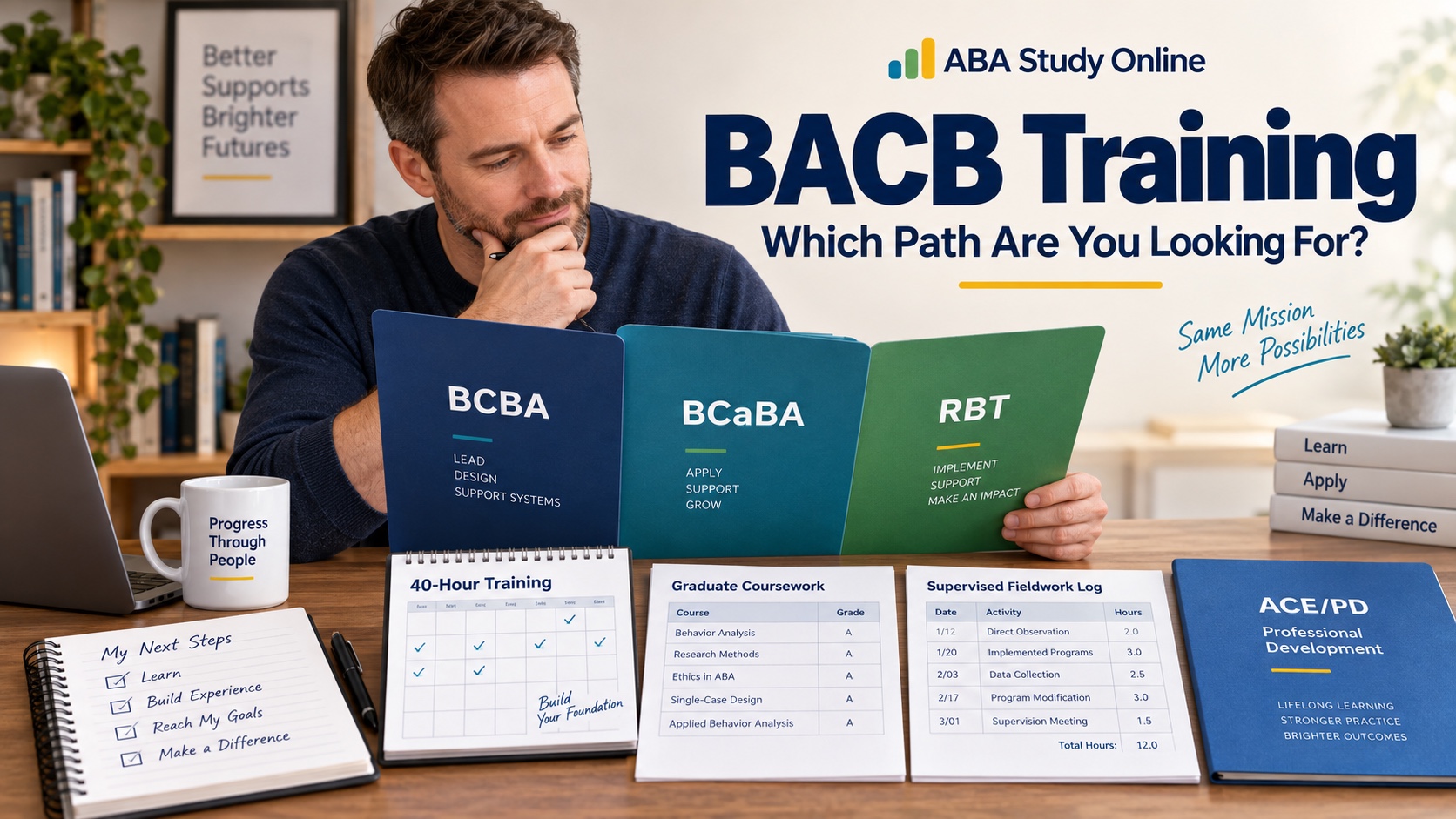
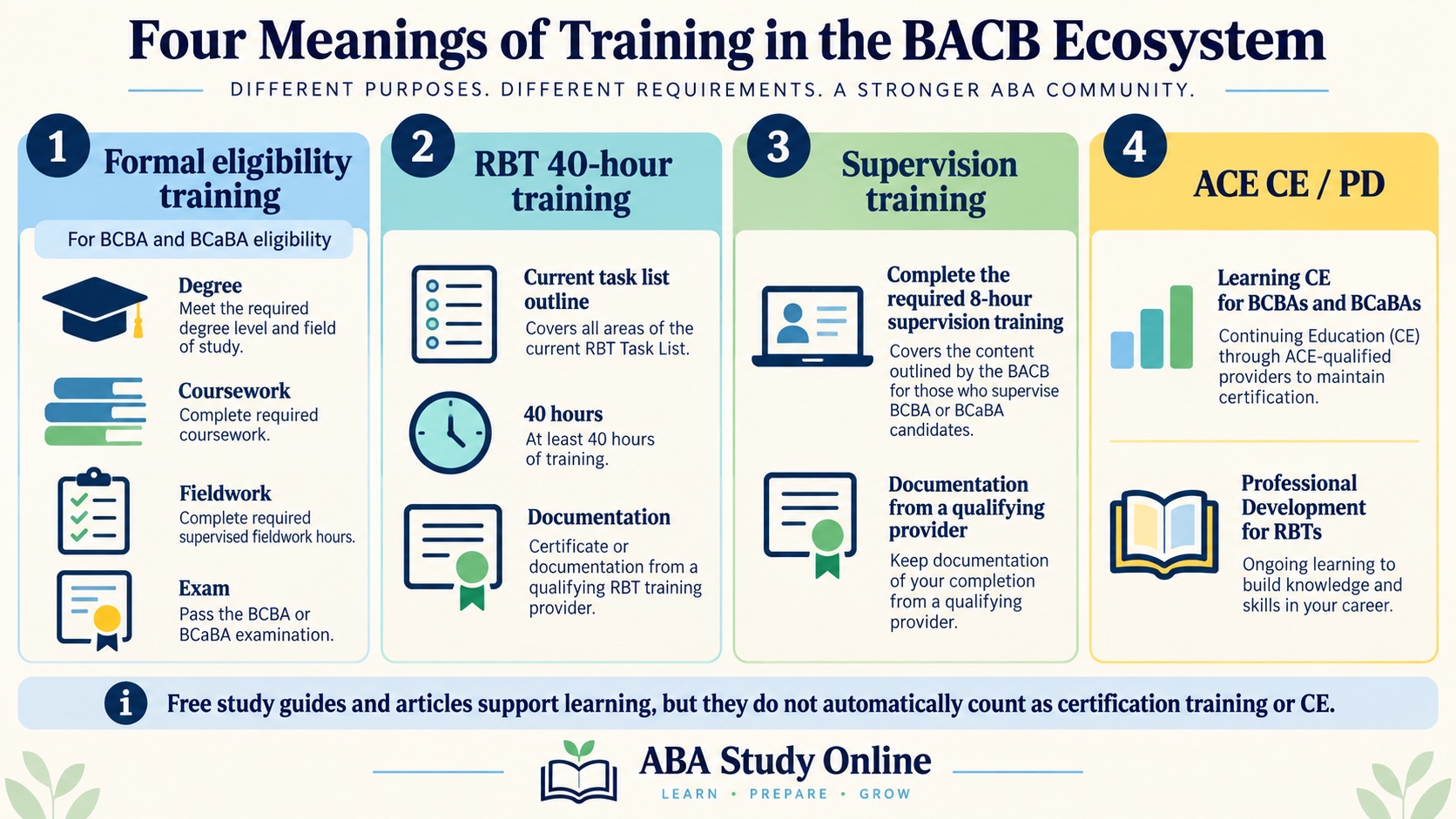
If you search for BACB training, you may be looking for a course before an exam, the RBT 40-hour requirement, supervision training, continuing education, or a study resource. Those are not interchangeable. The Behavior Analyst Certification Board (BACB) has separate pathways for the BCBA, BCaBA, and RBT credentials, and each pathway has its own education, training, assessment, supervision, ethics, and maintenance requirements.
The safest starting point is to identify the credential you want and then compare the program with the current BACB requirement for that credential. This guide explains the categories in plain language, shows where free study material fits, and points you to official sources. It is an orientation article, not an official certification application, training certificate, CE approval, or pass guarantee.
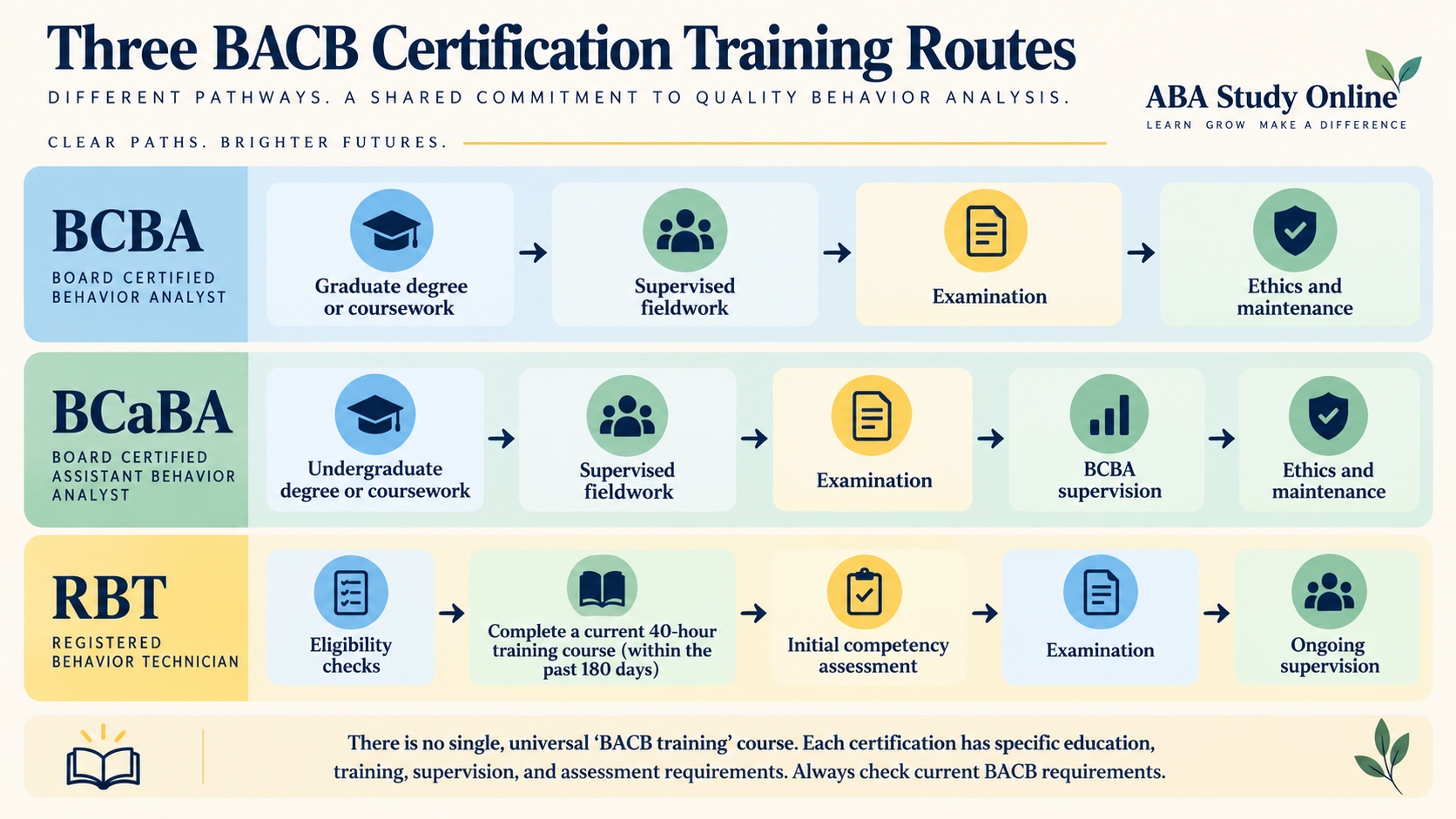
Quick answer: there is no single universal “BACB training” course for every learner. BCBA and BCaBA candidates usually need a qualifying education and supervised fieldwork pathway before the relevant examination. RBT candidates need the current RBT eligibility steps, including a qualifying 40-hour training course completed within the required time window and an initial competency assessment. People taking on certain supervision roles need role-specific supervision training. Certified professionals may seek ACE Learning CE or Professional Development. A study guide or free article can support learning, but it does not automatically satisfy one of those formal requirements.
Choose the certification track first
The word “BACB” describes the certification board, not one shared curriculum. The BACB’s consumer resources identify three main credentials: Board Certified Behavior Analyst (BCBA), Board Certified Assistant Behavior Analyst (BCaBA), and Registered Behavior Technician (RBT). They are different roles with different eligibility routes and responsibilities.
Use the following question before you buy or enroll: Which credential requirement am I trying to meet? If the answer is unclear, a broad course description can sound helpful while leaving you with the wrong kind of documentation. A BCBA exam-preparation course is not a substitute for a qualifying degree or coursework. An RBT 40-hour course is not a BCBA graduate pathway. An ACE activity is continuing education or professional development, not initial certification training.
BCBA and BCaBA eligibility training
For BCBA and BCaBA candidates, “training” often describes a larger eligibility pathway rather than a short standalone class. The pathway can include a qualifying degree level, required behavior-analytic coursework, supervised fieldwork, an application, and the relevant certification examination. The exact route depends on the current BACB requirements and the candidate’s education and experience.
A useful way to evaluate a BCBA or BCaBA program is to ask what part of the pathway it actually covers:
- Education: Does the program explain the degree and coursework route that applies to the candidate?
- Course sequence: Are the behavior-analytic subjects documented in a way that can be checked against the current requirement?
- Fieldwork: Does the program provide or clearly explain supervised fieldwork, qualified supervision, documentation, and the candidate’s responsibilities?
- Application and exam: Does it distinguish eligibility support from exam preparation?
- Maintenance: Does it explain ethics, renewal, and continuing requirements without promising a credential?
This is why a course marketed as “BACB certification training” deserves careful reading. It may be a university program, a coursework sequence, fieldwork support, an exam-prep product, or a general introduction. Those can all be useful, but they solve different problems. The BCBA learning path and BCaBA learning path can organize study concepts; they do not replace the candidate’s official eligibility review.
RBT 40-hour training
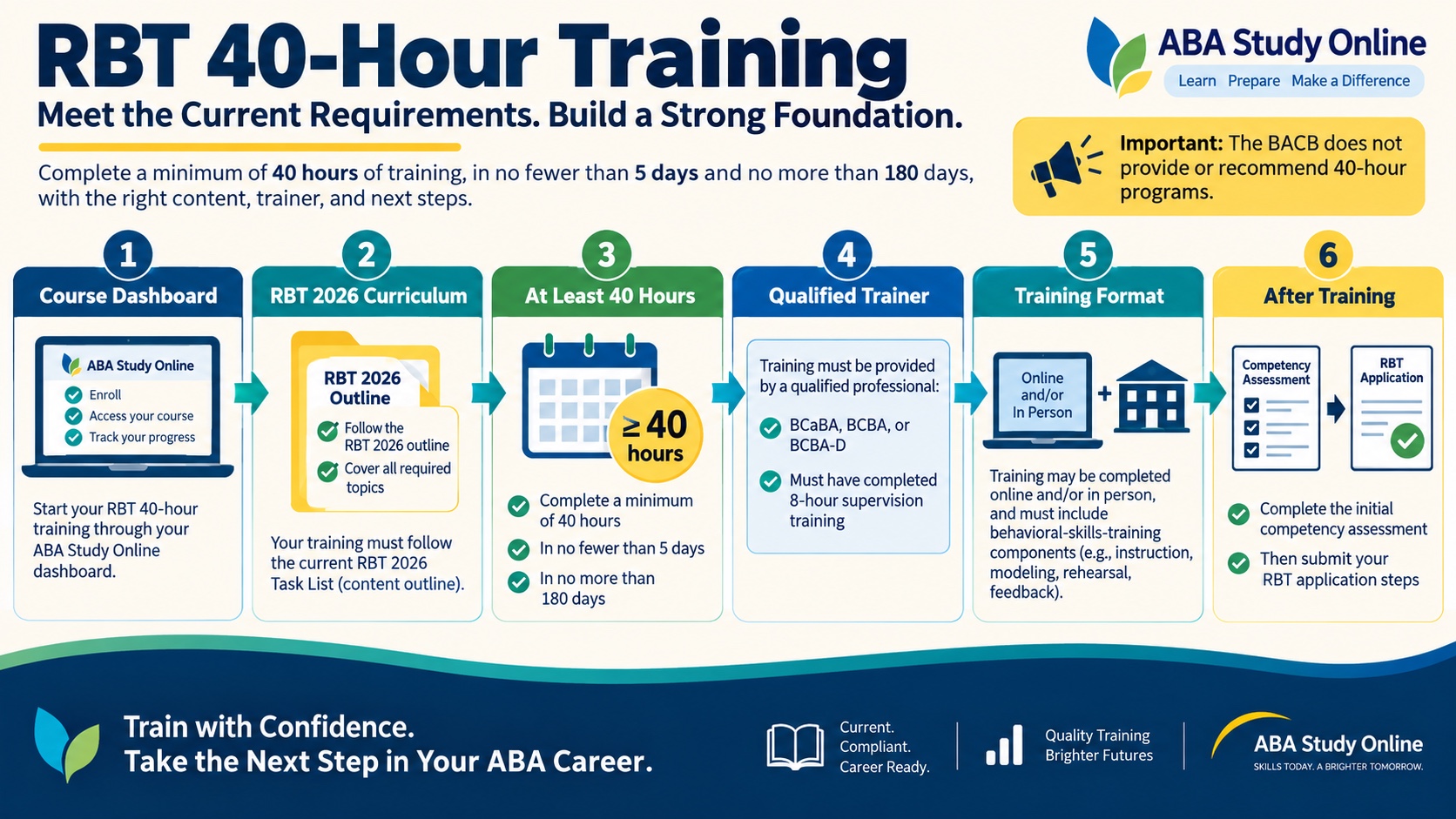
For an RBT candidate, the phrase “BACB training” often means the current 40-hour training requirement. The BACB’s 2026 RBT training outline says the training must include at least 40 hours, be completed in no fewer than 5 days and no more than 180 days, and cover the current RBT Task List outline. It also describes the responsible trainer qualifications and required training components.
The BACB does not provide or recommend 40-hour training programs. That boundary matters when comparing providers. Check who is responsible for the course, how the provider documents completion, which task-list version the course uses, how activities and assessments are handled, and whether the course fits the current RBT requirements. Completing an online video playlist by itself is not enough to assume eligibility.
The 40-hour training is also not the entire RBT process. The candidate still needs to review the current eligibility requirements, complete the initial competency assessment through the appropriate process, apply when eligible, pass the RBT examination, and work under ongoing supervision after certification. Keep each document because a training certificate, competency assessment, exam result, and supervision record serve different purposes.
Supervision training
Another meaning of “BACB training” appears when a professional takes on a supervision role. The BACB supervision and training resources describe role-specific expectations, including the 8-hour supervision training for people who supervise RBTs and for other applicable supervision responsibilities. Do not confuse this with the RBT 40-hour training or with a candidate’s supervised fieldwork.
When you compare supervision training, look for the role it addresses, the current BACB content it covers, the trainer’s qualifications, the completion documentation, and how the training fits with the separate supervision requirements. A certificate is evidence that a course was completed; it does not erase the supervisor’s continuing responsibility to provide competent, ethical, and properly documented supervision.
ACE continuing education and professional development
ACE stands for Authorized Continuing Education. ACE Providers offer Learning Continuing Education to BCBAs and BCaBAs and Professional Development opportunities for RBTs. This is ongoing learning for people who already hold or maintain a role; it is not the same as initial BCBA, BCaBA, or RBT certification training.
Before registering, confirm which designation the activity carries and whether it matches your role. A course that says “ABA training” may be useful for knowledge while not counting toward the requirement you have in mind. Keep the provider information, activity details, completion evidence, and any other record required by the current BACB guidance. If the activity’s status is unclear, ask the provider before paying or relying on it.
How to evaluate an online training program
Online delivery is a format, not a quality designation. An online course may be well designed, but the word “online” does not tell you whether it satisfies the requirement you need. Use this short review before enrolling:
- Name the destination: write down whether you need BCBA eligibility, BCaBA eligibility, RBT 40-hour training, supervision training, ACE Learning CE, RBT Professional Development, or general study support.
- Check the current source: compare the program’s task list, handbook reference, time window, hours, role, and documentation with the current BACB page.
- Verify the provider: look for the responsible trainer or provider, qualifications, contact details, and a clear explanation of what completion means.
- Inspect the learning design: look for stated objectives, examples, practice, feedback, accessibility, progress records, and a way to ask content questions.
- Save evidence: keep the syllabus, version date, receipts, completion record, certificate, and relevant correspondence in one folder.
Be cautious with claims such as “guaranteed certification,” “official BACB course,” “all-in-one for every credential,” or “automatically counts for everyone.” Certification eligibility belongs to the current BACB requirements and the candidate’s documented pathway. A strong provider should make its scope easy to understand rather than blur the boundaries.
Where free study material fits
Free articles, flashcards, concept explanations, practice questions, checklists, and videos can make a training journey more approachable. They are especially useful for building vocabulary, previewing a topic, identifying weak areas, and reviewing before a quiz. They can also help a learner decide whether a formal program is the right next step.
The boundary is simple: free study material supports learning, but it does not automatically count as formal certification training, supervised fieldwork, the RBT 40-hour course, an initial competency assessment, supervision training, or ACE CE/PD. On ABA Study Online, the free resources library, ABA glossary, and practice areas are designed to help learners understand and review concepts. The app learning tools can support ongoing practice, but users should still follow the official pathway and keep the required documentation.
Common mistakes and a comparison checklist
- Using one course for every credential: start with the track, because BCBA, BCaBA, and RBT requirements are different.
- Confusing exam preparation with eligibility: practice questions can improve readiness but do not create a degree, coursework sequence, fieldwork record, or application.
- Assuming “40 hours” is enough: the RBT course must meet the current content, timing, trainer, and documentation requirements.
- Confusing CE with initial training: ACE Learning CE and Professional Development are ongoing learning categories.
- Trusting an old task list or screenshot: open the current BACB source and save the version you used.
- Assuming a free resource is a credential document: learning value and formal eligibility evidence are different things.
A practical comparison note can contain five columns: credential or role, purpose, current BACB source, provider or supervisor documentation, and next action. If a course cannot answer the first four columns clearly, pause before enrolling.
FAQ
Is there one official BACB training course?
No. The BACB describes separate credentials and requirements. The phrase “BACB training” is a broad search phrase that may refer to eligibility education, the RBT 40-hour training, supervision training, ACE learning, professional development, or exam study.
Can I use free ABA articles instead of the RBT 40-hour course?
No. Free articles can support learning, but they do not automatically satisfy the current RBT 40-hour training requirement or provide the required course documentation.
Does an online course count automatically?
No. Online delivery does not determine whether a course meets your requirement. Check the credential, current content, timing, trainer or provider, assessment process, and documentation against the current BACB guidance.
Is supervision training the same as supervised fieldwork?
No. Supervised fieldwork is part of applicable candidate pathways. Supervision training prepares a person for certain supervisory responsibilities. They involve different purposes and records.
Can ABA Study Online certify me?
ABA Study Online provides educational study support and free learning material. It does not replace the current BACB eligibility process, official application, examination, required training, supervision, or professional judgment.
Sources
- BACB Consumer Resources
- BACB RBT certification resources
- BACB RBT 2026 40-hour training requirements
- BACB Supervision and Training
- BACB Authorized Continuing Education Providers
- BACB BCBA certification resources
- BACB BCaBA certification resources
- Related: free ABA resources
- Related: ABA Study Online app learning tools