BACB Test Outline: How to Use It as a Study Map
The phrase BACB test outline can point to three different certification tracks. The BCBA and BCaBA examinations use their respective 6th-edition Test Content Outlines, while the RBT examination uses the 3rd-edition outline beginning in 2026. Each outline names the content areas and tasks the examination is designed to assess, but the outline is not a question bank and it does not tell you the exact order of your exam.
The most useful way to study from it is to identify your track, map the domains, turn tasks into scenario practice, and review the reasoning behind each error. This guide compares the current outlines at a high level, then gives you a repeatable study loop. Always check the official BACB document and handbook for the version that applies to your application and examination date.
The quick answer
Use the outline as a blueprint for what to study, not as a promise about the exact questions you will see. The current BACB examination information describes multiple-choice examinations with four possible answers and one correct answer. The outline tells you which knowledge and skills are in scope for the track; your training, handbook, ethics materials, and carefully reviewed practice help you learn how to apply them.
| Track | Current outline | Exam map |
|---|---|---|
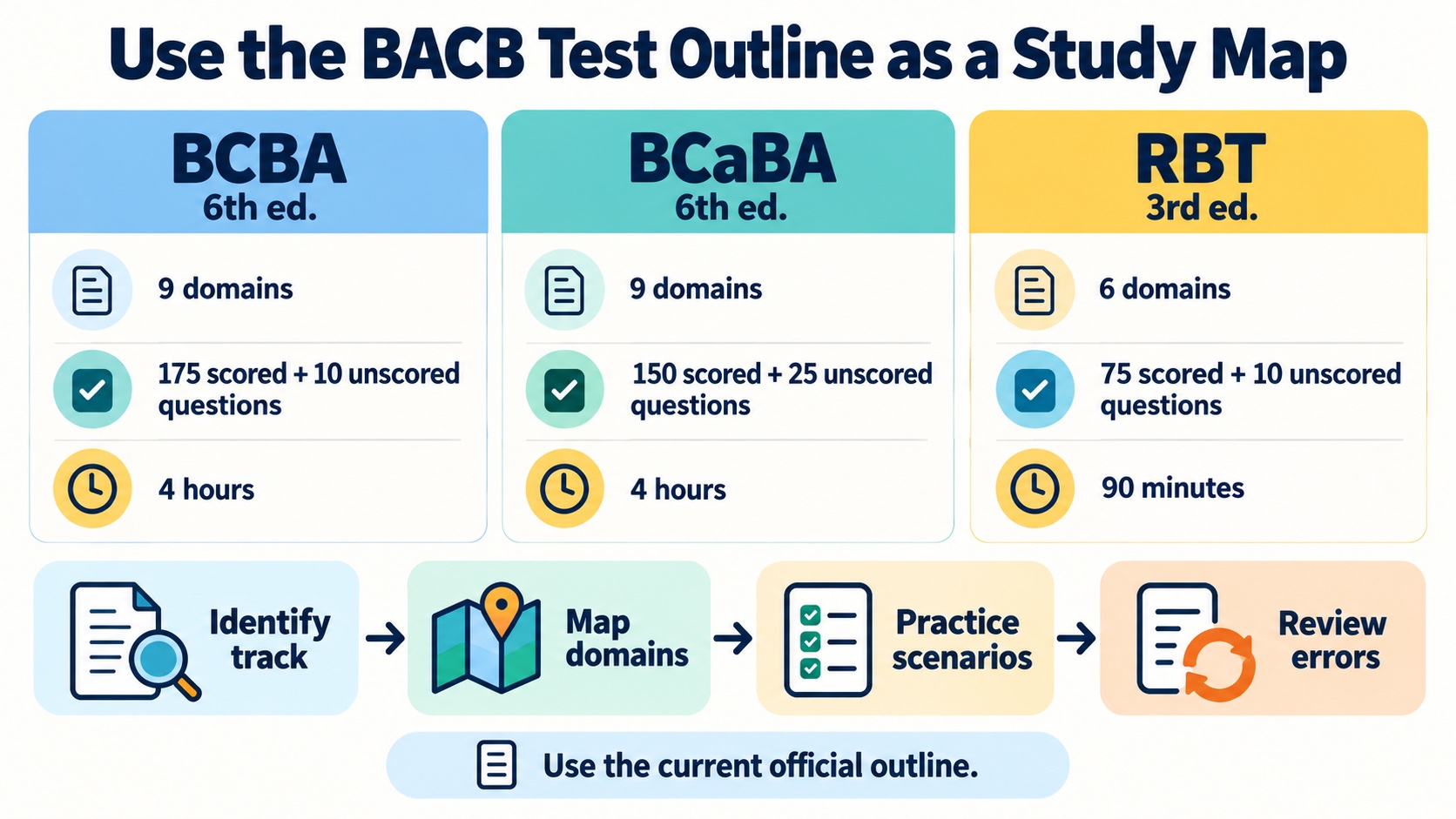
| BCBA | BCBA Test Content Outline, 6th ed. | 9 domains; 175 scored plus 10 unscored questions; 4 hours |
| BCaBA | BCaBA Test Content Outline, 6th ed. | 9 domains; 150 scored plus 25 unscored questions; 4 hours |
| RBT | RBT Test Content Outline, 3rd ed. | 6 domains; 75 scored plus 10 unscored questions; 90 minutes |
Question counts and time limits are useful for planning, but they are not a pass formula. A small domain can still contain concepts that need careful application, and a large domain cannot be learned by memorizing a list of terms.
Choose the correct outline
Begin with the credential you are pursuing. A BCBA candidate should not build a study plan from the RBT outline simply because it is shorter. The roles, decision-making expectations, content areas, and examination structures are different. The same word—such as reinforcement, assessment, or ethics—may appear across tracks while the expected level of application changes.
Then check the edition and effective date. The BACB currently lists the BCBA and BCaBA 6th-edition outlines and the RBT 3rd-edition outline. A course, flashcard deck, or blog post may still use an older task list. Older material can help explain a concept, but it should not silently replace the current official blueprint.
Finally, download the source from the BACB rather than relying on a screenshot. Keep the document date in your study notes. When a transition is underway, the date is part of the study decision.
What to read in the outline
Read the outline in three passes:
- Structure: identify the domains, task labels, question distribution, and any scored or unscored information.
- Task verbs: notice whether a task asks you to identify, distinguish, define, implement, analyze, select, or evaluate. The verb signals the type of thinking you need to rehearse.
- Boundaries: compare the task with the appropriate handbook, ethics code, and your training. An outline is not a license to perform work outside the role or outside your competence.
For example, “identify” may call for recognition of a concept in a clear scenario, while “distinguish” asks you to compare close alternatives. “Implement” requires attention to procedure, timing, fidelity, and the role of the person delivering the service. Your notes should reflect the task verb instead of reducing every line to a vocabulary flashcard.
The four-step study loop
1. Identify your track
Write the credential and outline edition at the top of your study plan. This prevents a common error: mixing BCBA, BCaBA, and RBT notes because the topic names look familiar. Keep separate folders or labels even when you are reviewing a shared foundation such as measurement or reinforcement.
2. Map the domains
Give each domain a page or digital card. Add the task statements beneath it, then mark your current confidence: can explain, can recognize in a scenario, can apply, or needs review. Use the official distribution as a time-allocation signal, but make room for weak areas rather than studying only the largest domain.
3. Practice scenarios
Convert each task into a short scenario with plausible distractors. Ask what fact in the scenario controls the answer, which task verb is being tested, and which answer choice asks for more authority than the role allows. Practice should require a decision, not only a definition.
4. Review errors
After a practice set, record the reason for each miss. Useful tags include definition gap, close-concept confusion, measurement mismatch, reading error, procedure sequencing, ethics boundary, or unsupported answer change. Revisit the specific task and retry later. A score without an error explanation is a weak study signal.
Turn tasks into practice
Suppose an outline task asks you to distinguish positive and negative reinforcement. A recognition card might ask for a definition. A stronger practice item presents a consequence, asks whether a stimulus was added or removed, asks whether behavior increased, and includes a distractor that confuses “positive” with “good.” The learner must inspect the contingency rather than choose a word by emotional meaning.
For a task involving data display, practice can show a small graph and ask which feature is changing or what additional information is needed before making a conclusion. For an ethics task, practice can ask which action protects confidentiality, competence, or the client’s welfare while keeping the scenario within the track’s role.
Do not copy secure or claimed official BACB questions. Independent practice should be clearly labeled as original study material, tied to the current outline, and accompanied by reasoning. The BACB does not endorse specific study guides, and buying a resource does not guarantee a passing result.
Common mistakes
- Using the wrong track: an RBT outline is not a shortened BCBA outline.
- Studying an old edition silently: keep older explanations separate from the current blueprint.
- Memorizing domain percentages only: task verbs and application matter more than a percentage copied into a planner.
- Ignoring smaller domains: fewer questions does not mean no questions.
- Treating practice as official: independent questions are study support, not BACB exam content.
- Equating a practice score with a result: use errors to decide what to learn next.
Choose your next practice set
Once you have identified your track and mapped the current domains, choose a practice set that names its track, outline edition, question purpose, and explanation method. Start with a focused set for one weak task, then move to mixed practice, and finally rehearse pacing under a defined time condition. Keep the outline open when reviewing—not to hunt for a copied question, but to connect your error to the skill it represents.
FAQ
Which BACB test outline should I use?
Use the outline for your credential: BCBA 6th ed., BCaBA 6th ed., or RBT 3rd ed. beginning in 2026. Confirm the current version on the BACB website and match it to your examination date.
Does the test outline contain the actual exam questions?
No. It describes the content and tasks the examination is designed to assess. It is a blueprint for study, not a public bank of secure questions.
Should I study every domain equally?
Use the official distribution to plan time, but also account for your confidence and the task verbs. Larger domains may need more scheduled time, while smaller domains still require accurate preparation.
Can a practice score predict whether I will pass?
No practice score guarantees an official result. Use the score together with an error log, domain tags, and delayed retries to decide what to study next.
Sources and study links
- BACB Test Content Outlines for BACB Certifications
- BACB Examination Information
- BCBA Test Content Outline (6th ed.)
- BCaBA Test Content Outline (6th ed.)
- RBT Test Content Outline (3rd ed.)
- ABA Study Online RBT practice
- ABA Study Online BCaBA practice
- ABA Study Online BCBA practice
- ABA Study Online app