BACB Task List: What to Use Now for RBT, BCaBA, and BCBA Study
If you search for a BACB task list, you may be looking for the document that tells you what to study for an RBT, BCaBA, or BCBA examination. The important update is terminology: the BACB now uses Test Content Outlines for the current examination content. A study plan should therefore start by identifying the correct track and current outline, not by downloading the first old task-list PDF that appears in a search result.
This guide explains the difference in plain language and shows how to use the current documents without mixing RBT, BCaBA, and BCBA requirements. It is independent educational material. The BACB’s current documents remain the source for examination content, certification requirements, and transition details.
Quick answer: Use the current Test Content Outline for your certification track. The RBT examination uses the RBT Test Content Outline (3rd ed.) beginning in 2026. The BCaBA and BCBA examinations use their respective Test Content Outline (6th ed.) documents. Older task-list language may still appear in search results, study notes, or conversations, but an old label does not make an old document the right source for today’s study plan.
Source boundary: An outline represents examination content; it does not replace the handbook, eligibility requirements, ethics code, supervision rules, or applicable state requirements. Keep those documents connected but separate.
What changed in the terminology
For many years, people used “task list” as a short way to describe the BACB document that organized examination content. The BACB’s February 2026 newsletter explains that the examinations are now based on the BCBA and BCaBA Test Content Outline (6th ed.) and the RBT Test Content Outline (3rd ed.), and that the documents should no longer be referred to as task lists.
That wording change is useful because it clarifies what the document does. A Test Content Outline is a representation of the knowledge, skills, and abilities assessed on an entry-level certification examination. It is not a complete curriculum, a clinical protocol, a collection of recalled examination questions, or a promise that every outline item will appear in the same form.
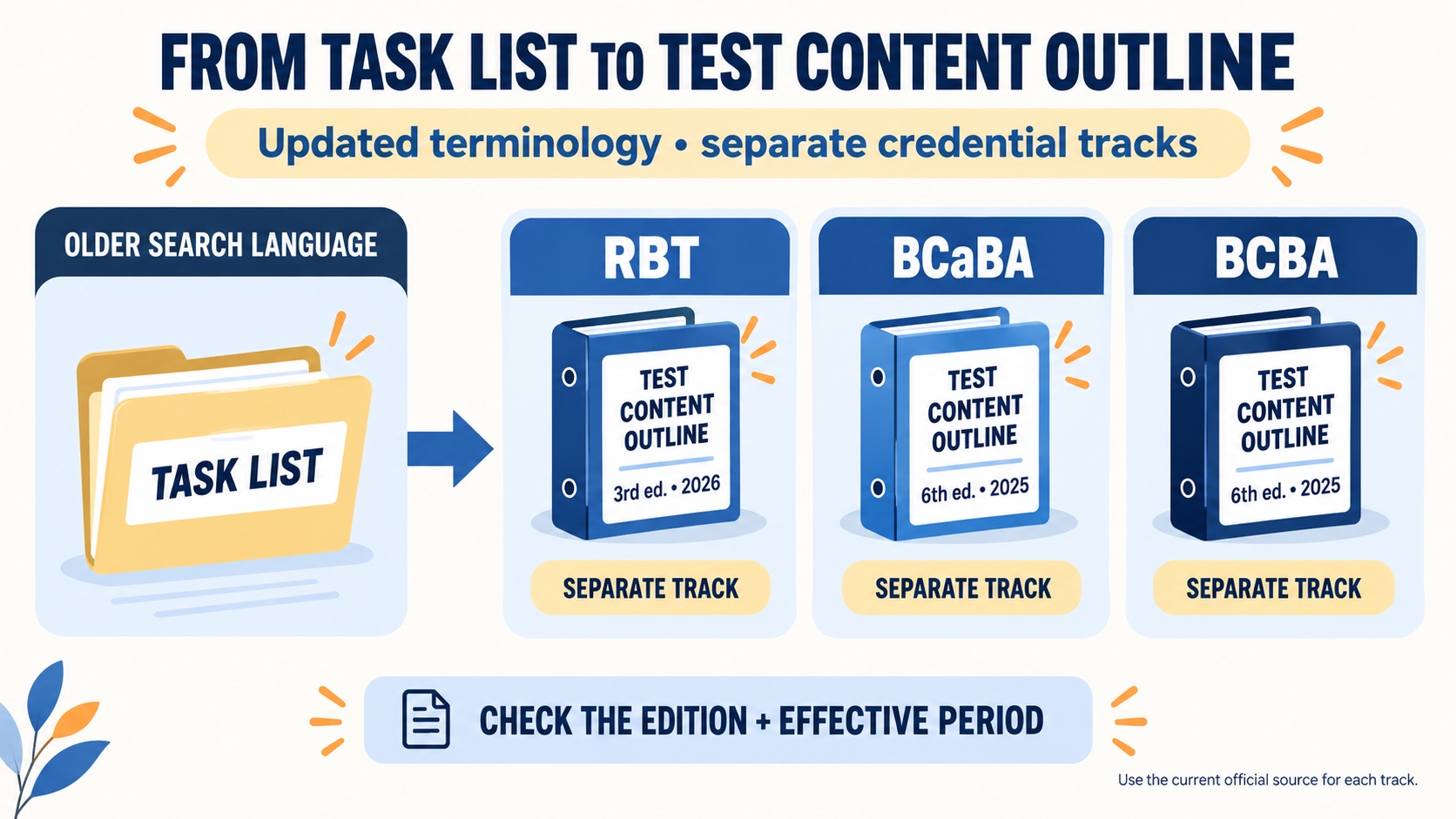
When an older resource uses task-list language, check four things before keeping it:
- Which track does it cover?
- Which edition and effective period does it name?
- Does it match the current BACB examination page?
- Is it being used for exam study, or is someone incorrectly presenting it as a handbook or practice standard?
The three current examination outlines
RBT, BCaBA, and BCBA are separate certification tracks. Their outlines should not be combined into one giant “ABA task list,” because the role, level, domains, and examination structure differ.
RBT Test Content Outline (3rd ed.)
The RBT Test Content Outline (3rd ed.) applies to RBT examination content beginning January 1, 2026. It organizes 43 tasks into six domains: Data Collection and Graphing, Behavior Assessment, Behavior Acquisition, Behavior Reduction, Documentation and Reporting, and Ethics. The BACB outline lists 75 scored questions and 10 unscored pilot questions.
Use the RBT study path when you need entry-level explanations, observable examples, and practice with measurement, teaching procedures, documentation, and professional conduct. Do not use the BCBA outline to fill in an RBT study gap simply because it contains more advanced terminology.
BCaBA Test Content Outline (6th ed.)
The BCaBA Test Content Outline (6th ed.) applies to the BCaBA examination beginning in 2025. It organizes 90 tasks across nine domains, including philosophical foundations, concepts and principles, measurement, experimental design, ethical and professional issues, assessment, behavior-change procedures, intervention development and monitoring, and supervisory relationships.
The BCaBA study path should therefore include more analysis and intervention reasoning than an RBT plan, while keeping supervision and role boundaries visible.
BCBA Test Content Outline (6th ed.)
The BCBA Test Content Outline (6th ed.) applies to the BCBA examination beginning in 2025. It organizes 104 tasks across nine domains: Behaviorism and Philosophical Foundations, Concepts and Principles, Measurement, Data Display, and Interpretation, Experimental Design, Ethical and Professional Issues, Behavior Assessment, Behavior-Change Procedures, Selecting and Implementing Interventions, and Personnel Supervision and Management.
The BCBA study path is the correct place to connect the outline with deeper reasoning about assessment, experimental control, intervention selection, ethics, and supervision. The BCBA Handbook remains a separate source for certification and examination procedures.
How to choose the right outline
Start with your intended or current credential, then confirm the source before you plan the week. This simple decision tree prevents the most common version mistake:
- Preparing for RBT? Open the current RBT outline and RBT Handbook.
- Preparing for BCaBA? Open the current BCaBA outline and BCaBA Handbook.
- Preparing for BCBA? Open the current BCBA outline and BCBA Handbook.
- Studying ABA generally? Choose one track as the anchor and label cross-track concepts instead of treating all three examinations as interchangeable.
Also check whether your question is about examination content or certification requirements. “What will be assessed?” points toward the Test Content Outline. “What education, fieldwork, or documentation do I need?” points toward the handbook and current requirements pages. “What should I do in a client situation?” may require the Ethics Code, supervision guidance, workplace policy, licensure rules, or qualified consultation.
How to turn an outline into a study plan
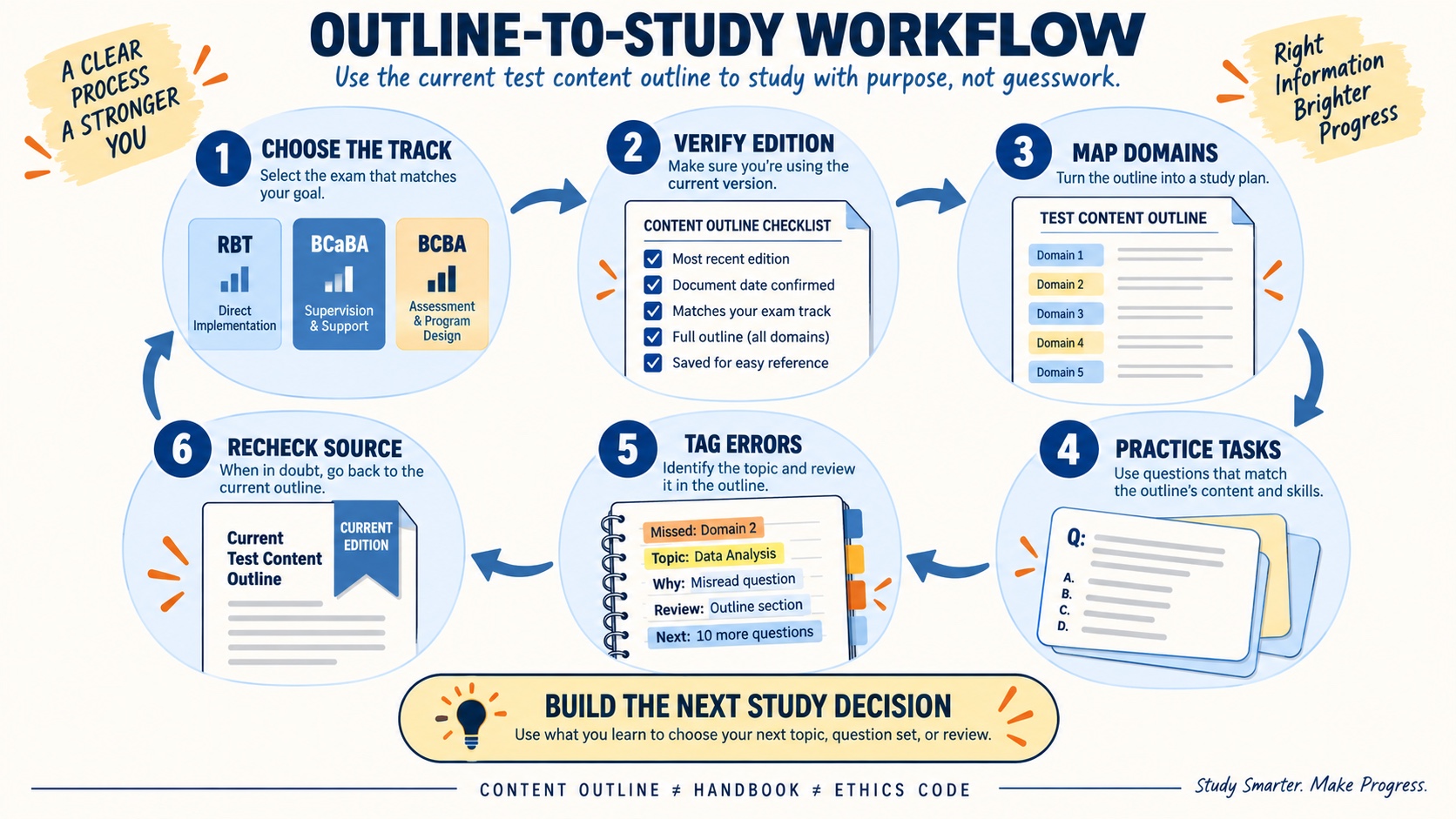
- Save the current source. Record the title, edition, effective period, and access date in your study notes.
- Build a domain map. List each domain, then group related tasks beneath it. Keep RBT, BCaBA, and BCBA maps in separate files.
- Translate tasks into observable study actions. “Distinguish” can become a comparison table and scenario set. “Implement” requires procedure steps, examples, and boundary checks. “Interpret” requires data or case reasoning.
- Practice the smallest useful unit. Work a short set tied to one domain, tag the error, and review the related concept instead of rereading the entire outline.
- Recheck version-sensitive questions. If a question mentions a date, edition, application route, fieldwork form, or examination structure, return to the current BACB page.
- Use an error log. Record whether the miss came from vocabulary, discrimination, measurement, scenario reading, task-list terminology, or an unsupported assumption.
A good outline-based plan is not a checklist where every item receives identical time. It is a map for choosing the next explanation, example, question, or source check. That is especially important when a high-volume concept appears in several domains or when a current transition makes older study material confusing.
Common BACB task-list study mistakes
- Using one “ABA task list” for every track: separate the credential paths before choosing practice material.
- Studying the search phrase instead of the source: use “task list” to find the question, then update the study file to the current outline name.
- Mixing examination content with eligibility rules: an outline does not tell you every application, education, fieldwork, or maintenance requirement.
- Assuming every task is a definition: verbs such as identify, distinguish, explain, interpret, select, and implement call for different practice formats.
- Treating a commercial guide as official: independent materials can organize practice, but they do not replace the BACB source or guarantee a result.
- Ignoring transition dates: a document that was accurate for an earlier examination period may be the wrong guide now.
Where 2027 requirements fit
The BACB has published 2027 BCBA and BCaBA requirements and transition guidance. Those resources concern future or changing certification requirements, such as eligibility, coursework, fieldwork, or related forms. They should be researched as a separate version-sensitive topic.
Do not rename the current BCBA Test Content Outline as a “7th edition” unless the BACB publishes and identifies that edition. A 2027 requirements page is not, by itself, evidence that the BCBA examination content outline has become a 7th edition. Keep a separate update note in your study system and link each claim to the exact official source that supports it.
For definitions, use the ABA Definition Search. For independent scenario practice, use the free question hub, and always return to the current BACB document when the answer depends on an edition or requirement.
BACB task list FAQ
Is there still a current BACB task list?
The BACB’s current examination documents are Test Content Outlines. People may still use “task list” as a search phrase or informal shorthand, but your study plan should identify the current outline and edition for the track you are studying.
Which outline should I use for the RBT exam?
Use the RBT Test Content Outline (3rd ed.) for examination content beginning January 1, 2026, together with the current RBT Handbook and official RBT resources.
Can I use the BCBA outline to study for the BCaBA exam?
It may help explain a shared ABA concept, but it is not a substitute for the BCaBA Test Content Outline. Keep the track, domain, role, and exam source clearly labeled.
Does the 2027 transition mean there is a BCBA 7th edition?
Do not assume that. Verify the current BACB announcement and the exact outline edition named by the BACB. Requirements changes and examination-content-outline editions are related topics, but one does not prove the other.
Is ABA Study Online’s task-list study content official?
No. ABA Study Online provides independent explanations, practice, and study tools. The BACB’s current Test Content Outlines, handbooks, and requirements pages remain the authoritative sources.