BACB Task List Definitions: How to Find the Right Current Source
When someone searches for BACB task list definitions, they are usually trying to solve a practical study problem: Which document applies to my credential, which edition is current, and how should I turn a technical task into something I can understand and practice? The answer begins with scope. A definition is useful only when it is tied to the right certification track, the right edition, and the right level of responsibility.
BACB materials may use the term Test Content Outline rather than a single universal “task list.” The official outline pages are the source of truth for the current credential-specific content map. This guide explains how to navigate those sources, paraphrase a task accurately, and avoid copying or mixing materials. It does not reproduce BACB documents, and it does not replace the official pages when requirements change.
Quick answer: what are BACB task list definitions?
A BACB task-list definition is a plain-language explanation of a credential-specific knowledge or practice area named in an official BACB content document. The definition should preserve the task’s meaning and boundaries without pretending to be the official wording. It should also tell you which credential and edition it belongs to.
For study purposes, a useful definition answers five questions:
- Which track does this task belong to: RBT, BCaBA, or BCBA?
- Which official outline or edition contains it?
- What behavior, measurement, procedure, or professional decision does it describe?
- What is the task not asking you to do?
- What short example would show that you understand the idea?
This approach is safer than memorizing an isolated sentence. The same broad topic, such as measurement, can appear across credential tracks while carrying different expectations for implementation, interpretation, supervision, or decision-making.
Task list, Test Content Outline, and study guide
A task list is a common learner-friendly name for a document that organizes the knowledge and skills associated with a credential. A Test Content Outline is BACB’s current terminology for the examination content map used for the applicable certification. The outline can organize domains and tasks without functioning as a complete textbook or a glossary of every term a learner may encounter.
A study guide is different. It is an educational resource that explains, illustrates, and practices content. A study guide may be helpful, but it is not automatically an official BACB source. It can also become outdated when an outline changes. Check the official BACB page first, then use a study guide to build understanding and retrieval practice.
These terms also have different jobs:
- Official outline: identifies the credential-specific exam content and current edition.
- Definition: explains a task or concept in clear language while preserving its scope.
- Example: shows how the idea might appear in a fictional learning or service situation.
- Practice question: asks you to discriminate between plausible options or apply the concept.
Confusing these jobs creates study errors. A definition is not a full procedure, an example is not a clinical recommendation, and a practice question is not evidence that a particular phrase is official.
Current credential and edition map
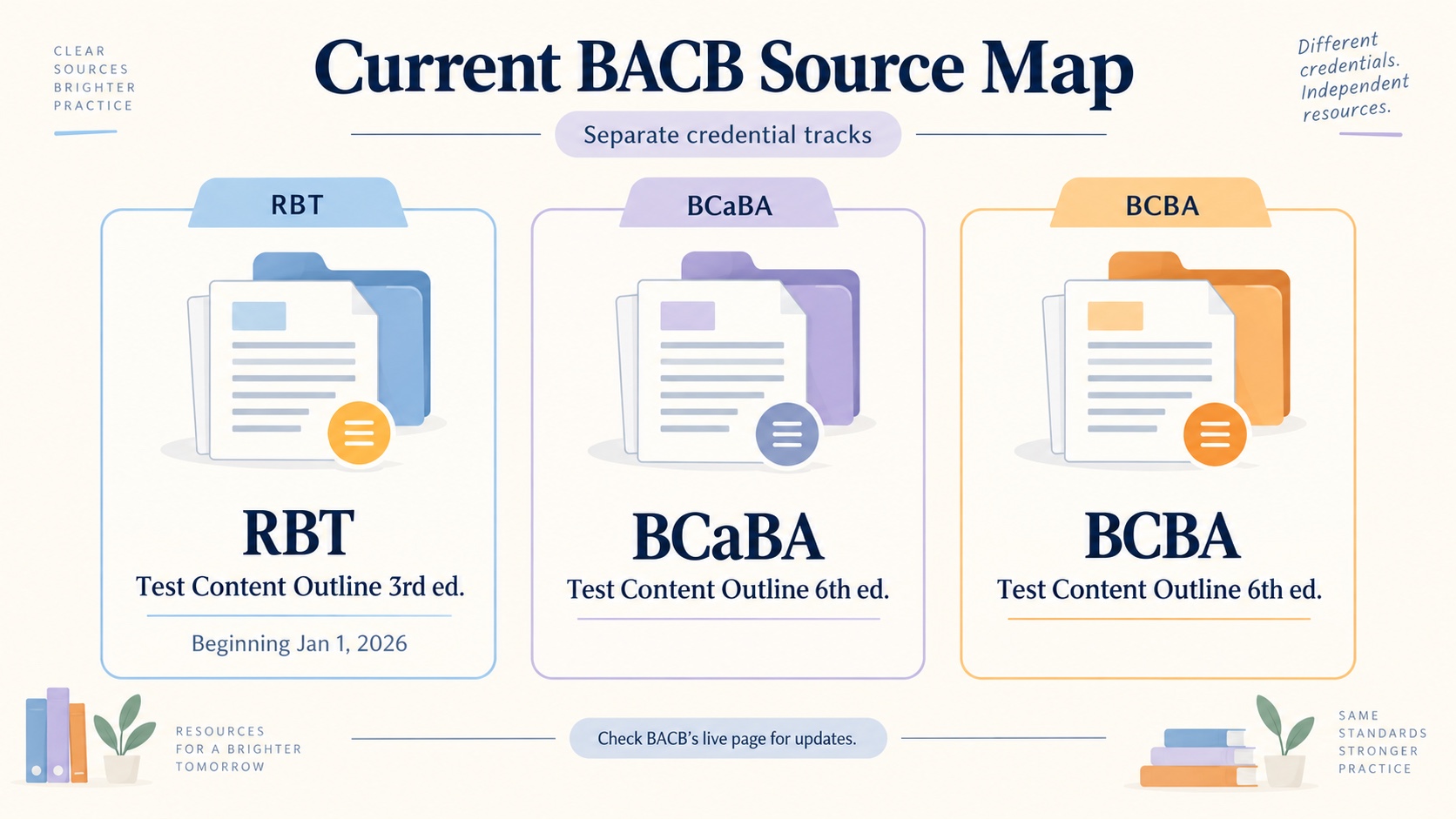
The current BACB Test Content Outlines page lists the following map at the time of this article’s research:
- RBT: the Test Content Outline, 3rd edition, begins January 1, 2026. The page also identifies the prior RBT Task List, 2nd edition, as applying through December 31, 2025.
- BCaBA: the Test Content Outline, 6th edition.
- BCBA: the Test Content Outline, 6th edition.
Edition information is date-sensitive. A search result, downloaded PDF, course handout, or social-media post may continue circulating after an official page changes. Before planning study content, open the current BACB outline page, confirm the credential, confirm the edition, and record the date you checked it. Do not assume that a future “7th edition” exists simply because a learner expects a reform or sees an unverified claim online.
The three tracks should remain separate even when their headings sound similar. RBT preparation focuses on the responsibilities and content defined for the RBT examination. BCaBA and BCBA preparation involve different credential expectations and outline scopes. A shared topic label is not permission to merge the tracks into one definition or one practice set.
How to read and study a task definition
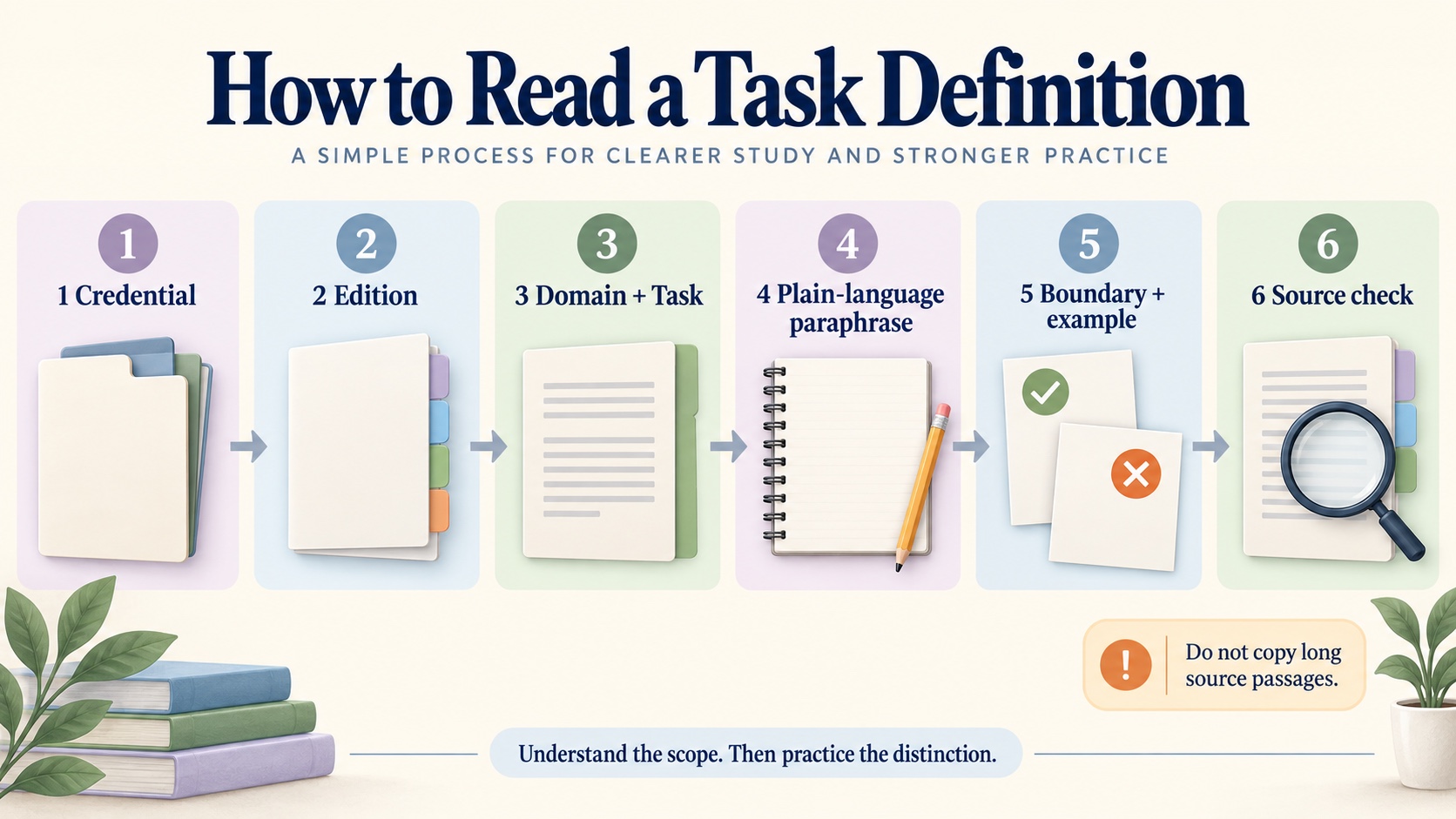
Use a six-step reading routine:
- Identify the credential. Write RBT, BCaBA, or BCBA at the top of your notes before you interpret the task.
- Confirm the edition. Link to the official BACB page or document you actually checked. If the edition is unclear, stop and verify it.
- Locate the domain and task. Keep the task in its official neighborhood. A measurement task should not quietly become a treatment-design task just because both appear in the same course.
- Paraphrase the job. Explain what the learner must recognize, perform, interpret, or decide using fresh language. Do not turn a paraphrase into a long reproduction of protected source text.
- Add a boundary and example. State one thing the task covers and one thing it does not establish. Then write a short fictional example that demonstrates the distinction.
- Run a source check. Compare your note against the current official source and remove unsupported claims, invented requirements, and track mixing.
A strong note is brief enough to retrieve but precise enough to prevent overgeneralization. One practical template is: “For the [credential] track and [edition], this task is about [plain-language job]. In a fictional example, [application]. It should not be confused with [nearby concept or different responsibility].”
A fictional measurement example
Suppose a learner is reviewing the word measurement. The learner should first ask which track and edition the study set is using. An RBT-oriented item may focus on accurately implementing an established measurement procedure and recording data as directed. A BCaBA or BCBA-oriented resource may require a different level of interpretation or planning, depending on the exact official task and the professional context. The broad word is shared; the task scope is not automatically shared.
A safe study note might say: “Measurement turns observable behavior into recorded data using a defined system. In this study set, check the credential-specific outline to determine whether the emphasis is selecting, implementing, interpreting, or evaluating the measurement process.” That note teaches the central idea without pretending that one generalized sentence replaces the official task.
Now add a fictional example: a team defines independent task starts as beginning the assigned step within 10 seconds of the instruction and records each opportunity using the agreed system. The example shows the relationship between an operational definition, an observable response, and a recording procedure. It does not establish that this exact definition or timing rule is required by BACB.
Common mistakes and a study checklist
- Mixing tracks: using an RBT explanation to answer a BCBA question without checking the task’s scope.
- Using an old edition: studying a saved document without confirming its effective period.
- Inventing a future edition: treating an unverified reform claim as an official BACB change.
- Copying instead of learning: reproducing long official passages rather than making a bounded paraphrase.
- Turning a definition into a recommendation: presenting a fictional example as a universal clinical procedure.
- Expecting one master list: assuming that every term, task, and responsibility belongs to every credential.
Before you keep a task-definition note, check:
- Did I name the credential and edition?
- Did I use the current official BACB source?
- Did I preserve the task’s scope rather than broaden it?
- Did I separate the definition, example, and personal study strategy?
- Did I avoid a certification promise, pass guarantee, or unsupported requirement?
For related study support, explore ABA Theory Blocks, use the free ABA questions for retrieval practice, or browse the ABA Definition Search. These are natural internal study links; this informational resource does not use a conversion CTA.
FAQ and official sources
Does BACB use the phrase “task list” for every current credential document? The current BACB materials use credential-specific Test Content Outline terminology, while older materials and learners may still say task list. Check the official page rather than relying on the label alone.
Is there one BACB definition list for RBT, BCaBA, and BCBA? No. The tracks have separate content outlines and should be studied separately, even when a topic appears in more than one track.
Is the BCBA outline a 7th edition? The official source reviewed for this article lists the BCBA Test Content Outline, 6th edition. Do not treat an unverified future-edition claim as current.
Can I copy the official outline into my study notes? Use the official source for verification and link to it, but write your own concise, accurate paraphrase instead of reproducing the document.