BACB Task List 7th Edition? Current TCO Status and 2027 Changes
If you searched for the BACB task list 7th edition, you are probably trying to avoid studying from an outdated outline. The question is understandable: BACB has published major 2027 changes for BCBA and BCaBA eligibility and maintenance, while many search results still use older “task list” language.
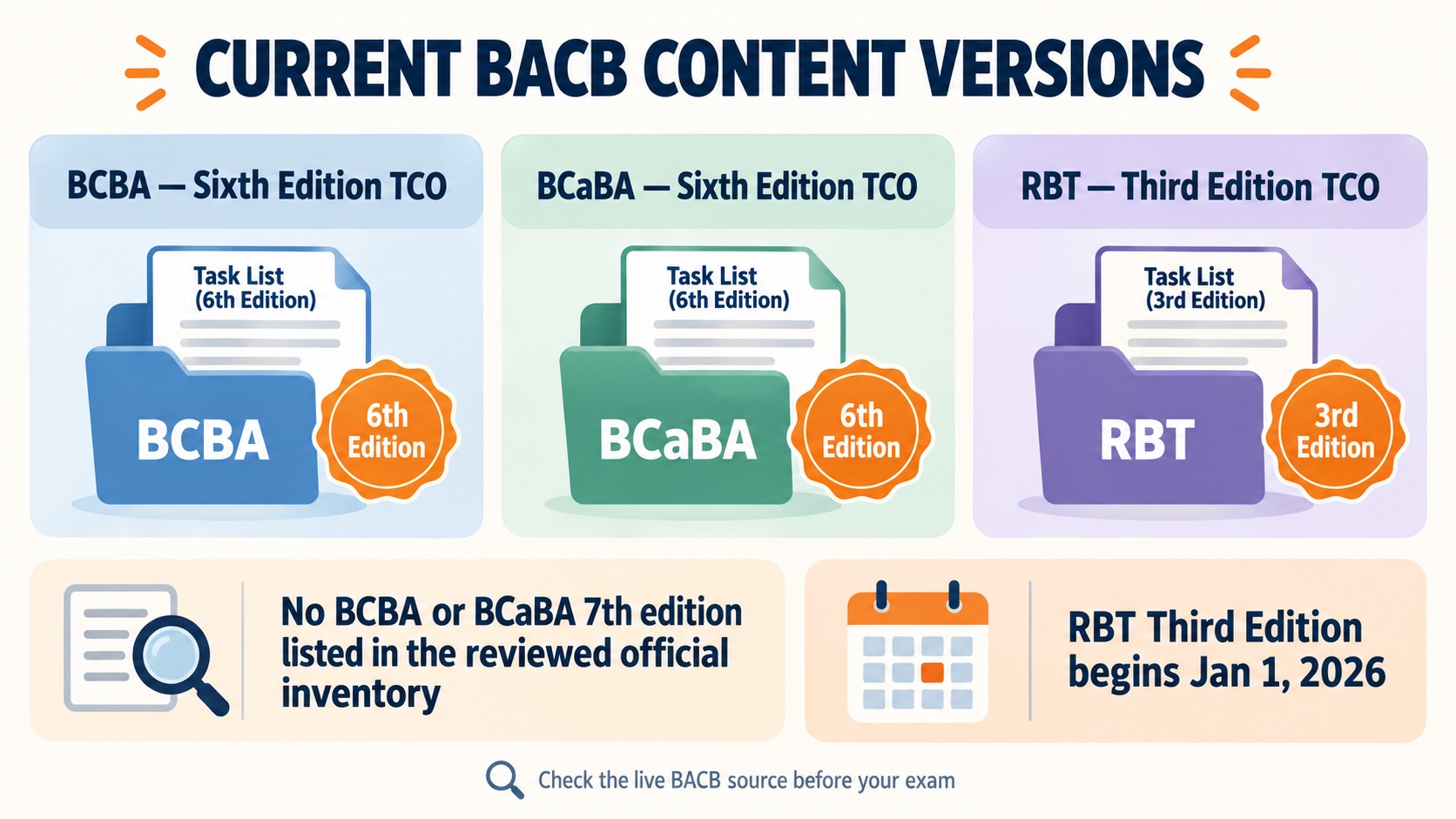
Based on the official BACB pages reviewed on September 27, 2026, no BCBA or BCaBA seventh edition is listed in the current source inventory. The current BCBA and BCaBA exam-content materials are Sixth Edition Test Content Outlines. The 2027 announcements describe qualification and maintenance changes; they do not, by themselves, announce a seventh-edition exam outline.
Table of Contents
Short answer: is there a BACB 7th edition?
No BCBA or BCaBA seventh-edition TCO is listed in the current official BACB source inventory reviewed on September 27, 2026. The current materials to verify are the BCBA Sixth Edition TCO and the BCaBA Sixth Edition TCO. This is a time-bounded source check, not a claim that BACB could never publish a future edition.
That wording matters because “not currently listed” and “will never be released” are different claims. BACB controls the official examination materials and can update its pages. Before you apply, schedule an exam, or buy a new study resource, open the live BACB page and confirm the edition shown for your credential.
If a search result says “new task list,” look for the credential, edition number, effective date, and direct BACB source before treating it as an update. Those four details usually resolve the confusion quickly.
What the current BACB pages list
The BACB’s current Test Content Outlines page lists the BCBA Test Content Outline as Sixth Edition and the BCaBA Test Content Outline as Sixth Edition. It also lists the RBT Test Content Outline as Third Edition beginning January 1, 2026. That is why a searcher should not treat every “new edition” headline as a BCBA or BCaBA update.
The BACB task-list page uses a related transition description. The BCBA and BCaBA Sixth Edition TCOs are effective January 1, 2025. For RBT, the Second Edition Task List applies through December 31, 2025, and the Third Edition TCO begins January 1, 2026. RBT’s 2026 transition is real, but it is a separate credential track from the BCBA and BCaBA version question.
Task list versus Test Content Outline
Older study conversations often say “task list” because earlier BACB materials were organized and discussed using that term. Current pages may instead use Test Content Outline, or TCO. A TCO describes the content areas and tasks the exam is designed to assess. It is not the same thing as an eligibility handbook, a university course sequence, or a list of every question that can appear on an exam.
This distinction helps explain why a page can mention a “sixth edition task list” even when the current BACB page labels the document a Sixth Edition TCO. The practical study question is not which phrase appears in an old forum post. It is which current official TCO and handbook the BACB identifies for your credential and exam date.
For BCBA and BCaBA preparation, use the current TCO as the content map, then use the current handbook and certification page for application, authorization, and exam rules. For RBT preparation, use the RBT materials that apply to the current date and credential. Do not move a BCBA domain list into an RBT study plan just because both pages use the word “task.”
What the 2027 changes actually change
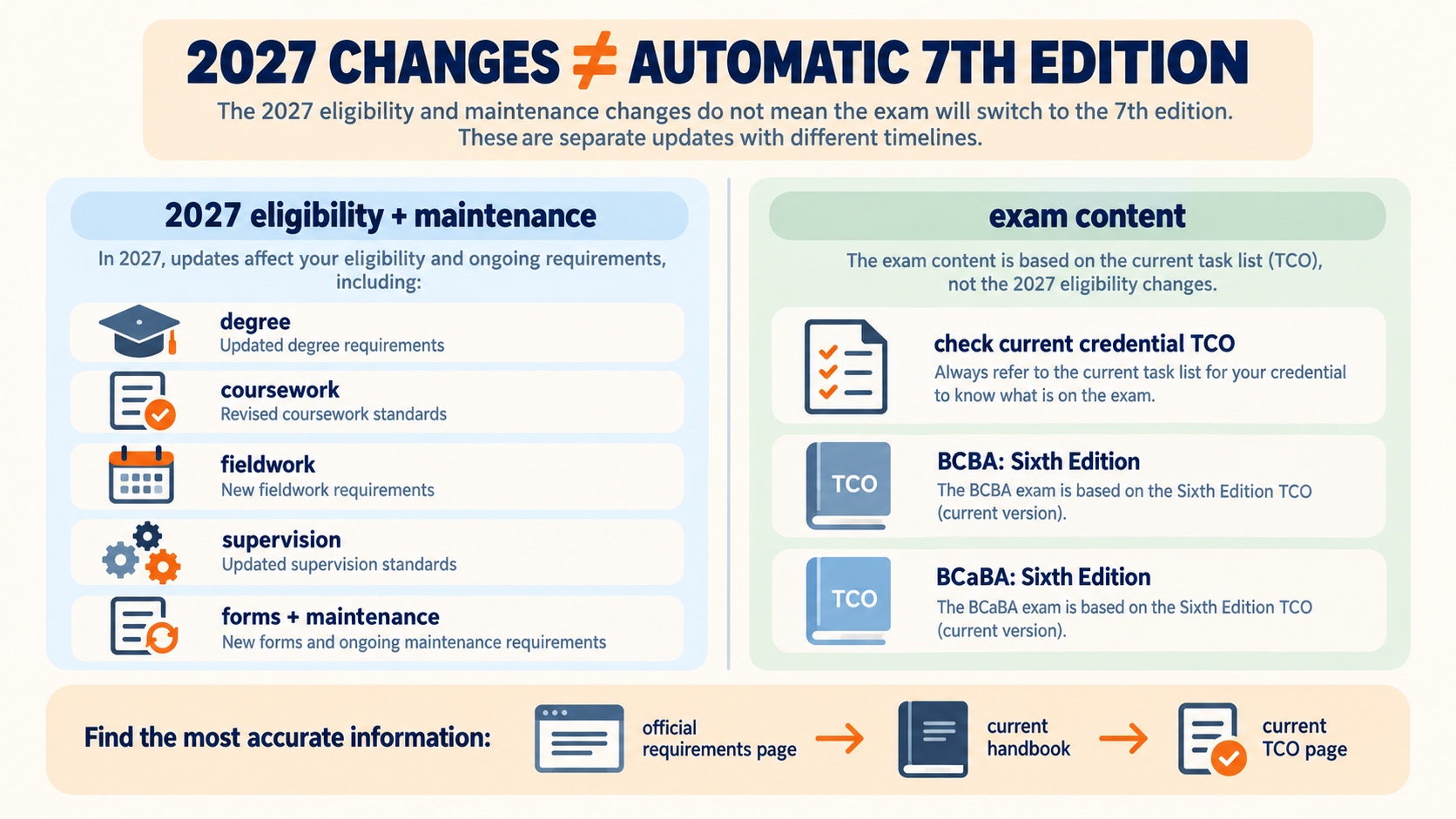
BACB’s 2027 announcements focus on the route into and through BCBA or BCaBA certification. Depending on the credential and pathway, the changes address degree requirements, coursework, fieldwork, supervision, application timing, forms, or maintenance expectations. Those are important changes for candidates and certificants, but they answer a different question from “What content outline does the exam assess?”
A useful mental model is to keep two columns. In the eligibility and maintenance column, record the degree, coursework, fieldwork, supervision, documentation, and transition deadlines that apply to your pathway. In the exam-content column, record the current TCO named by BACB for the credential. A 2027 change in the first column does not automatically create a seventh-edition label in the second column.
For example, a candidate might discover that a 2027 pathway requires a different coursework or fieldwork record. That discovery changes the candidate’s application plan. It does not tell the candidate to replace the current BCBA content outline with an unofficial “7th edition” packet. The application checklist and the study outline should be updated from their respective BACB sources.
The current BCBA Handbook says the examination assesses the BCBA TCO (6th ed.) and explains that candidates test under the current edition. It also describes what happens if a new edition takes effect during an active authorization period. That implementation language is the reason to monitor the live handbook and TCO pages instead of inferring an edition change from a social post or a course advertisement.
Which edition should you study?
Start by naming your credential and the date that controls your exam. A BCBA candidate should open the current BCBA Handbook and BCBA TCO page. A BCaBA candidate should open the current BCaBA certification and TCO pages. An RBT candidate should use the current RBT handbook and TCO, including the Third Edition transition that began January 1, 2026.
Then separate content study from administrative planning. Build your concept review from the TCO. Build your application checklist from the handbook and the pathway page. If you are aiming for a 2027 application or maintenance transition, add the applicable 2027 requirements page to your checklist. This prevents a candidate from buying a “7th edition” product that has not been tied to an official BACB announcement.
ABA Study Online can help you organize review by track: use the BCBA learning path, BCaBA learning path, or RBT learning path after confirming the official source version. Practice questions and app review can support retrieval and scenario work, but they do not replace the current BACB handbook, TCO, application instructions, or official exam policies.
A three-source version-check workflow
- Check the credential page: confirm that you are looking at BCBA, BCaBA, or RBT material rather than a neighboring track.
- Check the current handbook: look for the edition named for the exam and for rules about current-edition implementation, authorization, and exam scheduling.
- Check the TCO or task-list page: record the edition label, effective date, and any transition note. Save the page date or download the current document for your study records.
Finally, compare the page date with the date on the study product. A product can be useful for concepts and practice while still using an outdated edition label. If the two sources disagree, pause and use the BACB source as the authority. Recheck shortly before submitting an application or sitting for the exam.
A simple record can make that recheck easier: write down the credential, the exam date or authorization window, the TCO edition, the handbook version, and the date you checked each source. If a course, flashcard deck, mock exam, or video uses a different label, ask whether it is teaching stable concepts, covering a former outline, or claiming alignment with a new official edition. That small habit keeps a confusing search phrase from steering your entire study plan.
BACB edition FAQ
Is the BACB changing to a 7th edition in 2027?
The official BACB pages reviewed on September 27, 2026 describe 2027 eligibility and maintenance changes, but do not list a BCBA or BCaBA seventh-edition TCO. Check the live BACB TCO and handbook pages for later updates.
What is the current BCBA task list edition?
The current official material is labeled the BCBA Sixth Edition Test Content Outline, effective January 1, 2025 in the BACB transition materials reviewed for this article.
What is the current BCaBA task list edition?
The current official material is labeled the BCaBA Sixth Edition Test Content Outline, effective January 1, 2025 in the BACB transition materials reviewed for this article.
Is RBT part of the BCBA 7th edition update?
No. RBT has its own content-outline track. The BACB materials reviewed here identify the RBT Third Edition TCO as beginning January 1, 2026. Keep RBT resources separate from BCBA and BCaBA resources.
Can I study from a course called “BACB 7th edition”?
Verify the course’s edition claim against the current BACB TCO and handbook before purchasing or relying on it. A marketing title is not an official edition announcement.