BACB Task List 6th Edition: What the Current TCO Means for BCBA, BCaBA, and RBT
If you searched for “BACB task list 6th edition,” you are probably trying to find the right exam blueprint for your track. The confusing part is that the phrase sounds like one document for every BACB credential. It is not. The BACB now uses the name Test Content Outline (TCO) for its current examination blueprints, and the edition depends on the credential.
For current study planning, the short version is this: BCBA uses the 6th-edition TCO, BCaBA uses the 6th-edition TCO, and RBT uses the 3rd-edition TCO beginning in 2026. The older RBT Task List 2nd edition is listed through December 31, 2025. The safest plan is to choose your track first, open the matching current outline, and build your notes from that document rather than combining task names from different credentials.
This guide explains the naming difference, the current task and question maps, and a practical way to turn an outline into daily study sessions. It is an independent study article, not a BACB publication, an official question bank, an eligibility determination, or a promise of examination results.
Table of Contents
What “6th edition” means now
“Task list” remains a familiar search phrase because earlier BACB materials used task-list language. The current official index, however, distinguishes among credential-specific Test Content Outlines. A TCO describes the content areas and tasks that organize an examination. It is an exam map: useful for deciding what to learn and how to distribute review, but not a complete course, textbook, or collection of released questions.
That distinction matters because the same letter or task number does not automatically mean the same thing across tracks. A BCBA learner, a BCaBA learner, and an RBT learner should each use the outline for the examination they are preparing for. Even when two outlines share broad ideas such as measurement, assessment, intervention, or ethics, the role boundary and task wording can be different.
Start with the BACB’s current Test Content Outlines index. Then download the outline for your credential and check its beginning date. Keep a copy of the version you used in your study notes, especially when you are studying across a transition year.
BCBA TCO 6th edition
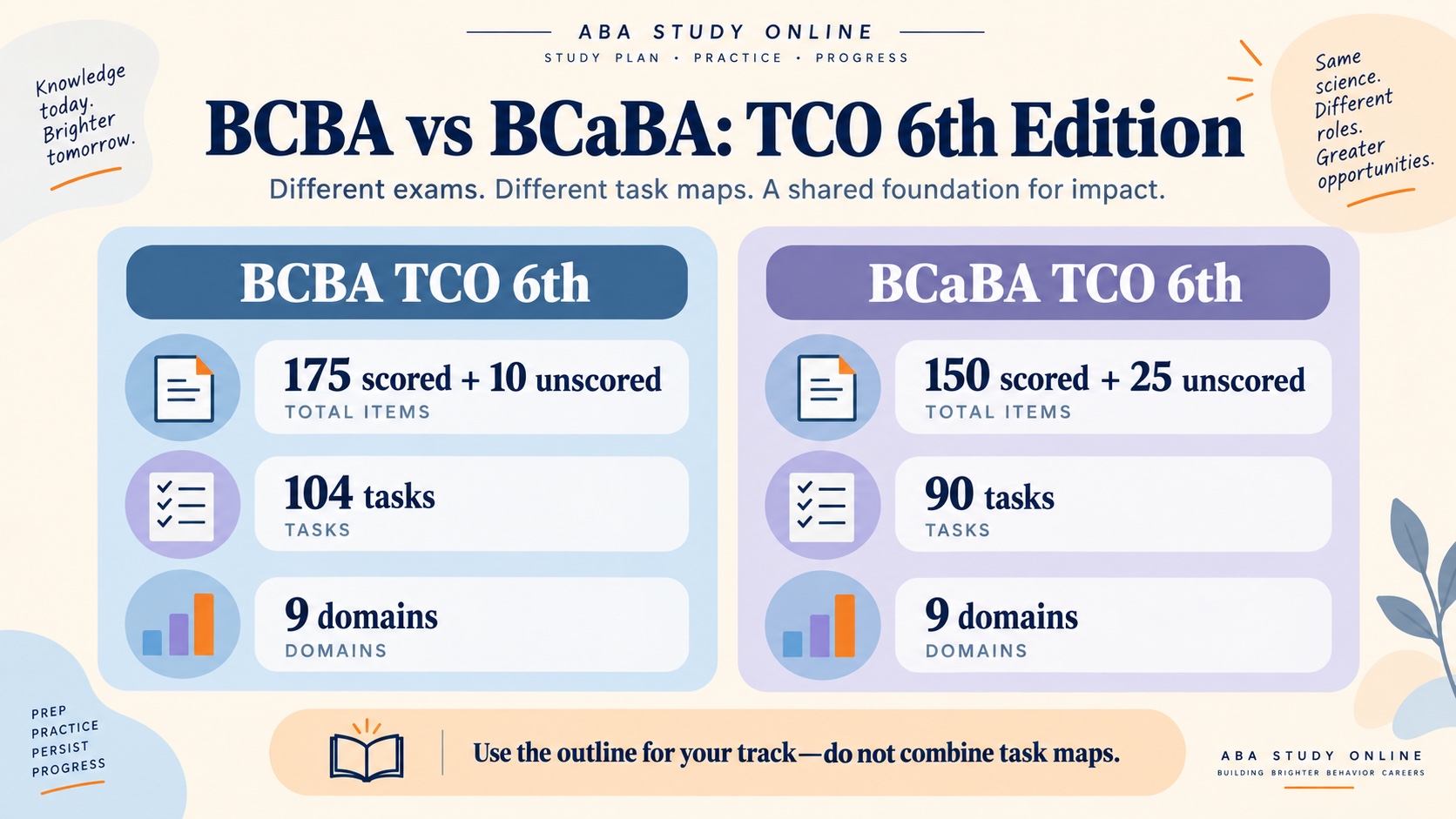
The BCBA Test Content Outline, 6th edition, begins in 2025. It organizes the examination around 104 tasks in nine domains. The outline lists 175 scored questions and 10 unscored questions. Those numbers help you understand the blueprint; they do not mean that every task receives one question or that you can calculate a personal pass score from the domain percentages.
The nine BCBA domains are:
- A — Foundations: 5%.
- B — Concepts and Principles: 14%.
- C — Measurement, Data Display, and Interpretation: 12%.
- D — Experimental Design: 7%.
- E — Ethics: 13%.
- F — Behavior Assessment: 13%.
- G — Behavior-Change Procedures: 14%.
- H — Selecting and Implementing Interventions: 11%.
- I — Personnel Supervision and Management: 11%.
Use those percentages as a planning signal, not as a reason to ignore the smaller domains. A sensible BCBA review cycle gives more repeated retrieval practice to the larger domains while still touching Foundations and Experimental Design every week. Within a domain, work task by task. For example, instead of writing “study assessment,” write the exact task, define the relevant terms, create a short applied scenario, and explain what evidence would justify the decision.
The BCBA outline is especially useful when your notes have become too broad. “Know functional assessment” is not a study action. “Explain what information a descriptive assessment can and cannot establish, then choose the next assessment step in a scenario” is a study action. The TCO helps you make that shift from a large subject label to observable learning targets.
For a broader learning path, you can pair the outline with the BCBA theory blocks, use BCBA practice questions to rehearse applied reasoning, and check unfamiliar vocabulary in the ABA Definition Search. Those are independent study resources; the BACB outline remains the source for the official blueprint.
BCaBA TCO 6th edition
The BCaBA Test Content Outline, 6th edition, also begins in 2025, but it is not a shortened copy of the BCBA outline. It organizes 90 tasks across nine domains and lists 150 scored questions plus 25 unscored questions. The track has its own role expectations, task wording, and domain distribution.
The current BCaBA domain percentages are:
- A — Foundations: 7%.
- B — Concepts and Principles: 12%.
- C — Measurement, Data Display, and Interpretation: 13%.
- D — Experimental Design: 7%.
- E — Ethics: 12%.
- F — Behavior Assessment: 11%.
- G — Behavior-Change Procedures: 15%.
- H — Selecting and Implementing Interventions: 13%.
- I — Supervisory Relationships: 10%.
The last domain is a useful reminder that track labels are not interchangeable. A BCaBA learner should not simply import the BCBA supervision-and-management map and assume it covers the same content. Begin with the BCaBA TCO, then organize examples around the responsibilities and supervision context that the BCaBA track describes.
A practical BCaBA notebook might have one page for each domain and a smaller row for each task. For every row, record four things: the plain-language meaning, one concrete ABA example, the evidence or measurement involved, and the mistake you are most likely to make. When a practice question exposes a gap, send the error back to the task row instead of creating an unrelated pile of missed questions.
You can use the BCaBA study path, free BCaBA practice questions, and the free resources library as supporting study surfaces. None of those pages changes the official examination blueprint or decides whether an individual applicant meets certification requirements.
Why RBT is not a 6th-edition task list
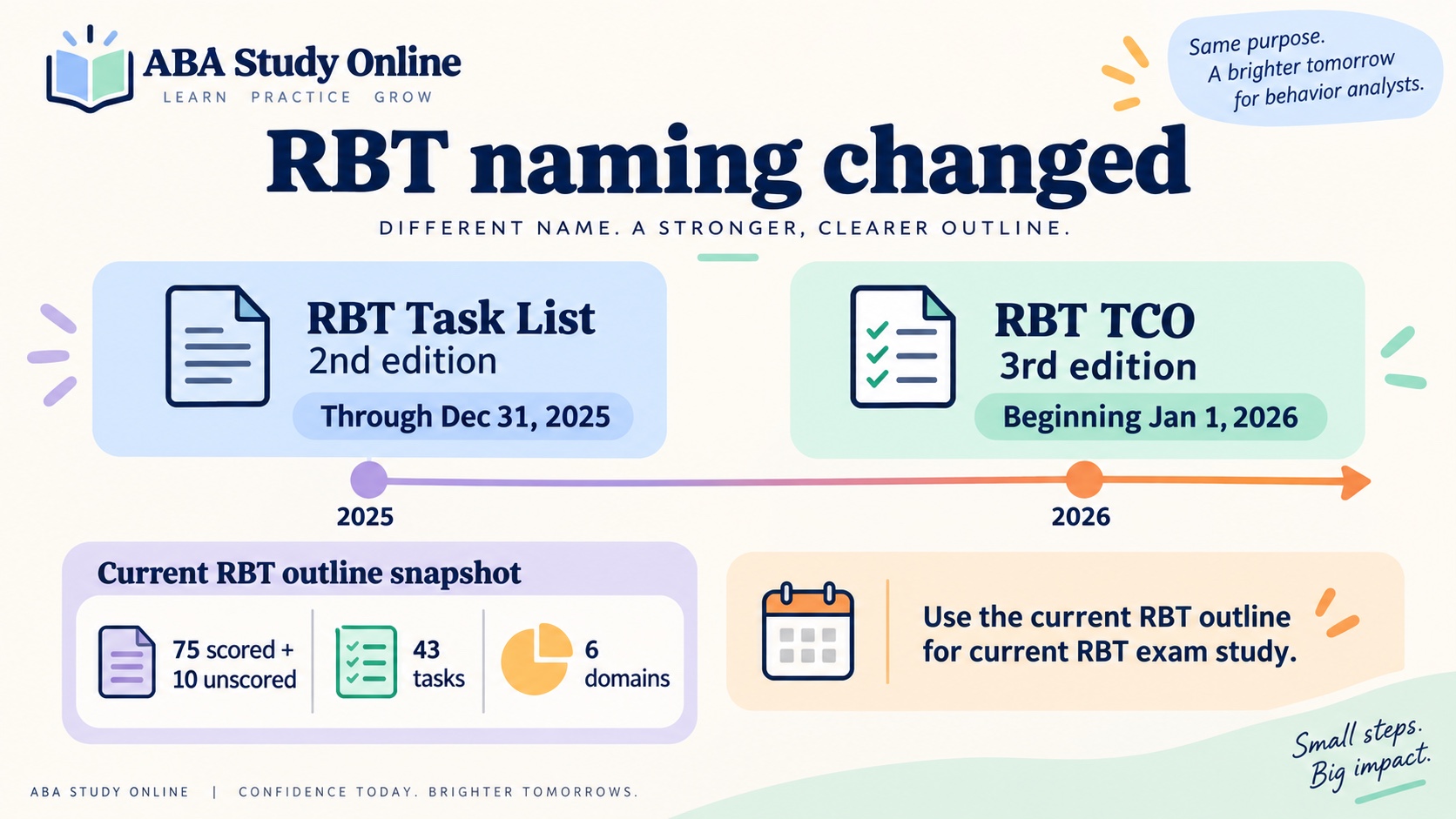
RBT is the place where the search phrase causes the most confusion. The BACB index lists the RBT Task List, 2nd edition, through December 31, 2025. Beginning January 1, 2026, the current RBT blueprint is the RBT Test Content Outline, 3rd edition. Calling the current RBT outline “the 6th edition” mixes it with the BCBA and BCaBA editions.
The RBT TCO 3rd edition lists 75 scored questions and 10 unscored questions, with 43 tasks across six domains:
- A — Data Collection and Graphing: 17%.
- B — Behavior Assessment: 11%.
- C — Behavior Acquisition: 25%.
- D — Behavior Reduction: 19%.
- E — Documentation and Reporting: 13%.
- F — Ethics: 15%.
The large C and D percentages may influence review time, but they do not erase documentation, reporting, or ethics. A good RBT study plan still rotates through all six domains and keeps role boundaries visible. The current RBT Handbook is also important because the examination outline and the handbook answer different questions: the TCO maps exam content, while the handbook explains certification and examination processes.
If you are preparing for RBT, the RBT learning path and RBT practice questions can help you rehearse concepts. Keep the current BACB documents open when you study so that a practice explanation does not quietly become a claim about official exam content.
How to turn a TCO into a study plan
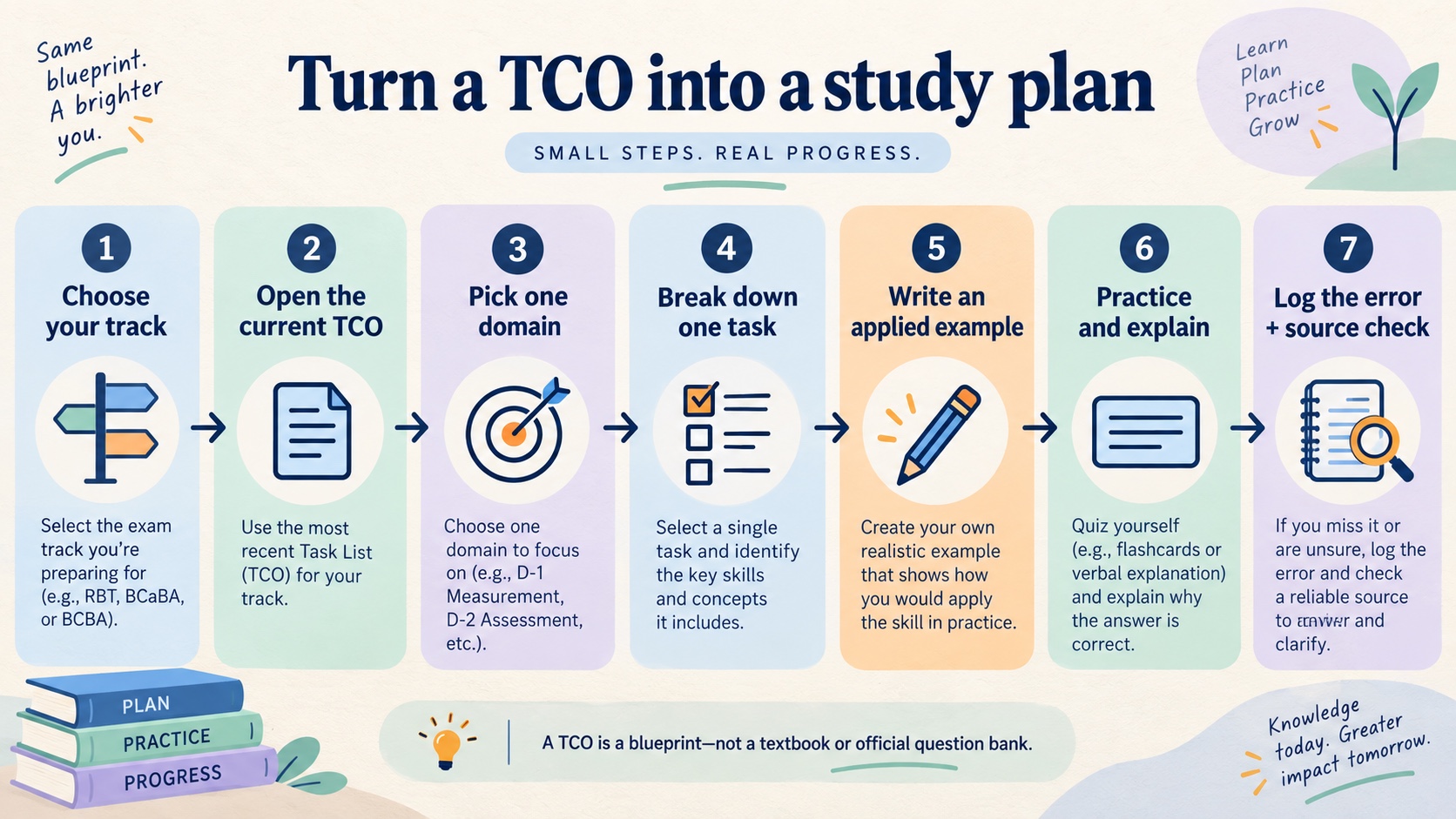
A TCO is most useful when it becomes a repeatable study loop. You do not need to read all the task language once and hope it stays in memory. Instead, make each task produce a small, checkable piece of work.
- Choose your track. Write RBT, BCaBA, or BCBA at the top of the session. This prevents a familiar term from pulling you into the wrong outline.
- Open the current TCO. Verify the edition and beginning date. Save the official link in your notes.
- Pick one domain. Use the domain percentages to plan rotation, but choose a manageable focus for the session.
- Break down one task. Circle the action words. Ask what a learner would have to define, select, measure, implement, document, or explain.
- Write an applied example. Create a short scenario with observable behavior, a setting, a decision point, and enough evidence to support one answer.
- Practice and explain. Answer an original question, then explain why the best answer fits the task and why the distractors do not.
- Log the error and check the source. Record the task, the mistaken assumption, and the next review action. If the question involves a current rule, verify it against the relevant BACB handbook or page.
For example, a measurement task should not end with a vocabulary flashcard alone. Define the dimension, choose a measurement procedure for a small scenario, explain what the resulting data can support, and identify one limitation. That sequence turns recognition into applied reasoning. It also gives you a clear way to diagnose whether the problem was terminology, measurement selection, data interpretation, or reading the scenario too quickly.
What the TCO does not tell you—and where 2027 fits
The outline does not tell you whether a specific course, degree, fieldwork record, supervisor relationship, application, or jurisdictional requirement qualifies for certification. It also does not provide official exam questions or guarantee that a certain number of practice items will appear. Those questions belong to the relevant BACB handbook, application instructions, current requirements, and other official communications.
The 2027 changes create another reason to separate documents. Current BCBA and BCaBA transition information addresses eligibility, coursework, fieldwork, maintenance, and related requirements. A change in certification requirements does not automatically mean that the examination outline has become a 7th edition. Do not relabel the current BCBA or BCaBA TCO until the BACB publishes a new outline or a clear examination announcement.
In practical terms, keep two columns in your planning notes: “exam blueprint” and “certification requirements.” Put the BCBA or BCaBA TCO in the first column. Put the current handbook and dated transition instructions in the second. For RBT, keep the 2026 TCO 3rd-edition boundary visible. This simple separation prevents a future eligibility change from being mistaken for a new exam content edition.
Common mistakes and FAQ
Is there one BACB task list 6th edition for all credentials?
No. BCBA and BCaBA currently use 6th-edition TCOs, while RBT uses the 3rd-edition TCO beginning in 2026. Always attach the credential to the edition name.
Can I use the BCBA TCO to study for the BCaBA exam?
Use the BCaBA TCO as your controlling exam map. The BCBA outline may help you explore a shared concept, but it should not replace the BCaBA task wording, domain distribution, or role context.
Does a higher domain percentage mean I can skip the other domains?
No. Percentages can help you distribute repetition, but every domain remains part of the blueprint. A smaller domain can still expose a foundational gap or a role-boundary mistake.
Is a TCO the same as a study guide?
No. It is a content outline. Use it to build a study plan, then use reliable instruction, examples, practice, and source checks to learn the concepts.
Is there a BCBA 7th edition because the rules change in 2027?
Do not assume that. The public 2027 materials concern certification requirements and transition rules. Use the BACB’s current examination and TCO pages for any announced exam-outline change.
Where should I start on ABA Study Online?
Start with the official outline for your track, then use the relevant ABA theory blocks, free question sets, glossary, and app study loop to practice retrieval. Treat those as independent learning support, not as BACB-endorsed or official examination material.