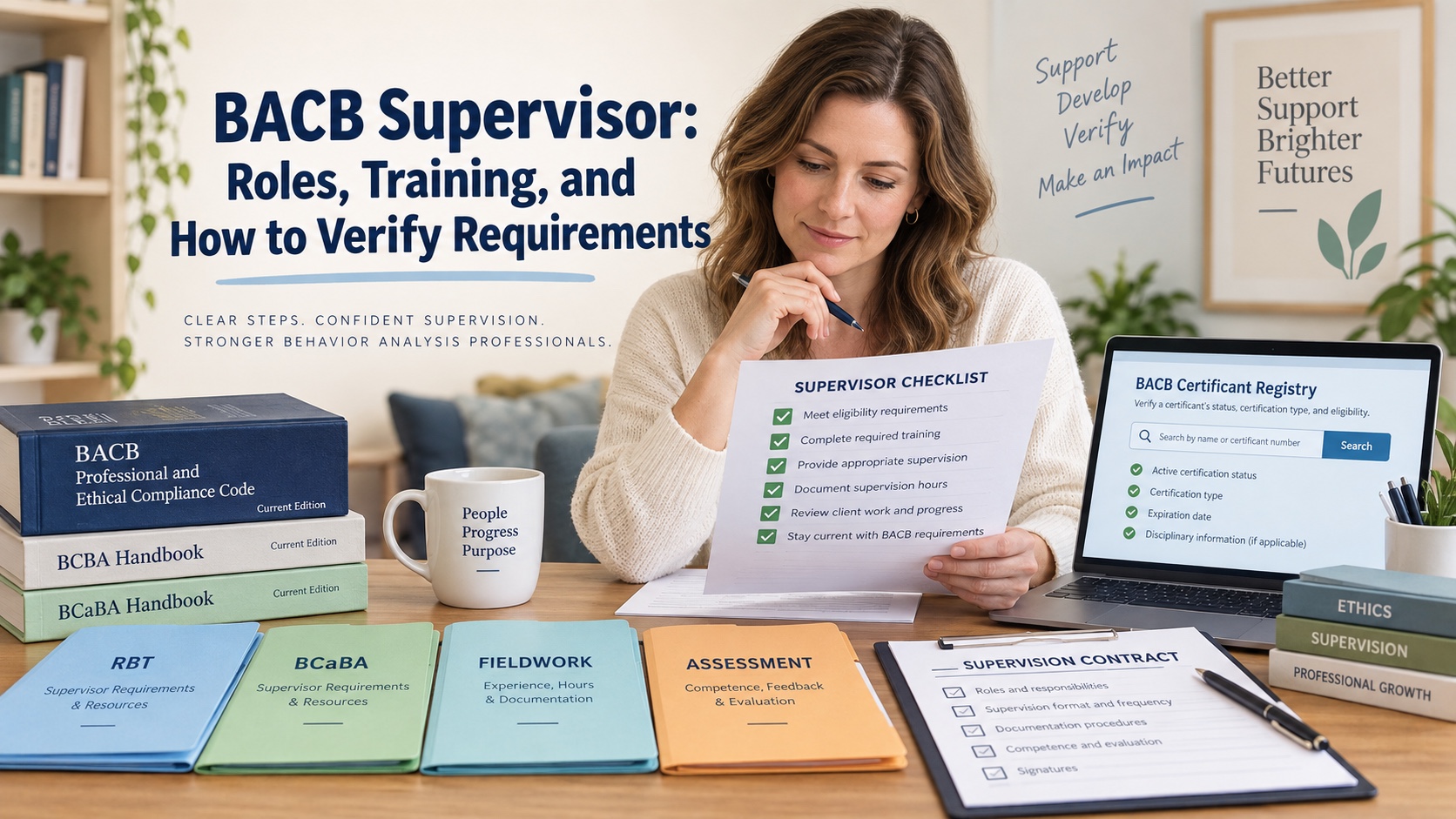
BACB Supervisor: Roles, Training, and How to Verify Requirements
The phrase BACB supervisor sounds like the name of one credential, but it usually describes a person who supervises behavior-analytic services, assesses or trains RBTs, or oversees fieldwork for someone pursuing certification. The correct requirements depend on what the person is supervising and which credential or pathway is involved.
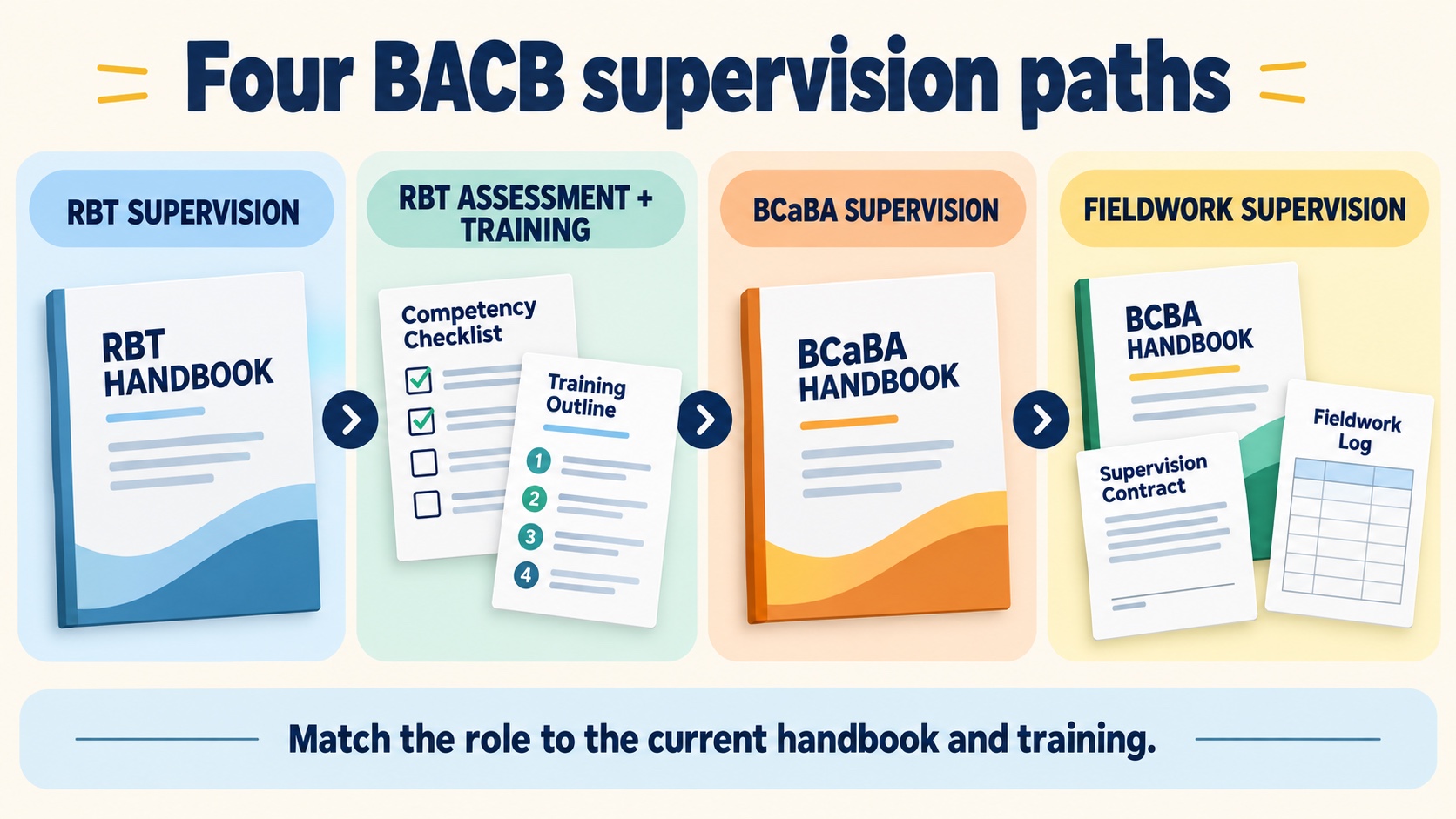
The BACB’s current supervision guidance separates several roles that are easy to blur together: supervising RBTs, assessing RBT competency, training RBTs, supervising BCaBAs, and supervising trainees who are accruing BCBA or BCaBA fieldwork. The safest approach is to identify the role first, open the corresponding handbook or official resource, and then verify the person, training, contract, client relationship, records, and applicable state rules.
Quick answer: a BACB supervisor is a qualified person overseeing behavior-analytic services, RBT or BCaBA supervision, RBT assessment or training, or supervised fieldwork. It is not a separate universal certification called “BACB Supervisor.” A person’s credential, role, training, client relationship, contract, documentation, and current BACB requirements all matter. Confirm the exact role before assuming that one supervision arrangement satisfies another.
The four supervision and oversight paths
The BACB’s Supervision, Assessment, Training, and Oversight page presents a useful role map. The responsible professional and official resources can differ by path.
1. Supervising RBTs
RBT supervision concerns an RBT who is providing behavior-analytic services under ongoing supervision. The BACB identifies a BCBA or BCaBA as possible RBT Supervisors in the relevant role structure, with additional details in the current RBT Handbook. Organizations may also use an RBT Requirements Coordinator to help oversee supervision systems. The exact arrangement, required contacts, observations, documentation, and qualifications should be checked in the current handbook rather than inferred from a job title.
2. Assessing or training RBTs
RBT competency assessment and RBT 40-hour training are different tasks from ongoing RBT supervision. The BACB lists BCBA and BCaBA roles for these functions and provides separate competency-assessment packets and a current 40-hour training curriculum outline. Some tasks may be delegated to qualified and proficient assistant assessors or trainers with oversight from the responsible BCBA or BCaBA, who remains responsible for the applicable sign-off. Do not treat helping with a skills check as permission to conduct every assessment or certify every competency independently.
3. Supervising BCaBAs
BCaBA supervision is governed by the BCaBA Handbook’s ongoing-supervision provisions. The BACB’s supervision page identifies BCBA and, when the additional requirements are met, licensed or registered psychologists as possible supervisors for BCaBAs. The role is not interchangeable with an RBT supervisor role. Read the current BCaBA Handbook for the supervision relationship, documentation, and any additional qualification rules.
4. Supervising BCBA or BCaBA fieldwork
Fieldwork supervision is for trainees accruing supervised experience toward BCBA or BCaBA certification. BCBA fieldwork supervision and BCaBA fieldwork supervision have their own handbook sections and forms. The supervisor must meet the applicable qualification criteria, connect the fieldwork to relevant client programming and learning opportunities, establish the supervisory relationship, observe and provide feedback, and sign only what can be supported by the records.
When 8-hour supervision training matters
The BACB states that supervisors who oversee people acquiring fieldwork for BCBA or BCaBA certification, and supervisors of current BCaBA or RBT certificants who require ongoing supervision, must complete an 8-hour supervision training based on the Supervisor Training Curriculum Outline (2.0) before providing the applicable supervision. The current outline also states that, as of January 1, 2026, this training may only be offered by ACE Providers or eligible Verified Course Sequences, subject to the current provider requirements.
The training requirement is important, but it does not answer every qualification question. Completing eight hours does not by itself make a person eligible to supervise every role, create a valid fieldwork relationship, satisfy state licensure law, or prove competence with every client population. It is one part of a larger verification process.
The curriculum focuses on creating an effective supervisory relationship. Relevant learning areas include contracts and expectations, goals, performance assessment, behavioral skills training, feedback, documentation, cultural responsiveness, and data-based decisions about supervisory practices. A responsible supervisor should be able to connect these topics to the actual supervisee, client context, role, and records.
How to verify a supervisor
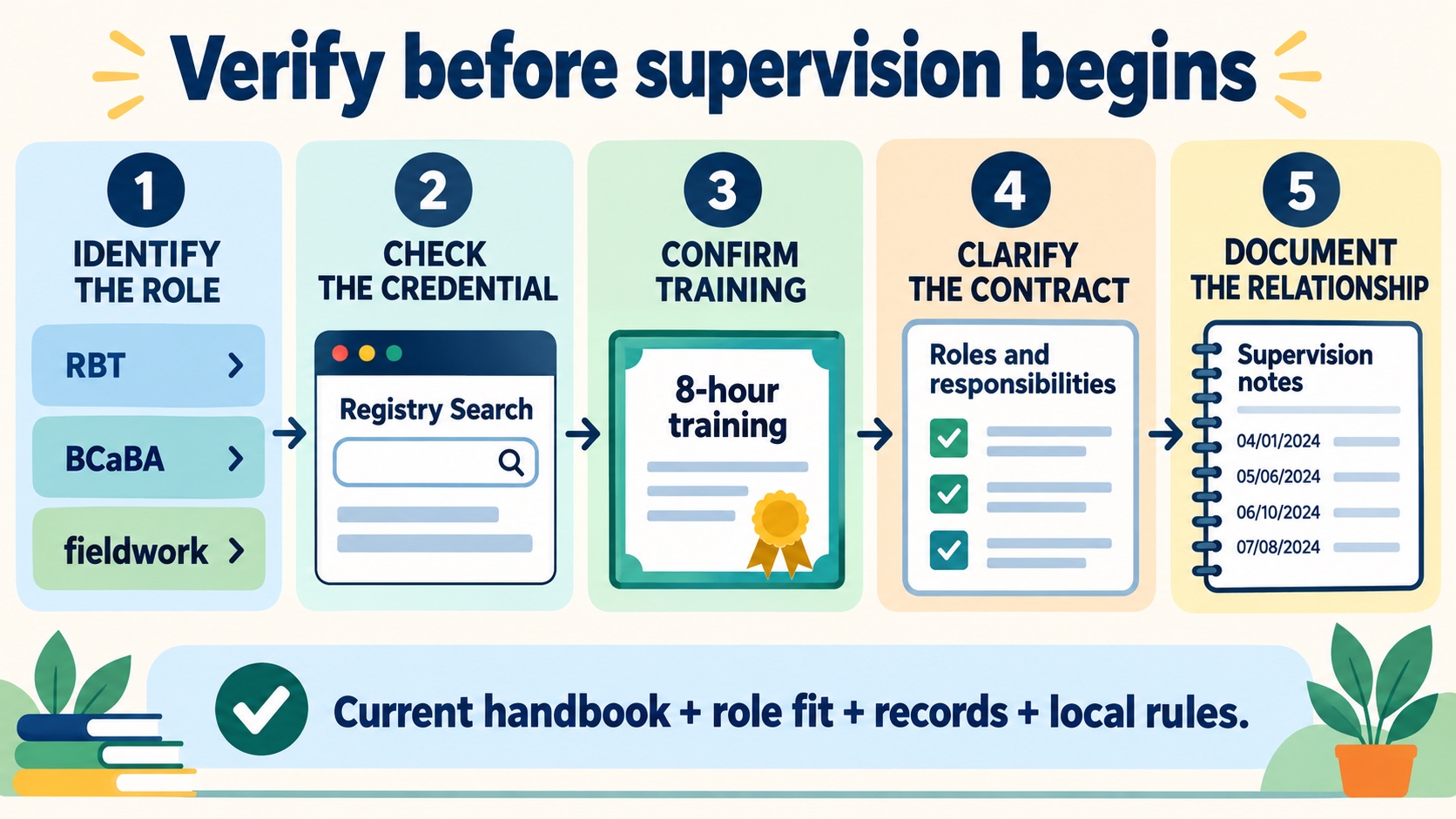
Before beginning supervision, use a written checklist. The checklist is not a substitute for the current handbook or professional advice, but it prevents the most common assumptions.
- Identify the role. Are you receiving RBT supervision, pursuing BCBA fieldwork, pursuing BCaBA fieldwork, receiving BCaBA supervision, completing an RBT competency assessment, or participating in RBT training?
- Check the credential and status. Use the BACB Certificant Registry where appropriate. Confirm the credential type, current status, and any information relevant to the role. A registry search is a starting point, not a complete contract or scope review.
- Confirm role-specific qualifications. Read the current RBT, BCaBA, or BCBA Handbook section that applies. Ask the supervisor which qualification pathway and requirements support the arrangement.
- Confirm supervision training. For roles covered by the 8-hour requirement, verify that the supervisor completed the required training before the relationship begins, using the current BACB instructions and available records.
- Write the contract. Clarify roles, responsibilities, meeting frequency, observation, feedback, documentation, communication, fees, privacy, conflicts, and what happens if the relationship ends.
- Check the client relationship. For fieldwork, confirm that the supervisor has the appropriate relationship with or oversight of the clients and that activities connect to the required learning and services. Do not assume that any ABA-related job task counts.
- Plan the records. Decide what will document contacts, observations, hours, feedback, assignments, signatures, and changes. Keep the records consistent with the current forms and handbook.
- Check local rules. BACB certification and state licensure, employer policy, funding requirements, privacy rules, and payer conditions can overlap without being identical. Obtain jurisdiction-specific guidance when needed.
Supervision is not the same as fieldwork
One of the most important distinctions is between receiving supervision and accruing supervised fieldwork. A person may have a supervisor at work, an RBT supervisor, a university advisor, and a fieldwork supervisor. Those relationships can overlap, but they do not automatically satisfy the same requirements.
For example, an RBT may work under ongoing RBT supervision while also pursuing BCBA fieldwork. The RBT role and the fieldwork role have different documentation, contacts, observations, learning activities, and eligibility expectations. The fact that a BCBA watched an RBT session does not automatically mean that every minute of that work counts as BCBA fieldwork. The candidate and supervisor should map the work to the current BCBA or BCaBA Handbook and keep the records distinct.
Similarly, an eight-hour training certificate does not prove that a person has the client access, competence, role authority, or supervision structure needed for a particular case. When the facts are unclear, pause the arrangement and consult the relevant handbook, supervisor, program faculty, employer, licensing board, or BACB channel before counting hours or signing an attestation.
A bounded verification scenario
Imagine that a trainee is offered “BACB supervision” by a person who has an ABA job title but has not shown a current credential, a supervision-training record, a contract, or a plan for client observation. The trainee should not begin counting hours simply because the person works at the same clinic.
A safer next step is to identify whether the trainee needs BCBA or BCaBA fieldwork, review the relevant handbook, verify the supervisor’s current status and qualification, confirm the required training, define the relationship in writing, and clarify how client programming and documentation will be handled. If the supervisor cannot answer those questions or the records do not support the arrangement, the trainee should seek qualified guidance before proceeding.
Common mistakes
- Assuming “BACB supervisor” is a separate certificate: the role depends on the person, supervisee, and task.
- Using one handbook for every situation: RBT, BCaBA, and BCBA supervision have distinct resources.
- Treating eight-hour training as universal authorization: training is one requirement, not a complete role determination.
- Confusing registry status with fit: a current credential does not answer client access, competence, contract, or state-law questions by itself.
- Counting work automatically as fieldwork: map activities to the current fieldwork requirements and keep records.
- Signing under deadline pressure: a supervisor should sign only what can be accurately verified.
- Ignoring culture, privacy, and power: effective supervision includes respectful, accessible, and context-responsive practice.
How to handle 2027 requirement changes
The BACB’s 2027 BCBA and BCaBA requirement changes are a separate transition topic from the basic meaning of a supervisor. If your fieldwork or application crosses a transition date, use the current BACB transition guidance and handbook to determine which requirements apply to your situation. Do not assume that a future certification-requirement update automatically changes every RBT supervision rule, supervisor qualification, or training record.
For a study-oriented overview, you can also use the BCBA learning path, the BCaBA learning path, or the RBT learning path. These explain concepts and study boundaries; they do not replace a current handbook, a qualified supervisor, or jurisdiction-specific guidance.
FAQ
Is there a BACB supervisor certification?
“BACB supervisor” generally describes a supervision role, not a separate universal BACB credential. The applicable credential and requirements depend on whether the person supervises RBTs, BCaBAs, RBT assessment or training, or BCBA/BCaBA fieldwork.
Who can supervise RBTs?
The BACB identifies BCBA and BCaBA roles in the current supervision structure, with additional rules and role distinctions in the RBT Handbook. Confirm the exact arrangement, training, and ongoing-supervision requirements in the current handbook.
Who can supervise BCBA fieldwork?
BCBA fieldwork supervision has specific qualification, training, contract, observation, and documentation requirements in the current BCBA Handbook. A person’s workplace title or general ABA experience is not enough to establish eligibility.
Is 8-hour supervision training required?
It is required before covered supervision of BCBA or BCaBA fieldwork trainees and current BCaBA or RBT certificants who require ongoing supervision, according to the BACB’s current supervision guidance. Read the current Supervisor Training Curriculum Outline and relevant handbook for scope and provider rules.
How do I verify a supervisor?
Start with the BACB Certificant Registry, then confirm the role-specific handbook requirements, current credential and status, supervision training, contract, client relationship, records, and applicable state or employer rules.