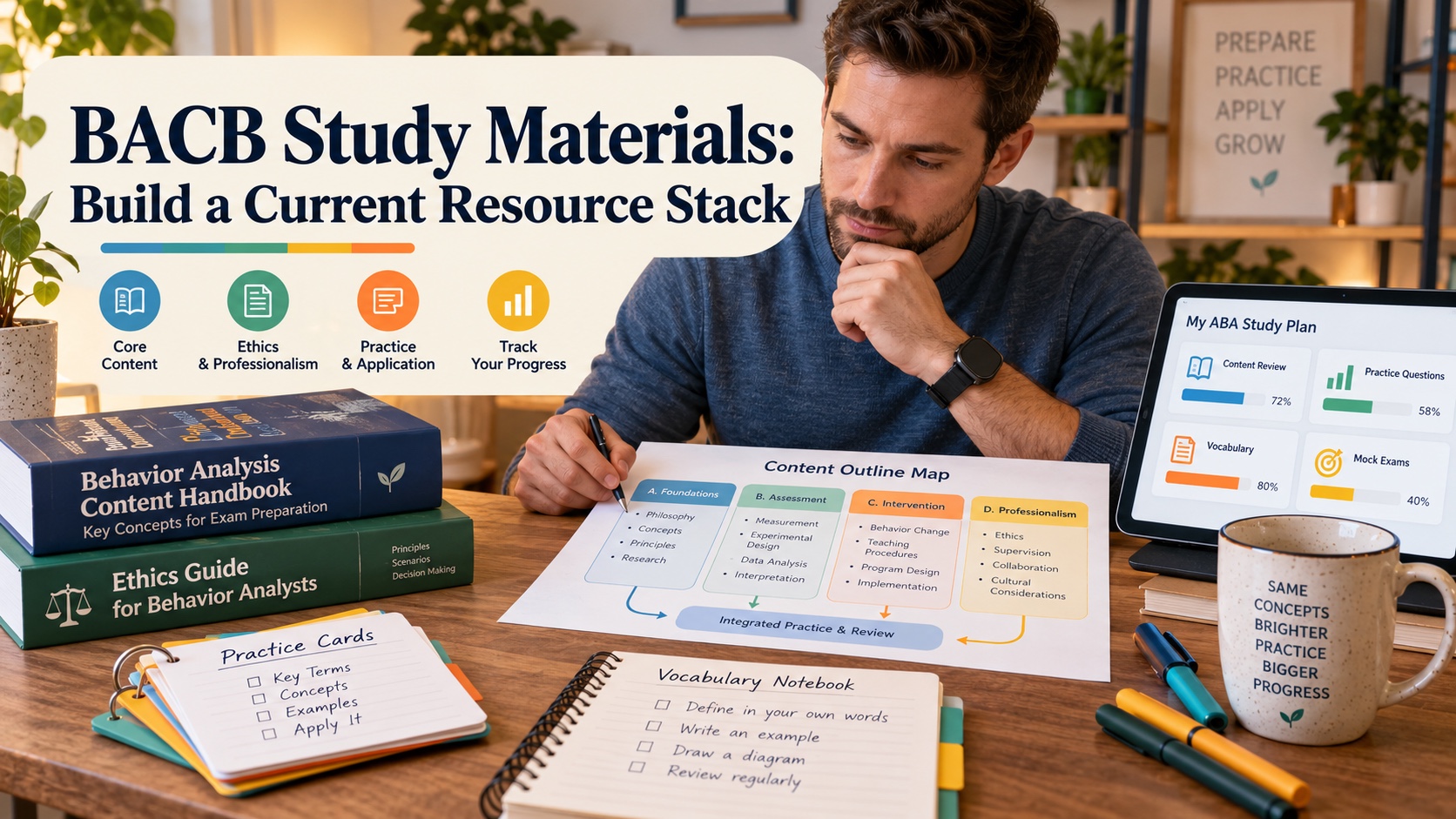
BACB Study Materials: Build a Current Resource Stack
Searching for BACB study materials can produce a very long list: handbooks, content outlines, books, videos, flashcards, question banks, mock exams, apps, PDFs, and course notes. More resources do not automatically create a better study plan. The first decision is to identify the credential track. The second is to give each resource one clear job.
Use official BACB documents for requirements, examination structure, and the content map. Use independent materials for explanation and practice, but label them honestly. The BACB does not endorse specific study guides or guarantee a passing result because someone purchased study materials. A resource stack should make your learning clearer, not make an unofficial page look official.
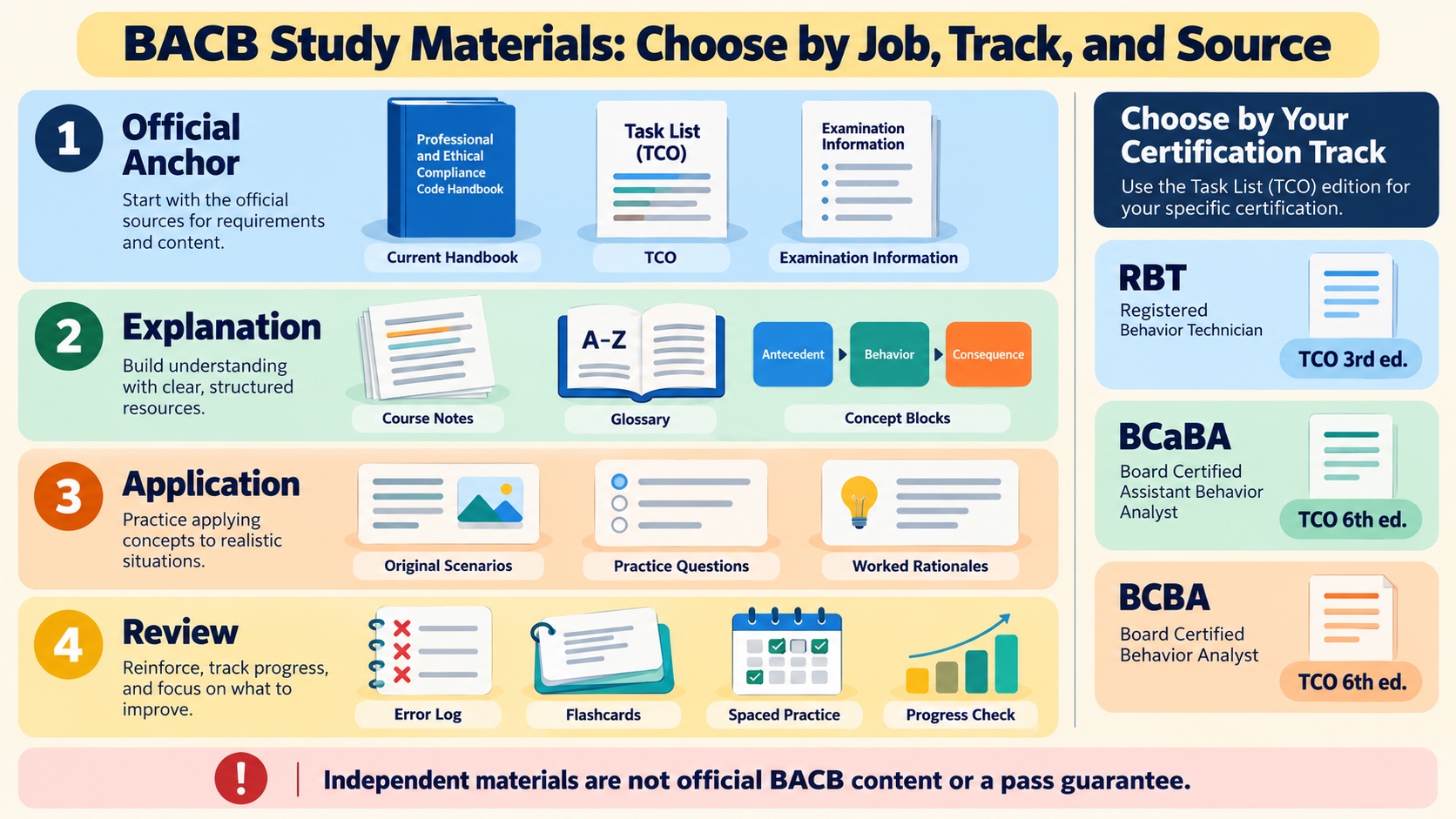
The four jobs in a study-material stack
1. Official anchor
Start with the document that controls the question you are asking. The current Test Content Outline identifies examination content and tasks. The relevant Handbook explains eligibility, application, testing, and maintenance rules. Examination Information explains shared format details and routes candidates to Pearson VUE. The Ethics Code provides professional responsibilities. These documents are not interchangeable, and a study guide should not pretend they are.
2. Explanation
Use a glossary, course note, theory block, video, or textbook chapter to make the official language understandable. A useful explanation connects a term to an observable example, a decision, and a common confusion. If the page only repeats a definition, it may support recognition but not application.
3. Application
Use original scenarios, practice questions, worked examples, or a mock exam to decide what you would do with the concept. The quality check is not only the score. Look for clear rationales, track-appropriate role boundaries, current terminology, and an explanation of why the closest alternative is weaker.
4. Review
Use an error log, flashcards, spaced review, and progress notes to decide what to revisit. A review tool should help you name the domain or task, classify the error, and schedule another attempt. A dashboard that shows a percentage without a next action is less useful than a simple record that tells you exactly what to practice.
Choose the correct track and edition
The BACB has separate certification tracks. For examination content beginning in 2026, the RBT Test Content Outline is the 3rd edition. The BCaBA and BCBA examinations use their respective 6th-edition Test Content Outlines. Keep these maps in separate folders or clearly labeled sections. Shared ABA vocabulary does not make the exam tasks, role expectations, or study depth interchangeable.
If a resource uses “BACB” or “ABA” broadly, look for a track label. An RBT learner may need entry-level measurement, assessment participation, skill acquisition, behavior reduction, documentation, and ethics practice. A BCaBA or BCBA candidate may need deeper reasoning about assessment, intervention selection, experimental design, supervision, and professional decisions. Match the resource to the job you need to perform.
How to audit each resource
Before you save a PDF, buy a book, or commit to a course, ask five questions:
- Which track and edition? Is the scope named, dated, and consistent with the current TCO?
- What job does it do? Does it explain, provide application, simulate timing, or support review?
- Who is responsible for the claim? Is the author named, and are official rules linked to the BACB source?
- What feedback exists? Do practice questions have rationales, and can you see why an answer is better?
- What are the limits? Does the resource clearly say it is independent, not a pass guarantee, and not secure exam content?
Also check usability. Can you search the file, read the contrast, access it on your normal device, and return to missed concepts quickly? If you use flashcards, can you add an example instead of only a word? If you use an app, can it separate your track and show what needs another review? Convenience matters because a resource you cannot return to will not become part of a routine.
Build a free-first study workflow
A free-first stack can begin with the applicable BACB Handbook, TCO, Examination Information, and Ethics Code. Add one clear explanation source. Then answer a small set of original practice questions and record the reason for each miss. Only after you know the gap should you decide whether another paid book, course, mock exam, or tool solves a real problem.
A simple weekly loop might look like this: preview one domain, retrieve yesterday’s ideas without notes, practice several scenarios, read every rationale, and schedule weak tasks for later. Keep official rules separate from study explanations. Never copy or share secure examination content, and do not call an independent resource BACB-approved unless the exact claim and provider status are verified for that purpose.
ABA Study Online’s RBT learning path, BCaBA learning path, and BCBA learning path can organize theory. The practice-question routes can support application, while the ABA Definition Search can help with a single term. These are independent learning supports, not BACB certification services or official examination content.
When a resource stops helping, do not keep it because you already paid for it or highlighted it. Compare its claims with the current official source, identify the learning job it was supposed to solve, and decide whether a shorter explanation or better feedback would serve you more. A smaller, labeled stack is easier to review, easier to update, and less likely to blur an unofficial summary with a certification rule.
Keep a source note for every major resource: title, track, edition, date checked, and next review date. That habit is especially valuable when your study plan spans several months or when the BACB publishes transition guidance.
Common mistakes
- Collecting instead of studying: give each resource one job and stop adding formats without a gap to solve.
- Using one track’s guide for another: keep RBT, BCaBA, and BCBA labels visible.
- Assuming a logo or title means endorsement: verify the provider and read the resource’s boundaries.
- Memorizing without application: practice a decision, not only a definition.
- Ignoring source dates: revisit the official pages when a requirement, outline, or form may have changed.
- Confusing study support with CEU or ACE credit: a useful lesson is not automatically a qualifying continuing-education event.
FAQ
What are the best BACB study materials?
The best stack depends on your track and gap. Start with the applicable official Handbook and TCO, add a clear explanation, then use original practice and an error-review system.
Are third-party BACB study guides official?
Not automatically. A third-party guide should identify itself as independent and link to the current official sources for rules, content, and examination information.
Can I use one study guide for RBT, BCaBA, and BCBA?
A general ABA explanation can support shared foundations, but track-specific preparation should follow the correct TCO, role boundary, depth, and Handbook.