BACB Self-Reporting: What to Know Before You Submit a Report
If you are searching for BACB self-reporting, start with the official BACB Self-Reporting page and the handbook that applies to your credential or application level. Self-reporting is not a general customer-service message and it is not the same as reporting another person. It is the process applicants and certificants use to provide information that could affect communication with the BACB, certification status, or safe and competent practice.
This guide explains the categories, timing, form sequence, and documentation habits. It does not decide whether a particular personal or professional event must be reported, provide legal advice, or predict what the BACB will do with a submission. For a situation-specific decision, read the current BACB source and consult an appropriately qualified professional.
Table of Contents
Short answer: what is BACB self-reporting?
BACB self-reporting is the process for an applicant or certificant to disclose certain professional or personal conduct, conditions, investigations, agreements, or actions that may affect certification status or pose a risk to others. The current BACB guidance says the obligation can relate to a person’s role as a service provider, supervisor, educator, trainer, or business owner or manager of an organization that provides behavior-analytic services, supervision, education, or training.
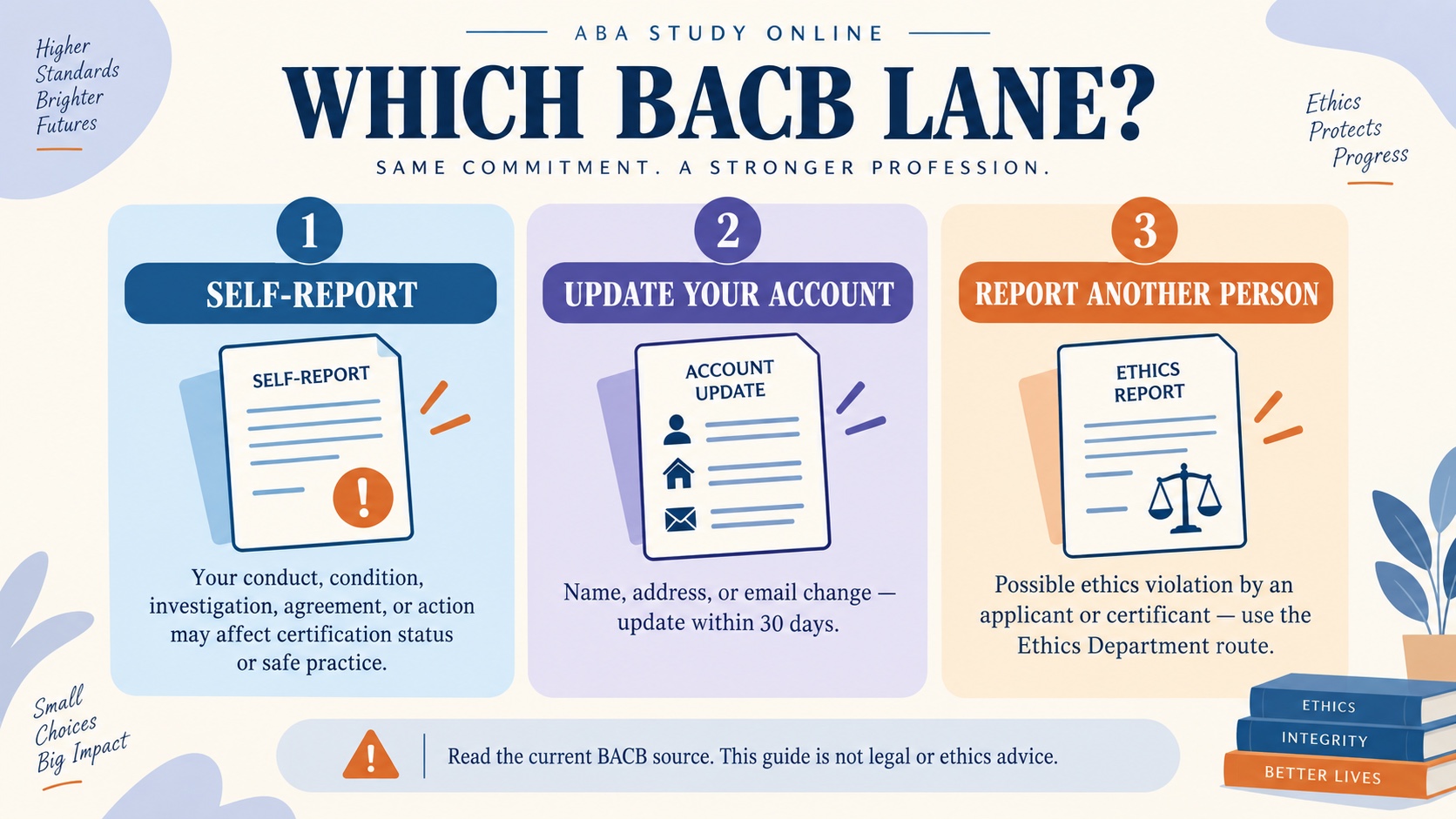
Self-reporting is different from making a Notice of Alleged Violation against another person. The BACB specifically tells people not to complete a Notice of Alleged Violation for themselves. The self-report route uses the Self-Reporting Statement together with the Ethics Self-Reporting Form.
What kinds of events may require self-reporting?
The BACB lists several main categories. The wording and exceptions matter, so use the current Self-Reporting page and the handbook for your credential rather than relying on a short list copied into a study post.
Possible ethics-standard violations
If you believe you violated a standard in the ethics code that applies to your BACB certification, the BACB identifies self-reporting as the relevant route. The Ethics Code for Behavior Analysts applies to BCaBA and BCBA applicants and certificants, while the RBT Ethics Code 2.0 applies to RBT applicants and certificants. Keep the code version and your credential level clear in your notes.
Qualifying health or substance-use conditions
The BACB guidance includes physical or mental health conditions and substance use disorders when they meet the self-reporting requirements. The question is not whether someone has ever experienced ordinary stress or sought healthcare. The official source focuses on conditions that fit its reporting standard and may affect safe or competent practice. Do not use a blog article to make a medical judgment about yourself or someone else.
Investigations
If you, or a company in which you hold a primary role related to the matter, are named in a qualifying investigation, the BACB says to self-report within 30 days of becoming aware that the investigation is being conducted. The guidance says not to wait for the investigation to finish. Keep the notice, the date you learned about it, and a clear description of what documentation is available.
Agreements and actions
The BACB also identifies qualifying court orders, civil or criminal charges, final determinations or dispositions, and agreements or consent orders. The exact category and exceptions should be checked against the applicable handbook. The current guidance states that qualifying agreements and actions are reported within 30 days of receipt or signing.
The 30-day timing boundary
Some self-reporting categories use a 30-day deadline, but the event that starts the clock is not always the same. For an investigation, the BACB guidance refers to when you become aware that an investigation is being conducted. For an agreement or action, it refers to receipt or signing. Record the date that matters, save the source document, and do not wait for a convenient summary if the official guidance says to report earlier.
The BACB may ask for additional documentation or actions after a self-report, such as verification of competence. A timely submission is not an admission of a particular outcome, and a late submission should not be hidden. If you are reporting after a stated deadline, explain the delay accurately in the materials the form requests.
What is not an ethics self-report?
Name, address, and email changes
The BACB Self-Reporting page says that name, address, and email changes are not self-reported through the ethics process. Instead, keep the personal information in your BACB Account accurate and update it within 30 days of the change or of learning that it is outdated. This is an account-maintenance task, not a Notice of Alleged Violation or Ethics Self-Reporting Form.
Reporting another person
If you believe another BACB applicant or certificant violated an ethics requirement, the BACB provides a reporting-to-the-Ethics-Department route. That is a different process from self-reporting. The BACB says reports about companies alone are outside its certification jurisdiction, although conduct by a certificant connected to a company may be relevant. Do not mix another person’s allegation into your own self-report form.
Asking the BACB for legal or ethics advice
The BACB states that it cannot provide legal or ethics advice. Its sources explain the reporting process and requirements, but an article cannot decide how a complex fact pattern should be characterized. Keep the question focused on the official process and seek qualified advice when the decision involves law, licensure, health, employment, or client safety.
The official form and document sequence
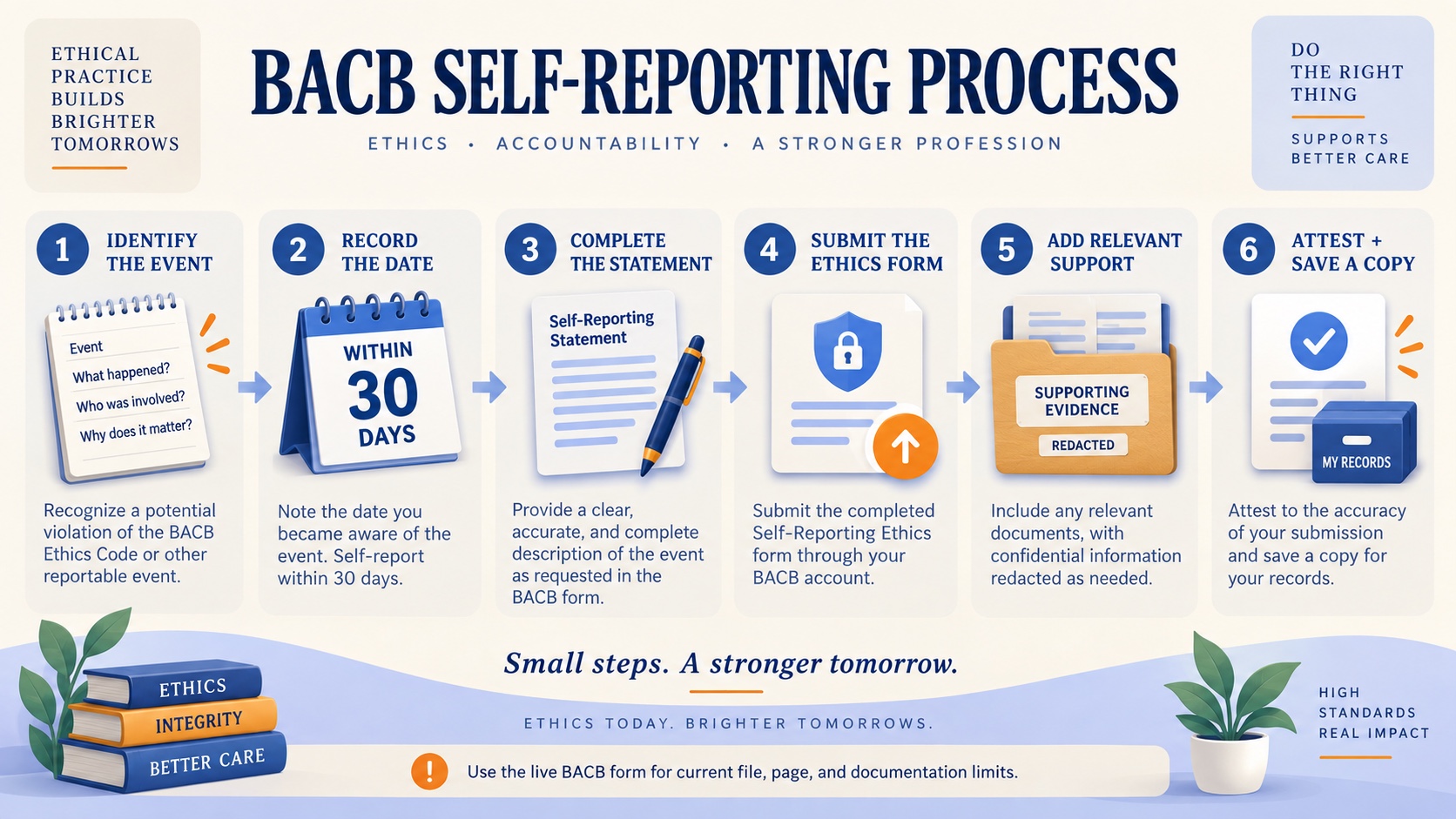
- Read the current Self-Reporting page. Confirm that you are using the correct route and credential-specific handbook.
- Download the Self-Reporting Statement. Complete the statement required by the BACB and keep a copy of what you submit.
- Open the Ethics Self-Reporting Form. Select the category or categories that actually apply and answer the questions truthfully.
- Describe the event clearly. Give dates, role, people involved where requested, and a factual explanation. Do not turn the rationale into speculation or an accusation.
- Attach relevant supporting documentation. The form asks for a description of what each document is and why it is relevant. Follow its file type, size, and page limits.
- Check the attestation. The BACB form requires confirmation that the report is truthful and complete and that the submission follows the format and documentation rules.
- Save the record. Keep the submitted statement, form, attachments, confirmation, and later correspondence in a secure folder.
The current online form can ask whether the report relates to an open examination, recertification, or renewal application; whether it updates a prior report; and whether additional documentation is being uploaded. It also includes specific categories such as supervision requirements, ethics, public-health-and-safety tickets, health or substance use, investigations, and agreements or actions. Use the live form because these fields and instructions can change.
Common mistakes and privacy checks
- Using a Notice of Alleged Violation for yourself: use the self-report route the BACB identifies.
- Waiting for an investigation to end: the current guidance says qualifying investigations are reported after you become aware of them, not after the conclusion.
- Confusing an account update with self-reporting: update name, address, and email in the account route.
- Uploading unrelated documents: provide relevant evidence and explain its relevance.
- Leaving private information unprotected: review the current instructions and redact or protect personal information where the BACB process requires it.
- Promising a result: a self-report is reviewed by the BACB; an article cannot predict the outcome.
Before submitting, make a private checklist of the event date, awareness date, deadline, source documents, people notified, current applications, and next action. Do not place client names or unnecessary health details into an educational article, public post, or practice question. Use the secure BACB process and the minimum relevant information the form requests.
BACB self-reporting FAQ
What does self-reporting to the BACB mean?
It means an applicant or certificant provides the BACB with information that may affect communication, certification status, or safe and competent practice, using the official self-report process.
Do I self-report a name or address change?
Not through the ethics self-report route. The BACB says to update personal information through your BACB Account within 30 days of the change or of learning it is outdated.
How quickly must an investigation be self-reported?
For a qualifying investigation, the current BACB guidance says within 30 days of becoming aware that the investigation is being conducted. Do not wait for the investigation to finish.
What forms are used for a BACB self-report?
The BACB directs users to the Self-Reporting Statement and the Ethics Self-Reporting Form. Do not use a Notice of Alleged Violation to report yourself.
Can ABA Study Online tell me whether I must self-report?
No. ABA Study Online can help explain terminology and organize study notes, but the current BACB source and qualified situation-specific advice control a real self-reporting decision.