BACB Reporting: Where to Start and Which Route May Apply
Searching for BACB reporting usually means you need a practical next step: you may be concerned about a possible ethics violation, wondering whether you must report something about yourself, or trying to understand whether the BACB is the right authority. The safest starting point is to identify the kind of report before writing a conclusion about what happened.
The BACB’s current Ethics Department guidance separates alleged violations, self-reporting, publicly available documentation, and infringement or misuse. It also makes an important boundary clear: the BACB certifies people, not companies, and it cannot provide legal or ethics advice. This guide is a routing and preparation overview, not a finding that anyone violated an ethics code.
Table of Contents
Short answer: what BACB reporting means
BACB reporting is the process of sending information to the appropriate BACB Ethics Department route when you believe an applicant or certificant may have violated a BACB ethics requirement, or when the BACB’s self-reporting rules require you to report information about yourself. A report is not the same thing as a final disciplinary finding. The report gives the BACB information to review under its own procedures.
Before you report, write down four neutral facts:
- Who is involved? Is the person a BACB applicant or certificant, an RBT, a BCaBA, a BCBA, an organization, or someone outside BACB jurisdiction?
- What happened? Describe observable events, dates, documents, and communications instead of labeling the outcome as proven.
- What authority is involved? Is this a BACB ethics matter, a state licensure matter, a payer issue, a safety concern, or an employment dispute?
- What private information appears in the evidence? Plan to redact personal identifiers before submitting material.
Choose the reporting route first
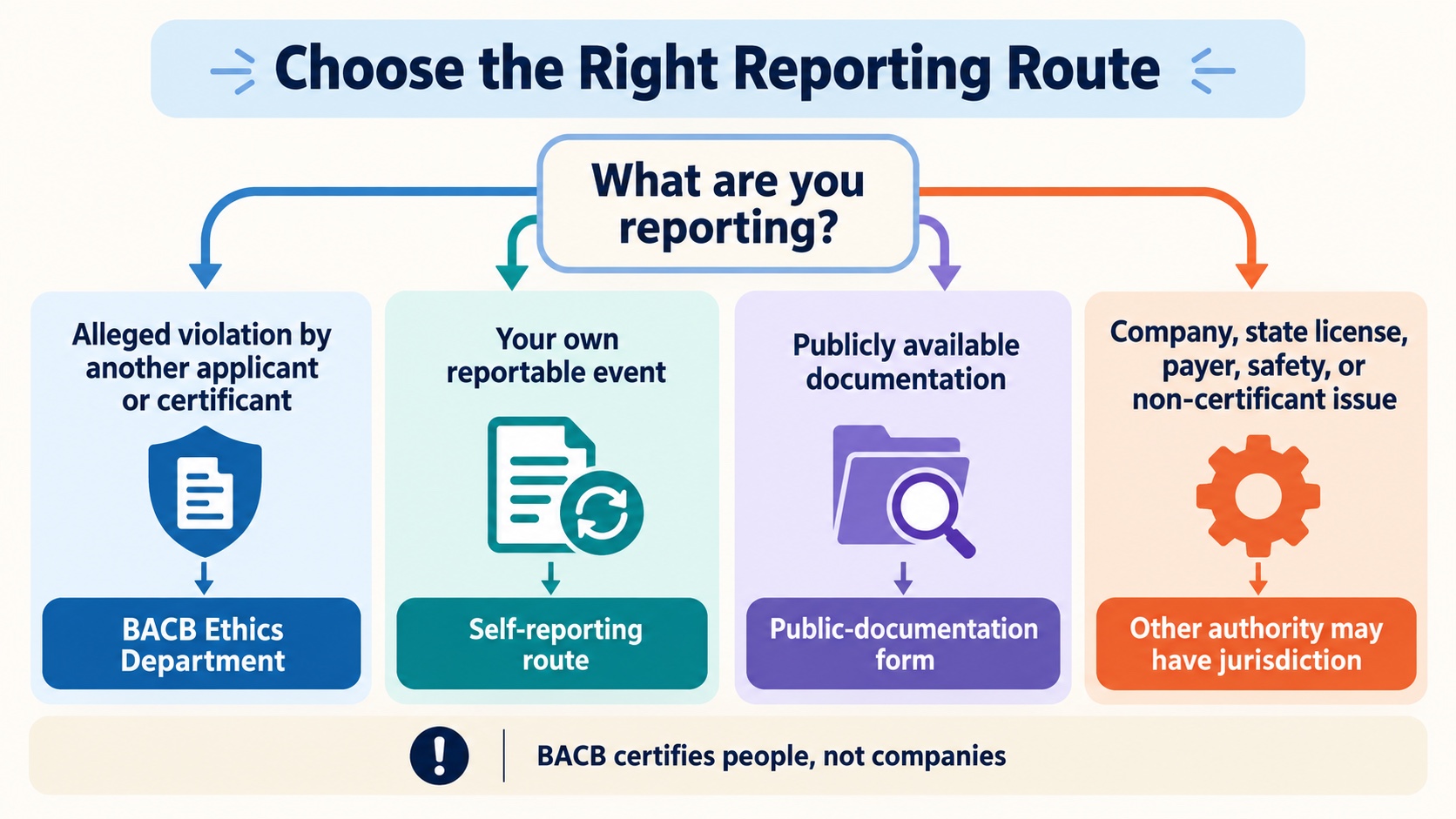
The BACB’s Reporting to the Ethics Department page describes several routes. They are not interchangeable forms:
- Alleged violation by another applicant or certificant: use the reporting route for a possible ethics violation by another person who falls within the BACB’s process.
- Self-report: use the self-reporting route when you are an applicant or certificant and a reportable event concerns your own conduct, health-related requirement, investigation, agreement, or other qualifying event.
- Publicly available documentation: use the public-documentation route when the alleged issue is clearly identified in material the public can access without creating an account or supplying private information.
- Infringement or misuse: use the route that addresses misuse of BACB credentials, marks, or related materials rather than treating every problem as an ethics allegation.
- Another authority: a state licensing board, payer, employer, law-enforcement agency, or other regulator may have authority over part of the concern.
If the facts fit more than one route, do not submit duplicate allegations with inconsistent descriptions. Review the relevant BACB instructions, preserve the original records, and obtain qualified professional advice when the situation involves legal rights, immediate safety, licensing, or mandatory reporting.
Reporting an alleged violation by another person
If you believe another BACB applicant or certificant may have violated an applicable ethics code, start with the BACB reporting guidance and the code that applies to that person’s role. The Ethics Code for Behavior Analysts applies to BCaBA, BCBA, and BCBA-D applicants and certificants. The RBT Ethics Code (2.0) applies to RBT applicants and certificants.
The BACB encourages people to consider whether the issue could be addressed by speaking with the person or a workplace supervisor first, when that is safe and appropriate. That is not a requirement to confront someone. If direct discussion is not an option, is unsafe, or does not resolve the issue, the BACB page explains how to submit a Notice of Alleged Violation and supporting documentation.
RBT situations require particular care. The BACB says that some alleged RBT violations should first be reported to the RBT Requirements Coordinator or Supervisor, while other allegations should be reported to the BACB. Do not apply a universal rule without checking the current RBT guidance and the facts of the case.
Use neutral language in the description. “On March 4, the progress note listed a session that I did not observe, and the email attached here was sent at 6:12 p.m.” is more useful than “This person committed fraud.” The first sentence identifies evidence; the second announces a conclusion that the BACB must determine under its process.
Self-reporting your own event
Self-reporting is separate from reporting another person. The BACB’s current Self-Reporting guidance says applicants and certificants must provide information that could affect effective communication with them or influence certification status. The examples include ethics-code violations, qualifying physical or mental health conditions or substance use disorders, investigations, and certain agreements, actions, charges, or dispositions.
The exact self-reporting requirements depend on your certification or application level and the event. Review the self-reporting section of the relevant handbook rather than relying on a social-media summary. The BACB also explains that a name, address, or email change is handled by updating account information rather than treating it as a self-report in the same way as a reportable event.
Do not submit a Notice of Alleged Violation for yourself when the BACB directs you to use its self-reporting form. Prepare the required Self-Reporting Statement, describe the event accurately, attach relevant documentation, and follow the current submission instructions. If you are uncertain about legal consequences or professional obligations, consult a licensed attorney or an appropriately qualified professional; the BACB does not provide legal or ethics advice.
Publicly available documentation
The BACB has a separate route for alleged violations based on publicly available documentation. This may include a court ruling, a licensure-board action, a third-party payer finding, or other material that the public can access without logging in, joining a group, paying a fee, or providing personal information.
Because the public-documentation route is anonymous, the notifier may not receive updates about the matter. The BACB says it may follow up with the subject when the evidence supports a potential ethics violation, and the Certificant Registry is the place to check published sanctions. Do not confuse an anonymous public-documentation report with a private complaint where you expect case updates.
When another authority may be the right route
The BACB certifies people, not companies. If your concern is only that a company has a policy, billing practice, workplace dispute, or service problem, the BACB may not have jurisdiction over the company as an entity. The concern may belong with the company, a third-party payer, a state regulatory board, law enforcement, an accrediting body, or another agency.
There can still be a BACB question when a certificant owns or works at that company. Separate the organization-level issue from the individual’s conduct and identify which records support each question. If a state licenses behavior analysts, a state regulatory board may have authority even when the person is also BACB certified. A payer may have its own fraud, quality, or credentialing process.
For immediate danger, abuse, neglect, or a medical emergency, use the appropriate emergency or protective-service route first. A BACB report is not a substitute for an urgent safety response.
What to prepare and how to protect privacy
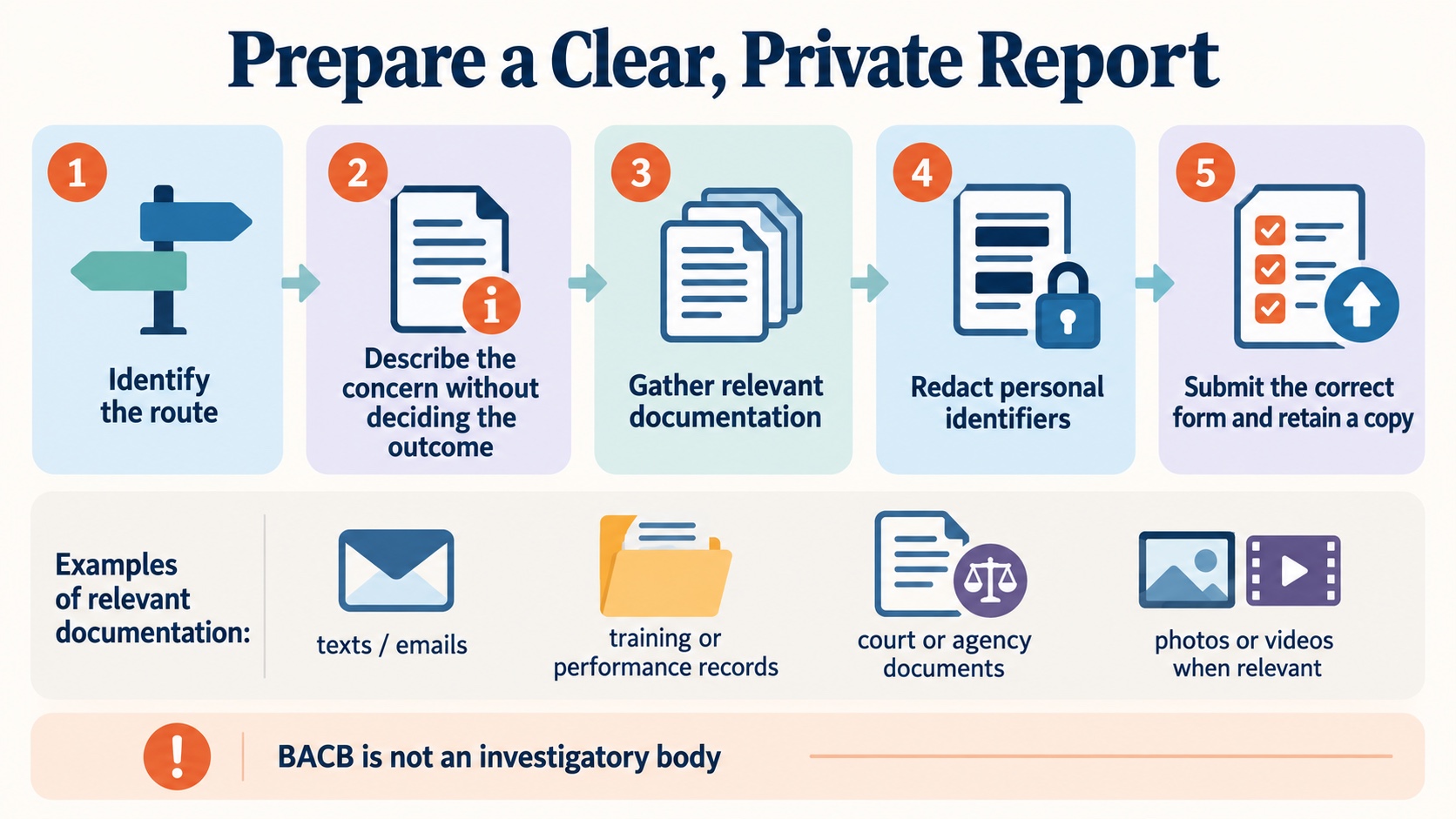
The BACB says it is not an investigatory body and relies on the documentation submitted. Depending on the matter, relevant material can include training or performance records, termination letters, court documents, texts or emails, third-party investigation outcomes, photos or videos, behavioral assessments, intervention documents, or a witness account. Relevance matters more than volume.
Before attaching anything, make a private copy and redact personal identifying information for clients, certificants, applicants, coworkers, and other stakeholders. Check names, addresses, dates of birth, phone numbers, email addresses, identification numbers, faces, school names, medical details, and indirect identifiers that could reveal a person even after a name is removed. Keep the original securely; submit only what the current form requires.
A clear report usually contains:
- The person’s role and any identifier you are permitted to provide.
- A chronological description of what you observed or received.
- The ethics requirement or reporting concern you believe may be relevant, without declaring a final violation.
- A list of attached documents and an explanation of why each one matters.
- A note identifying any missing records, uncertainty, or first-hand versus second-hand information.
- A privacy check confirming that personal identifiers were redacted where appropriate.
Common reporting mistakes
- Reporting a company as if it were a BACB certificant: separate company, individual, payer, and licensing questions.
- Declaring guilt in the first sentence: describe facts and let the relevant authority evaluate the allegation.
- Using the wrong form: alleged violation, self-reporting, public documentation, and infringement routes have different purposes.
- Submitting unredacted records: remove client and stakeholder identifiers before uploading evidence.
- Assuming every RBT issue goes directly to BACB: check whether a supervisor or Requirements Coordinator has a role under the current guidance.
- Treating BACB reporting as legal advice: the BACB cannot advise you on legal strategy, state licensure, or emergency protection.
BACB reporting FAQ
Can I report a BACB certificant?
You can review the BACB’s reporting guidance when you believe an applicant or certificant may have violated an applicable ethics requirement. Describe the concern and supporting evidence neutrally; submitting a report does not itself establish a violation.
Can I report a company to the BACB?
The BACB says it certifies people, not companies. A concern about an individual certificant who owns or works at a company may be different from a complaint about the company as an entity. The latter may belong with another authority.
What is a BACB self-report?
It is the route for an applicant or certificant to report a qualifying event about themselves. Review the relevant handbook and current self-reporting instructions; do not use a Notice of Alleged Violation for your own report when the BACB directs you to self-report.
Should I include client names and records?
Only provide relevant documentation through the correct current process, and redact personal identifying information before submission. Retain the original securely and follow the BACB’s current privacy and form instructions.
Does the BACB give legal or ethics advice?
No. The BACB states that it cannot provide legal or ethics advice. For legal questions, state-licensure issues, or urgent safety matters, contact the appropriate qualified professional or authority.