BACB RBT Exam: Current Format and Study Map
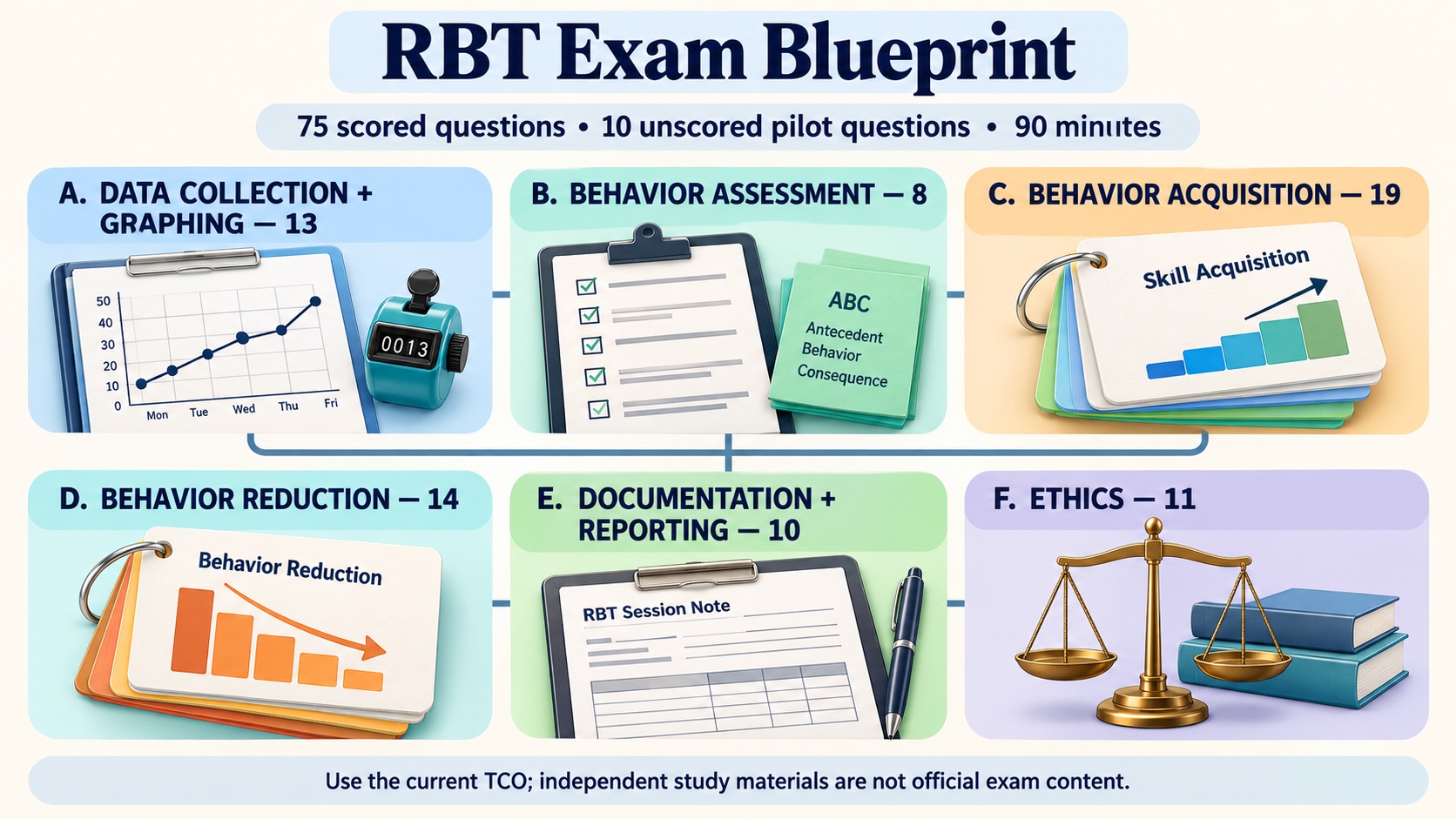
The BACB RBT exam currently uses the RBT Test Content Outline (3rd ed.), which began governing examination content in 2026. The examination includes 75 scored questions and 10 unscored pilot questions. Candidates have 90 minutes, and the scored content is organized into six domains covering measurement, assessment, acquisition, reduction, documentation, and ethics.
That blueprint gives you a better starting point than a random stack of practice questions. Use the official TCO to see what the exam is designed to assess, then use your 40-hour training, Competency Assessment materials, and carefully reviewed practice as study inputs. Independent materials can support preparation, but they are not BACB exam content and cannot guarantee a pass.
The quick answer
| Exam element | Current RBT exam detail |
|---|---|
| Content basis | RBT Test Content Outline, 3rd ed., beginning in 2026 |
| Questions | 75 scored questions plus 10 unscored pilot questions |
| Time | 90 minutes |
| Question style | Multiple choice; four possible answers and one correct answer |
| Delivery | Computer-based examination delivered through authorized Pearson VUE testing sites |
The 10 unscored questions are included in the examination experience, but they do not contribute to the scored result. You are not told which questions are unscored, so treat every item as a real opportunity to apply the content. The official RBT Handbook and Examination Information page are the places to check current appointment, eligibility, and test-day rules.
Current RBT exam format
The RBT examination is an entry-level certification examination. It tests knowledge and skills associated with the RBT role, not independent behavior-program design. The BACB describes RBTs as paraprofessionals who assist with behavior-analytic services under the direction and close supervision of an RBT Supervisor and/or RBT Requirements Coordinator.
That role boundary is useful when you study scenarios. If an answer choice asks the RBT to change a target, make an independent diagnosis, or override the supervising professional’s direction without an appropriate reason and communication path, examine it carefully. The exam can ask about implementation, data, documentation, ethics, and reporting without turning the RBT into the person who independently designs every intervention.
Do not use an old exam map without checking its edition. The 3rd-edition TCO replaced the older outline for examinations beginning in 2026. A study guide that still organizes the entire exam around the previous domain names or percentages may contain useful concepts, but its map should be cross-checked against the current official TCO.
The six content domains
The current TCO organizes 75 scored questions across six domains. The percentages are rounded, so use the question counts as a planning signal rather than a promise about the exact order of your test.
- A. Data Collection and Graphing — 13 questions: measurement, recording, graphing, and using data accurately.
- B. Behavior Assessment — 8 questions: participating in assessment activities and recognizing the limits of the RBT role.
- C. Behavior Acquisition — 19 questions: implementing teaching procedures, prompting, reinforcement, and skill-development programs.
- D. Behavior Reduction — 14 questions: implementing approved reduction procedures, recording behavior, and responding within the written plan and supervision structure.
- E. Documentation and Reporting — 10 questions: factual session notes, data communication, confidentiality, and reporting concerns through the correct route.
- F. Ethics — 11 questions: professional conduct, boundaries, client protection, supervision, and the RBT Ethics Code.
Behavior Acquisition is the largest domain, but the other five are not optional. An RBT who can describe prompting but cannot distinguish frequency from duration, record a factual note, or recognize an ethics boundary has an incomplete exam map. Build connections across domains: an acquisition program produces data, documentation communicates the result, and ethics shapes how the service is delivered.
How to study from the blueprint
Start by turning each TCO domain into a small study inventory. For every task, write one plain-language definition, one example, one non-example, and one question you still need to clarify. This turns the outline into an active study map rather than a document you read once and forget.
Next, alternate recognition and application. Recognition is knowing that duration measures how long behavior lasts. Application is choosing duration when a scenario asks how long a learner engages in a response. A useful study session moves between a short concept review, a scenario, an explanation of the distractors, and a delayed retry.
Give extra scheduled time to Behavior Acquisition because it carries the largest number of scored questions, but do not study only the largest domain. A balanced week might pair an acquisition procedure with a measurement decision, a documentation note, and an ethics boundary. That combination resembles the way workplace decisions connect multiple responsibilities.
Use the blueprint as a priority signal, not as a prediction of the exact sequence you will see. Build enough fluency to explain a concept in plain language, choose it in a scenario, and recognize when an answer exceeds the RBT role. That is stronger preparation than memorizing isolated labels or trusting a single practice score.
How to review practice questions
When a practice item is wrong, record more than the letter you missed. Tag the error as a definition gap, measurement mismatch, prompt or reinforcement confusion, reading error, role-boundary problem, ethics problem, or unsupported answer change. Then write why the correct option fits the scenario and why the closest distractor does not.
Be cautious with materials that promise “real BACB questions.” The BACB does not endorse specific study guides, and independent providers should not present their questions as live or official exam items. A good independent resource identifies its purpose, explains the answer, respects the current TCO, and makes no pass guarantee.
Before exam day
- Confirm that your study map uses the current RBT TCO (3rd ed.).
- Practice the six domains, including the smaller assessment domain.
- Complete timed sets without assuming you can identify unscored items.
- Review the RBT Handbook, application status, appointment instructions, and identification requirements.
- Use Pearson VUE and BACB instructions for scheduling, rescheduling, accommodations, and test-day questions.
- Do not translate a practice score into a guaranteed official result.
For concept review, the ABA Study Online RBT learning route can sit beside the current BACB TCO and handbook. The RBT question library is independent practice, not official BACB exam content. Keep your source date visible whenever a transition is underway.
FAQ
How many questions are on the RBT exam?
The current examination includes 75 scored questions and 10 unscored pilot questions. You are not told which questions are unscored.
How long is the RBT exam?
Candidates have 90 minutes. Build some timed practice into your study, but use the current BACB and Pearson VUE instructions for the appointment and test-day details.
Is the RBT exam based on the 3rd edition?
Yes. The BACB says the RBT examination is based on the RBT Test Content Outline (3rd ed.) beginning in 2026.
Does ABA Study Online provide official BACB questions?
No. ABA Study Online materials are independent study resources. They should be used to practice concepts and review reasoning, not represented as official BACB questions or a pass guarantee.