BACB RBT Competency Assessment: The 2026 Process Explained
The BACB RBT competency assessment is the practical skills step that an RBT applicant completes after the required 40-hour training and before submitting an RBT certification application. It is not the RBT exam, and it is not simply a signature from a trainer. The applicant must demonstrate competent performance on the tasks in the current Initial Competency Assessment, the responsible assessor must complete the BACB form, and the completed assessment must be submitted with the application.
The current packet became effective January 1, 2026. Because RBT requirements are changing, use this article as a map of the process and open the live BACB packet and RBT Handbook before scheduling your assessment. The version of the official form, the timing window, the assessor relationship, and the documentation all matter.
Table of Contents
What is the RBT competency assessment?
It is a structured evaluation of whether an applicant can perform the tasks listed in the BACB’s current Initial Competency Assessment. The responsible assessor gives the applicant an opportunity to perform each task and evaluates whether the performance is competent. The form groups the tasks into practical areas such as measurement, assessment, skill acquisition, and behavior reduction, along with the remaining items in the official packet.
The important word is demonstrate. Studying definitions can prepare you, but the assessment is designed to show that you can apply the skill. Depending on the task instructions, the assessor may observe you with a client, in a role-play, or in a live interview. You should be able to explain the concept and provide examples and nonexamples when an interview is the selected assessment type.
How is initial different from recertification?
| Question | Initial competency assessment | Recertification competency assessment |
|---|---|---|
| Who completes it? | An applicant pursuing initial RBT certification | An RBT maintaining certification |
| When? | After 40-hour training and no more than 90 days before the certification application | Within the current maintenance window described by the RBT Handbook |
| Which document? | Current RBT Initial Competency Assessment packet | Current RBT Recertification Competency Assessment packet |
| Why? | Show entry-level task competence for the application | Show ongoing proficiency as part of maintenance |
Do not use the initial packet as a substitute for the recertification packet. The 2026 RBT Handbook lists the recertification competency assessment as an ongoing maintenance requirement. It also says that RBT recertification applications will move to a two-year cycle beginning in 2027. Those are related but not identical concepts, so read the current transition guidance when your assessment or expiration date crosses a rule change.
When should you complete it?
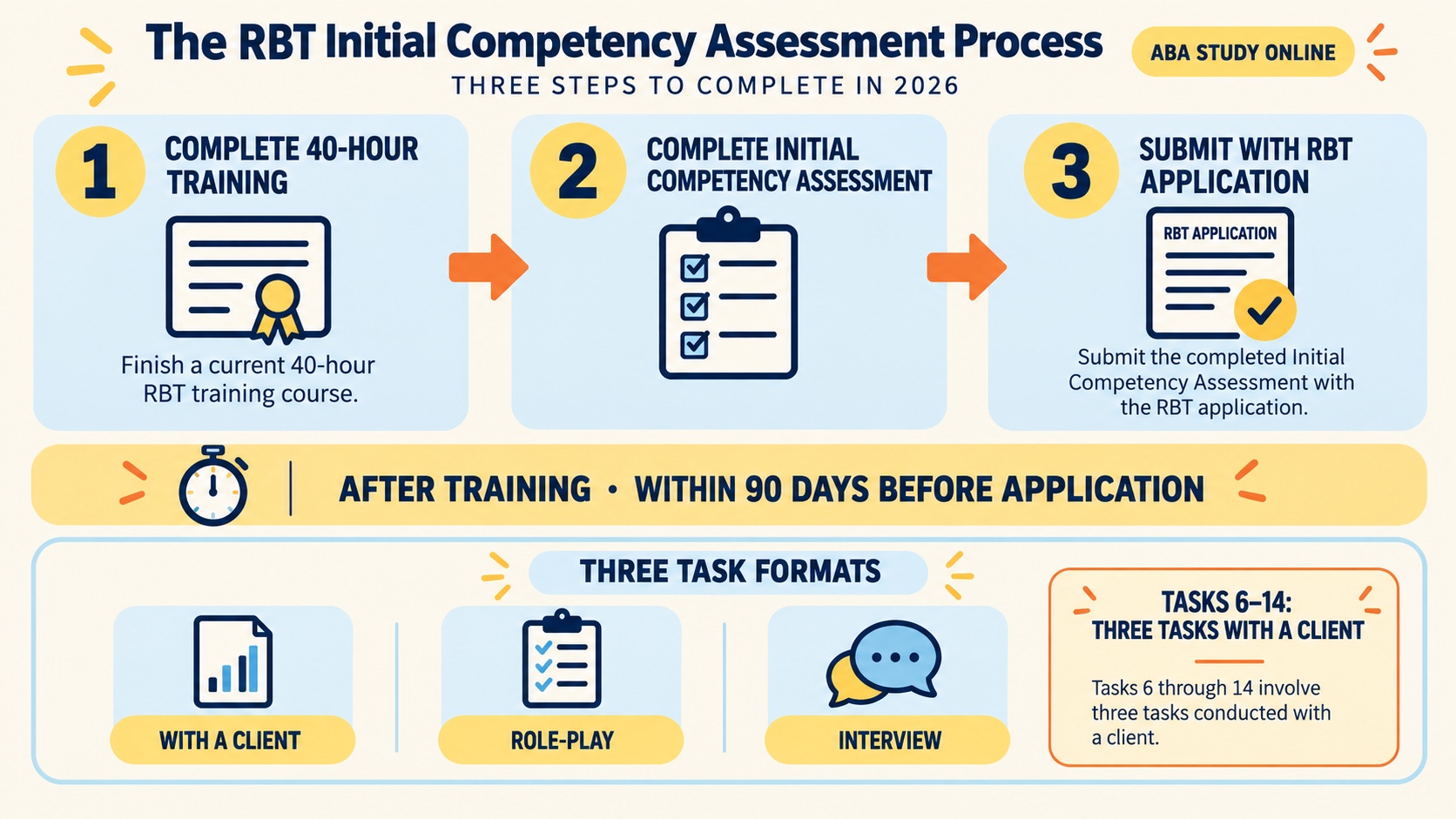
Under the current initial-assessment packet, complete the assessment after the 40-hour training is complete and no more than 90 days before you submit the RBT certification application. This creates a planning window, not an invitation to complete the form months before training or to keep using an old assessment after the application timing has passed.
A practical plan is to finish the training, confirm that the training certificate meets the current 2026 requirements, identify the responsible assessor and any client opportunities, and then schedule the assessment. Ask how the organization will handle role-play, interview, or recorded-video portions before the first session. If a client is involved, the assessor must also consider whether the client can participate safely and whether the task is appropriate for that client.
Who can oversee the assessment?
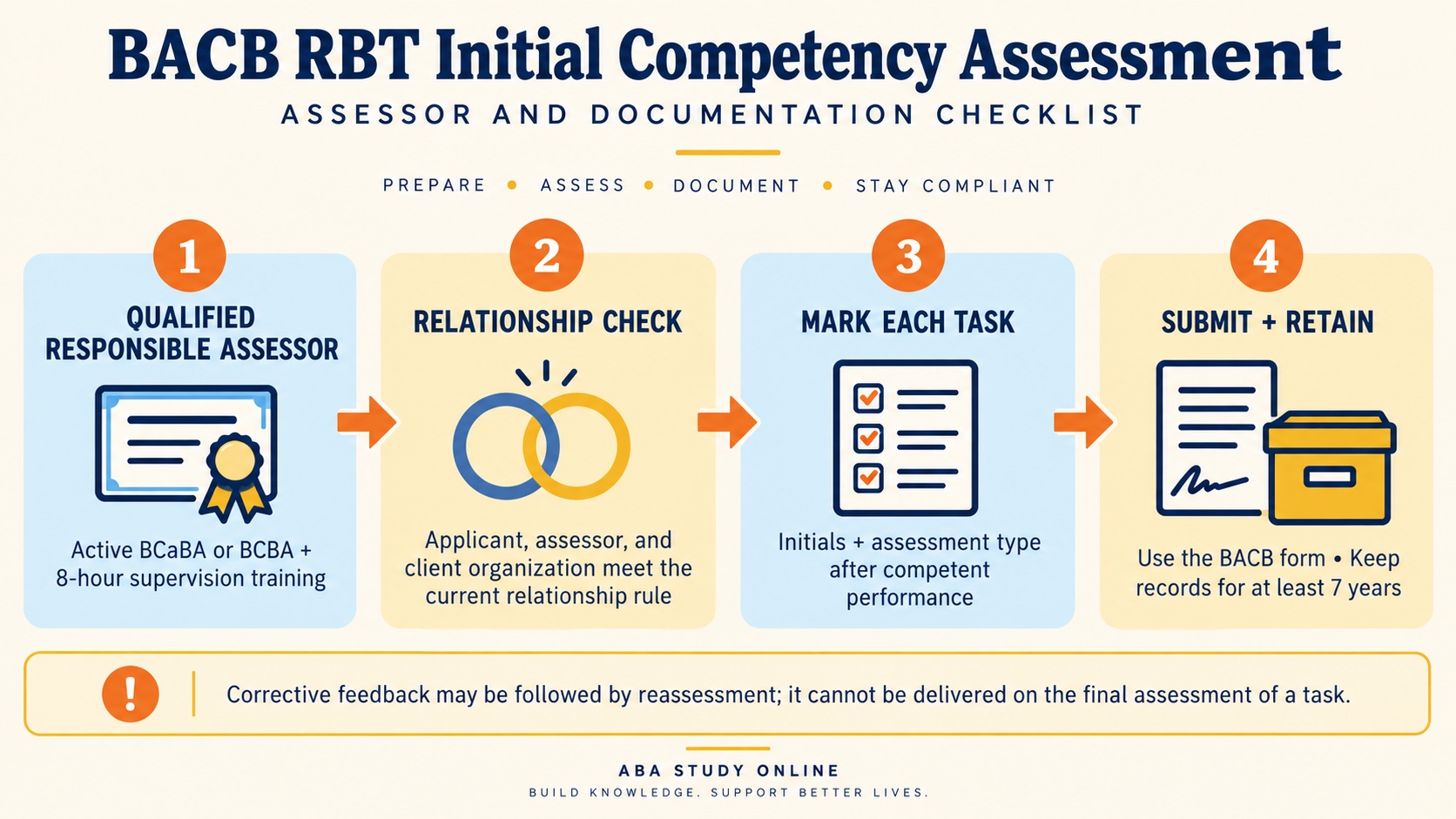
The current packet names a responsible assessor who is an actively certified BCaBA or BCBA and has completed the 8-hour supervision training. The responsible assessor oversees the assessment, signs the final form, maintains records, and remains responsible for quality even when assistant assessors complete portions of the evaluation.
The relationship requirements are just as important as the credential. The responsible assessor, applicant, and client organization must have the employment or contractual relationship described in the packet. The assessor may not be related to, subordinate to, or employed by the applicant during the assessment. The packet also allows the assessor to be the person who delivered the 40-hour training, provided the other requirements are met. “My trainer knows me” is not enough by itself; verify the current relationship rules.
An assistant assessor may help with some or all portions when they have demonstrated proficiency through direct observation and hold active RBT certification or higher. The responsible assessor must have a process to check assistant-assessor readiness and consistency. That is why a large organization may use more than one person while still keeping one responsible assessor accountable for the completed packet.
What formats can be used?
The current initial packet permits the assessment to occur over one or more sessions. It may be conducted in person, live via the internet, or through observations of recorded videos created specifically for the assessment. The format does not remove the performance standard; the assessor still has to observe enough evidence to decide whether the task was performed competently.
The three assessment types are:
- With a client: the applicant performs the task with a client receiving behavior-analytic services.
- Role-play: another person acts in a client-like role when circumstances do not permit assessment with a client.
- Interview: the assessor conducts a live interview and the applicant explains the relevant concept with examples and nonexamples where applicable.
For tasks 6–14 in the Skill Acquisition and Behavior Reduction section, three tasks must be demonstrated with a client. That requirement is easy to miss because many other task rows allow a client or role-play option. Read the current packet row by row instead of assuming that one format can be used for every item.
What tasks are assessed?
The 2026 initial form contains 19 task items. The early items include continuous measurement, discontinuous measurement, entering data and updating graphs, preference assessments, and ABC data. The Skill Acquisition and Behavior Reduction section includes procedures such as discrete-trial teaching, naturalistic teaching, chaining, shaping, discrimination training, prompting and prompt fading, and token systems. The remaining tasks are also required; the current form must be completed in its entirety.
This is a useful study insight: prepare the skill families, not just isolated vocabulary. Practice taking data accurately, explaining why a procedure is selected, following a written teaching or behavior-reduction plan, and recognizing when a task requires a client demonstration. You are preparing for observable performance and professional communication, not a memorized list of definitions.
What must be documented?
After the assessor observes competent performance, the assessor initials the task and marks the assessment type used. Once all tasks have been performed competently, the responsible assessor signs and dates the final attestation. The applicant submits the completed Initial Competency Assessment with the RBT certification application.
Use the BACB form. The packet says that non-BACB forms will not be accepted. The responsible assessor must also keep documentation of the assessments, including information about assistant assessors, for at least seven years. As an applicant, keep your completed copy and related records in a secure place so that the application file and the organization’s records tell the same story.
What mistakes should applicants avoid?
- Scheduling before the 40-hour training is complete: the initial assessment comes after the training.
- Using the wrong timing window: an assessment completed more than 90 days before the application may not satisfy the current initial requirement.
- Using a homemade checklist: study notes can help you prepare, but the BACB form is the form submitted with the application.
- Assuming every task can be role-played: three tasks in the 6–14 section must be demonstrated with a client.
- Ignoring relationship rules: a friendly trainer or supervisor still has to meet the current assessor requirements.
- Treating corrective feedback as a final score: the assessor may give feedback and reassess later, but corrective feedback cannot be delivered on the final assessment of a task.
- Confusing initial and recertification packets: download the document that matches your certification stage and current rule date.
For a focused study path, use the ABA Study Online RBT learning path to review measurement, assessment, teaching, behavior reduction, ethics, and data skills. Study materials can support preparation, but the current BACB packet, assessor, organization, and application portal control the official process.
RBT competency assessment FAQ
Is the RBT competency assessment the same as the RBT exam? No. The competency assessment evaluates practical task performance; the exam is a separate certification step.
Can the assessment be completed online? The current initial packet permits live internet assessment and observations of recorded videos created specifically for the assessment, as well as in-person administration. The assessor must still follow the task-specific requirements.
Can my 40-hour training instructor assess me? It may be permissible for the assessor to be the person who delivered the training, but the assessor must meet the current certification, training, relationship, and documentation requirements.
How many tasks are on the initial assessment? The current form contains 19 task items, and all task items must be completed. Three tasks in the Skill Acquisition and Behavior Reduction section must be demonstrated with a client.
What happens if I am not competent on a task the first time? The assessor may provide corrective feedback and assess the task on another day. The process can continue until competence is demonstrated, but corrective feedback cannot be delivered on the final assessment of that task.