
BACB Pre-Experience Checklist: What to Confirm Before Fieldwork
Starting supervised fieldwork can feel like a simple next step: find a supervisor, begin collecting hours, and save the paperwork. In practice, the first useful step is a readiness conversation. Are you eligible to begin? Does the supervisor have the right role and capacity? Is the client or service relationship clear? Which forms, records, and current rules apply?
A BACB pre-experience checklist can organize those questions. It cannot determine whether your degree, coursework, or specific experience qualifies, and it is not an official BACB approval. Use the relevant BCBA or BCaBA Handbook, current BACB forms, university or employer requirements, and supervisor guidance for decisions that affect your application.
What the checklist is for
Think of the checklist as a pre-start conversation, not a form to complete alone. Put each question into one of three columns: confirmed, needs evidence, or needs an answer from someone else. This prevents a hopeful assumption—such as “my job must count” or “this person can supervise me”—from becoming an undocumented fact.
The current BACB fieldwork resources are role-specific. Supervised fieldwork for BCBA or BCaBA applicants is different from RBT training, an RBT competency assessment, and ongoing supervision of a current RBT. Choose the correct track before you copy a checklist or save a form.
1. Confirm eligibility and coursework
Start with the relevant certification handbook and your intended application pathway. Confirm what degree, behavior-analytic coursework, and other prerequisites apply to you. If your university, coursework sequence, or documentation is unusual, collect the official records and ask the institution or supervisor how they should be interpreted.
Write down the source and date you checked. A useful note might say: “Reviewed the current BCBA Handbook and program guidance; coursework question sent to the university advisor.” That is better than a checkbox marked “eligible” when no formal review has occurred. The BACB states that it cannot decide whether a specific degree, set of coursework, or training experience meets certification requirements outside formal application review.
2. Confirm the supervisor and agreement
Identify who is responsible for supervising the fieldwork and confirm the person’s current certification, required training, and availability. The BACB’s fieldwork checklist for supervisors includes questions about active certification, supervision training, experience, capacity, scope of competence, and the trainee’s goals. A name on a calendar is not the same as a workable supervisory relationship.
Discuss the supervision agreement before hours begin. Clarify meeting frequency, observations, feedback, communication when a session changes, record ownership, missed meetings, and how disagreements will be handled. Keep the signed agreement and any required forms in the approved record system. If the supervisor is a first-year BCBA or the arrangement involves consulting supervision, confirm the additional requirements rather than assuming ordinary supervision rules apply.
3. Confirm clients, services, and scope
Ask how the fieldwork activities connect to behavior-analytic services and who has the required relationship with the clients. The BACB checklist highlights the supervisor’s direct relationship with or oversight of clients receiving services connected to fieldwork. That checkpoint protects both the trainee and the service recipients: fieldwork should not be built around tasks that are disconnected from the approved service context.
Clarify what you may observe, analyze, implement, or discuss. A trainee can have learning goals, but a checklist should not authorize independent clinical decisions. Confirm how client consent, dignity, privacy, cultural responsiveness, data access, and workplace policies are handled. Do not place client identifiers in personal study files or use a training checklist as a reason to export confidential records.
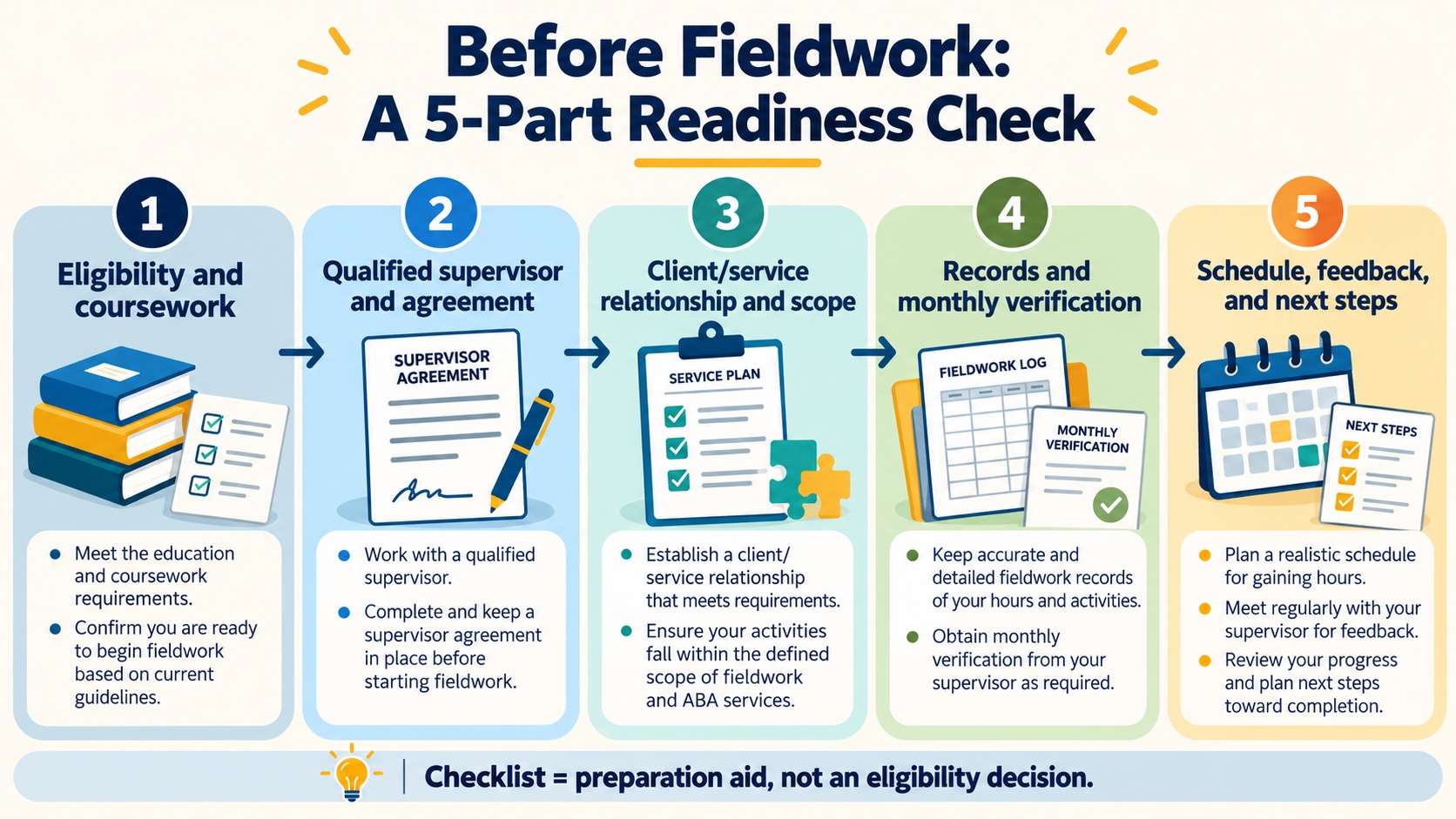
4. Set up records and verification
Before the first fieldwork month closes, agree on where records will live and who reviews them. Discuss the required monthly verification form, activity descriptions, supervision notes, dates, signatures, corrections, and retention. Use the current form for your pathway and application year; a saved PDF from a friend or an old folder may not be the right version.
Keep a contemporaneous log rather than reconstructing months later. Record the date, setting, type of activity, supervision event, feedback, and any issue that needs follow-up. If a session is canceled, a form is late, or the service context changes, document the fact and ask what correction is required. Never change a record to make the month look cleaner than it was.
5. Plan feedback and next steps
Build a schedule that can survive ordinary life. A realistic plan includes time for direct work, unrestricted learning activities when applicable, supervision meetings, observation, documentation, reading, and feedback. Ask how the supervisor will know whether you are improving and how goals will be updated. A monthly checkbox is not a substitute for useful feedback.
Because BACB requirements and forms can change, add a source-review date to the checklist. If you plan to apply under 2027 requirements, review the current transition guidance and handbook for your track. Do not assume that a new requirement is a new examination edition, or that a form designed for one application year automatically applies to another.
For study support, use the BCBA learning path or BCaBA learning path to review concepts, and keep fieldwork questions separate from exam memorization. ABA Study Online resources can help organize learning, but they cannot determine eligibility, approve a supervisor, verify hours, or replace the current BACB forms.
A short meeting agenda before the first day
Bring the checklist to a real conversation with the supervisor, program advisor, or employer. Ask which handbook and pathway apply, what evidence should be saved, where the supervision agreement belongs, how feedback will be documented, and whom to contact when a client or service situation changes. End the meeting by writing down the next three actions, their owners, and a date for checking them.
This small routine turns a vague “I am ready” feeling into observable preparation. It also gives the trainee a record of unresolved questions. If an answer depends on a formal BACB review, an institutional decision, a state rule, or a payer policy, label it that way instead of forcing a yes-or-no checkbox. The strongest checklist leaves uncertainty visible until the right authority resolves it clearly.
FAQ
Does a BACB checklist prove that I can start fieldwork?
No. It helps you identify questions and missing evidence. Eligibility depends on the current pathway, handbook, coursework, supervision arrangement, and formal review where required.
Should I start logging hours while the agreement is still being discussed?
Ask the qualified supervisor and follow the applicable handbook and workplace process. Do not assume that an informal conversation retroactively makes every activity count.
Is the same checklist used for BCBA, BCaBA, and RBT work?
No. BCBA and BCaBA supervised fieldwork, RBT training, RBT competency assessment, and ongoing RBT supervision have different documents and role boundaries.