BACB Pass Rates: How to Read the Official Numbers
People searching for BACB pass rates are often trying to answer one of two questions: “How often do candidates pass?” or “What might this mean for my own study plan?” The official numbers can help with the first question, but they cannot answer the second by themselves. RBT, BCaBA, and BCBA are different credentials with different eligibility routes, examination formats, and candidate populations.
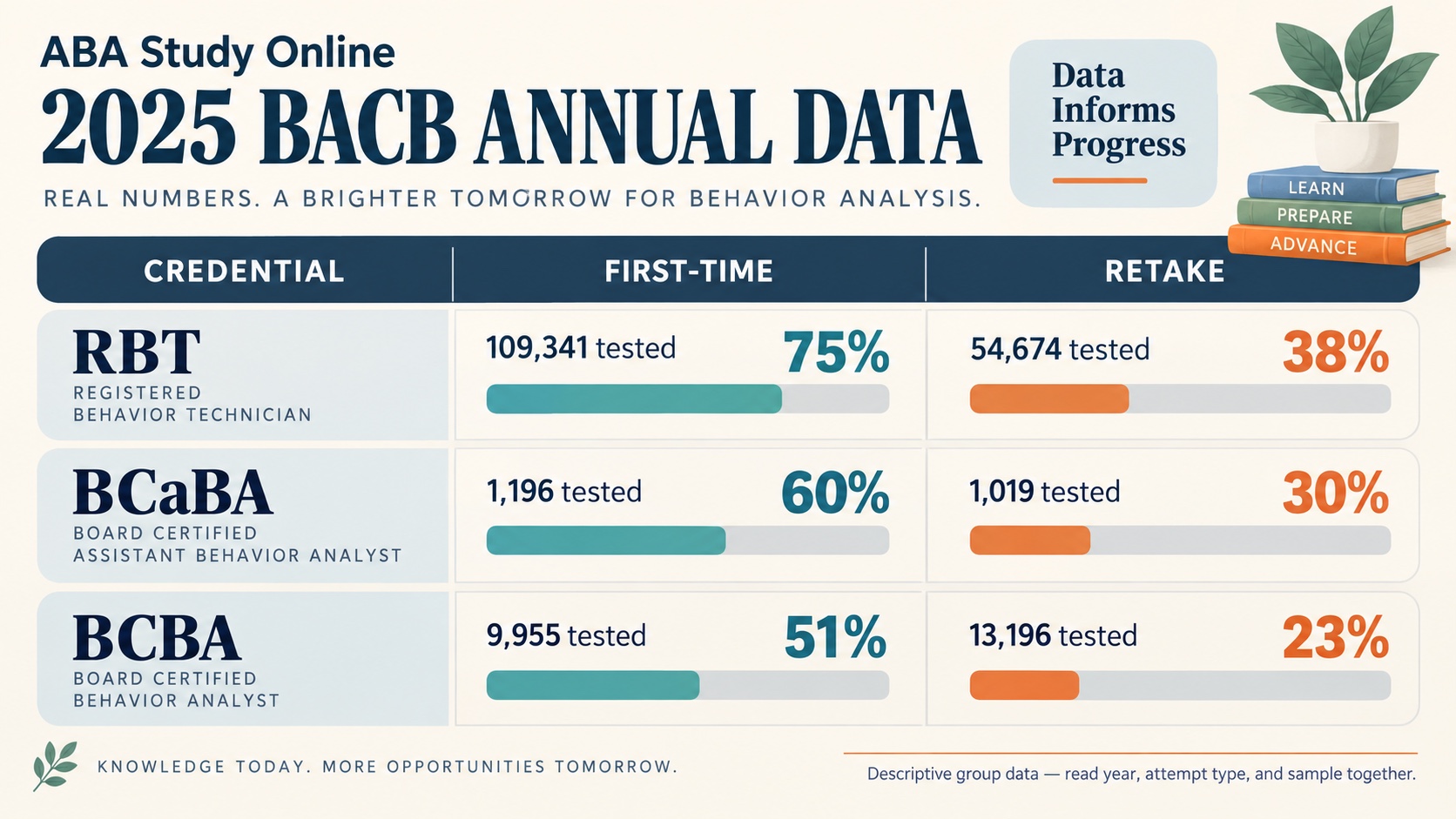
The latest BACB annual data currently displayed for 2025 show first-time pass rates of 75% for RBT, 60% for BCaBA, and 51% for BCBA. For retakes, the rates are 38%, 30%, and 23%, respectively. Those percentages describe groups tested during a particular year; they are not a personal probability, a universal score target, or a ranking of which credential is “easy.”
Table of Contents
The quick answer: 2025 BACB pass rates
For the 2025 annual data, first-time pass rates were 75% for RBT, 60% for BCaBA, and 51% for BCBA. Retake pass rates were 38% for RBT, 30% for BCaBA, and 23% for BCBA. Read each figure with its credential, year, attempt type, and candidate count attached.
| Credential | First-time candidates | First-time pass rate | Retake candidates | Retake pass rate |
|---|---|---|---|---|
| RBT | 109,341 | 75% | 54,674 | 38% |
| BCaBA | 1,196 | 60% | 1,019 | 30% |
| BCBA | 9,955 | 51% | 13,196 | 23% |
These figures come from the BACB Annual Data Report. They are not calculated from a small survey or from one school. At the same time, a large annual dataset does not make the result predictive for every individual. Your preparation, prior coursework, supervised experience, testing conditions, and the particular mix of candidates in the year all matter.
How to read the official table
A pass rate is the percentage of candidates in a defined group who passed during the reporting period. If a group has 1,000 candidates and 600 pass, the reported rate is 60%. That simple calculation becomes easy to misunderstand when readers remove the labels.
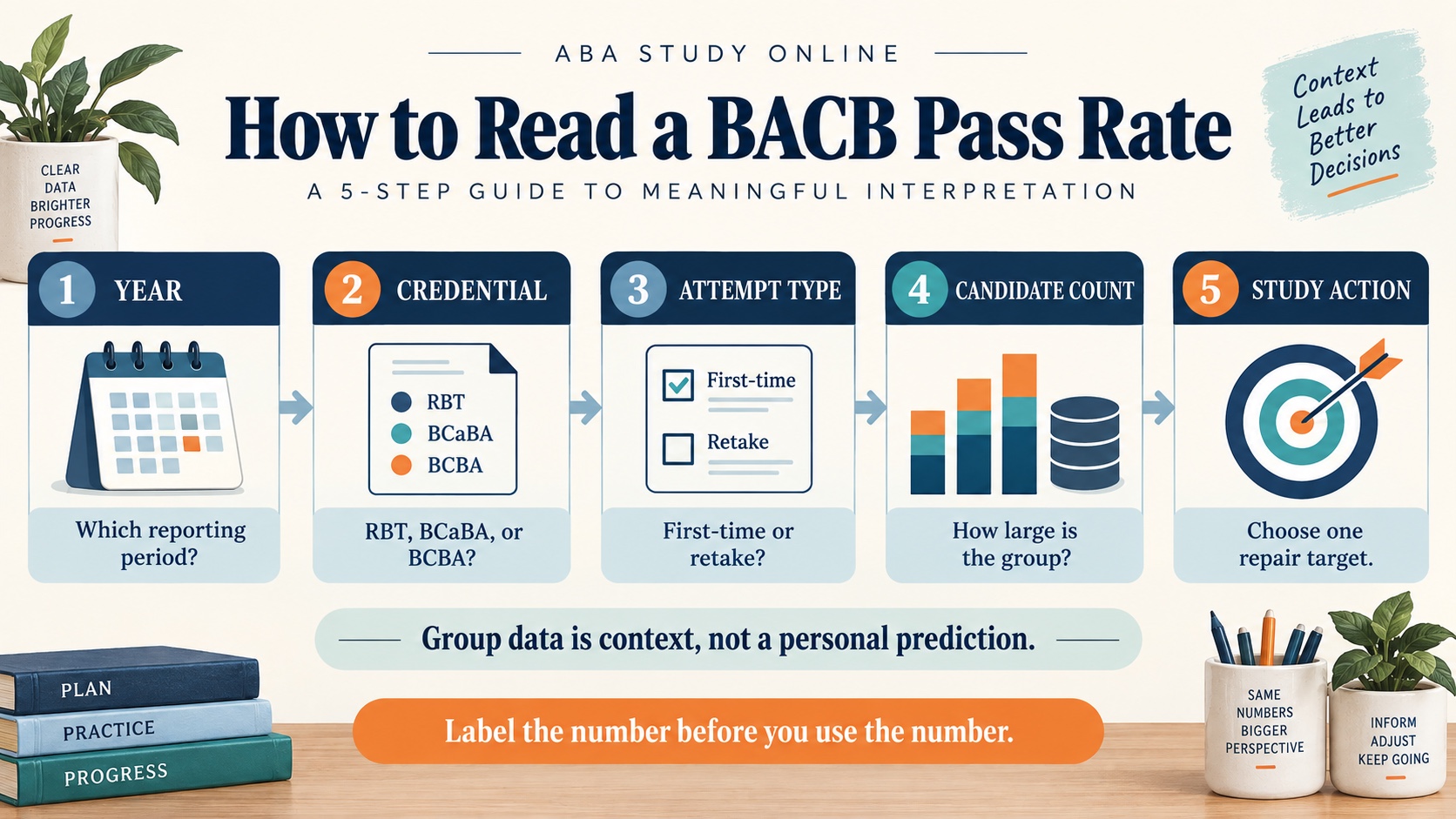
Start with the credential. An RBT candidate is not taking the BCBA examination, and the RBT certification role is different from the BCaBA and BCBA roles. Next, check the year. A 2025 rate describes candidates tested in 2025; it is not a timeless property of the exam. Then check the attempt type. First-time candidates and retake candidates are separate rows, not one blended measure. Finally, look at the number tested. A percentage without its population is incomplete context.
The BACB Examination Information page also shows why a cross-track comparison needs care. It currently lists 185 questions and four hours for BCBA, 175 questions and four hours for BCaBA, and 85 questions and 90 minutes for RBT. The format and eligibility context differ, so the three percentages should not be converted into a simple difficulty ladder.
Why first-time and retake rates differ
First-time and retake groups are formed from people at different points in a certification journey. A first-time group may include candidates completing their initial application and preparing for their first attempt. A retake group has already encountered the examination and may be returning after a prior unsuccessful attempt, a pause in study, or a change in preparation. The annual table does not, by itself, explain each person’s reason for testing again.
That is why the retake rate should not be used as a personal forecast. A 23% BCBA retake rate does not mean that every person who retakes has a 23% chance of passing. It is a group-level percentage for that year’s retake candidates. It can signal that a retake deserves a different preparation approach, but it cannot tell you how many weeks you personally need or what score you must reach on an unofficial practice set.
It is also risky to compare the first-time rate for one credential with the retake rate for another. Keep the comparison within the same row type first. After that, ask what study decision the number supports: clarifying eligibility, reviewing a content domain, practising application, or improving pacing.
What the multi-year data can show
The BACB annual report provides historical data so readers can see movement across years. For example, the BCBA first-time rate shown by BACB was 60% in 2021, 55% in 2022, 56% in 2023, 54% in 2024, and 51% in 2025. The BCaBA first-time figures were 61%, 49%, 56%, 54%, and 60% across those same years. The RBT first-time figures shown in the report were 83%, 77%, 74%, 73%, and 75%; the 2021 RBT entry carries a specific reporting note about anomalous regional activity.
A trend can encourage a careful question—what changed in the candidate population, preparation environment, or reporting period?—but it does not prove why a percentage moved. It also does not tell you that a future year will continue in the same direction. Use historical data to identify the need for current sources, not to replace them.
When you plan content for a current exam, confirm the official handbook, examination information, and relevant content outline again. This matters especially when a search result or a study product still uses an older edition label.
Overall exam rates versus program reports
Another common source of confusion is the difference between overall examination pass rates and university or training-program reports. The BACB’s University Examination Pass Rates page publishes separate annual reports for first-time BCBA and BCaBA candidates in university training programs. It also explains that programs below the stated candidate threshold may not appear and cautions readers not to compare a program’s rate directly with the overall examination rate.
That warning is important for students comparing schools. A program-level percentage describes a defined group associated with that program, while the annual overall rate combines candidates across a much larger and different population. The two reports can answer different questions:
- Overall BACB rate: What percentage of the reported RBT, BCaBA, or BCBA testing group passed in that year and attempt category?
- Program report: What was reported for first-time candidates associated with a qualifying university training program?
- Your decision: Which eligibility route, learning support, and study routine fit your situation and current requirements?
A high program rate is not a guarantee for a new student, and a lower rate is not a complete judgment of program quality. Look at the candidate count, reporting year, curriculum, supervision, support, and current accreditation or course-sequence information together.
Turn pass-rate information into a study plan
Use the public data as a planning prompt, not as a reason to panic. First, identify your credential and confirm the current eligibility requirements. Second, map your preparation to the relevant content outline or official handbook. Third, use practice questions to locate specific gaps. A practice percentage is more helpful when paired with the domain, confidence level, error type, and explanation behind each answer.
For a first attempt, a sensible sequence is baseline → focused review → mixed application → timed rehearsal. For a retake, start by reviewing the previous preparation process rather than simply adding more questions. Did you miss a concept, confuse two similar procedures, struggle to apply a rule to a scenario, or lose time? The answer determines the next study block.
ABA Study Online can organize the longer practice experience on the website and carry shorter repeatable review in the app through section practice, flashcards, audio review, progress, and saved mistakes. Use those tools to make a next action visible. Do not use them to manufacture an “official passing score” or to promise a certification result.
How the 2027 transition fits into this topic
The BACB has announced significant BCBA and BCaBA certification-requirement changes taking effect on January 1, 2027. The current notice says that a complete application, including payment and required documents, must be received by December 31, 2026 to be reviewed under the current 2022 requirements. The BACB also provides transition guidance and updated handbooks.
This transition is a reason to recheck eligibility, coursework, fieldwork, and maintenance information—not a reason to assume that the 2025 pass-rate table is a 2027 pass-rate prediction. A requirements change and an examination-content edition are related planning questions but are not automatically the same thing. When you study or publish an exam guide, confirm the current BACB source for the credential and date you are discussing. See the BACB’s 2027 requirements notice and upcoming-changes page for the current transition boundaries.
BACB pass-rate FAQ
What is the current BACB pass rate?
In the 2025 annual data currently displayed by BACB, first-time rates are 75% for RBT, 60% for BCaBA, and 51% for BCBA. Retake rates are 38%, 30%, and 23%, respectively. Always include the year and attempt type when you quote one of these figures.
Which BACB credential has the highest pass rate?
The 2025 first-time percentage is highest for RBT in the current annual table. That does not establish that RBT is the easiest credential or that the three examinations can be ranked by percentage. They serve different roles and test different candidate populations and formats.
Can BACB pass rates predict whether I will pass?
No. Annual pass rates are descriptive group data. Use them to understand context, then use official requirements, content outlines, deliberate practice, and error review to guide your own preparation.
Are school pass rates the same as BACB overall pass rates?
No. University reports are a separate dataset for qualifying first-time BCBA and BCaBA candidates, with their own reporting rules and thresholds. BACB specifically cautions readers against comparing a program rate directly with the overall examination rate.
Official sources and next steps
For current figures and boundaries, start with the BACB Annual Data Report, Examination Information, University Examination Pass Rates, and the official Recent and Upcoming Changes page. For study support, explore the RBT learning path, BCaBA learning path, BCBA learning path, RBT practice questions, BCaBA practice questions, BCBA practice questions, and the ABA Study Online app. Recheck official sources before relying on a date-sensitive requirement or pass-rate figure.