BACB News: How to Track Official Updates Without Missing a Requirement Change
If you search for BACB news, you may be trying to answer several different questions at once: Did a certification requirement change? Is there a new exam outline? What does a newsletter mean for my application? Did the Board post an operational notice that affects my timing? These are related questions, but they do not always have the same controlling source.
The most reliable way to follow BACB news is to identify your credential, find the effective date, and open the official page or document that governs the decision. A news item can point you toward a change; it should not replace the current handbook, examination information, test content outline, or applicable jurisdictional rule.
Table of Contents
What BACB news can mean
“BACB news” is not one type of announcement. It can refer to a policy transition, an examination-resource update, a newsletter explanation, an application-processing notice, a portal issue, an ethics or professional-practice reminder, or a credential-page revision. The practical effect depends on the credential and on the action you are considering.
For example, an application-processing notice may help explain timing without changing the eligibility pathway. A newsletter may explain how the Board is communicating a transition, while the handbook or transition resource contains the instructions you need to follow. An exam-outline page may define the content map, while a separate announcement explains when a version takes effect. Keeping these functions separate prevents a headline from doing too much work.
When an update affects your plan, write down four labels: credential, decision, effective date, and controlling source. If one of those labels is missing, you probably have a lead for research rather than an answer.
The official source hierarchy
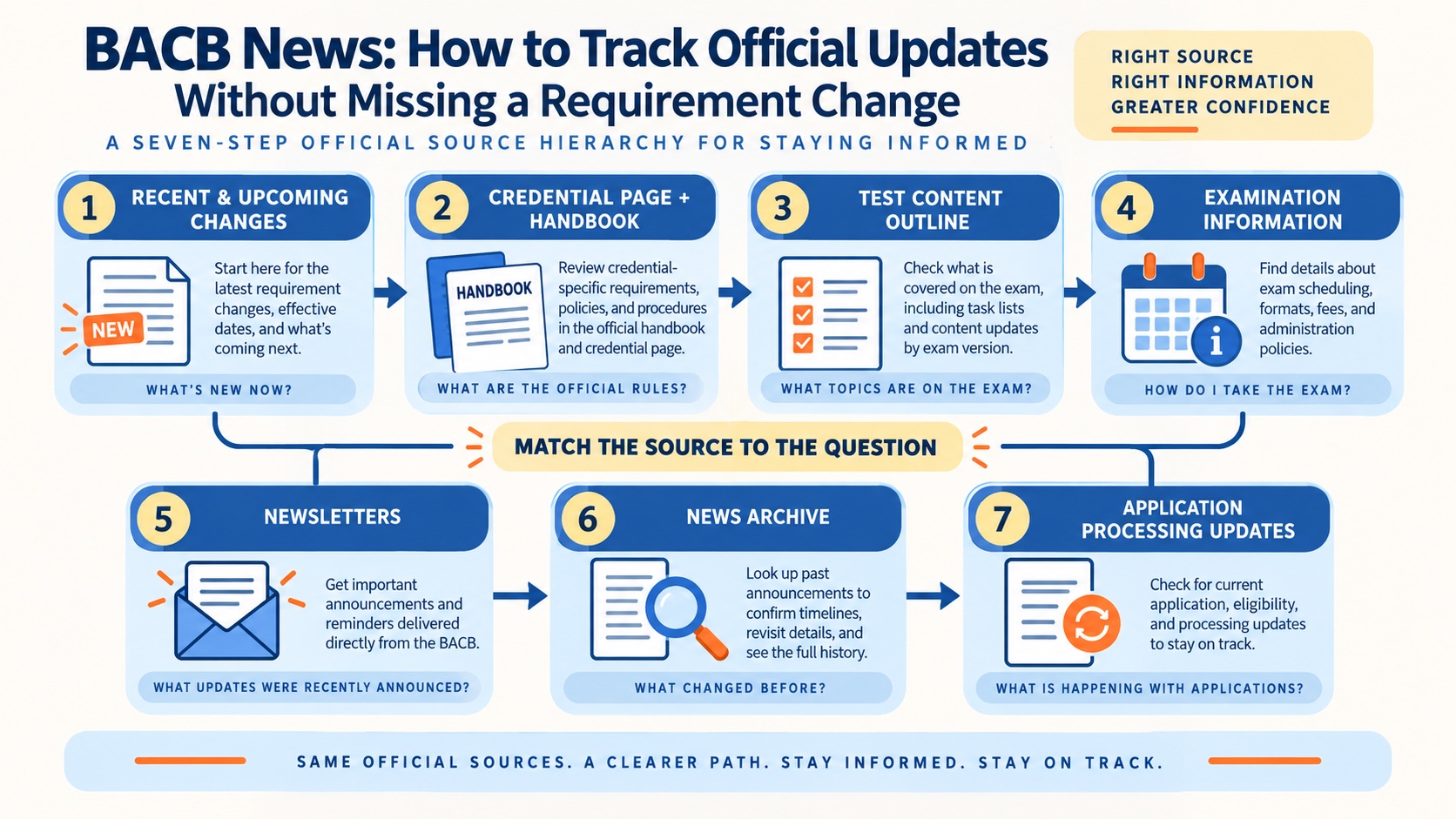
The BACB’s pages work together, but they are not interchangeable. Use the following order as a practical routing system.
- Recent & Upcoming Changes: begin here when you need implementation dates or a high-level list of transitions.
- Credential page and handbook: use the current BCBA, BCaBA, or RBT resource and handbook for eligibility, maintenance, documentation, and application boundaries.
- Test Content Outline: use the current TCO when your question is what the examination covers. Do not infer a new edition from a general policy announcement.
- Examination Information: use the exam-information page for registration, administration, security, and process questions.
- Newsletters and news archive: use these to discover context, reminders, and announcements. Follow the linked source when a decision depends on the details.
- Application Processing Updates: use operational notices for portal or processing context. They do not automatically rewrite the certification requirements.
The 2026–2027 update map
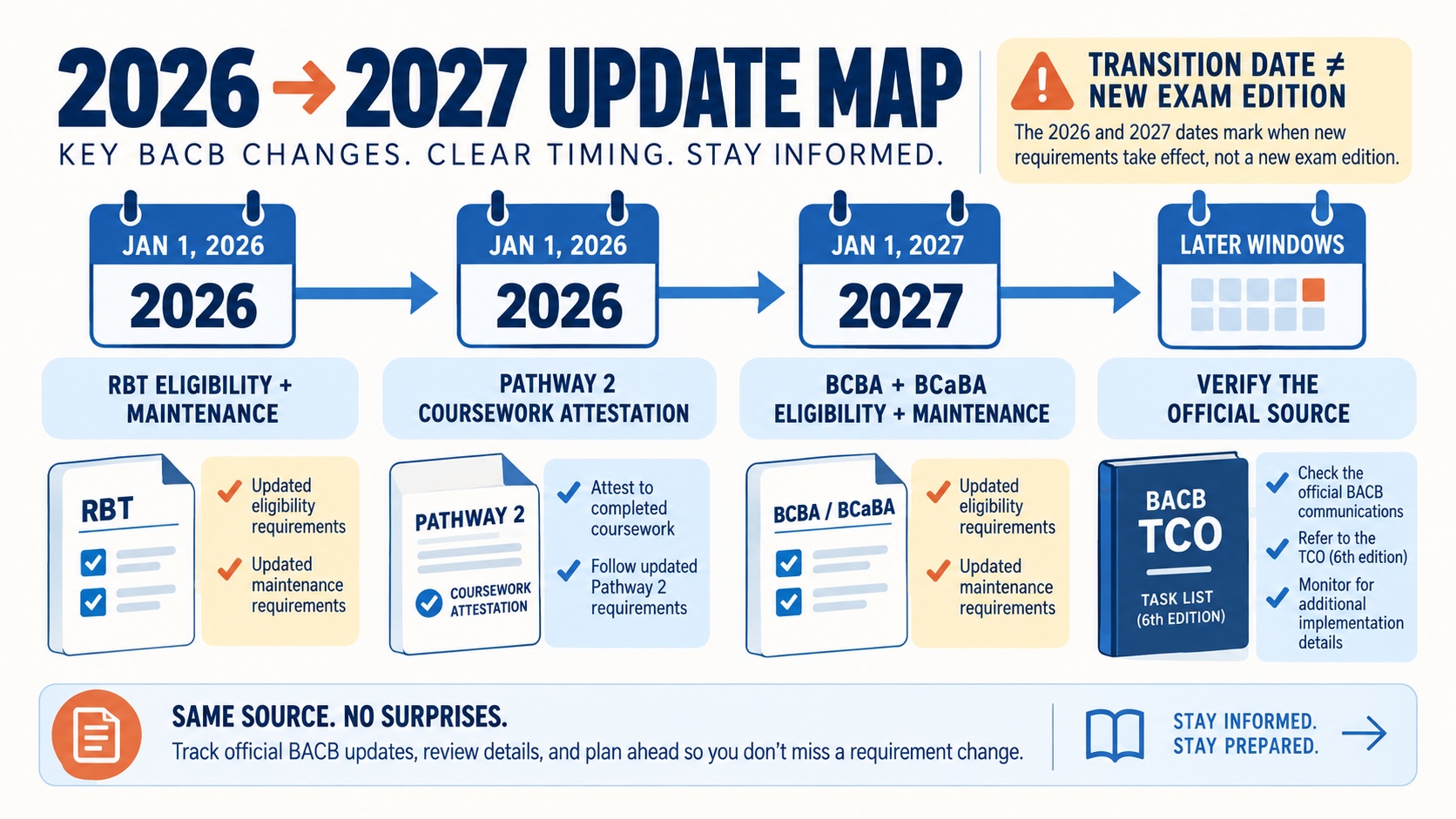
The official update table reviewed for this guide lists several transition windows. In 2026, the Board lists changes involving BCBA and BCaBA Pathway 2 coursework attestation, as well as RBT eligibility and maintenance revisions. The RBT examination is listed with the RBT third-edition TCO beginning January 1, 2026. These dates are useful orientation points, but a reader still needs the credential-specific page and current requirements document before changing an application or study plan.
The same table lists BCBA and BCaBA eligibility and maintenance changes beginning January 1, 2027. That is a transition date, not evidence that the BCBA or BCaBA exam outline has become a “7th edition.” The current TCO inventory reviewed for this article lists BCBA TCO6, BCaBA TCO6, and RBT TCO3 beginning January 1, 2026. Keep eligibility and maintenance changes separate from exam content-outline versions.
The table also contains later implementation windows. Rather than memorizing a long list, save the official changes page, record the date relevant to your credential, and recheck the linked source when you are within the application, renewal, training, or examination window. Future-dated information can change in detail before it affects your case.
How to read the update itself
An official update becomes easier to use when you read it in layers. First, find the scope: which credential, pathway, provider type, or administrative process is named? Second, find the action: is the reader expected to attest, document, complete training, use a new form, follow a new examination outline, or simply be aware of a communication? Third, find the date relationship: is the page describing what is already in effect, what begins on a future date, or what is being phased out over several years?
Then look for the linked implementation document. A summary may use a familiar phrase such as “requirements update,” but the linked page may narrow it to a specific pathway or application date. That detail is where many avoidable mistakes begin. A learner who is still collecting coursework may need one answer, while a certificant renewing under a different cycle may need another. The source does not become less useful because the answer is conditional; the condition is part of the answer.
For study planning, keep a two-column note. In the first column, write content to learn: concepts, task-list areas, definitions, or practice decisions. In the second, write process to verify: application documents, competency steps, renewal evidence, deadlines, or portal instructions. This prevents a process announcement from displacing exam content in your notes. The BCBA and BCaBA learning paths can organize concept review, while the official source should control the process checklist.
Choose the route for your credential
BCBA
Start with the BCBA resource page and current Handbook when the question concerns eligibility, fieldwork, application, maintenance, supervision, or ethics. Use the BCBA 2027 transition resource for transition-specific guidance. If the question is exam content, open the current BCBA TCO and examination information instead of relying on a post that says a new edition is coming.
BCaBA
Use the BCaBA resource page and current handbook for the pathway, fieldwork, application, and maintenance details. The 2027 update window may affect planning, but a BCaBA learner should verify which pathway and date apply to their own application. A general BACB headline is not enough to decide whether coursework or supervised fieldwork is acceptable.
RBT
Use the RBT resource page, current RBT requirements, competency-assessment information, and examination resources. The RBT pathway has its own eligibility and maintenance rules, so a BCBA or BCaBA update should not be copied into an RBT checklist. The RBT learning path can help organize study topics, while the BACB remains the authority for the current credential process.
For any track, separate a certification rule from a local practice or employment rule. State or provincial licensing, payer policies, employer requirements, and training-provider policies may add conditions that are not the same as BACB certification requirements.
A repeatable update-check workflow
- Capture the claim. Copy the headline or question in your own words; do not let a short snippet become the whole rule.
- Identify the track. Mark BCBA, BCaBA, RBT, or general professional practice.
- Check the date. Record the announcement date and the effective date separately.
- Open the primary source. Follow the link to the current handbook, TCO, requirements document, transition resource, or application notice.
- Translate it into one action. For example: update a study outline, ask a supervisor for documentation guidance, or recheck an application checklist.
- Set a recheck point. For a future transition, review the official source again before submitting, renewing, or scheduling.
Common BACB news mistakes
- Confusing a newsletter with a handbook: a newsletter can explain context, but the current governing document answers the operational question.
- Confusing a transition date with a test edition: eligibility, maintenance, and examination content are separate update tracks.
- Using an old screenshot: open the live official page and check the document date and effective date.
- Applying another credential’s rule: BCBA, BCaBA, and RBT pathways are separate.
- Treating a provider’s summary as universal: a course or employer may add a policy that is not a BACB requirement.
BACB news FAQ
Where should I start for current BACB news?
Start with the official Recent & Upcoming Changes page, then open the credential-specific source linked to your question. Use the newsletter and news archive for context and discovery.
Does a 2027 BACB change automatically mean a new exam edition?
No. A change to eligibility or maintenance is not the same as a new test content outline. Check the current TCO inventory and examination information for exam-version questions.
Can I use BACB news to update my study notes?
Yes, if you label the note with the credential, source, effective date, and action. Keep study-content changes separate from application, maintenance, or administrative reminders.
Is ABA Study Online an official BACB news source?
No. ABA Study Online can explain concepts and organize study resources, but it is not the BACB. For current certification decisions, open the official BACB source and applicable jurisdictional guidance.