
BACB Initial Competency Assessment: What RBT Applicants Need to Know
If you are searching for the BACB initial competency assessment, you are usually asking about the assessment required for an RBT applicant. The current BACB packet says that RBT applicants must demonstrate that they can competently perform the listed tasks. In other words, this is an observed skills assessment connected to RBT certification—not a generic ABA quiz, not the 40-hour training certificate, and not the RBT certification examination.
The packet effective January 1, 2026 also sets rules for who can oversee the assessment, when it must happen, which formats may be used, how the official form is completed, and what records must be kept. This guide explains the process in plain language. The current BACB packet and RBT Handbook control if a rule changes or your situation needs an individual eligibility decision.
Table of Contents
What the initial competency assessment is
The RBT Initial Competency Assessment checks whether an applicant can perform entry-level RBT tasks competently. The assessor gives the applicant an opportunity to perform each task and evaluates the performance against the packet’s instructions. Some tasks involve doing something; others require the applicant to explain a concept, provide examples and nonexamples, or describe when to seek direction.
That distinction is important because several documents appear in the RBT application process:
| Document or step | What it does | What it does not do |
|---|---|---|
| 40-hour training | Provides the training required before the initial assessment sequence. | Does not prove that every skill was demonstrated competently. |
| Initial competency assessment | Documents observed performance and explanations across the current task items. | Is not the written RBT certification examination. |
| RBT application and exam | Moves the applicant through the BACB certification process after applicable requirements are met. | Does not replace the completed official competency assessment. |
The assessment is therefore a bridge between training and application evidence. Completing a course can help you rehearse the skills, but the responsible assessor must still evaluate the tasks and sign the official document.
When to complete it
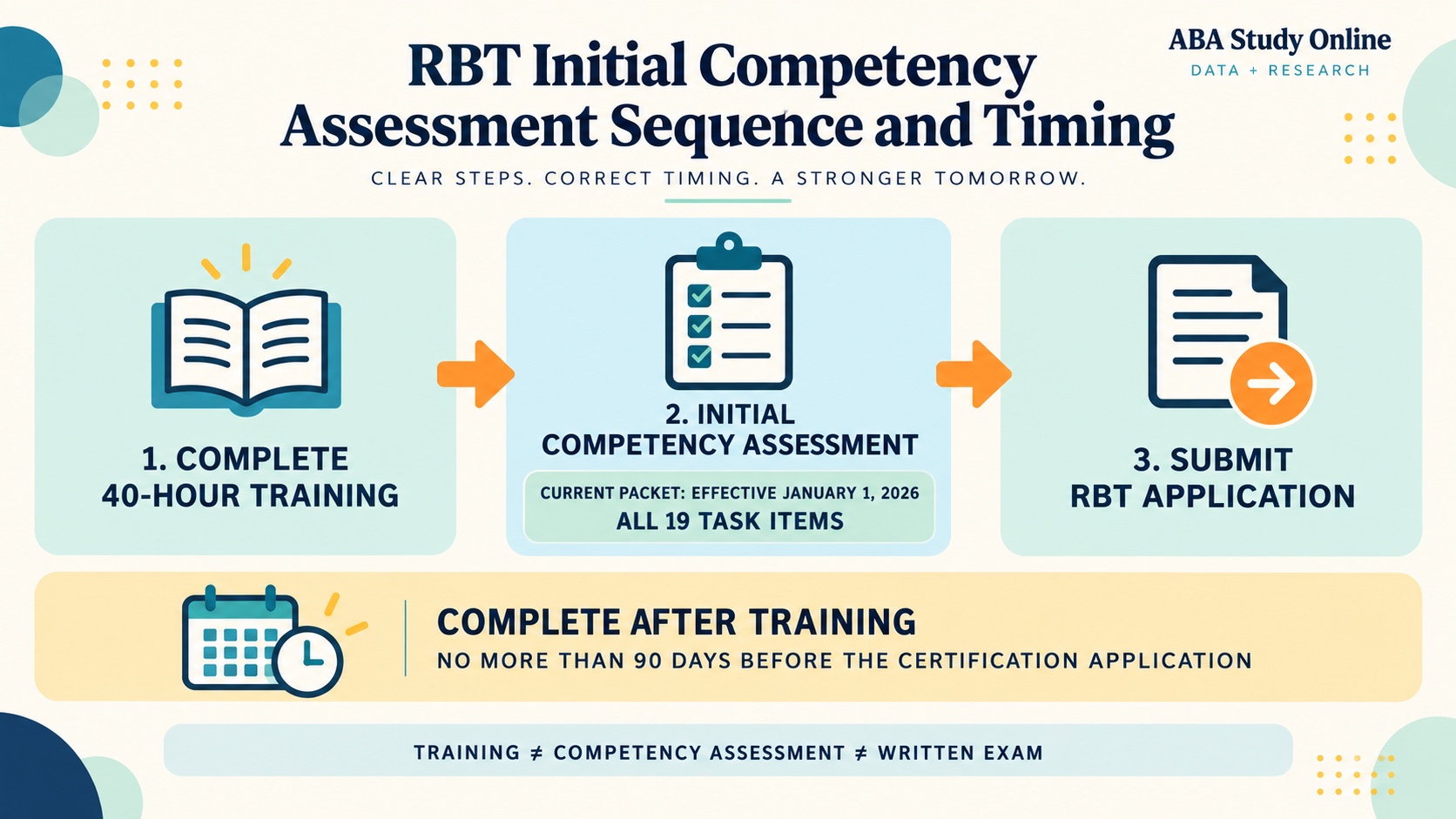
The current packet requires the Initial Competency Assessment to be completed after the 40-hour training is complete. It also says the assessment cannot be completed more than 90 days before submitting the RBT certification application. That is a timing boundary, not a recommendation to rush through the assessment without preparation.
A practical sequence is:
- Complete the applicable RBT 40-hour training.
- Confirm that the assessor and organization relationship meets the current packet.
- Review the official 2026 Initial Competency Assessment Packet and identify the task demonstrations or interviews you will need.
- Complete the assessment after training and within the 90-day application window.
- Keep the completed BACB form with the application materials and follow current portal instructions.
Dates and document versions are easy to mix up when older PDFs remain online. Before scheduling, verify that you are using the packet marked effective January 1, 2026 and that the current RBT Handbook matches your application date.
Who can oversee the assessment
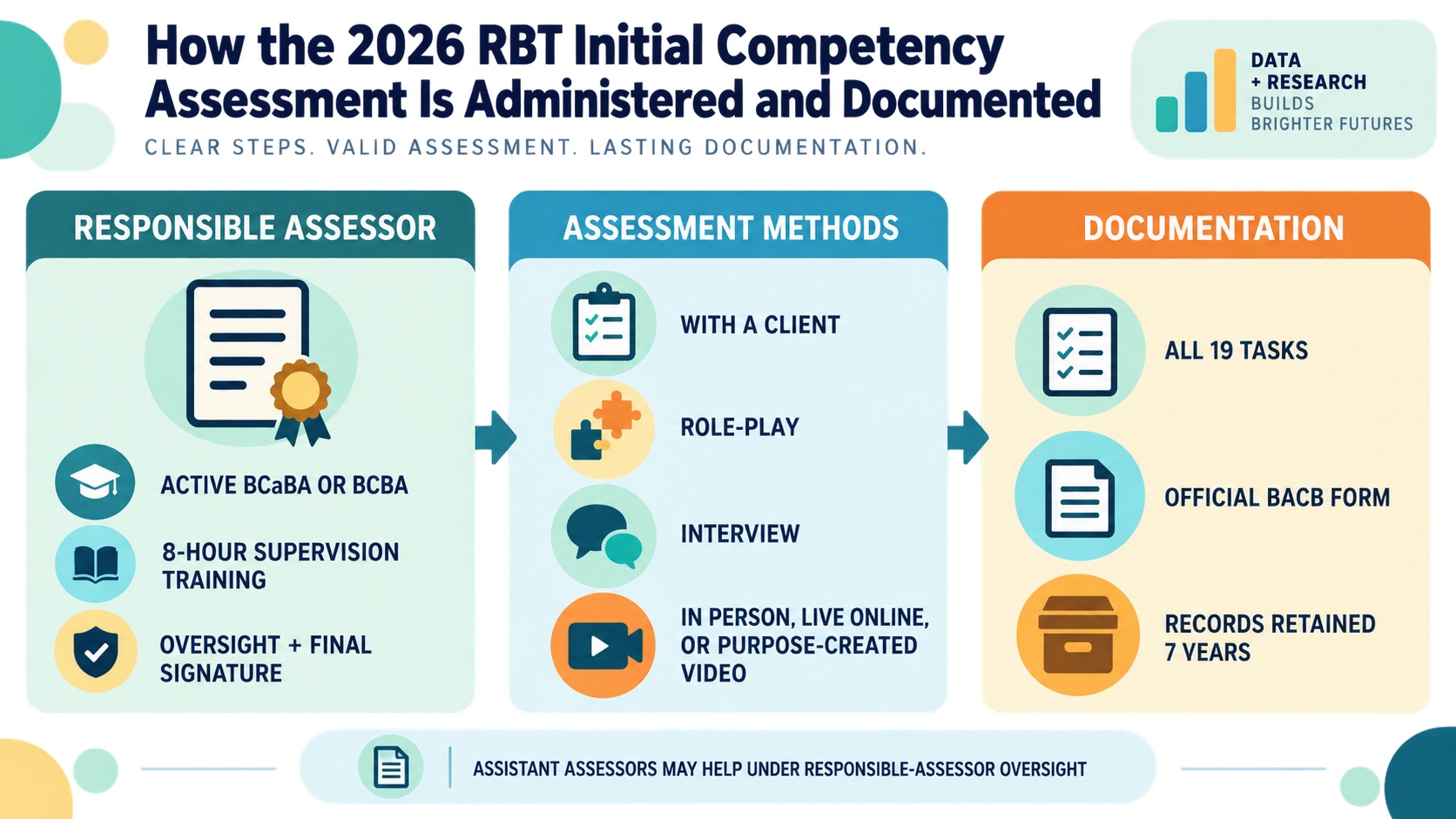
The responsible assessor is an active BCaBA or BCBA who has completed the required 8-hour supervision training. The responsible assessor oversees the assessment, ensures that the requirements are followed, signs the Initial Competency Assessment, maintains records, and remains responsible for quality even when other assessors help with portions of the process.
The relationship rules matter. Under the current packet, the responsible assessor, any assistant assessor, and the applicant must be employed by—or have a contractual relationship with—the same organization. That organization must also be the entity providing services to the client involved in the assessment. The packet adds requirements for BCaBA or RBT assistant assessors and their supervisors. A familiar job title alone is not enough; the assessor and organization should verify the full relationship rule in the current packet.
An assistant assessor may complete some or all of the assessment when the responsible assessor has confirmed the assistant’s proficiency through direct observation and the assistant holds an active RBT certification or higher. The responsible assessor still owns the oversight and sign-off. The packet also says the assessor may not be related to, subordinate to, or employed by the applicant during the assessment. Compensation for assessment services is treated separately from employment in that rule.
What the 19 tasks cover
The current 2026 form contains 19 task items, and all task items must be completed. The task groups help you understand the kind of preparation needed:
- Measurement: implement continuous and discontinuous measurement, and enter data or update graphs.
- Assessment: conduct preference assessments and collect ABC data.
- Skill acquisition and behavior reduction: demonstrate procedures such as discrete-trial teaching, naturalistic teaching, chaining, shaping, discrimination training, prompting and prompt fading, token systems, crisis or emergency procedures, and one specified behavior-change option.
- Professionalism and requirements: generate objective session notes, explain client dignity and professional boundaries, describe RBT supervision standards, and explain when to seek clinical direction.
Three tasks from the skill-acquisition and behavior-reduction section must be demonstrated with a client. The form specifies the allowed assessment type for each task. The exact wording on the current form matters, so use the packet itself as the checklist rather than copying a list from an older training handout.
Notice the balance: the assessment is not only about teaching procedures. A strong applicant also needs to record data, write objective notes, protect dignity, maintain boundaries, understand supervision, and recognize when a supervisor should provide clinical direction.
How the assessment can be administered
The packet allows the assessment to take place over one or more sessions. It may be conducted in person, live through the internet, or through observations of recorded videos created specifically for the purpose of the assessment. The format still has to preserve the assessor’s opportunity to evaluate each task and follow the requirements for the task category.
The packet identifies three assessment methods:
- With a client: the assessor observes the applicant performing a task with a client receiving behavior-analytic services.
- Role-play: the assessor observes performance in a situation similar to a client interaction, with another person acting in the client role when a client demonstration is not appropriate or available.
- Interview: the assessor conducts a live interview in person or online. The applicant must accurately discuss the concept and provide examples and nonexamples when required.
Online does not mean self-administered. A video call, live observation, or purpose-created recording still needs a responsible assessor and must follow the official packet. A multiple-choice practice test can help you retrieve vocabulary, but it cannot replace the performance evidence required by the assessment.
What must be documented
After the assessor observes a task performed competently, the assessor initials the task and marks the assessment type used. After all tasks are demonstrated competently, the responsible assessor signs and dates the final attestation. The applicant submits the completed Initial Competency Assessment with the certification application.
The packet states that non-BACB forms will not be accepted. That is why a custom employer checklist, course certificate, or informal supervisor note cannot substitute for the official form. The responsible assessor must also maintain documentation of each assessment—including completed assessments, participating assessors, and dates—for a minimum of seven years.
If competence is not demonstrated on a task, the assessor may provide corrective feedback and assess the task again on another day. The process repeats until competence is demonstrated. The packet does not allow corrective feedback to be delivered on the final assessment of a task, so “almost correct” should not be treated as a completed sign-off.
How to prepare without treating it like a quiz
Preparation works best when you rehearse both the action and the explanation. For measurement, practice recording the behavior and updating a graph rather than memorizing definitions only. For teaching procedures, practice following a written program, using prompts as directed, and describing how you would respond when the plan is unclear. For professionalism tasks, rehearse concise examples of objective notes, client dignity, boundaries, and seeking clinical direction.
Use a four-column practice sheet:
- Task: copy the current task language from the official form.
- Performance: write what you would do and what the assessor would be able to observe.
- Explanation: prepare a plain-language definition, example, and nonexample where the packet requires discussion.
- Feedback: record the correction you received and the next time you will demonstrate the skill.
For concept review, the RBT learning path, RBT practice questions, and ABA Definition Search can support retrieval. They are study resources, not substitutes for the responsible assessor, the official packet, or the RBT Handbook.
Common mistakes
- Calling it the RBT exam: the competency assessment is a practical and interview-based requirement; the certification examination is a separate step.
- Doing it before the 40-hour training: the current packet places the assessment after training is complete.
- Using an old form: check the effective date and version before beginning.
- Ignoring the 90-day boundary: schedule the assessment close enough to the application to remain within the current window.
- Assuming any BCBA can sign: responsible-assessor qualifications and organization relationships still apply.
- Replacing the BACB form with a workplace checklist: the packet says non-BACB forms will not be accepted.
- Studying only definitions: the assessment checks performance, documentation, professional judgment, and communication as well as vocabulary.
FAQ and official sources
Is the BACB initial competency assessment required for RBT applicants?
The current BACB packet says that all RBT applicants must demonstrate competence on the Initial Competency Assessment as part of the requirements to qualify for RBT certification. Confirm the current RBT Handbook and packet for the application date you are using.
Can the assessment be completed online?
The current packet allows in-person assessment, live internet assessment, or observation of recorded videos created specifically for the assessment. Online delivery still requires the responsible assessor, applicable relationship rules, official task evaluation, and sign-off.
Is the 40-hour certificate enough?
No. Training and competency assessment perform different jobs. The training supports learning, while the assessment documents that the applicant can perform the current tasks competently.
Is this the same process for BCaBA or BCBA fieldwork?
No. The Initial Competency Assessment is an RBT applicant requirement. BCaBA and BCBA trainees follow the supervised-fieldwork requirements in the handbook for their credential. Do not use an RBT competency form as a generic BACB fieldwork form.
Before you schedule or submit anything, read the current 2026 RBT Initial Competency Assessment Packet, the BACB RBT page, and the BACB supervision and assessment resources. Then use the detailed RBT initial competency assessment guide for a task-by-task planning pass.