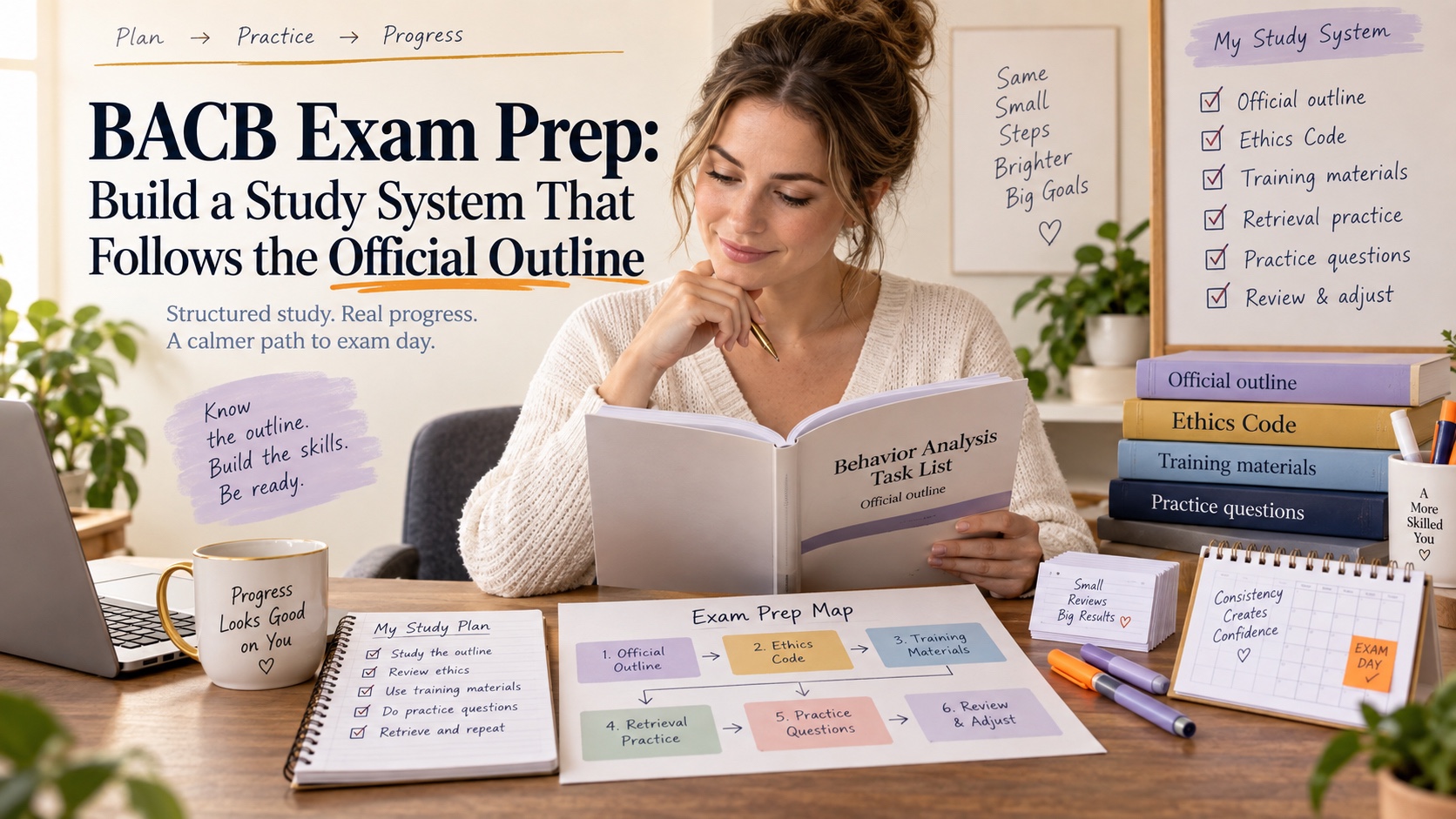
BACB Exam Prep: Build a Study System That Follows the Official Outline
Searching for BACB exam prep can lead you toward flashcards, question banks, study groups, or long lists of “must-know” terms. Those tools may be useful, but the first decision is simpler: identify the certification track you are preparing for and anchor your plan to the current official materials for that track. BCBA, BCaBA, and RBT preparation overlap in some behavior-analytic foundations, yet their outlines, roles, examination structures, and current requirements are not interchangeable.
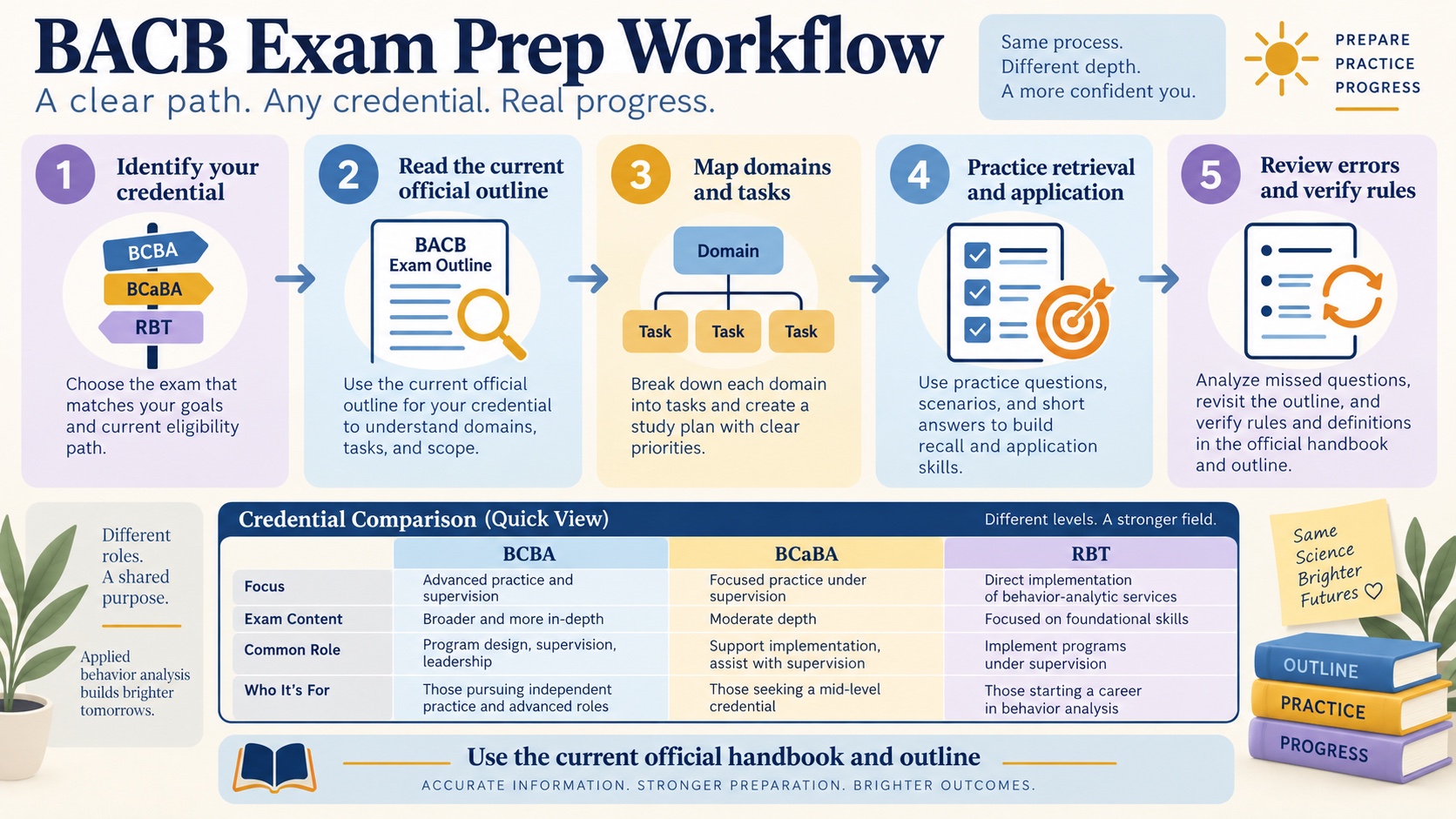
A dependable preparation system has five parts: choose the right credential, read the current outline, map domains and tasks, practice retrieval and application, and review errors against the source. This framework is not an official BACB study guide, does not predict exam questions, and does not guarantee a passing result. It is a way to make your study time more deliberate and easier to adjust.
Start with the correct credential
Write the credential at the top of your study document: BCBA, BCaBA, or RBT. Then write the eligibility route you are actually following. This small step prevents a common preparation error: collecting attractive materials from several tracks and assuming that a familiar word means the same thing at every level.
The BACB examination-information page describes the exams as computer-based, multiple-choice examinations delivered through Pearson VUE. The current pages list different examination lengths and question counts by credential. For example, the BCBA examination is listed as 4 hours with 185 total questions, while the RBT examination is listed as 90 minutes with 85 questions. Use the official page and your current handbook for the track you will take; do not build a timing plan from a screenshot, an old course, or another candidate’s recollection.
Your first page of notes should therefore answer three questions: Which exam am I taking? Which current outline applies? Which official handbook explains the policies and preparation boundaries? If any answer is uncertain, resolve that uncertainty before you buy a course or schedule a testing appointment.
Use the official materials as your map
The BACB’s preparation advice is intentionally source-first. The current BCBA Handbook recommends reviewing the BCBA Test Content Outline, the Ethics Code for Behavior Analysts, and materials gathered from training. It also states that BACB cannot endorse specific study guides or preparation materials, and that purchasing study materials does not guarantee a passing result. The same principle applies when you prepare for BCaBA or RBT: start from the current official outline and handbook, then use outside resources as learning aids rather than replacements for the source.
The BACB content-outline hub currently separates the BCBA and BCaBA Test Content Outline 6th editions from the RBT Test Content Outline 3rd edition, which begins January 1, 2026. That matters when a search result uses an old “task list” label or when a product page promises coverage of an edition that no longer controls your exam. Record the document title, edition, effective date, and URL in your study plan.
Next, create a source hierarchy. Put the current credential handbook and content outline first. Put the Ethics Code and your verified training materials beside them. Put commercial summaries, videos, flashcards, and mock questions in a third layer. When a third-layer resource conflicts with a current official source, pause and investigate instead of memorizing both versions.
Build a domain-and-task map
Do not turn the outline into a list that you only highlight. Turn it into a working map. Create one row for each domain or content area and add four columns: “What the task asks me to do,” “What I can explain,” “What I can recognize in a scenario,” and “What I still confuse.” The wording of the task matters. A task that asks you to identify, distinguish, select, interpret, or evaluate calls for different practice than a page of vocabulary definitions.
For a BCBA plan, the current outline groups content into nine areas, including behaviorism and philosophical foundations, concepts and principles, measurement and data interpretation, experimental design, ethics, assessment, behavior-change procedures, intervention selection and implementation, and personnel supervision and management. The percentages in the outline can help you allocate attention, but they are not a promise that your personal exam will mirror a practice test. A smaller domain can still contain a major weakness for you.
For BCaBA or RBT preparation, build the same kind of map from the correct outline instead of copying a BCBA grid. Shared terms can be reviewed together, but the depth and role expectations should remain track-specific. Use the map to decide what to study next, not to claim that one credential is a shortened version of another.
Turn reading into retrieval and application
Reading a definition can create a feeling of familiarity without proving that you can use the concept. After a short study block, close the source and answer from memory. Define the concept in plain language, identify its critical feature, distinguish it from its nearest neighbor, and create a brief example that stays within the stated conditions. Then test yourself with a scenario that changes one important detail.
For example, if your map includes reinforcement, do more than recite “a consequence that increases future behavior.” Ask yourself what evidence would show an increase, what event was added or removed, whether the contingency is actually responsible for the change, and what information is still missing. If your map includes measurement, practice choosing a measurement dimension from a description and explaining what the resulting data can and cannot support. The aim is not to write an enormous essay for every term; it is to make the decision rule visible.
Use a balanced practice set. Mix direct recall, discrimination between similar concepts, data or graph interpretation, ethical judgment, and applied scenarios appropriate to your track. Keep a record of the question source and the reason for your answer. If a practice question is poorly written or uses an outdated rule, mark it as a resource problem rather than allowing it to rewrite your official notes.
Review errors without guessing
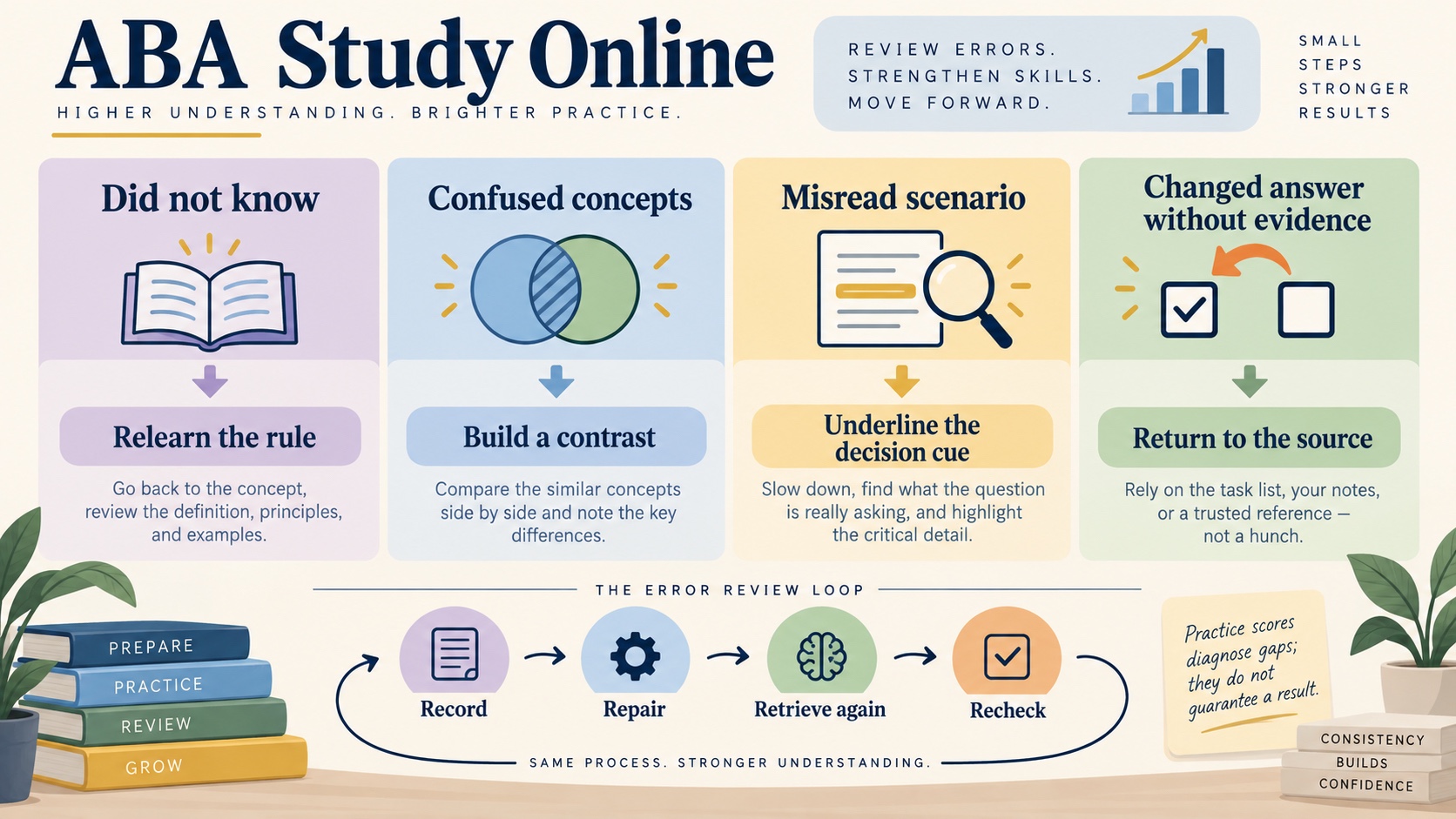
An incorrect answer is useful only when you can explain why it was incorrect. Sort each miss into one of four categories: I did not know the concept; I confused two concepts; I misread the scenario; or I changed my answer without evidence. Add a fifth category for source uncertainty when the item depends on a current rule, credential policy, or edition.
For the first four categories, write a one-sentence repair rule and one fresh example. For source uncertainty, return to the current handbook, outline, Ethics Code, or official examination-information page. Do not “average” conflicting explanations. A practice resource can help you notice a gap, but the current official document should control claims about BACB policy, eligibility, testing, or examination structure.
Use a simple weekly loop
A manageable week can have five repeating moves. On the first day, choose two or three tasks from your map. On the next study block, retrieve them without notes and mark the parts that fail. Then apply the ideas to short scenarios or data displays. Later in the week, complete a mixed set that includes older material. Finish by reviewing errors and changing next week’s priorities.
Keep the loop small enough to repeat. A plan that assigns every domain every day can look ambitious but produce shallow reading. Your calendar should show the next retrieval opportunity, not only the next chapter. If your score improves on familiar questions but drops on mixed scenarios, reduce rereading and increase discrimination and transfer practice. If timing is the problem, add timed blocks only after you understand the content you are timing.
Common preparation mistakes
- Using the wrong edition: check the official effective date before following a task list or course.
- Studying only vocabulary: the exam requires recognition, discrimination, interpretation, and application, not just word matching.
- Treating one mock score as a forecast: use practice results to find weaknesses, not to promise a result.
- Mixing credential tracks: shared language does not make the outlines or role boundaries identical.
- Ignoring policy updates: verify current application, testing, accommodation, and rescheduling information in the official source.
- Collecting resources without a repair loop: more PDFs do not replace a clear process for reviewing errors.
ABA Study Online can support this process with free explanations, practice previews, and track-specific resources. Start with the relevant BCBA, BCaBA, or RBT route, then use the resource library to fill a specific gap on your map. The official BACB materials remain the authority for current requirements and exam policies.
FAQ
What should I use first for BACB exam prep?
Use the current handbook and Test Content Outline for your credential, then add the Ethics Code and your verified training materials. After that, select practice resources that help you retrieve and apply the mapped tasks.
Is there one BACB study guide for every exam?
No. BCBA, BCaBA, and RBT candidates should use the current materials for their own track. A general ABA explanation may be a useful supplement, but it should not replace a credential-specific outline or handbook.
How many practice questions should I complete?
There is no universal number that proves readiness. Choose a volume you can review carefully, mix old and new tasks, and track the reason for every error. A smaller set with meaningful correction is more useful than a large set you never analyze.
Can a mock exam guarantee that I will pass?
No. A mock exam is a practice instrument. It can reveal gaps in recall, application, discrimination, or timing, but it cannot guarantee a BACB result or substitute for current official information.