BACB Ethics Code 2026: Find the Current Code and Study It Responsibly
If you search for the BACB Ethics Code 2026, you may be trying to find a downloadable document, check whether a new edition was released, or understand which ethics code applies to your role. The first clarification is important: “2026” describes the year of this lookup. The BACB’s current ethics page lists the Ethics Code for Behavior Analysts as having gone into effect January 1, 2022. The RBT Ethics Code (2.0) is a separate code for RBT applicants and certificants.
This article helps you find the right official source, understand the code’s high-level responsibility areas, and build a careful study routine. It is not legal advice, does not decide whether a specific event violates a code, and does not replace the full code, current BACB procedures, applicable law, or professional consultation.
Quick answer: the current Ethics Code for Behavior Analysts is the BACB ethics code that applies to BCBA and BCaBA applicants and certificants and certain Authorized Continuing Education providers. It went into effect January 1, 2022. RBT applicants and certificants follow the separate RBT Ethics Code (2.0). Use the BACB’s official ethics page for the current document, revision history, code-enforcement procedures, and related reporting resources.
Where to find the official code
Start at the BACB Ethics Codes page rather than a screenshot, repost, or study note. The page identifies the current Ethics Code for Behavior Analysts, provides the RBT Ethics Code (2.0), and links to code-enforcement procedures. It also includes a revision history so you can see whether a definition or other text has been edited.
Save the official page and the document version you used for studying. If a course, employer, social post, or practice question uses different wording, compare it with the current official source. A study summary can help you remember a concept, but it should not silently replace the code’s actual language.
The current BCBA Handbook also tells certificants and applicants to remain knowledgeable about the Ethics Code for Behavior Analysts. It explains that the code contains six sections covering responsibilities related to professional conduct, clients and service provisions, supervision, and colleagues. The handbook is useful context, but the complete code remains the primary ethics document.
Which code applies to which role?
The BACB’s ethics page lists two codes that are easy to confuse:
- Ethics Code for Behavior Analysts: applies to BCBA and BCaBA applicants and certificants and Authorized Continuing Education providers as described by the BACB.
- RBT Ethics Code (2.0): applies to RBT applicants and certificants.
Role matters because an ethics question may involve more than one person and more than one responsibility. A BCBA supervising an RBT may need to consider the Ethics Code for Behavior Analysts, applicable RBT ethics requirements, supervision standards, organizational policy, and local law. A trainee studying for the BCBA exam should learn the distinctions without treating a memorized label as a substitute for reading the relevant source.
Certification ethics and state or provincial licensure are also related but not identical. The BACB’s consumer resources note that many, but not all, U.S. states require behavior analysts to be licensed. If the question involves licensure, employment, mandated reporting, privacy, or another legal obligation, consult the applicable authority rather than asking a study article to make the decision.
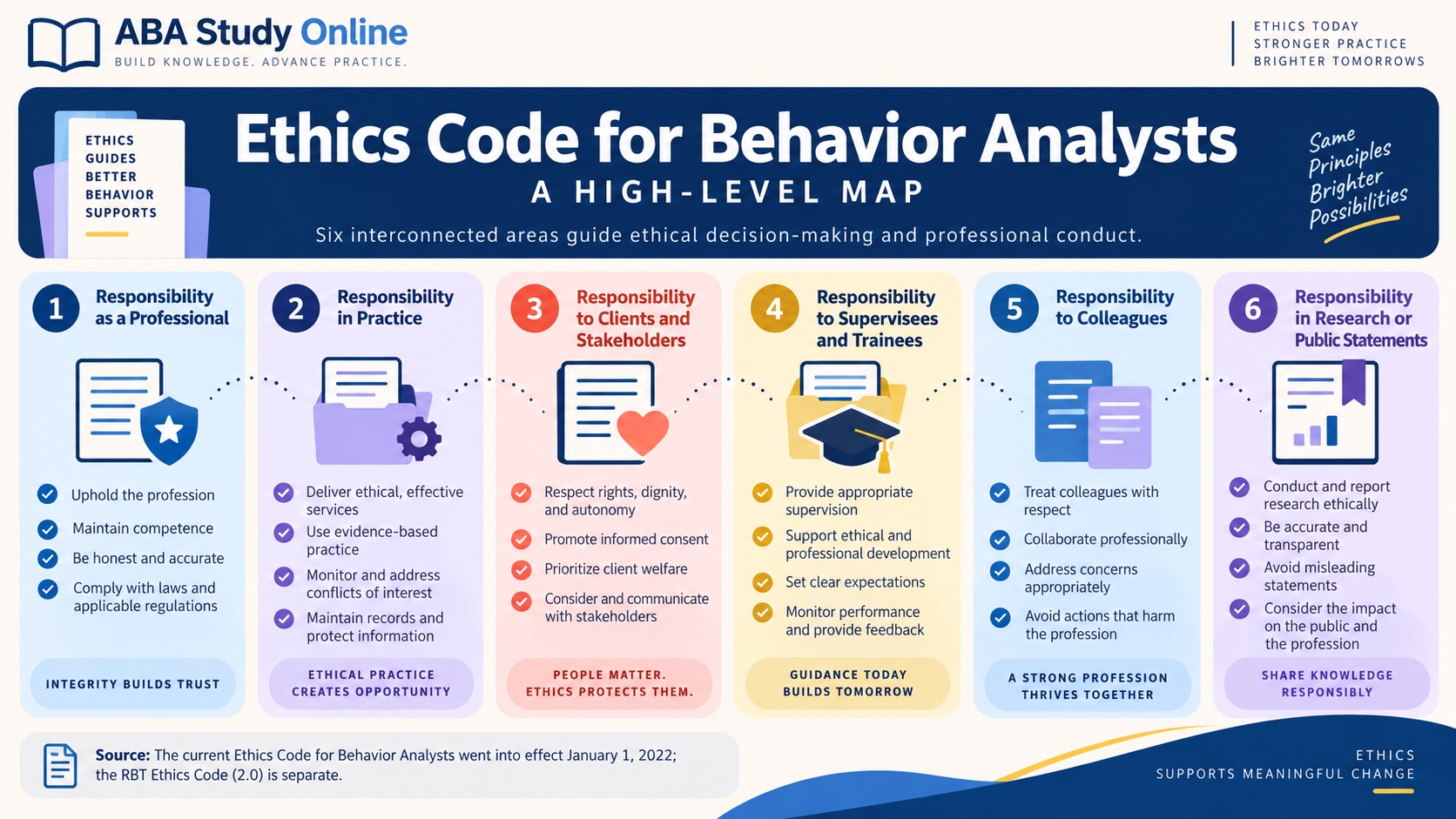
The six responsibility areas at a high level
A high-level map can make the code easier to revisit, but it is not a replacement for the standards inside each section. The six areas can be studied as connected questions:
- Responsibility as a professional: How does the behavior analyst maintain competence, honesty, professionalism, and compliance with applicable requirements?
- Responsibility in practice: How are services delivered competently, effectively, and with attention to conflicts, records, privacy, and professional boundaries?
- Responsibility to clients and stakeholders: How are dignity, rights, autonomy, informed consent or assent, welfare, and communication protected?
- Responsibility to supervisees and trainees: How does the supervisor establish expectations, provide competent supervision, give feedback, and protect the people receiving services?
- Responsibility to colleagues: How should behavior analysts communicate, collaborate, address concerns, and avoid conduct that harms the profession or other professionals?
- Responsibility in research and public statements: How should behavior analysts conduct, describe, publish, or communicate work accurately and responsibly?
These categories overlap. For example, a documentation question may involve practice, client privacy, professional conduct, and collaboration at the same time. The right study move is to identify the facts and then read the relevant standards together, not to force every situation into one memorized box.
How to study the code without memorizing isolated lines
Ethics questions are easier to reason through when you practice with facts, roles, and source boundaries. A useful study page or notebook can have five columns:
- Facts: What happened, and what is directly observable?
- Role: Is the person a BCBA, BCaBA, RBT, applicant, trainee, supervisor, educator, or another stakeholder?
- Context: Does the concern involve clients, service delivery, supervision, colleagues, research, public communication, or professional conduct?
- Source: Which exact code standard, definition, handbook section, policy, or law should be read?
- Next step: What consultation, documentation, correction, or official process is appropriate?
For a practice question, explain why each answer option fits or fails the facts. Avoid the shortcut “the most ethical answer is always the safest-sounding one.” Ethics decisions often depend on scope, consent, competence, privacy, supervision, documentation, and who has authority to act. A good rationale names the decision point and the source boundary.
Supervisors have an additional teaching responsibility. The current BCBA Handbook says that those supervising trainees, RBTs, or BCaBAs must ensure they review and address the applicable ethics code with their supervisees or trainees. That means an ethics study routine can be part of supervision rather than a one-time exam exercise.
A careful way to study an ethics concern
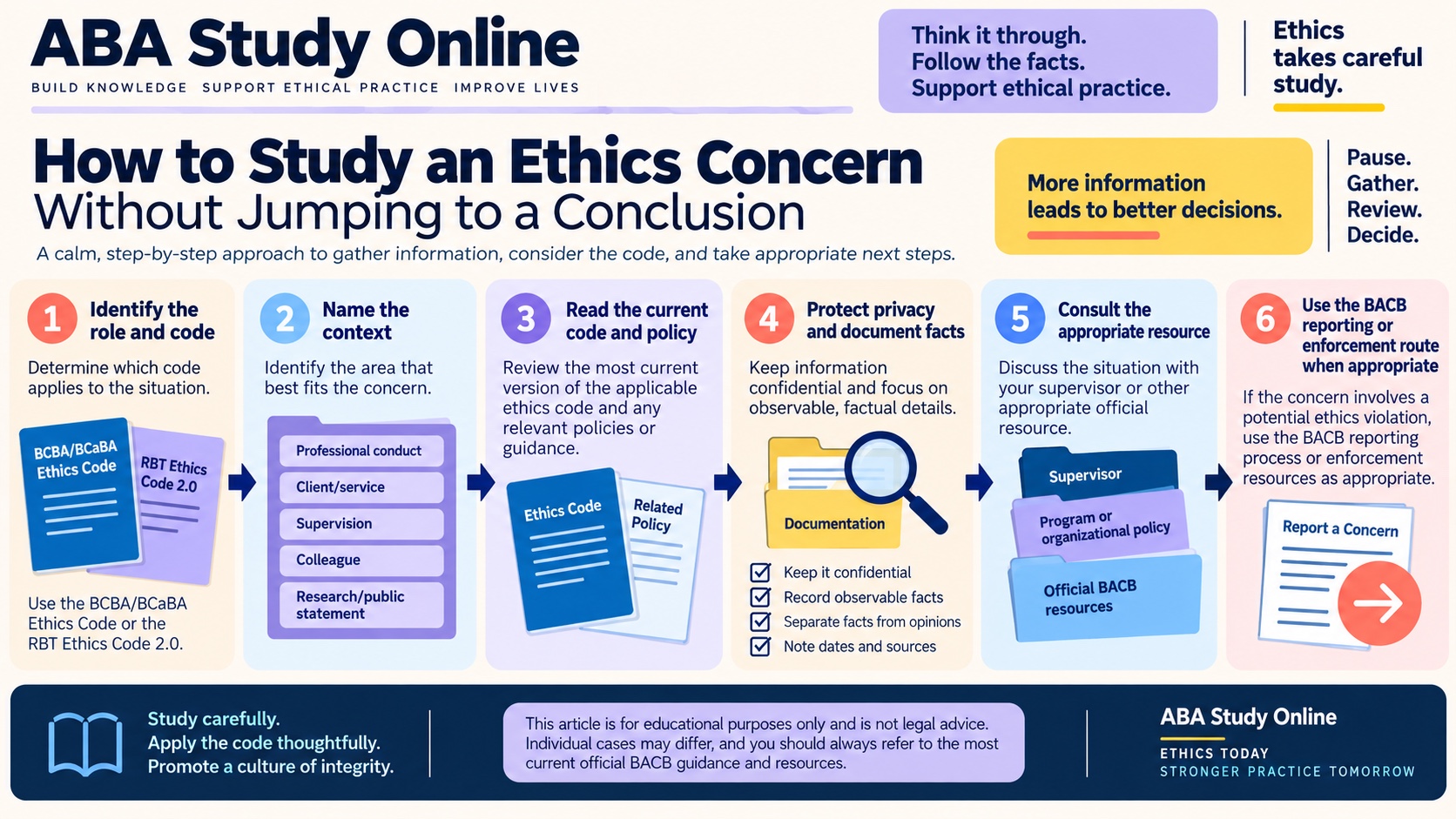
When a situation feels concerning, do not begin by assigning a violation label. Begin by preserving the facts and finding the current source. The following sequence is a study and documentation aid, not a legal decision tree:
- Identify the role and code: confirm whether the Ethics Code for Behavior Analysts or RBT Ethics Code (2.0) applies, and whether another code is relevant.
- Name the context: separate professional conduct, client or service delivery, supervision, colleague, research, and public-statement questions.
- Read the current source: open the official code and related BACB guidance; do not rely on a screenshot or an old flashcard.
- Protect privacy: document observable facts and dates without spreading unnecessary identifying information.
- Consult appropriately: speak with the supervisor, organization, or other qualified resource when that is safe and appropriate.
- Use an official route when needed: if the concern may involve a BACB ethics violation, review the current reporting and enforcement resources rather than improvising a process.
Reporting and enforcement boundaries
The BACB’s Ethics Codes page links to code-enforcement procedures and explains that the Ethics Department processes notices of alleged violations and possible outcomes. That information is useful for understanding the official route, but an article cannot determine whether a specific situation meets a standard or predict an enforcement outcome.
If the situation involves immediate safety, abuse, neglect, a court order, mandatory reporting, privacy law, or licensure, use the appropriate local authority and professional guidance. If the issue is a possible BACB ethics violation, read the current BACB instructions and preserve relevant documentation. Do not post identifiable client details in a public study group or use a public discussion as a substitute for a formal process.
Common mistakes
- Assuming “2026” means a new 2026 ethics-code edition: the current BACB page lists the Ethics Code for Behavior Analysts as effective January 1, 2022.
- Using the BCBA/BCaBA code for every role: RBT applicants and certificants have the separate RBT Ethics Code (2.0).
- Studying only summaries: summaries are useful prompts, but the official code and revision history control.
- Making a violation conclusion from one sentence: read the surrounding standard, definitions, facts, role, and applicable policy.
- Confusing ethics with legal advice: state or provincial law, licensure, employer policy, and the BACB code may all matter.
- Sharing private details while asking for help: protect client, family, supervisee, and colleague information.
FAQ
Is there a new BACB Ethics Code for 2026?
The BACB’s current ethics page says the Ethics Code for Behavior Analysts went into effect January 1, 2022 and provides a revision history. “2026” is best treated as a current-year search label unless BACB publishes a new version.
Does the BACB Ethics Code apply to RBTs?
RBT applicants and certificants follow the separate RBT Ethics Code (2.0). BCBA and BCaBA applicants and certificants follow the Ethics Code for Behavior Analysts as described by the BACB. A service situation may also involve supervision rules, organizational policy, or local law.
How many sections are in the Ethics Code for Behavior Analysts?
The current BCBA Handbook describes six sections covering professional conduct, clients and service provisions, supervision, and colleagues. Use the current code document for the exact section headings and standards.
Can ABA Study Online decide whether conduct violates the code?
No. ABA Study Online can help organize definitions and practice reasoning, but it cannot make an individual legal, licensure, or BACB enforcement decision. Read the current official code and use qualified or official resources for the situation.
For study support, visit the BCBA learning path, BCaBA learning path, RBT learning path, and ABA glossary. These links support learning and do not replace the current code or professional advice.