What Is BACB? Definition, Role, and ABA Certification Tracks
If you searched for a BACB definition, you may be trying to decode an acronym, understand an exam resource, or figure out how the organization relates to ABA. The short answer is that BACB stands for the Behavior Analyst Certification Board. It is a nonprofit credentialing organization that operates certification programs for behavior-analytic professionals and technicians.
BACB is not the same thing as applied behavior analysis, a university, or a state licensing board. It is part of the professional infrastructure around behavior analysis. The exact certification requirements and permission to practice can also depend on the current BACB rules and the law where a person works. This guide gives a source-oriented definition so you can choose the right next page without mixing those roles.
Quick answer: what does BACB stand for?
BACB stands for Behavior Analyst Certification Board. The official organization is the Behavior Analyst Certification Board, Inc. Its stated mission and activities center on professional certification and standards intended to support consumers of behavior-analytic services.
In a study note, you can write:
BACB is a nonprofit credentialing organization that operates certification programs in behavior analysis. It is not the name of ABA itself, and a BACB credential should not be treated as a universal substitute for state licensure or other local rules.
That definition is short, but it preserves the distinctions that matter. The word certification describes a credentialing process. The phrase behavior analysis describes the professional field and scientific approach. The BACB is the organization that administers the relevant certification programs and professional systems.
What BACB does—and what it does not mean
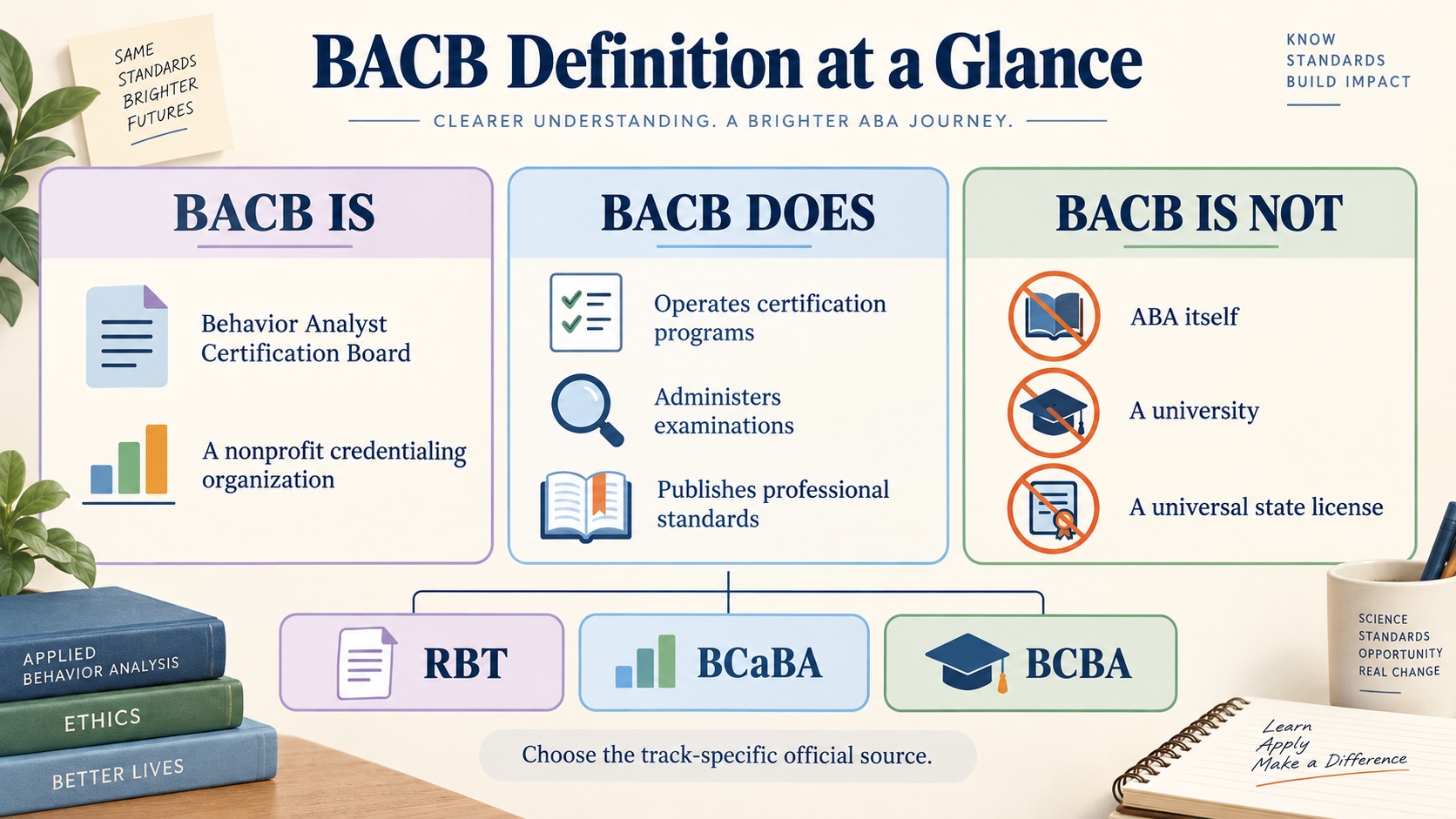
The BACB’s official About page describes the organization as a nonprofit corporation established in 1998 to meet professional certification needs. In its role within behavior analysis, the BACB operates certification programs, administers examinations, and provides ethics requirements and disciplinary systems associated with those programs.
That means BACB is involved in several activities a learner may encounter:
- Credentialing: establishing and maintaining certification pathways for specific roles.
- Examinations: providing certification examinations after applicable eligibility steps are met.
- Professional standards: publishing requirements, ethics materials, and related guidance for its certification programs.
- Consumer protection systems: offering ways to verify certification status and report certain concerns through the organization’s systems.
BACB does not mean “ABA therapy.” ABA is a field and practice context that includes concepts, research methods, assessment, teaching, behavior change, ethics, and many applications. A website, university course, employer, or state agency may provide ABA education or services without being the BACB. Conversely, a BACB study resource may discuss ABA concepts without being an official BACB document.
It is also important not to overstate the legal role. A certification board and a government licensing board are not automatically the same thing. A person may need to satisfy additional state, provincial, employer, payer, or facility requirements. For any practice decision, use the current official BACB information together with the applicable local rules rather than relying on a general acronym definition.
The three BACB certification tracks
The BACB currently presents three primary certification tracks at different levels of responsibility:
- Registered Behavior Technician (RBT): a paraprofessional role that practices under close, ongoing supervision as defined by the applicable BACB materials.
- Board Certified Assistant Behavior Analyst (BCaBA): an undergraduate-level behavior-analytic certification that practices under the supervision required by the applicable BACB rules.
- Board Certified Behavior Analyst (BCBA): a graduate-level certification associated with independent behavior-analytic practice within the person’s competence, training, and applicable law.
These labels are not interchangeable. An RBT study question, a BCaBA task, and a BCBA case decision may mention the same broad concept—such as measurement or reinforcement—while expecting different knowledge or responsibilities. Always identify the track before you choose a task list, Test Content Outline, handbook, practice question, or study guide.
The track names also do not tell you everything about a person’s legal scope of practice. Certification status, employer role, supervision arrangement, competence, and jurisdictional requirements can all matter. Use the official track page and current handbook for the credential you are actually studying.
A practical source-navigation example
Imagine a learner sees the phrase “BACB definition” in a search result and writes down “BACB means ABA certification.” That note is too broad. The learner should revise it in four steps.
- Expand the acronym: write Behavior Analyst Certification Board.
- Identify the organization’s job: it operates certification programs and related professional systems.
- Separate the field: ABA or behavior analysis is the professional and scientific context, not the name of the board.
- Choose the next source: open the RBT, BCaBA, or BCBA page based on the credential being studied.
For example, a learner preparing for an RBT examination should not use a BCBA task outline as if it were the RBT’s full study map. The learner can use a general BACB definition to understand the organization, then move to the official RBT handbook, current examination information, and the relevant current content outline. This is source navigation—not a claim that the learner is certified or that one page replaces the official requirements.
Common misconceptions and a checklist
- “BACB means ABA.” BACB is the credentialing organization; ABA is the field and practice context.
- “BACB is the same as a state license.” Certification and local licensure or practice requirements may be separate.
- “Every BACB credential has the same task list.” RBT, BCaBA, and BCBA materials are track-specific.
- “A search snippet is enough.” Open the current official page because names, requirements, and documents can change.
- “A study guide is an official BACB rule.” Third-party explanations can help learning, but they should be checked against current official sources.
Before you save a BACB definition, ask:
- Did I expand the acronym accurately?
- Did I distinguish the organization from ABA as a field?
- Did I name the specific certification track when discussing requirements or study content?
- Did I avoid turning certification information into a universal legal or clinical promise?
- Did I follow the current official source for the next step?
For related learning, explore ABA Theory Blocks, practice terminology with the free ABA questions, or browse the ABA Definition Search. These are natural internal study links; this definition page does not need a conversion CTA.
FAQ and official sources
What is the full name of BACB? BACB stands for the Behavior Analyst Certification Board. The official organization is the Behavior Analyst Certification Board, Inc.
Is BACB the same as ABA? No. ABA, or applied behavior analysis, is a field and practice context. BACB is a credentialing organization connected to professional certification in behavior analysis.
How many BACB certification tracks are there? The BACB’s current public overview presents RBT, BCaBA, and BCBA certification programs. Study each track from its own official materials.
Does BACB certification automatically equal a state license? Not necessarily. Certification and local legal requirements can be different. Check the current rules that apply to the location, role, employer, and service context.