
BACB Continuing Education Credits: CEUs, PDUs, and Documentation
If you are searching for BACB continuing education credits, the first question is not which webinar to buy. It is which maintenance requirement applies to you. BCBAs and BCaBAs track continuing education units (CEUs); RBTs track professional development units (PDUs). Ethics and supervision categories have their own boundaries, and a certificate from a random course does not automatically make an activity count.
This guide gives you a practical way to plan the two-year cycle, verify an activity, and save the right evidence. BACB requirements can change, so use the handbook and your BACB account for the cycle and certification status that apply to you. ABA Study Online can support study organization and review, but the app is not being presented as an ACE provider or a source of BACB CEUs.
Table of Contents
Quick answer: CEUs or PDUs?
Use the unit that matches your BACB certification:
| Role | Maintenance unit | Common current cycle total |
|---|---|---|
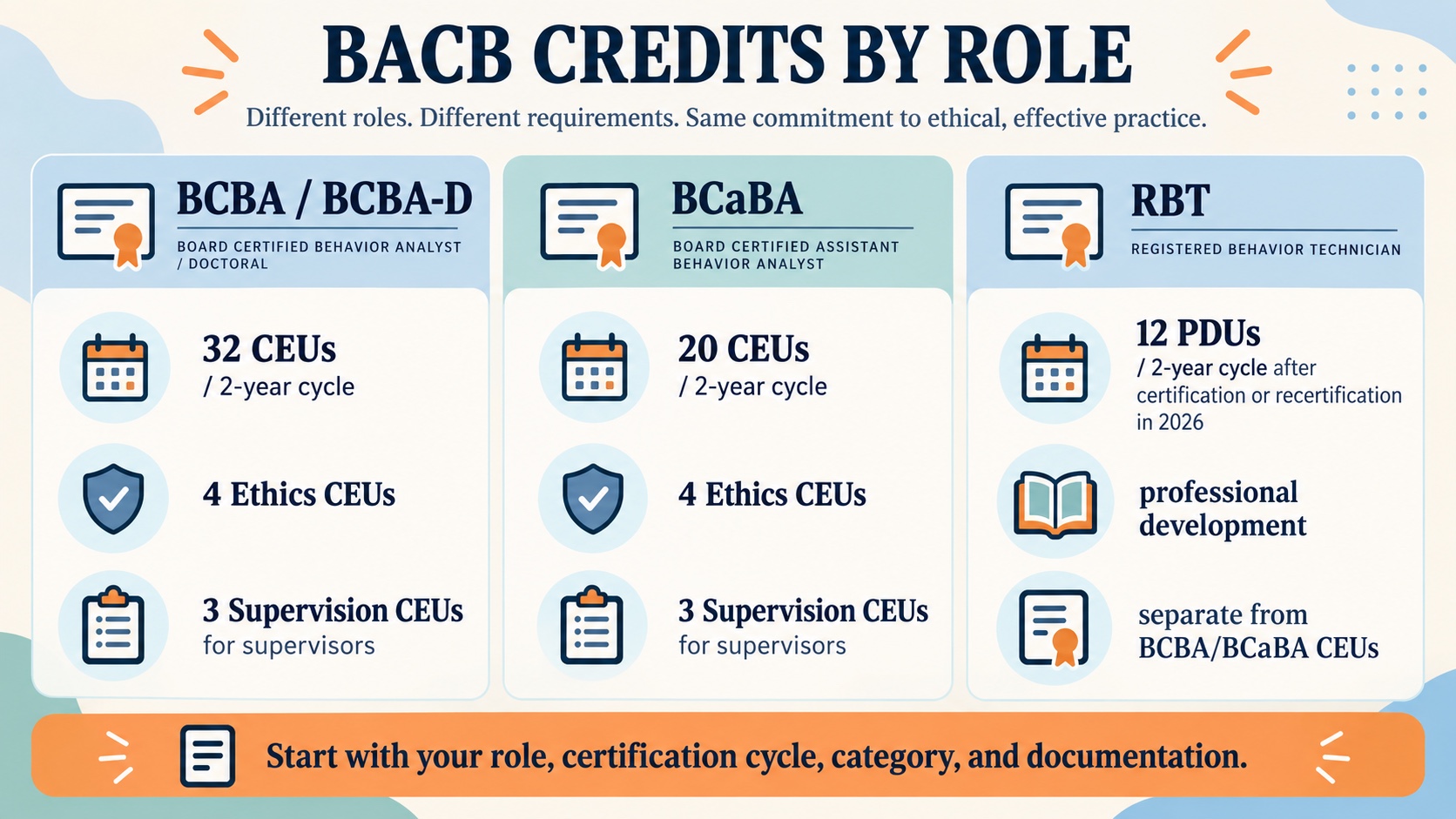
| BCBA/BCBA-D | CEUs | 32 CEUs in a two-year cycle |
| BCaBA | CEUs | 20 CEUs in a two-year cycle |
| RBT | PDUs | 12 PDUs after certification or recertification in 2026, under the current RBT maintenance rules |
The table is a starting point, not a substitute for the handbook. BCBA and BCaBA CEUs are not interchangeable with RBT PDUs simply because both involve professional learning. The audience, provider, content, documentation, and entry process can differ.
How many credits are required?
For BCBA and BCaBA maintenance, the BACB describes a two-year recertification cycle. The current overview lists 32 CEUs for BCBA/BCBA-D and 20 CEUs for BCaBA. Each role has an ethics requirement, and supervision CE is required for supervisors under the applicable handbook rules. A BCBA who is not supervising should not assume that the supervision category applies in the same way as it does to a supervisor.
RBTs follow a different unit system. The current RBT Handbook explains that after an RBT becomes certified or recertifies in 2026, the RBT must earn 12 PDUs during the two-year cycle. PDUs may come from qualifying in-service training, ACE professional-development events, or eligible didactic behavior-analytic university coursework, with the required documentation for the selected route.
Do not wait until the end of the cycle to discover that the activity belongs to another role. Before registering, write down your certification, recertification date, target unit, category, provider, and documentation. This takes a minute and prevents a surprisingly expensive mismatch.
Ethics, supervision, and learning categories
Not every useful professional event qualifies as Ethics CE. The ACE Provider Handbook defines Ethics CE as content related to BACB ethics requirements and/or cultural/contextual responsiveness, connected to behavior-analytic practice or applied research. Most of the event must focus on that subject. A general presentation that spends five minutes mentioning the Ethics Code and then teaches an unrelated topic should not automatically be labeled an ethics event.
Supervision CE is also specific. It should cover effective supervision in behavior-analytic practice as described in the Supervisor Training Curriculum Outline (2.0). For a supervisor, a session about general leadership may be interesting while still failing to meet the supervision-CE definition if it does not address behavior-analytic supervision.
Learning CE is the broader behavior-analysis category for BCBA and BCaBA audiences. The provider’s audience and the level of the content matter. The 2026 ACE Provider Handbook says ACE learning events are designed for BCBA- or BCaBA-level professionals; RBT professional-development events are a separate category. Read the event description, stated audience, unit type, and certificate details together.
One useful rule is to ask: “If I removed the category label, would the actual majority of the content still show why it belongs in this category?” If the answer is no, verify before counting it.
What is usually not enough by itself?
A completion badge, a replay link, or a topic that sounds professional does not answer the BACB’s documentation question. Client-specific training, routine staff orientation, company policy meetings, and a product demonstration may be valuable to your work while still being outside the relevant CE or PDU category. Exam-prep material can help you pass a certification exam, but it is not automatically Ethics CE, Supervision CE, or maintenance credit.
The same caution applies to reading. Reviewing a journal article may deepen your practice, but the activity needs to fit the route and evidence requirements if you want to enter it as a specific type of unit. When an activity is self-directed, check the handbook instructions before assuming that an informal note or personal study log is enough.
Think of the label as a claim that needs support. The event title, learning objectives, audience, instructor, duration, provider status, and certificate should tell the same story. If one part says “Ethics CE” but the objectives and certificate describe only general exam review, pause and ask the provider for clarification before counting it.
How to verify an activity before enrolling
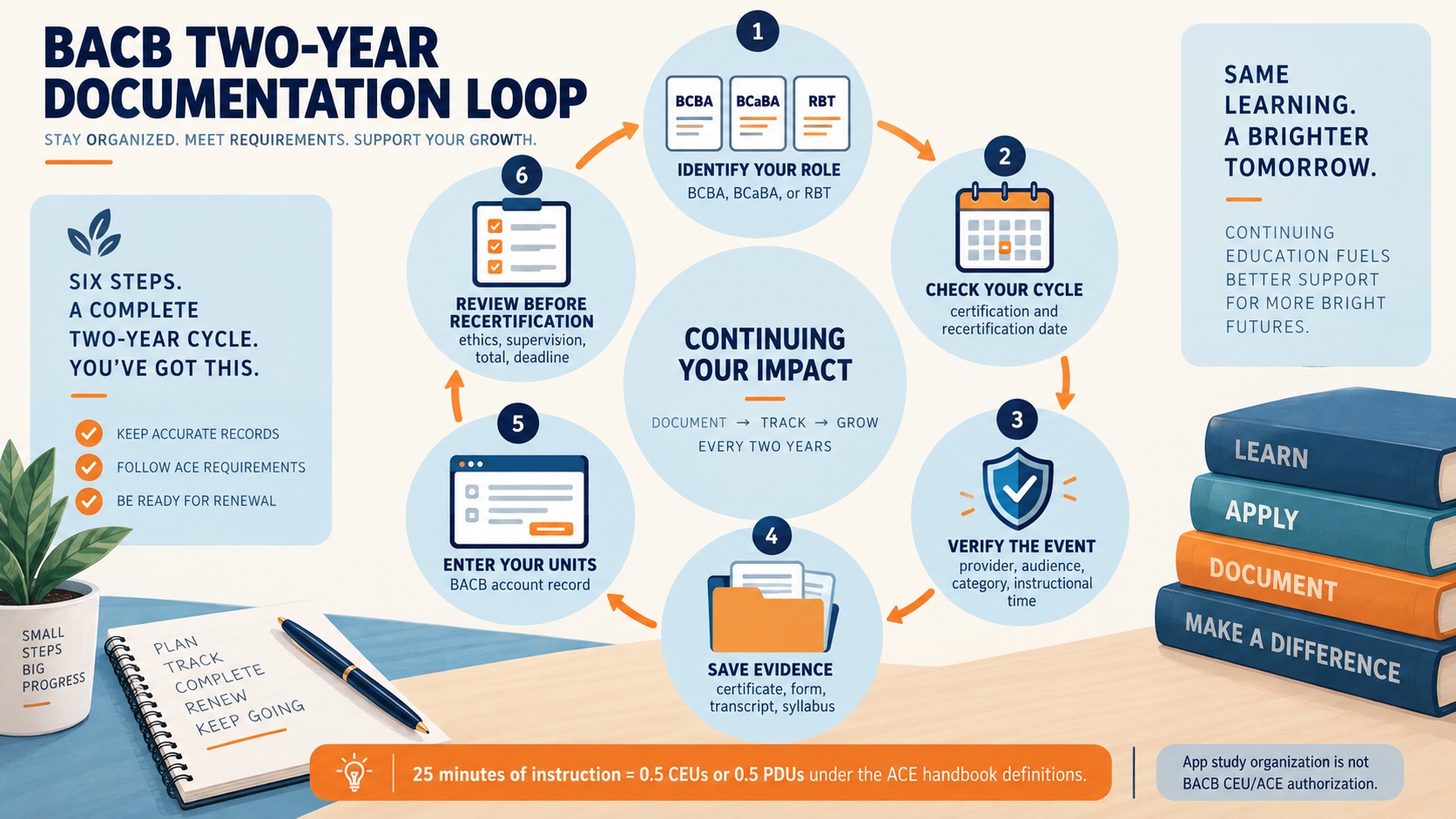
- Check the provider: if the event is marketed as ACE, verify the organization or individual in the BACB ACE Provider Verification Registry.
- Check the audience: determine whether the event is designed for BCBA/BCaBA CE, RBT PD, or another audience.
- Check the category: confirm Learning, Ethics, or Supervision CE—or the relevant RBT PDU route—before payment.
- Check the unit calculation: the ACE handbook defines 25 minutes of instruction as 0.5 CEUs or 0.5 PDUs; breaks and unrelated time do not automatically count.
- Check the evidence: ask what certificate, form, transcript, or provider record you will receive and where you will enter it.
- Check the cycle: make sure the activity falls inside the two-year recertification cycle to which you want to apply it.
“Online” is not the same as “automatically accepted.” An online event may count when it follows the applicable provider and documentation rules; a live event can fail if it is the wrong audience, category, or cycle. Format is only one variable.
How the instructional-time conversion works
The ACE Provider Handbook uses instructional time rather than simply the clock time shown on a calendar invitation. It defines 25 minutes of instruction as 0.5 CEUs for CE events and 0.5 PDUs for professional-development events. A two-hour appointment may therefore contain less instructional time after breaks, introductions, technical delays, or unrelated discussion. Keep the provider’s stated calculation with the certificate instead of doing a more generous conversion yourself.
What documentation to keep
Enter your units in the BACB account when you have the supporting evidence, rather than collecting a drawer full of certificates and trying to reconstruct the cycle later. The exact fields depend on the activity type, but your personal file should normally include:
- event title, date, provider, and instructor or organization;
- the unit type and category, such as Learning, Ethics, Supervision, or PDU;
- the amount of instructional time and the resulting units;
- certificate, form, transcript, syllabus, or other required supporting record;
- the BACB cycle to which you assigned the activity;
- any provider confirmation or correction notice.
Keep the record readable and connected to the entry in your account. If a provider changes the certificate or corrects the unit count, save the updated version and note why the original was replaced. Never edit a certificate yourself to change the category or number of units.
The same principle applies to university coursework and RBT professional development. A transcript or organizational form may be the required evidence; a generic attendance email may not be enough. Use the handbook for the evidence required by your route.
What to watch for in 2027
The BACB has announced significant BCBA and BCaBA requirements changes beginning January 1, 2027. That does not mean every person should copy a future maintenance table into a current account. Use the handbook for your certification and recertification date, and read the transition guidance if your cycle crosses the change.
The stable planning habit is to record the cycle first, then confirm the required total and category mix. Do not assume that a course advertised in 2026 remains categorized the same way in 2027, or that an excess unit automatically rolls forward. The BACB states that units must be earned within the cycle to which they are applied and that excess CEUs cannot be moved into the next cycle.
A simple two-year planning routine
At the beginning of the cycle, make four columns: required total, ethics, supervision if applicable, and documentation status. Divide the total into quarterly targets, but leave room for one or two deeper learning events rather than filling the calendar with the cheapest options.
After each activity, verify the category and save the evidence. Once a quarter, compare your personal record with the BACB account. If you are short in Ethics or Supervision, find a purpose-built event early enough to review its documentation. This is a better plan than hoping a general webinar can be relabeled later.
Put the recertification date on the same calendar as your learning targets, but do not treat a calendar reminder as proof of completion. Your account entry and supporting records are the authoritative checkpoints.
Want a study system for the learning behind your maintenance plan? Use the ABA Study Online app to organize review notes, flashcards, and practice around the topics you are studying. The app link is for learning organization only; it is not a claim that the app provides BACB CEUs, PDUs, or ACE authorization.
FAQ and official sources
How many BACB continuing education credits does a BCBA need?
The current overview lists 32 CEUs during a two-year recertification cycle, including 4 Ethics CEUs and 3 Supervision CEUs for supervisors. Verify your current handbook and account because requirements and transition rules can change.
Do BCaBAs earn CEUs or PDUs?
BCaBAs use CEUs. The current BCaBA Handbook lists 20 CEUs per two-year cycle, including 4 in ethics and 3 in supervision if applicable.
Do RBTs earn CEUs?
RBTs use PDUs rather than BCBA/BCaBA CEUs. The current RBT maintenance rules describe 12 PDUs after certification or recertification in 2026, with specific eligible routes and documentation.
Can any online webinar count as BACB CE?
No. Verify the provider, audience, category, instructional time, cycle, and documentation. An online format alone does not establish eligibility.