BACB Competency Assessment: Which Assessment Does the Term Mean?
Searching for a BACB competency assessment can be confusing because the phrase is often used as if it names one universal form. In the current BACB resource structure, the formal competency-assessment packets are associated with RBT certification and maintenance. A person applying for RBT certification may need the Initial Competency Assessment Packet. A current RBT may need the Recertification Competency Assessment Packet. A BCaBA or BCBA trainee usually needs to follow supervised-fieldwork and supervision requirements instead of looking for one generic BACB competency-assessment form.
That distinction changes what you should download, who should oversee the process, and what evidence belongs in an application. This guide gives you a simple routing method, explains the RBT boundary, and shows what to check when your path involves BCaBA or BCBA fieldwork. It is an educational guide, not an individual eligibility determination. The current BACB handbook, packet, portal instructions, and supervisor guidance control when a requirement affects your application.
Table of Contents
Quick answer: if you are applying for RBT certification, look for the current RBT Initial Competency Assessment Packet. If you are maintaining RBT certification, look for the current Recertification Competency Assessment Packet. If you are pursuing BCaBA or BCBA certification, start with the relevant handbook and supervised-fieldwork requirements. A practice quiz, course certificate, or general skills checklist does not replace the official process that applies to your credential.
Choose the right BACB-related route
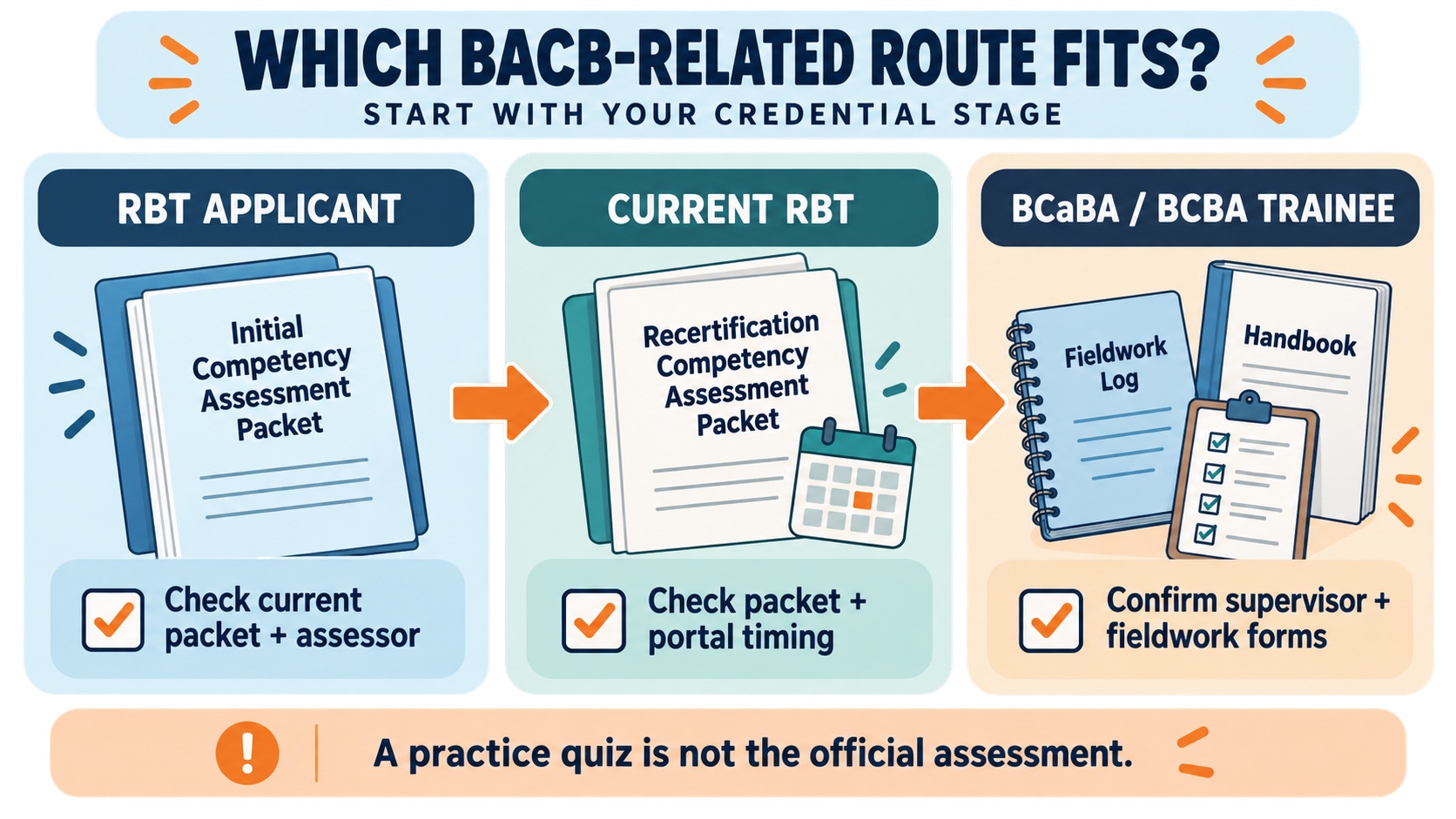
Start with the person’s current role, not with the broadest search result. The BACB’s Supervision, Assessment, Training, and Oversight page lists “assessing RBTs” as a specific competency-assessment role. It separately lists supervising BCaBAs and supervising fieldwork. Those categories are connected by professional oversight, but they are not the same paperwork.
RBT applicant
If you are working toward initial RBT certification, the relevant question is whether you have completed the current training and can demonstrate the tasks required by the Initial Competency Assessment Packet. The assessment is performance-based. It is not the written RBT examination, and it is not simply proof that you attended a training course. The official packet and the current RBT Handbook tell you what must be completed and submitted.
Current RBT
If you already hold RBT certification, do not automatically reuse an initial packet. The current BACB materials distinguish the Recertification Competency Assessment Packet from the Initial Competency Assessment Packet. The purpose, timing, and documentation can differ. Check the current packet label and the instructions in the BACB portal before an assessment is arranged.
BCaBA or BCBA trainee
If you are accumulating supervised fieldwork toward BCaBA or BCBA certification, the key process is supervised fieldwork under the requirements in the relevant handbook. Your supervisor and fieldwork documentation matter more than finding a generic “competency assessment” download. You may still discuss competence, receive observations, practice skills, and document progress, but those activities should not be represented as an RBT packet or as a universal BACB form.
Employee or course participant
An employer, course, or supervisor may create a local skills check. That can be useful for training and quality improvement, but a local checklist is not automatically an official BACB assessment. Label the purpose clearly: onboarding, rehearsal, feedback, or formal certification documentation. Confusing those purposes can create a problem when an applicant submits the wrong file or assumes that a practice score proves eligibility.
What the RBT initial assessment does
The current RBT Initial Competency Assessment Packet is effective January 1, 2026. It asks an RBT applicant to demonstrate competent performance on the task items required by the packet. The official document is designed for an assessor to observe and document performance, not for a learner to use as a self-scored online exam.
The packet covers practical areas such as measurement, assessment, skill acquisition and behavior reduction, and professionalism and requirements. The exact task instructions control how a task may be evaluated. Depending on the task, the assessor may use a client demonstration, role-play, or interview. The packet also describes other delivery conditions, including in-person, live internet, or recorded video created specifically for the assessment. Do not assume that one format can replace another when the task has a specific condition.
One commonly misunderstood detail is the relationship between “all tasks” and “client demonstration.” The current packet requires the applicable tasks to be completed, but it does not mean that every task must be performed with a client. It specifically requires three tasks from the skill-acquisition and behavior-reduction group to be demonstrated with a client. The assessor should follow the current task grid rather than relying on a simplified social-media checklist.
Who oversees it?
The current packet identifies a responsible assessor who is a BCaBA or BCBA certificant and has completed the required 8-hour supervision training. The responsible assessor oversees the process, ensures that the packet is followed, signs the assessment, maintains records, and remains responsible for quality when assistant assessors participate. An assistant assessor may help when the responsible assessor has confirmed the person’s proficiency and provides the required oversight.
There are also relationship expectations. The responsible assessor, assistant assessor, applicant, and the organization providing services to the client must fit the current packet’s requirements. The assessor cannot simply be any credentialed person who is willing to sign a form. Before scheduling, ask the responsible assessor to confirm the current qualification, organization relationship, task formats, and documentation process.
When does it happen?
For initial RBT certification, the assessment belongs after the required training and within the application timing described by the current handbook and packet. The current RBT process also requires the completed official assessment as part of the application materials. Because document versions and portal instructions can change, verify the live BACB source shortly before submission. An older PDF saved on a computer is not a reliable version check.
If you want a more detailed explanation of the current RBT process, use the site’s RBT competency assessment guide and the 2026 RBT assessment overview. Those pages own the task-level preparation details; this page is meant to help you choose the right route first.
Initial and recertification are not interchangeable
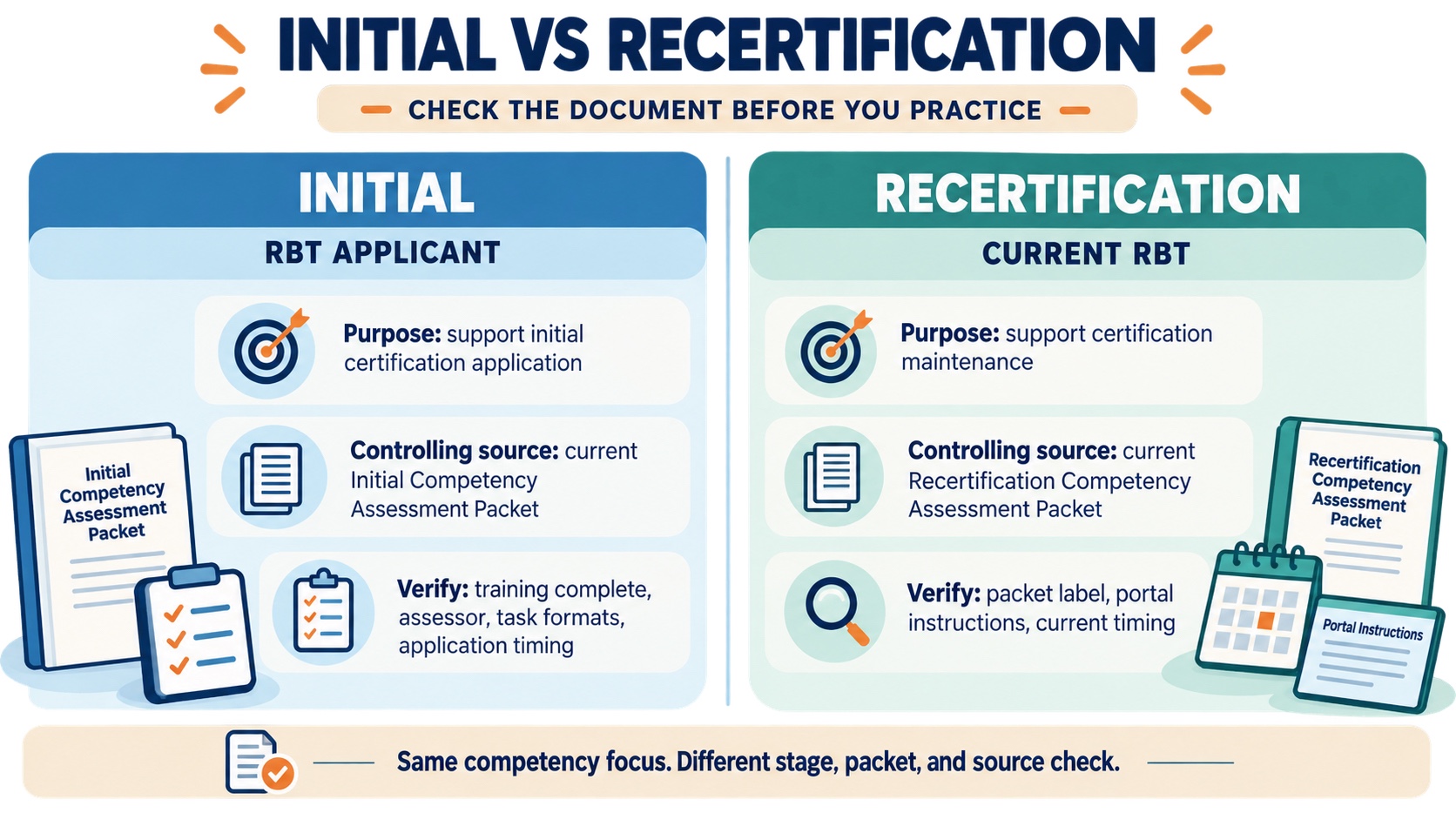
“Competency assessment” can describe more than one RBT document. An initial assessment supports an application for initial certification. A recertification assessment supports the maintenance process for a current RBT. The practical skills may overlap, but the document label, timing, and submission instructions are not interchangeable.
This is why a search result that says “RBT competency assessment” is not enough. Read the heading at the top of the document, check the version shown by the BACB, and confirm whether your portal task is an initial application or a recertification application. The BACB’s Application Processing Updates page is useful for checking current document versions, but it is a live administrative page, not a permanent archive.
Do not solve a version question by filling out both forms “just in case.” That can create extra confusion and does not turn an incorrect document into a correct submission. Ask the responsible assessor or use the relevant handbook when the timing or application status is unclear.
What BCaBA and BCBA trainees use instead
BCaBA and BCBA candidates should begin with the handbook for their credential and the current supervised-fieldwork requirements. The BACB’s oversight page treats supervising fieldwork as a distinct role from assessing RBTs. In practice, a trainee may receive observation, feedback, modeling, performance support, and review of fieldwork documentation. Those activities help develop competence, but they are not automatically an RBT competency assessment.
The relevant questions for a fieldwork trainee are different:
- Which credential and pathway are you pursuing?
- Who is qualified to supervise your fieldwork under the current handbook?
- What activities and supervision contacts must be documented?
- Which fieldwork forms and version requirements apply to your application date?
- What feedback or performance evidence does your supervisor require for safe, competent practice?
If you are studying the concepts behind these decisions, the site’s ABA competency assessment explainer discusses the difference between written knowledge, training completion, and observed performance. For track-specific study, use the RBT study path, BCaBA study path, or BCBA study path. These resources can help you prepare, but they do not replace a supervisor’s evaluation or the BACB’s current documentation.
A practical routing example
Imagine that Jordan has completed an RBT training course and searches for “BACB competency assessment.” Jordan’s first step is not to take a general online quiz. Jordan confirms that the goal is initial RBT certification, checks the current RBT Handbook and Initial Competency Assessment Packet, and asks a qualified responsible assessor about the organization and client relationship. Together, they identify which task formats are allowed, schedule the assessment after training, and keep the completed official document for the application.
Now imagine that Maya is a BCBA trainee. Maya sees the same search result and downloads an RBT packet because it includes the word “competency.” That is the wrong route. Maya should use the BCBA Handbook, confirm the supervisor and fieldwork requirements, and keep fieldwork documentation in the format required for the chosen pathway. The word “competency” describes an important learning goal, but it does not decide which credential process applies.
Source-check checklist and common mistakes
Before studying from a checklist or sending a document to the BACB, ask:
- What credential stage am I in: RBT applicant, current RBT, BCaBA trainee, BCBA trainee, or workplace learner?
- Does the document title say initial, recertification, fieldwork, supervision, or training?
- What effective date and version does the current BACB page show?
- Who is responsible for observing, supervising, signing, or maintaining the record?
- Does the document belong in an application portal, or is it only a local practice tool?
Common mistakes include treating a multiple-choice practice test as a competency assessment, using an initial RBT packet for recertification, assuming any BCBA or BCaBA can sign without checking the relationship rules, and applying RBT documentation to a BCaBA or BCBA fieldwork route. Another mistake is trusting an old course handout because it looks official. A clean version check is a small step that prevents a much larger application problem.
BACB competency assessment FAQ
Is a BACB competency assessment the same as the certification exam?
No. A certification exam samples knowledge through test questions. A competency assessment evaluates defined performance through the method allowed by the relevant packet or process. They can support the same professional journey, but one does not replace the other.
Does every BACB certification use the same competency assessment?
No. Current BACB resources specifically identify competency-assessment packets for RBT initial and recertification processes. BCaBA and BCBA candidates should follow their credential handbook and supervised-fieldwork requirements.
Can I use a generic ABA competency checklist?
You can use a generic checklist for learning or rehearsal if it is clearly labeled as an educational tool. It cannot replace the current official packet, handbook, supervisor review, or application document required for your credential.
Where should I verify the current form?
Start with the official BACB resource page for your credential, then check the current handbook, the relevant packet, Application Processing Updates, and your portal instructions. When the documents conflict or your situation is unusual, ask the responsible supervisor or contact the BACB through its current support channel.