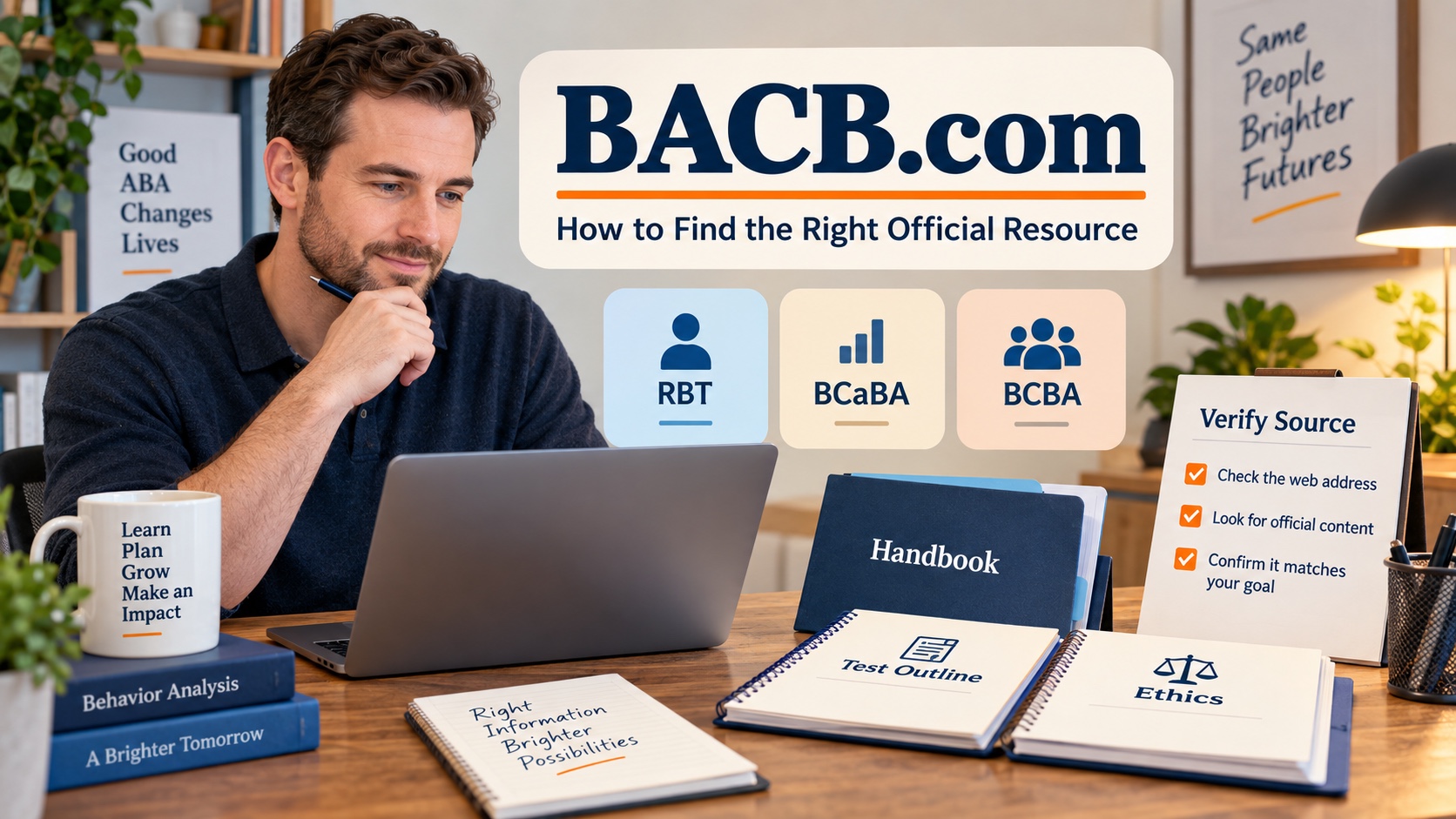
BACB.com: How to Find the Right Official ABA Certification Resource
If you searched for “BACB com,” you may be trying to reach the official Behavior Analyst Certification Board website, find a handbook, check an exam outline, verify a certificant, or open the correct account portal. Those are related tasks, but they do not all belong on the same page. The quickest reliable route is to start with the certification track, choose the topic, and then confirm the current official document or tool.
BACB.com is the source to use for current certification requirements, examination information, ethics resources, handbooks, test-content outlines, supervision materials, and official verification routes. A study website can explain concepts and help you practice, but it should not replace the current BACB page when a rule, form, effective date, or application decision matters.
This guide is a navigation map. It explains which kind of BACB destination answers common questions and shows you how to avoid mixing RBT, BCaBA, and BCBA requirements. It is not the BACB website, does not speak for the BACB, and does not reproduce official forms or examination content.
Table of Contents
What “BACB com” usually means
A short navigation query can hide several different jobs. Before opening a dozen tabs, name the job you are trying to complete:
- Understand the organization: learn what the BACB does and how certification fits into behavior analysis.
- Apply or maintain a credential: use the role-specific handbook, requirements, forms, and maintenance resources.
- Prepare for an examination: find the correct track’s test-content outline, handbook examination section, and application information.
- Check ethics: open the code that applies to your role and the current ethics resources.
- Verify a professional: use the official Certificant Registry rather than relying on a screenshot or an old directory.
- Access an account: use the BACB Portal for account-specific actions and follow its current sign-in instructions.
The search result that looks most familiar is not always the right destination. A third-party “task list summary” may help you study, but it is not the same source as the current BACB Test Content Outline. A blog may explain a transition, but it cannot replace the current handbook or official announcement.
What BACB.com is for
The BACB describes itself as a nonprofit organization that operates certification programs, establishes practice standards, administers examinations, and provides ethics requirements and disciplinary systems. It offers three main certification programs: BCBA, BCaBA, and RBT. The programs are connected to behavior analysis, but each has its own eligibility, examination, ethics, supervision, and maintenance boundaries.
That role explains why the official site contains several kinds of information:
- Certification pathways: requirements, application steps, handbooks, forms, and transition guidance.
- Examinations: examination information, current test-content outlines, scheduling or registration links, and preparation boundaries.
- Ethics: the applicable code, enforcement procedures, self-reporting information, and ethics resources.
- Supervision and training: resources for fieldwork, ongoing supervision, RBT training, competency assessment, and supervisor requirements.
- Verification and consumer information: the Certificant Registry, consumer resources, and information about reportable disciplinary actions.
Use the official page for the rule. Use a study resource for explanation, retrieval, and practice. Keeping those roles separate protects you from a common mistake: treating a clear explanation as if it were the current policy document.
It also helps to separate public information from account actions. The public BACB pages explain requirements and link to resources. The BACB Portal is for account-specific work such as accessing an account or following current application instructions. The Certificant Registry answers a verification question. These destinations may sit close together in search results, but they are not interchangeable. Knowing which one you need prevents a login problem from being mistaken for a requirements question.
Choose the correct certification track
The first routing decision is the credential. Do not begin with a general search for “BACB requirements” if you already know the role you are pursuing.
| Track | Start with | Check next |
|---|---|---|
| RBT | RBT page and RBT Handbook | Applying, examination, ethics, training, competency assessment, supervision, recertification, and current transition resources |
| BCaBA | BCaBA page and BCaBA Handbook | Eligibility, examination, fieldwork, ethics, supervision, continuing education, recertification, and current transition requirements |
| BCBA | BCBA page and BCBA Handbook | Eligibility, examination, fieldwork, ethics, supervision, continuing education, recertification, and current transition requirements |
Shared vocabulary does not mean shared rules. For example, RBT applicants use the RBT Ethics Code (2.0), while BCaBA and BCBA applicants and certificants use the Ethics Code for Behavior Analysts. Likewise, the current test-content outline and examination structure must be checked by credential. Save the role in your notes whenever you download a handbook or study outline.
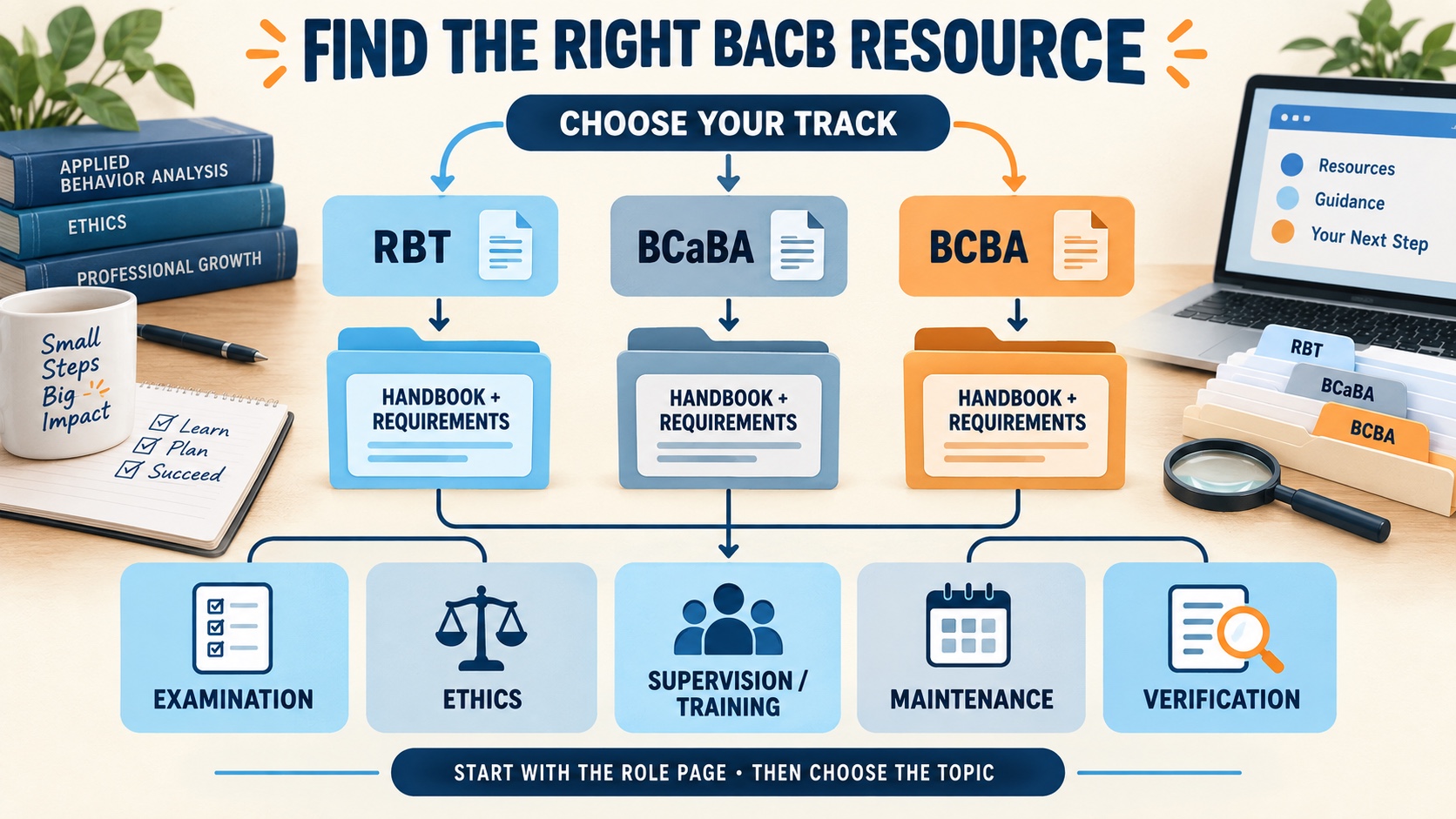
Find the right official resource by topic
Once you choose the track, use the topic labels on the current BACB role page. The exact layout may change, but the source-selection logic stays useful.
Requirements, application, and handbook
Start with the relevant handbook when you need eligibility rules, documentation, application steps, examination boundaries, supervision, or maintenance requirements. Read the effective date and version information. If you are applying in a future year or during a transition, check the current announcement and the handbook rather than assuming an older PDF still controls your case.
Examination and test-content outline
Use the examination-information page for broad examination processes and the track-specific handbook for the details that apply to your credential. Use the Test Content Outlines page to confirm the current outline and edition. The current index lists the RBT Test Content Outline (3rd ed.) beginning January 1, 2026, alongside the BCaBA and BCBA Test Content Outline (6th ed.). Do not copy the BCBA outline into an RBT or BCaBA study plan.
Ethics
Open the Ethics Codes page when you need the code itself or want to confirm which code applies. Follow the related ethics resources for reporting, self-reporting, enforcement procedures, and role-specific guidance. An ethics summary can help you study, but a current concern should be checked against the official code and the applicable professional or legal context.
Supervision, training, and assessment
The supervision and training page routes readers to the relevant handbooks, fieldwork resources, RBT training requirements, competency assessment packets, and supervisor training information. This is where a generic search can become risky: training an RBT, assessing an RBT, supervising an RBT, supervising a BCaBA, and supervising fieldwork are related but distinct responsibilities.
Verification and licensure
Use the Certificant Registry to verify a BACB certification status and see whether reportable disciplinary actions are associated with the certification. State licensure is a separate matter. If your state or payer requires a license, verify it with the applicable state authority; BACB certification is not a universal substitute for state licensure.
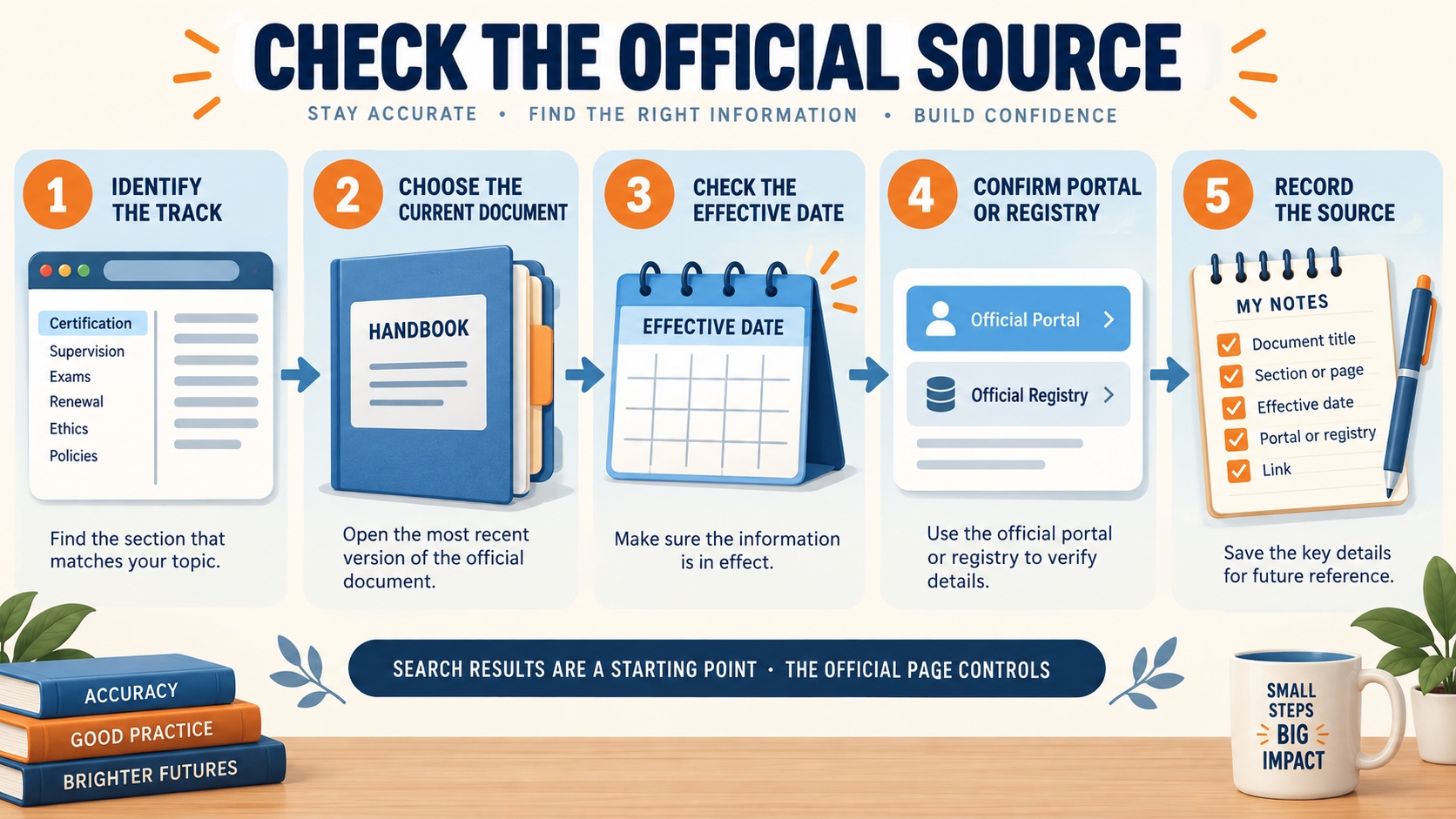
Keep a small source record
When a rule matters, make a small record instead of saving only a browser bookmark. Write down the credential, the question you were answering, the official page or document, the edition or effective date, and the date you checked it. If the page links to a PDF or form, save the document title as well as the URL. This takes a few minutes and makes it easier to notice when a study note was built from an older source.
For example, a source record might say: “BCaBA examination structure — BCaBA Handbook, examination section — current page checked today — use the current TCO for content.” A separate record might say: “RBT training — RBT 2026 40-Hour Training Requirements — confirm the current completion window before enrolling.” The two notes look similar, but they belong to different tracks and answer different questions.
Use search engines to find the official page, then read the page itself. A search snippet can be shortened, stale, or missing an exception. The source record is not a substitute for professional judgment or the current official rule; it is a simple way to keep your learning trail honest.
A practical source-checking scenario
Imagine that Sam is preparing for a BCaBA examination and finds a search result titled “BACB task list.” The page is easy to read, but it does not state the credential, edition, or effective date. Sam saves the page as a study lead, then goes to the official BACB site and selects the BCaBA resource page.
From there, Sam opens the BCaBA Handbook and the current BCaBA Test Content Outline. The handbook answers the examination-process questions; the TCO answers what the examination content covers. Sam records the URLs, edition, and access date in the study notes. When a third-party explanation disagrees with the official document, the official document controls the planning decision.
That small routine prevents three errors at once: using a BCBA outline by accident, studying from an older edition, and treating a search snippet as proof. Sam can still return to an accessible explainer or practice question after the source check, but the explanation now has a clear boundary.
Common navigation mistakes and FAQ
Is BACB certification the same as state licensure?
No. BACB certification and state licensure can interact in professional practice, but they are different systems. Check the current BACB information and the applicable state authority.
Where do I find the current task list?
Use the official Test Content Outlines page and choose the credential. Confirm the edition and effective-date language. The current RBT, BCaBA, and BCBA outlines are not interchangeable.
Where do I verify a BCBA, BCaBA, or RBT?
Use the BACB Certificant Registry linked through the official Consumer Resources page. A social profile, employer page, or old screenshot is not a substitute for the current registry result.
Where do I register for the examination?
Start from the relevant BACB role page and handbook, then follow the current examination or registration link. Do not rely on a saved third-party link if the official page has changed.
Can ABA Study Online replace BACB.com?
No. ABA Study Online can provide original study explanations, free practice questions, a searchable ABA glossary, and app-based review. It is not BACB, is not an official source, and should not be presented as endorsing or replacing current BACB requirements.
For study support after you complete the source check, explore the RBT Theory path, BCaBA Theory path, or BCBA Theory path. You can also use the free question route, ABA definition search, free ABA resources, and ABA Study Online app. These are learning destinations; current certification rules remain on the official BACB site.