BACB Code of Ethics: A Current Guide to the Code, Core Principles, and Ethical Decisions
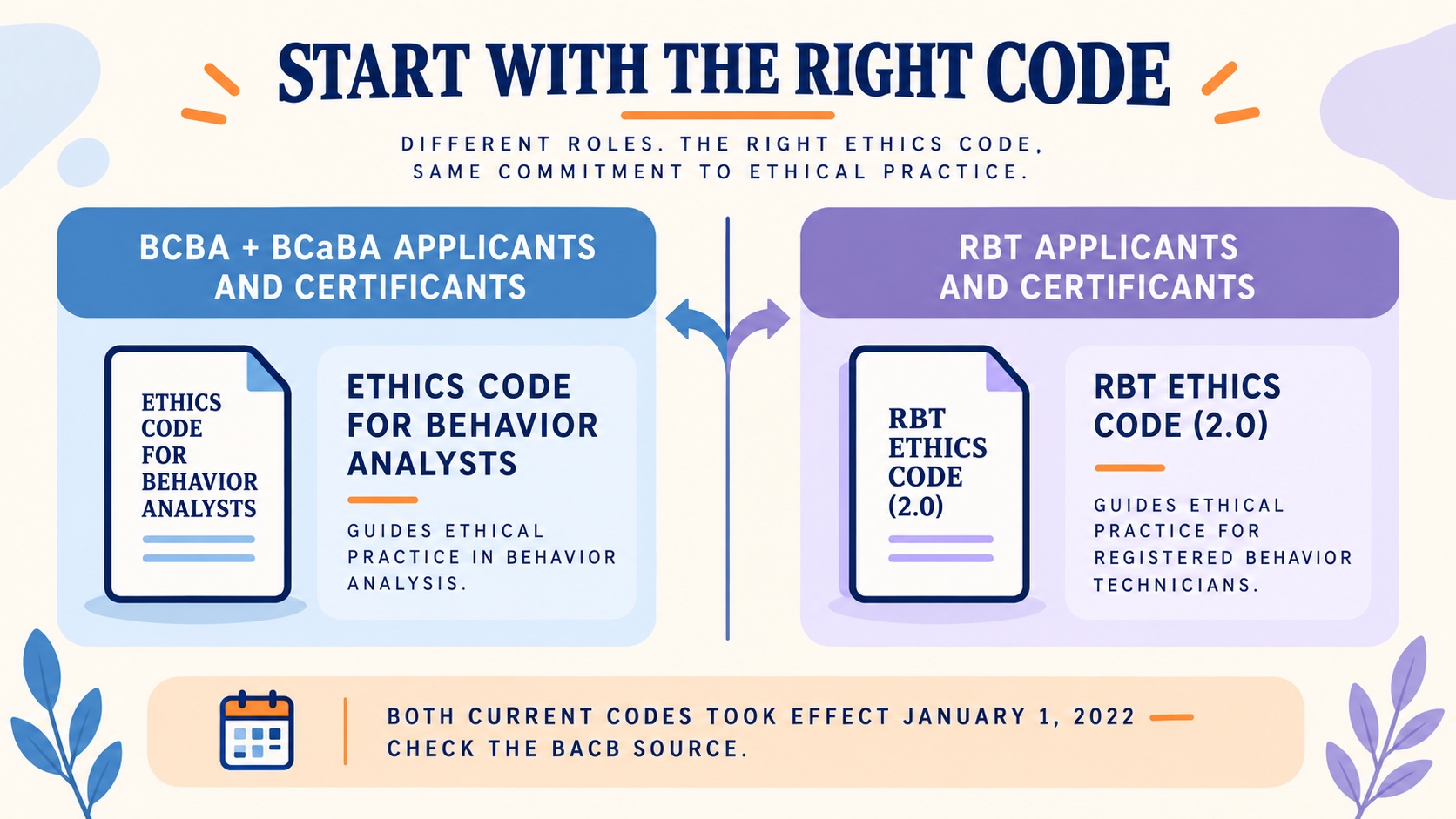
“BACB Code of Ethics” is a common search phrase, but the most useful starting point is the document’s current name: the Ethics Code for Behavior Analysts. It is the BACB ethics code that applies to BCBA and BCaBA applicants and certificants. RBT applicants and certificants follow a separate document, the RBT Ethics Code (2.0).
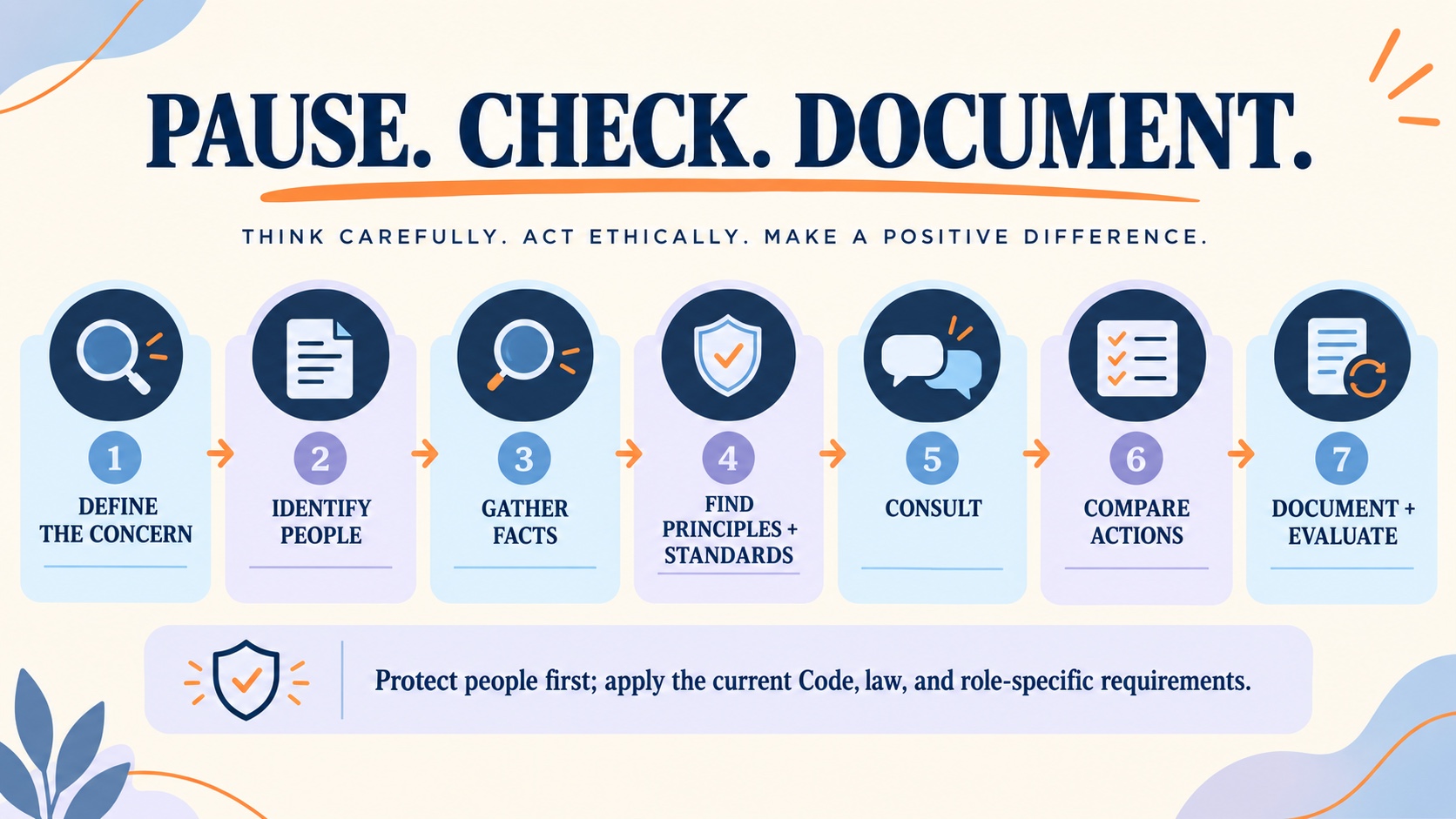
The Code is not just a list of isolated rules to memorize. It gives behavior analysts a professional framework for protecting clients and stakeholders, working within competence, communicating truthfully, supervising responsibly, handling public statements, and conducting research. It also gives a structured way to slow down when a situation feels unclear: define the concern, gather facts, identify the relevant standards, consult appropriate resources, document the reasoning, and evaluate what happens next.
This guide is a study-oriented map of the current BACB materials. It summarizes the structure and decision process without reproducing the Code. It is not legal advice, an individualized ethics ruling, or a replacement for the current BACB document, applicable law, licensure requirements, organization policy, or qualified supervision.
Table of Contents
What the BACB Code of Ethics is
The current Ethics Code for Behavior Analysts replaced the earlier Professional and Ethical Compliance Code for Behavior Analysts. The BACB states that the current Code took effect on January 1, 2022. It applies to the professional activities of people who hold BCBA or BCaBA certification and people who have completed an application for one of those certifications.
That scope is broader than direct therapy or a session at a table. The Code’s professional-activity scope includes service delivery, consultation, supervision, training, management, editorial and peer-review work, research, and other activities within the ABA profession. It also follows the professional activity across communication modes: in person, in writing, by email or text, through video conferencing, and in public digital spaces.
For a learner, that means an ethics question can appear in a treatment decision, a progress note, a supervision meeting, a social-media post, an advertisement, a research project, or a conversation with a funder. The setting changes, but the reasoning habit remains: identify who may be affected, identify what authority applies, and check the current standard instead of relying on a vague idea of being “nice” or “professional.”
The BACB also explains that the Code is not an exhaustive list of every possible situation. The absence of a particular behavior from a standard does not automatically make it ethical. Standards need to be interpreted with the Code’s core principles and the context of the situation, including power differences, diversity, client interests, applicable law, and risk of harm.
Who uses which current ethics code
The fastest way to avoid a source error is to identify the role before searching for a standard.
- BCBA and BCaBA applicants and certificants: use the Ethics Code for Behavior Analysts and the related BACB ethics resources.
- RBT applicants and certificants: use the RBT Ethics Code (2.0), which is a separate code written for the RBT role.
- Employers, organizations, and teams: may have additional policies, but an organization’s policy does not erase the individual professional’s applicable ethics, legal, or licensure obligations.
- People working across roles: need to check every role that applies. A person may be an RBT in one context and a trainee or certificant in another, so copying one role’s study notes into another role’s decision can create confusion.
The Code is not the same thing as state law. A state licensure board, funder, school district, employer, privacy rule, mandated-reporting law, or contract may impose another requirement. The Code itself tells behavior analysts to comply with applicable laws and professional requirements. When authorities conflict or the risk is immediate, do not solve the issue by guessing which document “sounds right.” Pause, protect the person who may be at risk, consult the relevant authority, and document the steps taken through the approved route.
The four core principles
The Code uses four foundational principles as an interpretive frame for the standards. They are useful because they keep a learner from reading one numbered item in isolation.
1. Benefit others
Ask what action is most likely to protect welfare, reduce harm, and support meaningful benefit for clients and other affected people. This principle is not a permission slip to do whatever seems helpful. It asks the professional to consider short- and long-term effects, conflicts of interest, health factors that may interfere with work, and the client’s interests in relation to everyone else’s interests.
2. Treat others with compassion, dignity, and respect
Ethical practice includes equity, privacy, confidentiality, self-determination, and informed choice. In a study question, look beyond whether a procedure is technically effective. Ask whether the person received understandable information, whether preferences and context were considered, and whether the communication protects dignity rather than using a label to dismiss the person.
3. Behave with integrity
Integrity shows up in accurate records, honest public statements, follow-through, accountability, and correcting errors. It includes how a professional describes credentials, reports data, represents another person’s work, communicates with a funder, or responds after discovering that an earlier submission was inaccurate.
4. Ensure your competence
Competence is more than having good intentions. The Code points behavior analysts toward defined roles, scope of practice, continuing development, current knowledge, cultural responsiveness, and awareness of interventions that may pose risk. When a new population or procedure is outside current competence, the ethical next step may include study, training, supervised experience, consultation, co-treatment, referral, or transition—not improvisation with a client.
On an exam or in practice, these principles can function like a first-pass filter: Which option protects the client, respects the person, represents the facts honestly, and stays within demonstrated competence? Then read the specific standard and the surrounding context.
The six responsibility sections
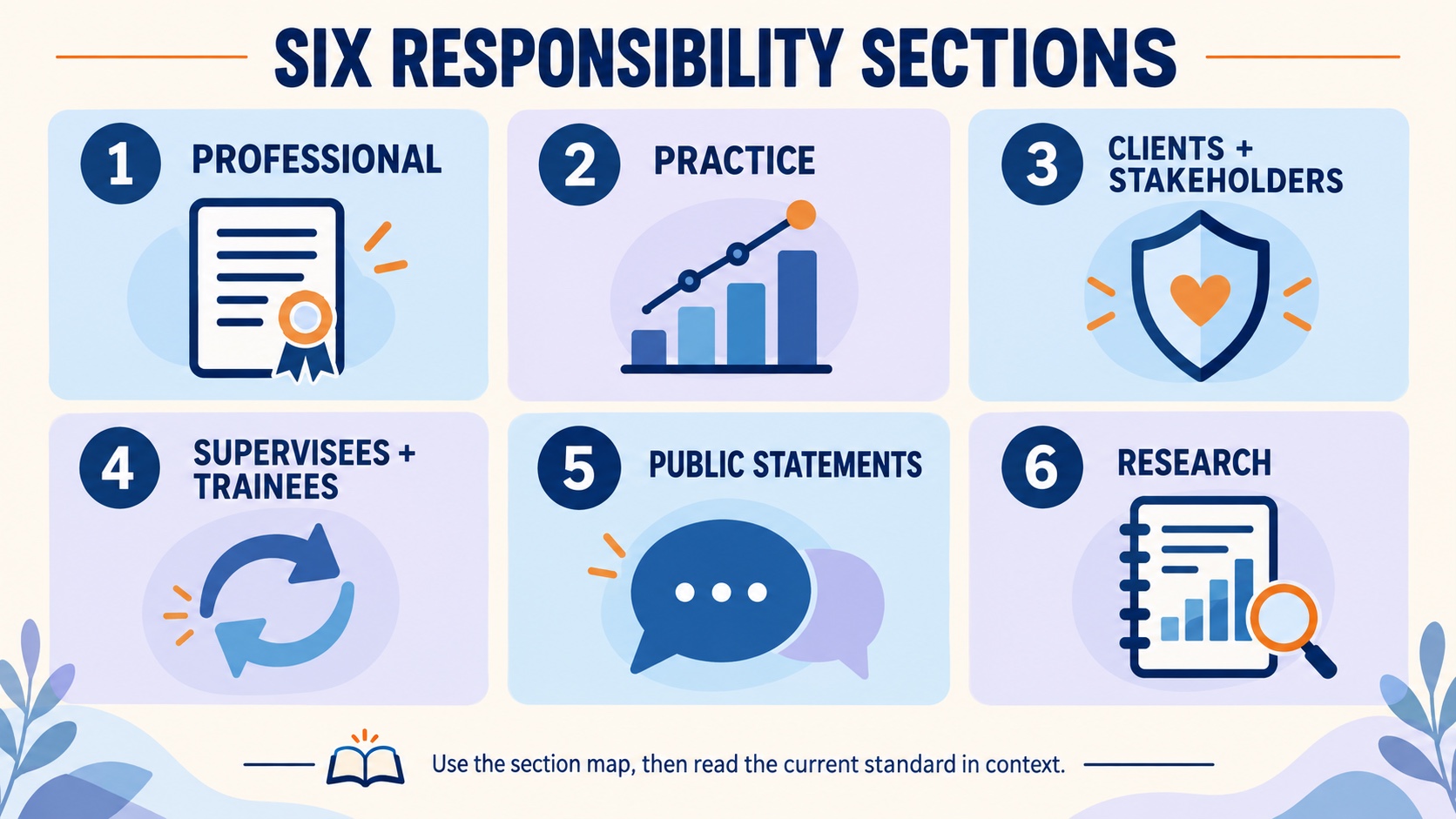
The Code organizes its standards into six sections. Think of them as navigation points, not six separate personalities of ethics.
- Responsibility as a Professional: truthfulness, legal and professional requirements, accountability, role definition, competence, conflicts, boundaries, and professional conduct. Use this section when the question is about how the behavior analyst presents and manages the professional role.
- Responsibility in Practice: service delivery, assessment, interventions, data, documentation, confidentiality, consent, risk, and conditions that interfere with services. Use it when the ethical question is tied to what happens in the service process.
- Responsibility to Clients and Stakeholders: client welfare, identifying stakeholders, service agreements, financial and third-party arrangements, referrals, continuity, transitions, and discontinuation. Use it when different people or organizations have different interests in the service relationship.
- Responsibility to Supervisees and Trainees: compliance with supervision requirements, supervisory competence, volume, documentation, training, feedback, delegation, diversity, evaluation, continuity, and termination. Use it when the professional’s responsibility includes teaching or overseeing someone else’s work.
- Responsibility in Public Statements: privacy in public communication, advertising, testimonials, intellectual property, social media, and digital content. Use it when information leaves the private service setting and enters a public or promotional channel.
- Responsibility in Research: legal and review requirements, service-delivery research, informed consent, confidentiality, competence, conflicts, credit, plagiarism, data retention, and data accuracy. Use it when the activity is designed to contribute generalizable knowledge or involves research responsibilities.
A single situation may touch more than one section. For example, a public post about a client can involve confidentiality, public statements, client rights, informed consent, and the professional’s responsibility to protect welfare. Choosing one label too early can hide the real risk.
How to reason through an ethical concern
The Code describes a structured decision-making process for potential ethical concerns. A practical study version looks like this:
- Define the concern. Describe what happened in observable terms. Separate what you saw from what someone inferred.
- Identify the people involved. Include the client, stakeholders, supervisees, trainees, colleagues, organization, and any person who may face risk or be affected by the decision.
- Gather supporting information. Check records, dates, messages, policies, and first-hand observations. Follow up on second-hand information rather than treating a rumor as a conclusion.
- Notice your own learning history and bias. Ask whether a personal assumption, role pressure, financial incentive, or power difference is shaping the interpretation.
- Locate the relevant principles and standards. Read the current Code in context. Also identify the law, licensure, payer, employer, school, or supervision requirement that applies.
- Consult. Use a qualified supervisor, trusted colleague, current research, decision-making model, organization route, licensure board, or legal counsel as appropriate. Consultation is not a sign that the learner failed; it is part of careful practice.
- Compare possible actions. Consider risk, client preference, social acceptability, restrictiveness, likely effectiveness, and whether the option solves the concern without creating a new one.
- Act, document, and evaluate. Take the selected action with relevant people, protect confidentiality, record the next steps and responsibilities, and review whether the action actually reduced risk.
This is a reasoning path, not a universal reporting script. The urgency of a situation matters. If there is immediate danger, suspected abuse, criminal conduct, or another issue governed by a mandatory reporting rule, the relevant authority may need to be contacted promptly. Do not delay necessary protection while trying to write a perfect blog-style analysis.
Scenario: privacy, public statements, and documentation
Consider a fictional scenario. A behavior analyst wants to post a “before and after” story on a public social-media page. The post removes the client’s name, but it includes a distinctive school setting, a rare target behavior, a recognizable quote, and a photo taken during a session. The analyst believes the post could educate families and attract new clients.
A weak analysis asks only, “Did the family say it was okay?” A stronger analysis slows down:
- What information could identify the client or another person indirectly?
- What consent or authorization was obtained, for what purpose, audience, duration, and type of use?
- Does the proposed post protect the client’s rights and confidentiality?
- Is the post educational, advertising, or both?
- Does the photo or story include a testimonial, intellectual property, or a public statement about outcomes?
- What do the Code, privacy requirements, employer policy, funder rules, and applicable law require?
The next step is not to announce that the analyst has violated the Code. The study lesson is to pause publication, preserve the relevant facts, consult the appropriate supervisor or authority, revise or abandon the post if the risk cannot be resolved, and document the decision. Removing a name after the fact does not automatically remove the risk of identification.
This example also shows why ethics is not just a final checkbox. The same decision can affect the client, family, employer, audience, and the professional’s public representation. The safest answer is usually the one that protects the person first and makes the reasoning reviewable.
Common mistakes and FAQ
Is the BACB Code of Ethics the same as the RBT Ethics Code?
No. The Ethics Code for Behavior Analysts applies to BCBA and BCaBA applicants and certificants. RBT applicants and certificants have the separate RBT Ethics Code (2.0). Always route the question by role before studying a standard.
How many sections are in the current Ethics Code for Behavior Analysts?
The current Code organizes its ethics standards into six sections: professional responsibility, practice, clients and stakeholders, supervisees and trainees, public statements, and research. The introductory core principles and application guidance also matter when interpreting those sections.
Can I memorize one rule and use it for every scenario?
Not reliably. The Code says the standards are not exhaustive, and application depends on context. Read the specific wording, the core principles, the people affected, the potential risk, and any other authority that applies.
Does the BACB give legal or individualized ethics advice?
The BACB says it cannot provide legal or ethics advice. For a real situation, use the applicable supervision, organization, licensure, reporting, or legal route. This article is a study map, not a case determination.
What should I do if I suspect a violation?
Start by protecting people from immediate risk, clarifying the facts, checking the current Code and other applicable requirements, and consulting an appropriate qualified resource. Document the steps and outcomes through the approved channel. Do not turn a rumor or incomplete screenshot into a public accusation.
Is the current Code a 2027 or 7th-edition document?
The Ethics Code for Behavior Analysts is a separate ethics document from the exam Test Content Outline. Do not label it as a “7th edition” simply because other BACB requirements are changing. Use the current BACB Ethics Codes page and linked Code when studying.
For connected study, you can review the BCBA Theory Blocks, the BCaBA Theory Blocks, role-specific BCBA practice questions or BCaBA practice questions, the ABA Definition Search, broader ABA resources, and the ABA Study Online app. These are learning destinations; the current BACB Code remains the authority for the ethics standards.