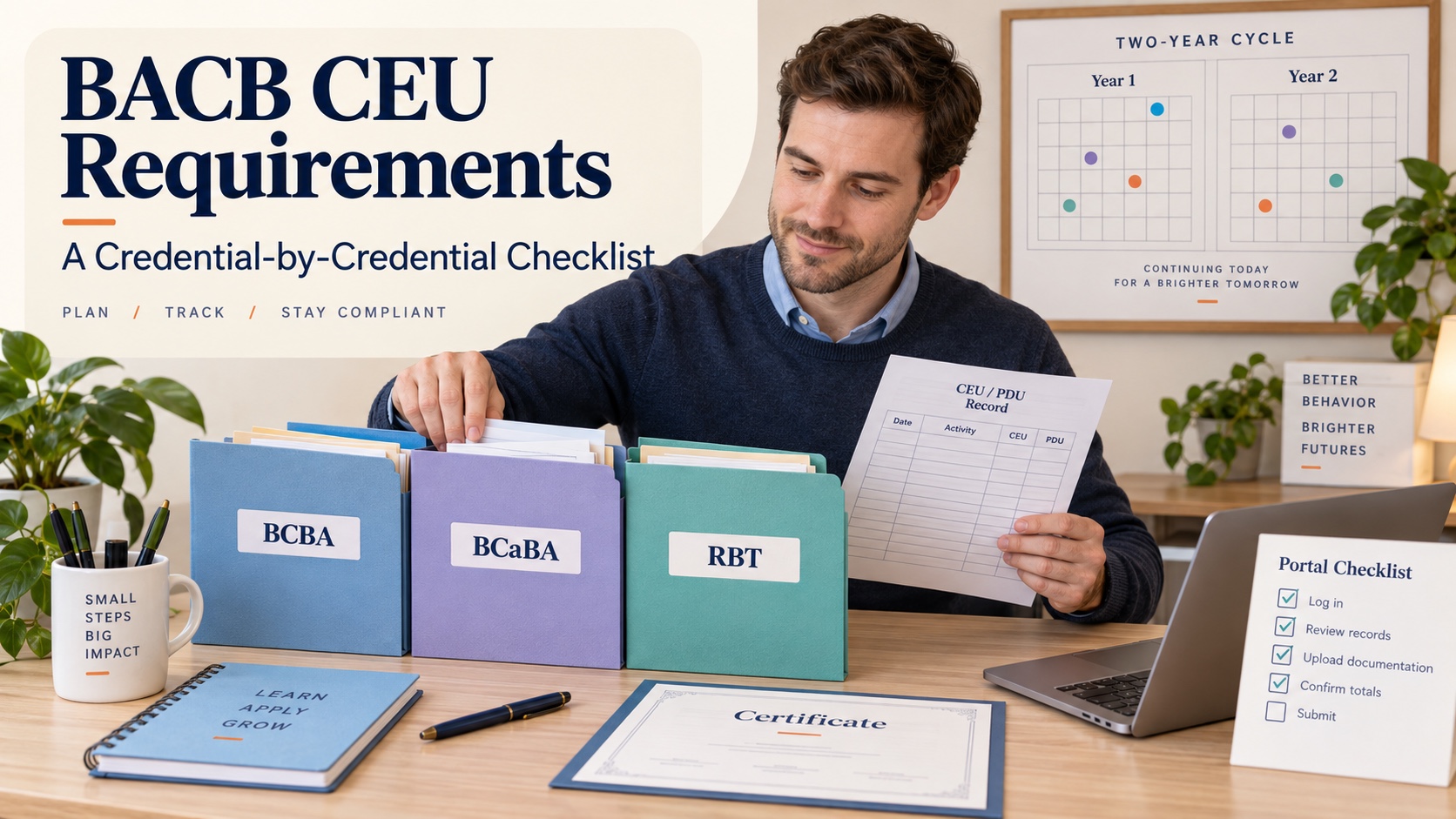
BACB CEU Requirements: A Credential-by-Credential Checklist
BACB CEU requirements depend on which credential you hold and which recertification cycle you are completing. BCBA and BCaBA certificants track continuing education units, or CEUs. RBTs track professional development units, or PDUs. Those labels are not interchangeable, and the total number alone does not tell you whether a specific activity counts.
The safest workflow is simple: identify your credential, identify your two-year cycle, classify the activity, verify the provider and completion record, and enter the information with supporting documentation. This guide summarizes the current planning numbers and the most common recordkeeping traps. The applicable BACB Handbook and your BACB Portal remain the controlling sources for your individual cycle.
Table of Contents
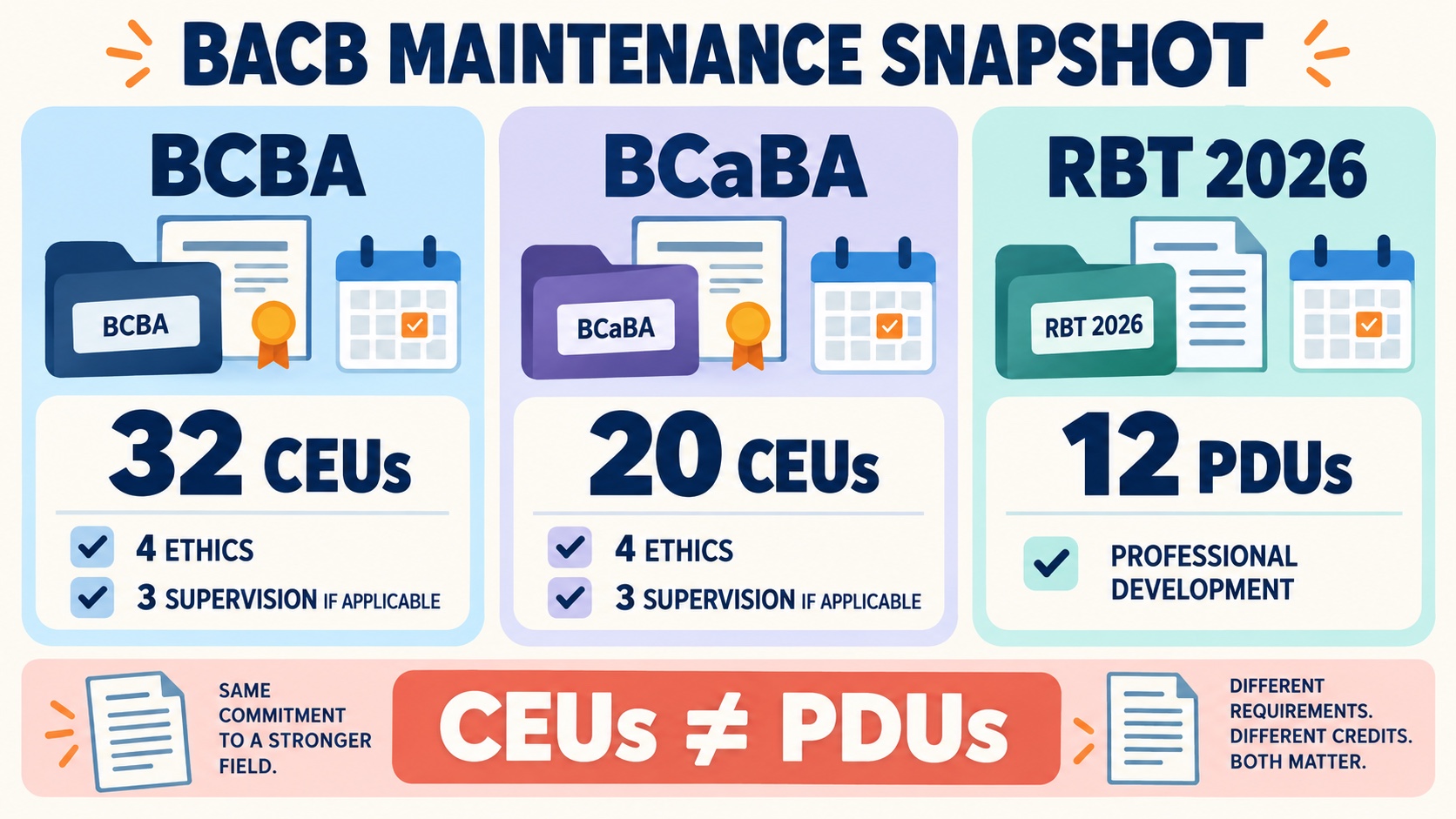
Current BACB maintenance snapshot
Use this table as a starting map, not as a substitute for the handbook section that matches your credential.
| Credential | Current two-year total | Category reminders | Unit name |
|---|---|---|---|
| BCBA | 32 | 4 ethics; 3 supervision for supervisors | CEUs |
| BCaBA | 20 | 4 ethics; 3 supervision for supervisors | CEUs |
| RBT certified or recertified in 2026 | 12 | Professional-development routes and supervision rules are separate | PDUs |
“Supervision” in the table is conditional. It applies when the credential’s handbook requires supervision CEUs for the certificant’s role. It does not mean that every hour spent receiving supervision can be entered as a supervision CEU, and it does not replace the ongoing supervision requirement itself.
Start with the credential and cycle
Before registering for a webinar or downloading a certificate, open your BACB account and write down three facts: your credential, your recertification date, and the start and end of the current cycle. The same course topic may be useful for different learners, but the credit rules follow the credential and the cycle to which the activity is applied.
For a BCBA, the current planning target is 32 CEUs in the two-year cycle, including 4 ethics CEUs and 3 supervision CEUs when applicable. For a BCaBA, the target is 20 CEUs, including 4 ethics and 3 supervision when applicable. For an RBT who becomes certified or recertifies in 2026, the target is 12 PDUs. Do not copy the BCBA number into a BCaBA spreadsheet or call RBT professional-development units “CEUs” simply because the activity was offered by an education provider.
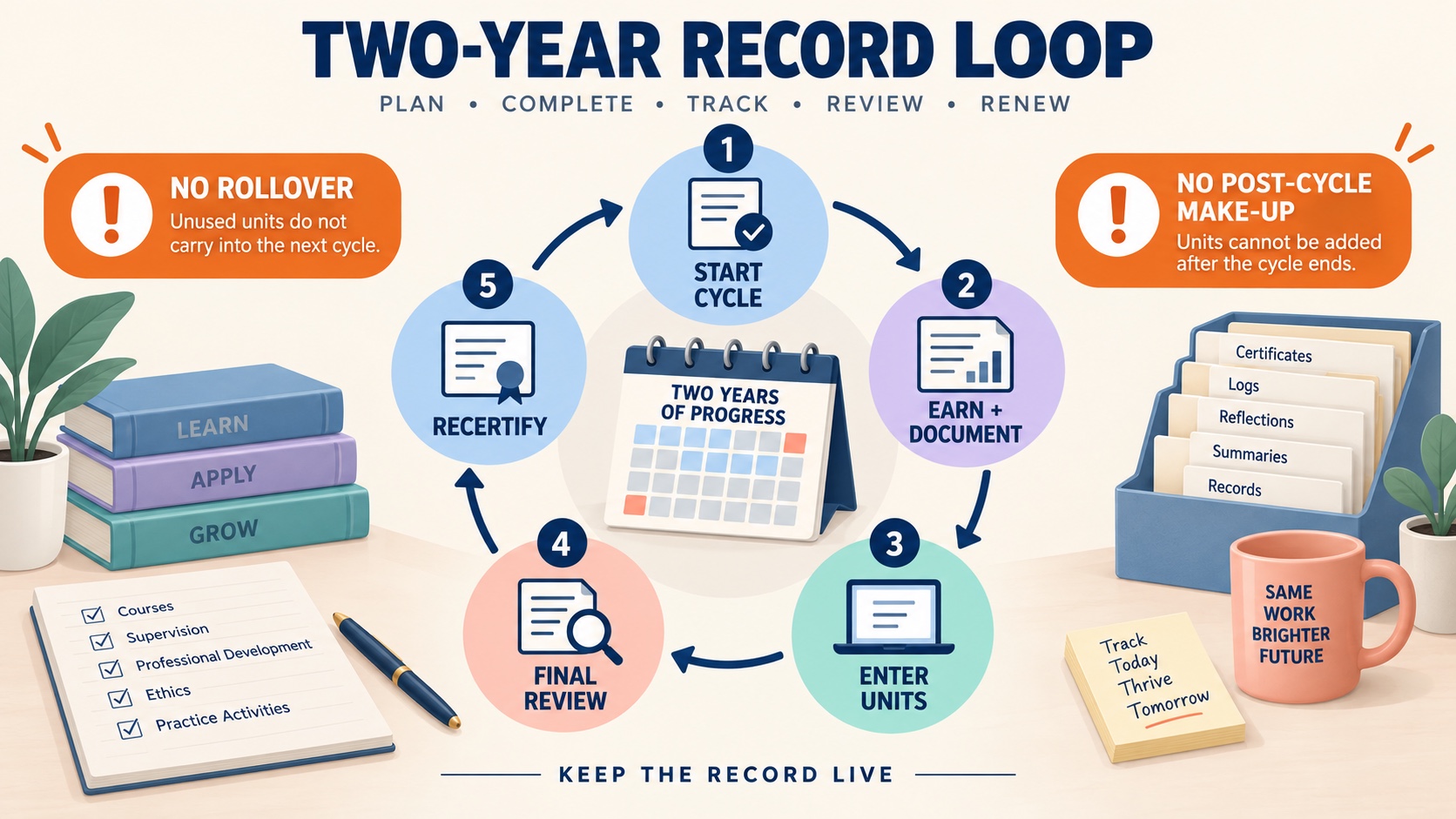
The cycle date is just as important as the total. An activity earned before the cycle begins may not be usable for that cycle, even if the certificate is still easy to find. An activity earned after the cycle closes cannot normally repair a missed requirement for the old cycle. Put the date range at the top of your record sheet and record the event date, not only the date you downloaded the certificate.
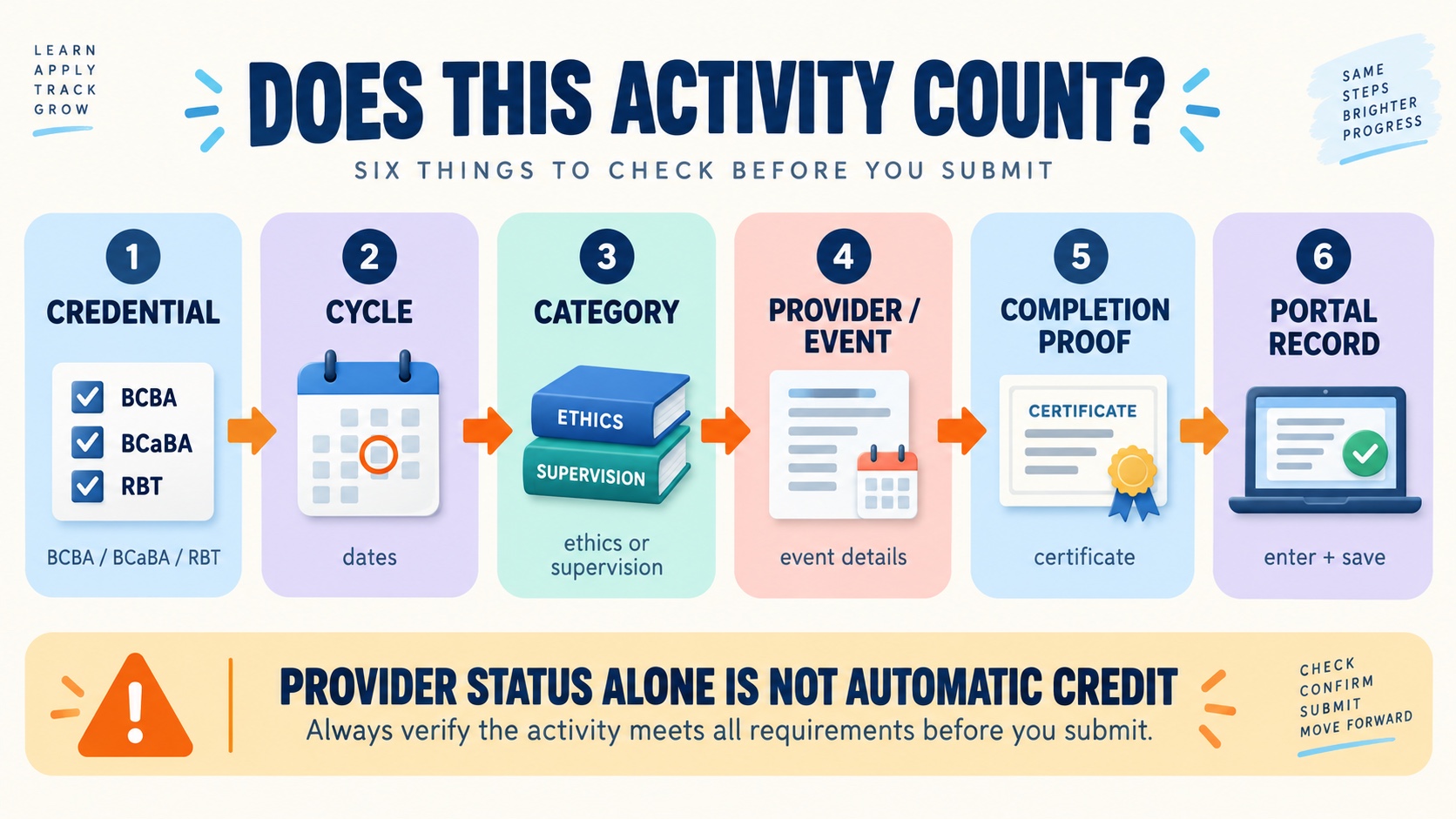
How to decide whether an activity counts
Use a six-question check before you count an activity:
- Which credential? Is the event designed and documented for BCBA, BCaBA, RBT, or another audience?
- Which cycle? Did the activity occur inside the two-year period to which you will apply it?
- Which category? Is it general learning, ethics, supervision, or an RBT professional-development route?
- Which provider or event? If you are relying on ACE status, can you verify the provider or event through the current BACB resource?
- What proof? Do you have the certificate, completion record, event title, date, hours, category, and any information the portal asks for?
- Where will it be recorded? Can you enter the activity in the appropriate BACB account area before the recertification deadline?
This workflow prevents a common mistake: treating the provider’s marketing label as the final answer. A provider may offer several event types, and one event may not be eligible for every credential. Read the event description, category, date, and certificate together. If the event is supposed to satisfy ethics or supervision, check that the content actually meets the applicable definition rather than relying on one sentence in a promotional email.
Three quick classification examples
Example one: a BCBA ethics webinar. The title mentions ethical decision-making, the event description explains how the content connects to behavior-analytic practice, the date falls inside the current cycle, and the certificate identifies the category. This is the kind of evidence chain you would keep before entering an ethics CEU. The title alone is not the evidence; the date, category, content, and completion record work together.
Example two: an RBT in-service session. An organization provides a documented professional-development session related to behavior-analytic service delivery. The RBT should check the current RBT materials for the accepted route, PDU documentation, and any exclusions. The same event should not be copied into a BCBA or BCaBA CEU spreadsheet merely because the subject is behavior analysis.
Example three: a supervision conversation. A routine supervision meeting may be required under a credential’s ongoing supervision rules, but that does not automatically turn the meeting into supervision CEU credit. Keep the supervision record and the continuing-education record separate unless the activity is explicitly documented for the relevant category.
Build a record sheet that survives a review
A useful record sheet has one row per activity and at least these fields: credential, cycle start, cycle end, event date, provider, event title, unit type, total units, ethics units, supervision units, evidence filename, portal-entry date, and verification note. The verification note can be short—“BCaBA, current cycle, ethics category shown on certificate”—but it forces you to explain why the activity belongs in the total.
Use filenames that preserve the date and event name rather than saving every certificate as “certificate.pdf.” If a provider updates a page or a portal changes its entry fields, your local record should still show what you relied on. This is ordinary document hygiene, not an attempt to replace the BACB’s records or formal review.
Finally, reconcile the sheet monthly. Add the category subtotals, compare them with the requirement for the credential, and flag any activity that is missing evidence. A monthly check is especially useful when you supervise others, because your own supervision CEU subset and your ongoing supervision obligations are related but not identical.
Ethics and supervision categories
Ethics CE is not simply any course that mentions the word “ethics.” The current BCBA guidance defines ethics continuing education around BACB ethics requirements and/or cultural and contextual responsiveness, connected to behavior-analytic practice or applied research and linked to behavior-analytic literature or established practice. Most of the event must focus on ethics or cultural/contextual responsiveness for it to fit the ethics category.
That means a general clinical webinar with one short ethics slide may be useful professional learning but may not satisfy the ethics category. Save the event description and certificate together so you can explain why you classified the activity as ethics if the portal or an audit requires the details.
Supervision CE is also a category with a purpose, not a shortcut for every supervision conversation. If you are a supervisor who needs the supervision subset, choose an activity that is actually documented for that category. Separately, keep meeting the ongoing supervision obligations associated with your credential. A CEU record cannot substitute for supervision contacts, a supervisor relationship, or other maintenance requirements.
Records, portal entry, and timing
Enter or organize your records while the activity is fresh. A compact record can include the credential, cycle, event title, provider, date, units, category, certificate location, and portal-entry date. Keep the original certificate and any supporting event information in a stable folder. If an activity has a separate evaluation, attendance confirmation, or completion code, save that with the certificate.
Portal entry is not the same as keeping a personal spreadsheet. The BACB instructions may ask for activity-specific information and supporting documentation. When you enter a unit, match the portal category to your evidence. If you discover that the certificate does not state the category or unit type clearly, contact the provider or consult the applicable handbook before assuming the activity is usable.
Do not wait until the last evening of the cycle. The current handbooks explain that certificants need to complete the required units, enter them, and submit recertification materials on time. Some systems also place a last-chance window before the recertification date; follow the exact date and submission instructions in your account. The free resources library can help you review behavior-analytic concepts, but it is not an ACE authorization and does not create BACB credit by itself.
What does not count or transfer
Several recordkeeping assumptions create avoidable problems:
- Making up missed units after the recertification date: late learning does not automatically repair an incomplete prior cycle.
- Rolling excess forward: extra CEUs do not normally transfer to the next cycle just because the activity was relevant.
- Repeating the same activity: repeating an event may be good review, but the handbook may exclude repeated activities from credit.
- Confusing CEUs and PDUs: RBT professional-development requirements are not BCBA or BCaBA CEUs.
- Counting client-specific training without checking the rule: training, supervision, and fieldwork may have different treatment from credential maintenance units.
- Assuming ACE status proves everything: verify the individual event, date, category, content, and completion record.
When you are uncertain, mark the entry “pending verification” instead of adding it to the completed total. That small habit prevents a spreadsheet from giving you false confidence.
Also separate learning value from credit value. An activity may be worthwhile for your practice and still fail to meet a particular maintenance category. You can keep it in a personal learning log while leaving it out of the official unit total until the credential-specific evidence is clear.
How to read the 2027 note
Future requirements should be read as versioned rules. The 2027 BCBA requirements list 32 CEUs in a two-year cycle, including 4 ethics CEUs and 4 supervision CEUs for supervisors. The 2027 BCaBA maintenance section keeps the 20/4/3 structure. These future notes do not mean that a current cycle should be rewritten with a future category or that old certificates suddenly become a different type of unit.
Write the cycle dates beside any 2027 planning note. If your cycle crosses a requirements update, check the current handbook, the official transition guidance, and the instructions in your BACB account. The BACB upcoming-changes page is a useful starting point, but it does not replace the credential-specific handbook for your record.
Checklist and FAQ
What should I do first?
Confirm your credential and recertification date in your BACB account. Then create separate columns for total units, ethics, supervision if applicable, activity date, evidence, and portal entry.
Are BACB CEUs the same for every credential?
No. Current planning numbers differ: BCBA 32 CEUs, BCaBA 20 CEUs, and RBT 12 PDUs for an RBT who becomes certified or recertifies in 2026. The unit type, category, and supporting evidence must match the credential.
Can I use an ACE provider’s certificate automatically?
No. ACE status is a useful verification starting point, but you still need to check the event’s credential fit, category, date, completion evidence, and current BACB entry requirements. Keep the certificate and event details together.
Can ABA Study Online issue BACB CEUs?
This article does not make a credit or ACE authorization claim for ABA Study Online. The site and app can support concept review, practice, and study organization. Use the BACB’s current handbook and portal instructions for official maintenance records.
For study support, the BCBA learning path, BCaBA learning path, ABA glossary, and app review tools can help you revisit concepts while you maintain your records. Keep the maintenance decision anchored to the credential, the cycle, the category, and the evidence.