BACB CEU Providers: How to Find and Verify an ACE Provider
People often search for “BACB CEU providers” when they need continuing education for a BCBA or BCaBA credential, professional development for an RBT credential, or a reliable way to check whether an online event is recognized within the current BACB system. The BACB’s formal language is more specific than the everyday phrase “CEU provider.” Authorized Continuing Education (ACE) Providers are authorized to offer Learning continuing education to BCBA and BCaBA certificants and professional development to RBT certificants.
That distinction gives you a useful starting rule: do not choose an event only because its page says “BACB CEU.” Verify the provider in the BACB ACE Provider Verification Registry, identify which credential the event serves, and keep the documentation that the current BACB requirements call for. Provider authorization is an important status check, but it is not the same thing as BACB approval of every piece of content.
Table of Contents
What does “BACB CEU provider” mean?
“BACB CEU provider” is a common search phrase, but the current program name to look for is Authorized Continuing Education Provider, usually shortened to ACE Provider. The BACB describes the ACE program as a way to make continuing education and professional development events available to BACB certificants. An ACE Provider may be an individual or an organization, and the BACB provides a registry for checking that status.
For a BCBA or BCaBA, the relevant phrase is generally Learning continuing education. For an RBT, the relevant phrase is generally professional development. People may use “CEU” for both in casual conversation, but the credential-specific wording matters when you read an event description, certificate, handbook, or maintenance requirement.
This is also why a large training company or a familiar instructor should not be your only verification method. A polished website can explain an event, but the BACB registry is the place to check whether the individual or organization is listed as an ACE Provider. If the event is marketed for multiple credentials, check that the provider clearly explains which portion or type of learning applies to your credential.
Who do ACE Providers serve?
The simplest way to remember the current distinction is to separate the learner, the type of credit or development, and the document you need to retain.
| Credential | BACB program language | What to confirm |
|---|---|---|
| BCBA | Learning continuing education | The event is offered by an ACE Provider and the documentation identifies the event, date, modality, and applicable CE information. |
| BCaBA | Learning continuing education | The event is appropriate for the BCaBA credential and any ethics or supervision category is identified when relevant. |
| RBT | Professional development | The event is structured as RBT professional development and the record shows what was completed and when. |
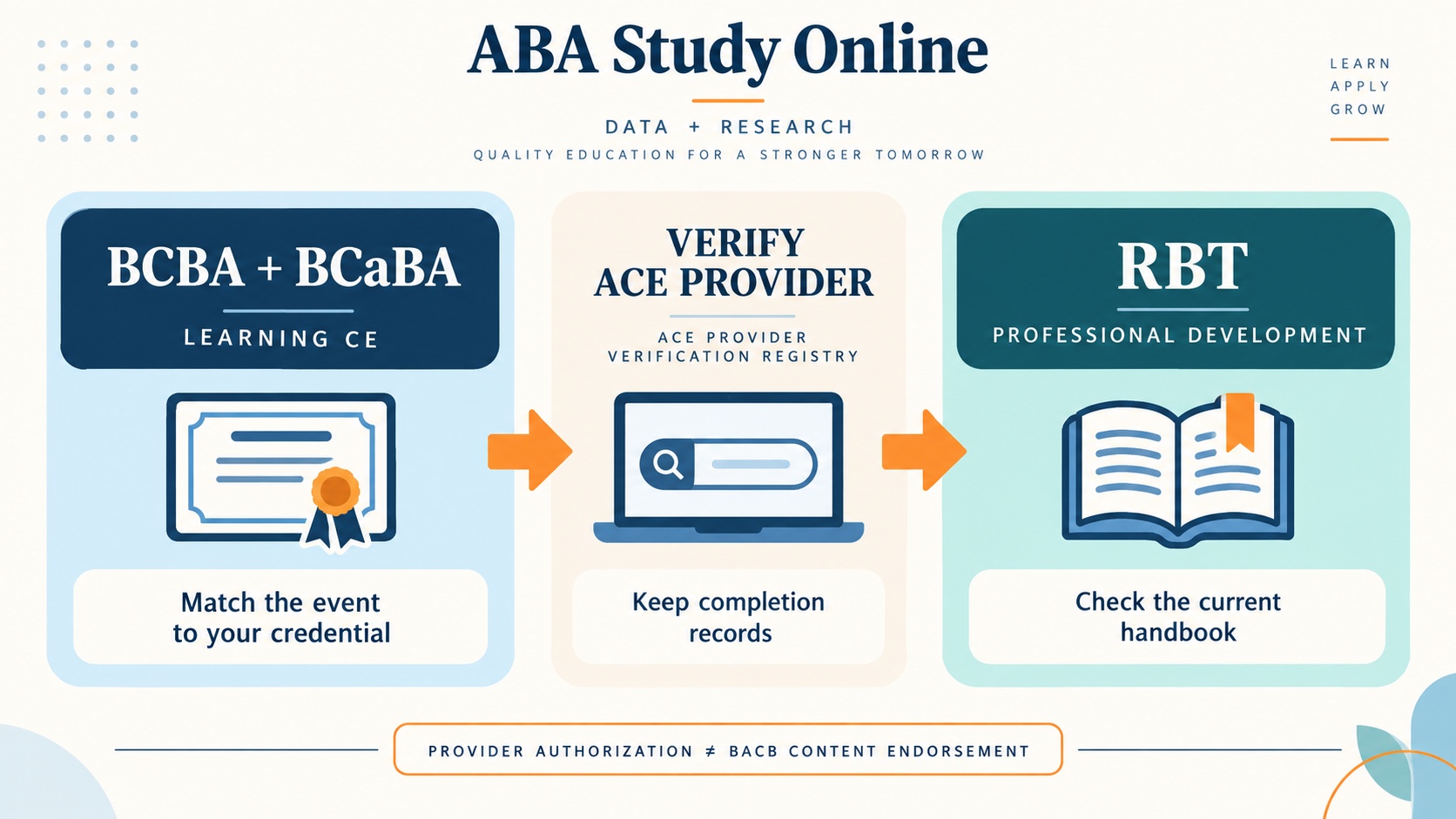
An event can be educational without answering every maintenance question for every credential. For example, a workshop might be useful to both a BCBA and an RBT but be recorded differently for each person. Read the event’s audience, learning objectives, modality, duration, and documentation instructions before registering.
How do you verify a BACB CEU provider?
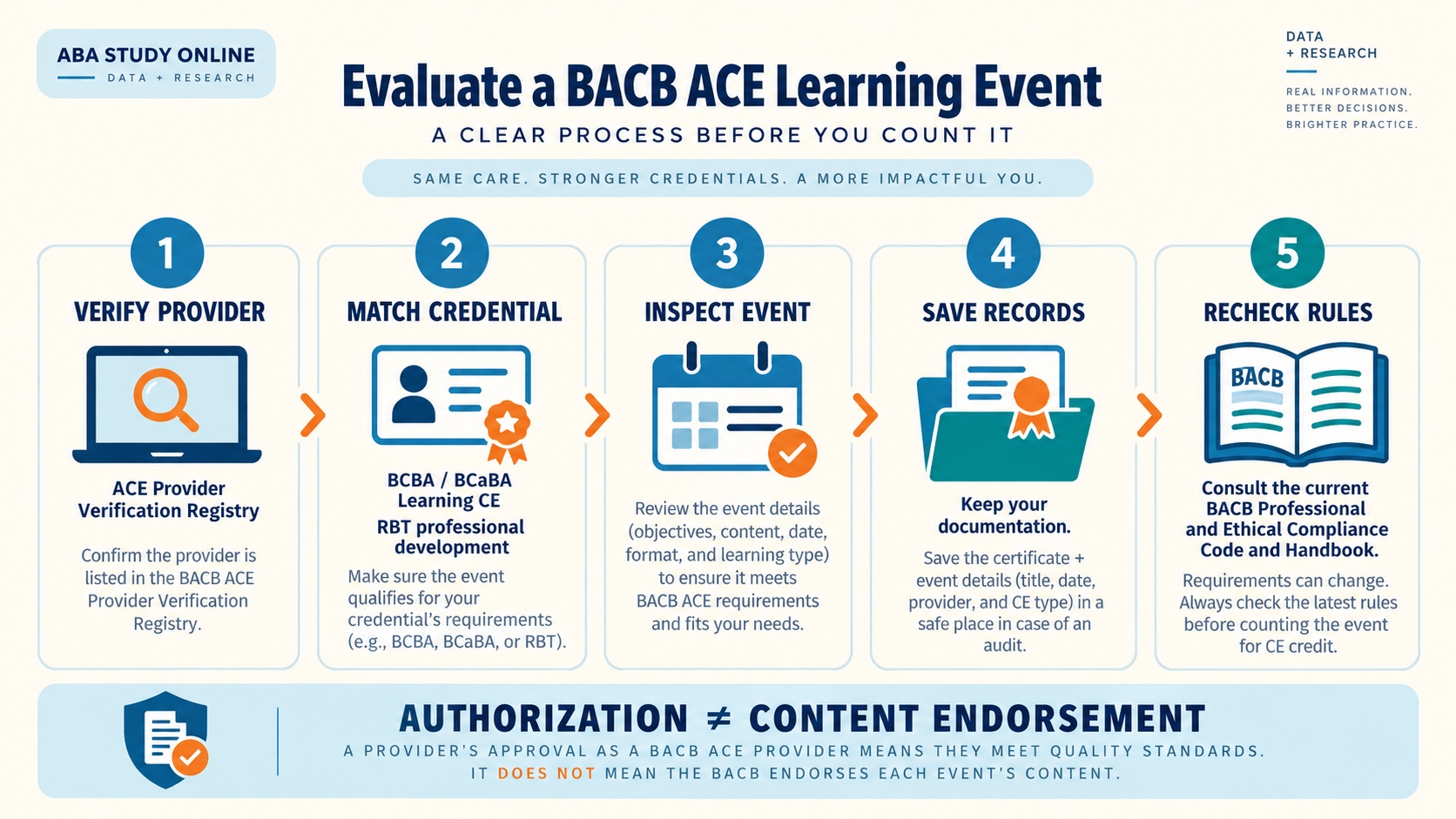
Use the BACB ACE Provider Verification Registry. The registry lets you search by provider name, ACE Coordinator name, or provider number. A practical verification sequence looks like this:
- Start with the exact provider name. Copy the legal or public-facing name from the event page instead of searching only for the instructor’s first name.
- Check the listing and authorization status. Compare the provider shown in the event registration with the name in the registry. If the names differ, ask the event organizer to explain the relationship before paying.
- Match the program to your credential. Confirm whether the event offers BCBA/BCaBA Learning CE or RBT professional development. Do not assume that “BACB-approved” means the same thing for all three tracks.
- Read the event documentation details. The current ACE materials describe documentation such as a formal certificate and event information. Keep your certificate, registration record, completion evidence, and any category information together.
- Recheck current rules when the event is near a renewal deadline. Maintenance requirements and provider requirements can change. A saved screenshot from an old event page is not a substitute for reading the current handbook or credential page.
If a provider is not found, pause before assuming the registry is wrong. Try the organization’s exact name, provider number, or coordinator name. If the result still cannot be verified, contact the organizer and use the BACB’s current support route for ACE-related questions. A payment receipt alone does not prove that an event counts toward your credential maintenance.
Does BACB approval cover the content?
No. The registry itself states that authorization as an ACE Provider does not imply endorsement or approval of the CEU content by the BACB. That sentence is easy to miss and protects an important distinction:
- Provider status: the individual or organization has been authorized within the ACE program.
- Event documentation: the event supplies the information and records needed for a participant to document completion.
- Professional judgment: the learner still evaluates whether the topic is relevant, current, within scope, and appropriate for their professional role.
In other words, an ACE label is not a promise that every claim in a presentation is correct for every situation, and it is not a pass guarantee for a certification exam. Choose learning that has clear objectives, qualified presenters, transparent documentation, and a topic you can apply responsibly.
What should a learner check before an event?
Before registering, ask five small questions. Who is the ACE Provider? Which credential is the event for? How long is the event and what learning activity is required? What certificate or completion record will I receive? Which current BACB rule tells me how to count or retain it?
Be especially cautious with content that promises that reading one article and passing a short knowledge check automatically creates BACB credit. The BACB’s recent ACE changes explain that reading an article and conducting a knowledge check may not count as an ACE event, while a journal club can qualify under the applicable requirements. Treat a marketing claim as something to verify, not as the rule itself.
What if you want to become a provider?
If your question is not “Where can I find a provider?” but “How can I become one?”, start with the current ACE Provider Handbook. The handbook says applicants must read the requirements, submit the appropriate individual or organization initial application through the BACB contact route, pay the nonrefundable processing fee, and allow processing time for a complete application. The current handbook also describes annual renewal and the responsibilities of an ACE Coordinator.
Provider status is therefore an operational commitment, not just a badge for a sales page. An organization must maintain its status, use qualified roles, keep event records, and follow the current rules for the type of learning it offers. If you are planning a new course, compare its format, presenter qualifications, learning objectives, assessment, and documentation against the live handbook before you advertise it as an ACE event.
How should you handle the 2026 and 2027 changes?
The BACB’s current change pages separate ACE Provider changes taking effect July 1, 2026, from BCBA and BCaBA eligibility and maintenance changes scheduled for January 1, 2027. Do not combine those announcements into one broad claim that “all CEU rules changed.” A provider may need to follow the ACE Handbook effective date, while a certificant may need to read a separate credential handbook and transition page.
For the safest workflow, use the live BACB ACE page and registry when selecting a provider, then use the current BCBA, BCaBA, or RBT handbook for your own maintenance requirement. The ABA Study Online BCBA learning path, BCaBA learning path, and RBT learning path can help you study concepts and organize questions, but they do not replace BACB records, an ACE Provider’s documentation, or individualized professional guidance.
BACB CEU provider FAQ
What is the official term for a BACB CEU provider? The current program term is Authorized Continuing Education Provider, or ACE Provider.
How can I check whether a provider is authorized? Search the BACB ACE Provider Verification Registry by provider name, ACE Coordinator name, or provider number, and compare the result with the event registration details.
Do RBTs earn the same CE as BCBAs? The BACB distinguishes BCBA/BCaBA Learning continuing education from RBT professional development. Check the RBT materials and the event documentation rather than assuming the labels are interchangeable.
Does an ACE Provider guarantee that the content is approved by BACB? No. The BACB registry expressly says that provider authorization does not imply endorsement or approval of the CEU content.
Should I keep my certificate? Yes. Keep the certificate or other completion record with the event name, date, modality, provider information, and any category details. Follow the retention and documentation instructions in the current credential handbook.