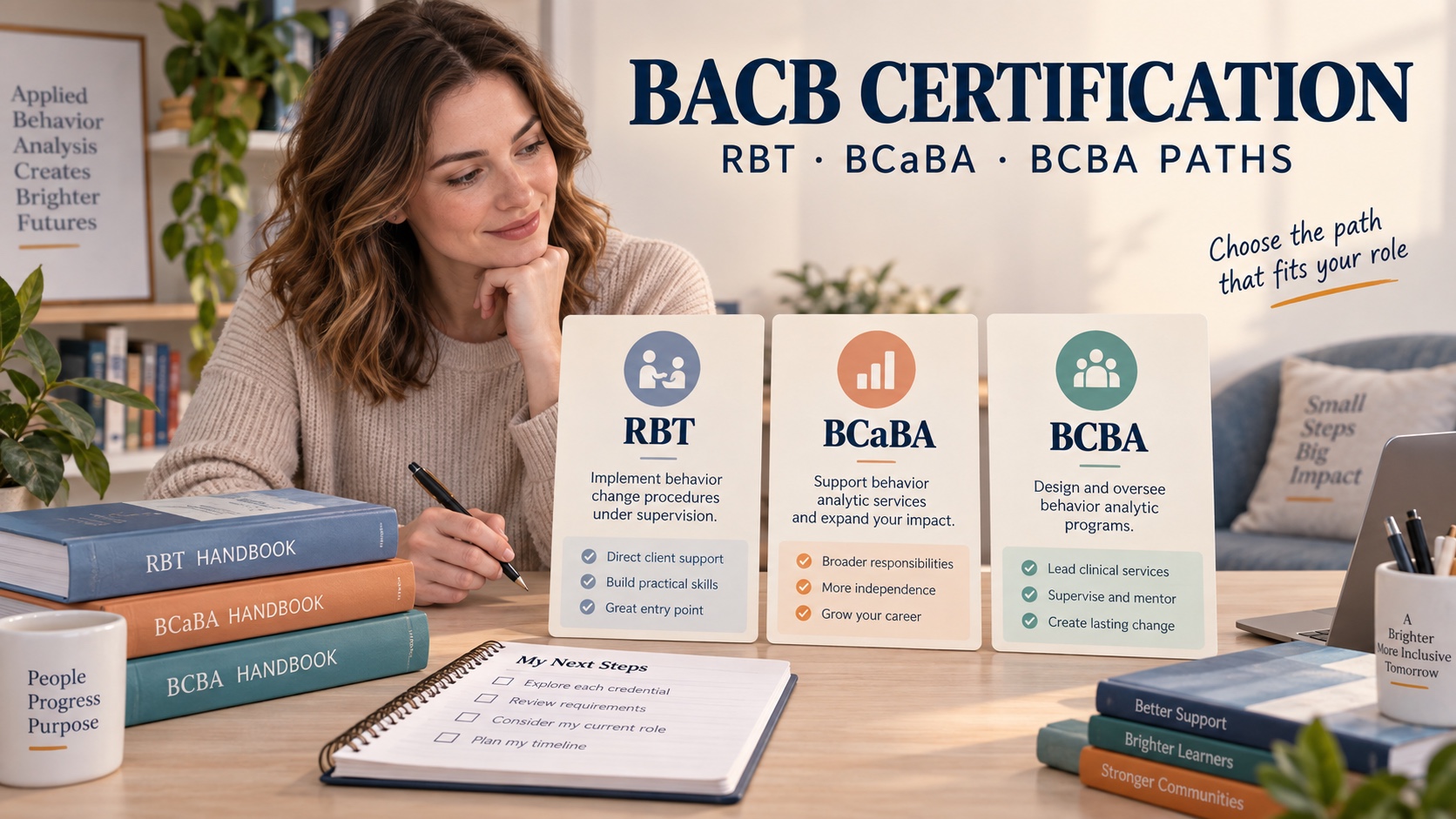
BACB Certification: RBT, BCaBA, and BCBA Paths Explained
“BACB certification” does not refer to one single credential. The Behavior Analyst Certification Board administers distinct certification programs for Registered Behavior Technicians (RBTs), Board Certified Assistant Behavior Analysts (BCaBAs), and Board Certified Behavior Analysts (BCBAs). The right next step depends on the role you want, your education, the supervision structure you will work within, and the current eligibility rules for that credential.
This guide gives you a map rather than a substitute application review. Start by identifying the credential, then open its current BACB handbook before you pay for training, submit an application, or plan an examination. Requirements and transition dates can change, and a course completion certificate is not the same thing as BACB certification.
Table of Contents
What BACB certification means
The BACB is the organization that sets eligibility requirements, administers certification examinations, publishes ethics and examination guidance, and maintains certification programs for behavior-analytic roles. Certification is a formal credential with a defined scope. It is not the same as saying that someone has taken an ABA class, worked in an autism-services setting, or downloaded a study guide.
Each credential has its own handbook, application requirements, examination boundary, supervision expectations, and maintenance rules. A general search for BACB certification is therefore a starting point. The next useful question is: Which BACB credential am I trying to pursue?
The three certification paths
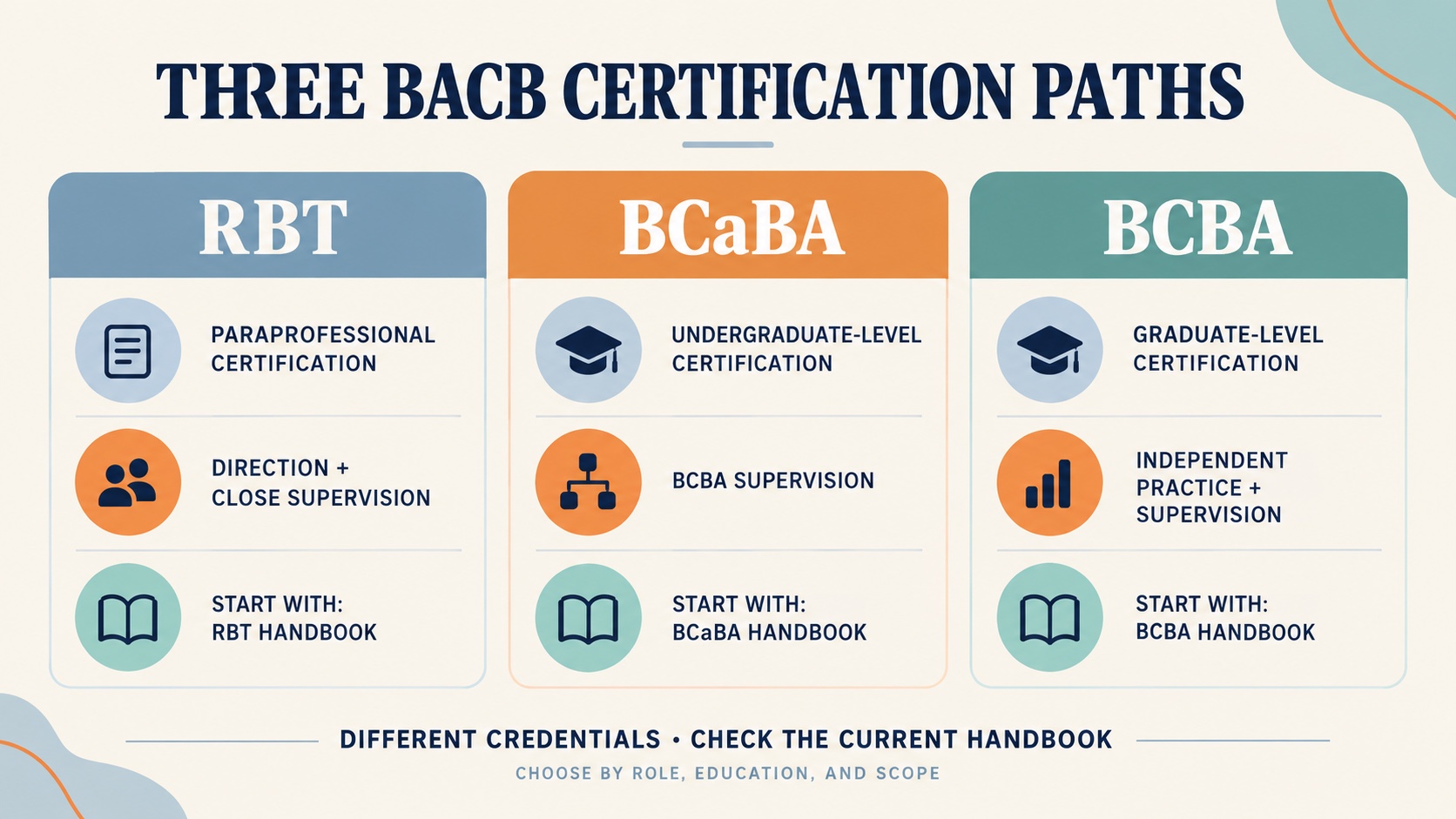
RBT: a paraprofessional certification
The RBT credential is designed for a paraprofessional role. RBTs assist in delivering behavior-analytic services under the direction and close supervision of an RBT Supervisor and/or RBT Requirements Coordinator who is responsible for their work. This is the most entry-level of the three BACB certification programs, but “entry-level” does not mean “automatic.”
For applicants using the current 2026 route, the RBT Handbook describes requirements that include being at least 18, having at least a high-school-level education or equivalent, passing the relevant background and abuse-registry checks, completing the required 40-hour training, completing an initial competency assessment, submitting an application, and passing the RBT examination. Check the current handbook for timing windows, attestation rules, fees, and the exact documents before applying.
BCaBA: an undergraduate-level assistant analyst certification
The BCaBA credential is an undergraduate-level certification. BCaBAs may provide behavior-analytic services under the supervision of a BCBA, and they may supervise the work of RBTs within the applicable requirements. The route is more advanced than the RBT path and is built around an undergraduate degree or an approved education route, behavior-analytic content, supervised fieldwork, an application, and the BCaBA examination.
There is not one generic “BCaBA course” that replaces the full eligibility pathway. The current BCaBA Handbook describes the available pathways and the documentation needed to demonstrate education, coursework or program fit, fieldwork, and examination eligibility. If your application timing overlaps the 2027 changes, use the official transition guidance instead of applying an old checklist.
BCBA: a graduate-level analyst certification
The BCBA credential is a graduate-level certification. BCBAs may provide behavior-analytic services independently and may supervise RBTs, BCaBAs, and other professionals who implement behavior-analytic interventions. The path typically involves a qualifying graduate degree or another recognized degree route, behavior-analytic coursework or program content, supervised fieldwork, an application, and the BCBA examination.
The details are pathway-specific. The BCBA Handbook explains the education, coursework, fieldwork, application, and examination requirements, while the BACB’s 2027 materials explain upcoming changes. Do not use a BCBA checklist to plan a BCaBA or RBT application. The credentials are related, but they are not interchangeable.
The common path from eligibility to certification
Although the details differ, most certification planning can be organized into four questions:
- Do I meet the eligibility route? Check the credential-specific handbook for age, degree, education, coursework, training, fieldwork, competency, background, and other requirements.
- Can I document it? A completed class or fieldwork experience is not enough if the required attestation, form, transcript, verification, or supervisor information is missing.
- What examination applies? Use the current exam information and content outline for the credential you actually selected. The current BACB comparison lists BCBA as 4 hours/185 questions, BCaBA as 4 hours/175 questions, and RBT as 90 minutes/85 questions; all are delivered in person according to that page.
- How will I maintain it? Certification does not end at the exam. Supervision, ethics, renewal, continuing education or professional development, and self-reporting obligations depend on the credential and the current handbook.
This sequence is useful for planning, but it is not a universal application checklist. The official handbook for the selected credential controls when the general summary and a specific rule appear to differ.
How to compare an official requirement page
When you open a BACB page, do not begin by copying every number into a personal checklist. First confirm the page’s identity. Look for the credential name, the handbook version or update date, the eligibility pathway, and the date the rule takes effect. A requirement can be correct for BCBA Pathway 2 and still be irrelevant to an RBT applicant or a BCaBA applicant using another route.
Next, separate the requirements into four columns: what must be completed, who verifies it, what document proves it, and when the document must be current. For an RBT applicant, that may mean distinguishing a training certificate from the initial competency assessment and from the application attestation. For a BCaBA or BCBA applicant, it may mean separating a transcript, coursework or program verification, fieldwork forms, and the examination application. The exact documents belong to the current handbook; the comparison method helps you notice missing evidence.
Finally, check what happens after certification. A page that answers “how to become certified” may not explain supervision, ethics, renewal, continuing education, professional development, or self-reporting. Add those maintenance obligations to your planning view, but do not import a maintenance rule from one credential into another. A clean source map is more reliable than a single undated blog checklist.
This source-check habit also helps when you use study materials. A practice app can organize concepts, questions, and review. It cannot decide whether your degree is acceptable, whether a supervisor meets the current qualification, whether a form is inside its validity window, or which transition rule applies. Those decisions belong to the BACB’s current official materials and, when necessary, direct clarification from the BACB.
Why the 2026–2027 transition matters
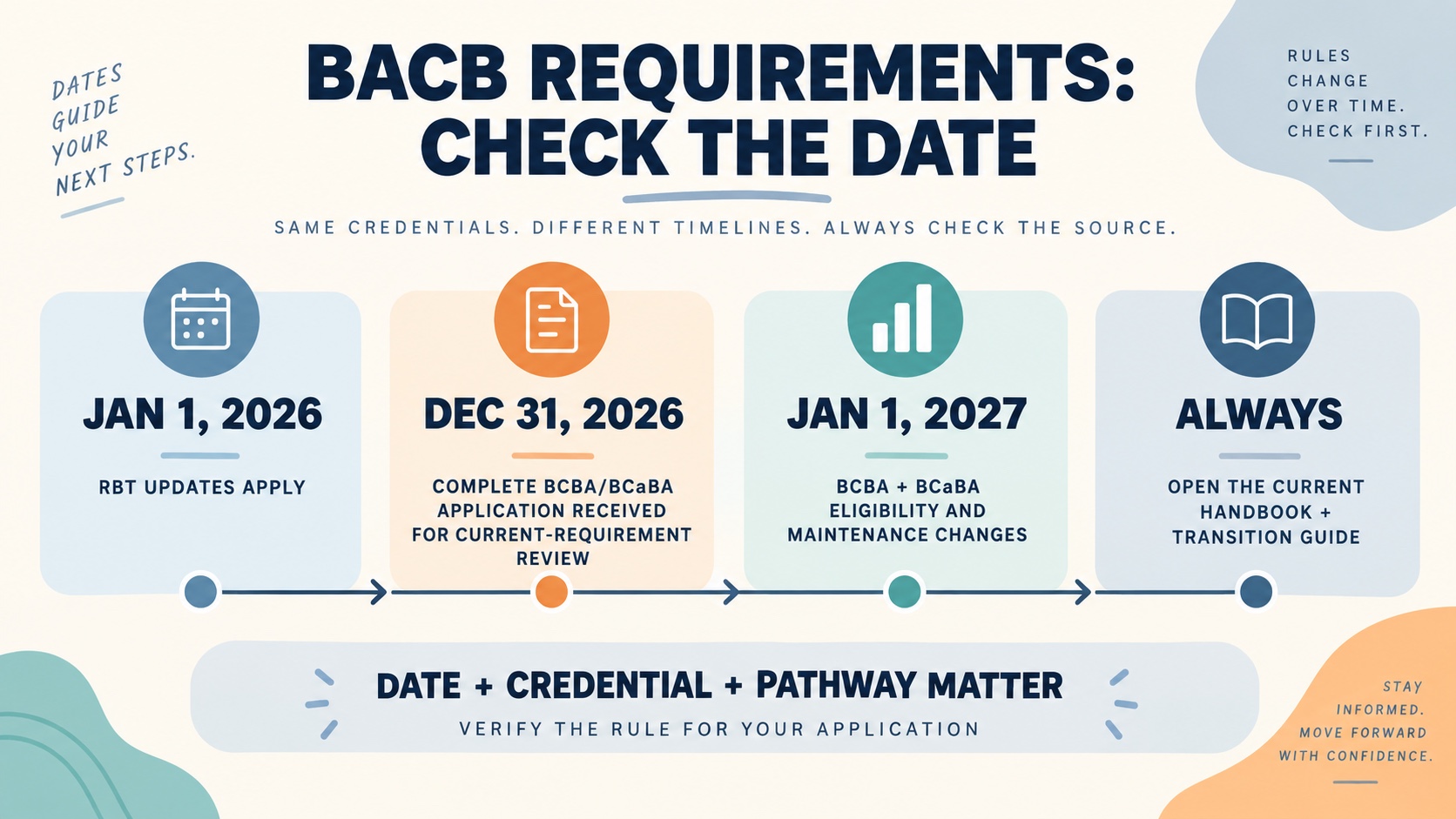
The current date matters in this topic. The BACB identifies RBT requirement and examination changes beginning in 2026, including the current RBT Test Content Outline (3rd ed.) boundary. It also identifies significant BCBA and BCaBA eligibility and maintenance changes beginning January 1, 2027.
For BCBA and BCaBA applicants near the transition, the BACB says a complete application—including payment and required documents—received by December 31, 2026 is reviewed under the current 2022 requirements. That sentence is a timing boundary, not a reason to rush an incomplete application. Use the BACB transition guide and the current handbook to determine which rule set applies to your situation.
Do not assume that an article labeled “2027” contains the final answer to every eligibility question. Check the publication or update context, the credential, the pathway, and the official source linked from the BACB site. This is especially important for international applicants and anyone whose degree, coursework, or fieldwork crosses a transition date.
What BACB certification is not
Several common shortcuts create confusion:
- It is not a universal ABA license. BACB certification is a credential with a defined program and scope; local laws, employer rules, and service-setting requirements may also matter.
- It is not the same as a course. A training course can support one requirement or help you study, but it does not by itself create RBT, BCaBA, or BCBA certification.
- It is not an exam-prep guarantee. No study app, mock exam, or paid guide can promise eligibility or a passing result.
- It is not one shared task list. The current RBT, BCaBA, and BCBA content outlines are credential-specific.
A practical route-selection checklist
Before you choose a training program or study plan, write down:
- The role you want to perform and the level of supervision you expect.
- Your highest completed education and the country or institution where it was earned.
- The credential-specific handbook and current content outline you will use.
- The requirements you have already documented and the ones still needing a supervisor, assessor, transcript, or form.
- The transition date that could affect your application, exam, or maintenance route.
If you cannot answer the first two questions, start with role clarification rather than buying an exam package. If you know the credential but not the current requirements, start with the handbook. If your eligibility is clear and you are preparing for the exam, then add targeted practice and error review.
Common questions
What certifications does the BACB offer?
The main certification programs covered here are RBT, BCaBA, and BCBA. BCBA-D is a designation for qualifying BCBAs, not a separate certification with separate privileges.
Can I become BACB certified by completing an ABA degree?
Not automatically. A degree may be part of a BCaBA or BCBA eligibility route, but the current credential-specific requirements, documentation, fieldwork where applicable, application, and examination still matter.
Which BACB certification should I choose?
Choose based on the role, education level, scope, and supervision structure you want—not only on the exam name. Compare the current RBT, BCaBA, and BCBA handbook pages before committing to a route.
Can one BACB certification substitute for another?
No. Experience in one role may support a later career plan, but it does not erase the separate eligibility and examination requirements for another credential. Treat each route as its own application decision.
Do all BACB exams have the same length?
No. The current BACB examination-information page lists different time and question counts for BCBA, BCaBA, and RBT. Always practice against the exam for the credential you selected.
Official sources and study paths
Start with the BACB pages for RBT, BCaBA, and BCBA. Then check the official examination information, the current content-outline index, and the BACB’s upcoming-changes page. For the 2027 transition, use the official BCBA/BCaBA transition notice.
Inside ABA Study Online, choose the matching RBT study path, BCaBA study path, or BCBA study path. You can then move to free practice questions or the ABA Definition Search without mixing the credential tracks.