BACB Certificants: Meaning, Current Data, and How to Verify a Credential
If you are searching for BACB certificants, the key word is “certificant.” It refers to a person who holds a BACB certification, such as BCBA, BCaBA, or RBT. It does not mean every applicant, student, employee, or person who has studied ABA. The certification track and the current Registry status determine what can be verified.
The BACB also publishes population data, but a count is not a personal credential check. The official data page reports a dated snapshot of people holding each certification, while the Certificant Registry is the place to check an individual’s status and any reportable disciplinary actions. Certification and state licensure are related questions in some settings, but they are not the same record.
Table of Contents
What does BACB certificant mean?
A certificant is a person who has met the requirements for a BACB certification and holds that credential. The term is useful because it describes the person’s certification relationship without pretending that all roles are identical. A BCBA, BCaBA, and RBT are all BACB certificants, but they have different education, examination, supervision, and practice boundaries.
An applicant is not automatically a certificant. An applicant may be completing training, submitting documents, waiting for an application decision, or preparing for an examination. A person may also have previously held a certification that is now inactive or expired. Use the current official status rather than a course completion badge, an old certificate image, or a job title alone.
Which credentials are included?
- BCBA: a graduate-level certification for behavior analysts. The BCBA role can include independent behavior-analytic practice within applicable requirements and supervision of certain services.
- BCaBA: an undergraduate-level assistant behavior analyst certification. BCaBAs provide behavior-analytic services under BCBA supervision and may perform other role-specific responsibilities under current rules.
- RBT: a paraprofessional certification for behavior technicians who implement behavior-analytic services under direction and close supervision.
These short descriptions are orientation points, not substitutes for the current handbook. A credential title does not answer every question about a person’s employer, caseload, state license, payer, competence, or supervision arrangement. For track-specific study, use the BCBA learning path, BCaBA learning path, or RBT learning path.
What the current BACB data shows
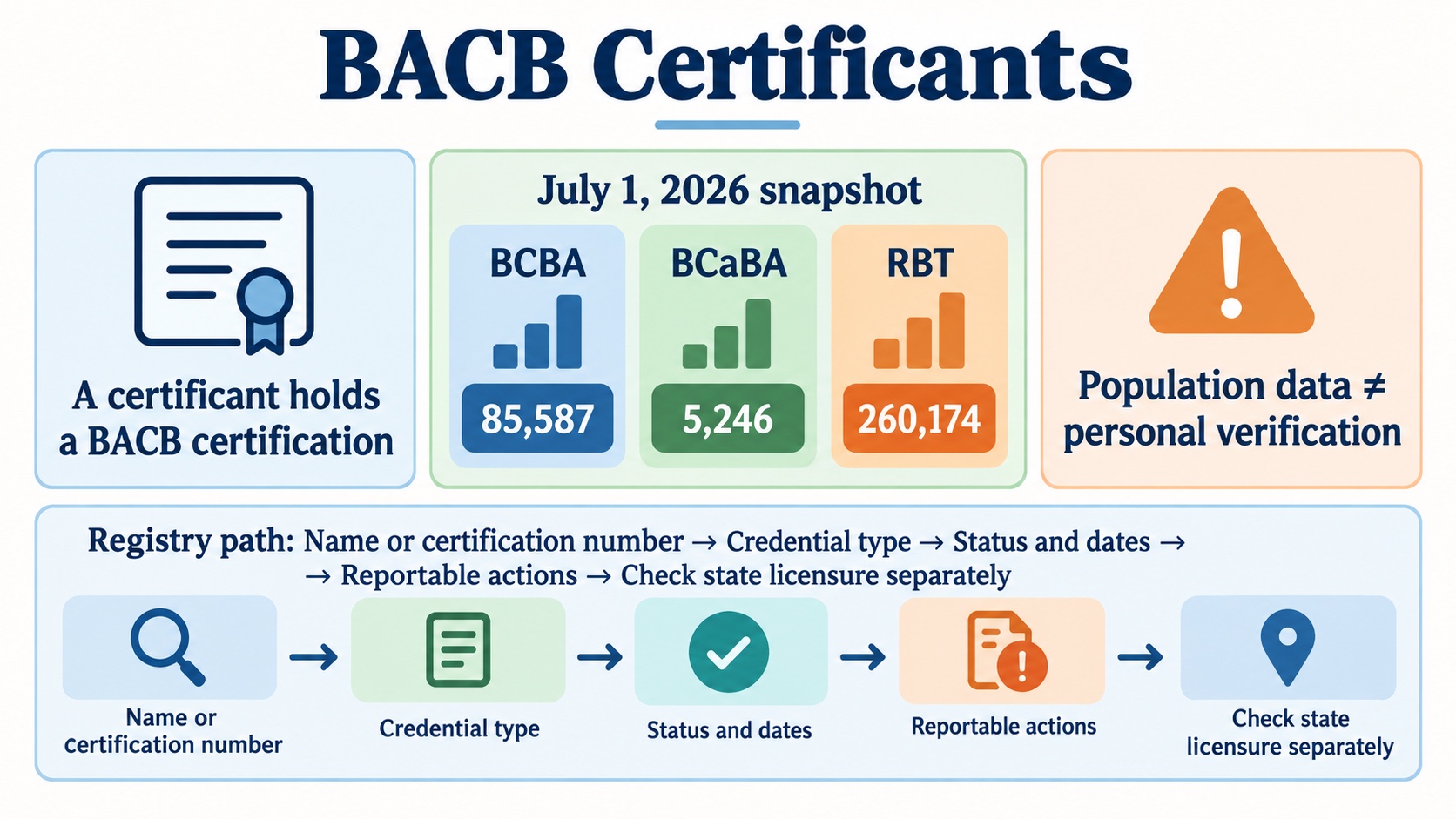
The BACB Certificant Data page reports the following snapshot as of July 1, 2026:
| Certification | Certificants in the snapshot | How to read it |
|---|---|---|
| BCBA | 85,587 | A dated population count, not a personal Registry result |
| BCaBA | 5,246 | A dated population count for the assistant-level certification |
| RBT | 260,174 | A dated population count for the paraprofessional certification |
The numbers are useful for understanding the size and shape of the credentialed workforce, but they should not be treated as a live total after the stated date. They also do not tell you how many people are practicing in a particular city, how many are currently providing a specific service, or what outcomes a credentialed professional will produce. The BACB data page itself is the source to revisit when you need a later snapshot.
How to verify a certificant
When you need to check a practitioner, employer, supervisor, or potential colleague, use the BACB Certificant Registry rather than relying on a social profile or a screenshot. A practical verification sequence is:
- Start with the person’s name or certification number. Use the information you can verify, and watch for similar names.
- Check the certification type. Confirm whether the record is RBT, BCaBA, BCBA, or another displayed designation.
- Read the status and dates. Look for active, inactive, expired, or other status language and note the recertification date when shown.
- Review reportable actions. The Registry can show whether reportable disciplinary actions are associated with the certification.
- Check local licensure separately. If the service or jurisdiction requires a state license, use the applicable state authority as an additional verification step.
Verification should answer a narrow question: what certification status does the official record show now? It does not prove that a person is the right match for every client, setting, or intervention. Ask about role, supervision, training, and service fit through the appropriate professional and organizational channels.
Why status matters to different readers
A parent or caregiver may use the Registry to confirm that a named professional holds the credential described by a service provider. An employer may use it as one part of a hiring or privileging process. A trainee may use it to check whether a potential supervisor appears in the correct certification category before discussing a fieldwork arrangement. Each reader is asking a different practical question, even though the same public record is involved.
The Registry is strongest when combined with the right next check. After confirming the credential, ask whether the person’s role fits the service, whether required supervision is in place, whether the jurisdiction has a separate license, and whether the organization can explain its responsibilities. A current record is important evidence, but it is not a substitute for a complete professional fit or service-safety review.
Status, licensure, and role boundaries
“Certified” and “licensed” should not be used as interchangeable words. BACB certification is a professional credential. Many jurisdictions also regulate behavior-analytic practice through state or local licensure, while some services involve payer or employer rules. The applicable requirements depend on where and how services are provided.
Similarly, a Registry record does not replace a conversation about scope. A BCBA may hold the certification but still need to consider competence, supervision, consent, documentation, employer policy, and the limits of the service context. A BCaBA or RBT has a different role relationship and should not be treated as a BCBA simply because all three are listed as certificants.
Common mistakes
- Counting applicants as certificants: completing a course or submitting an application does not by itself establish certification.
- Using a dated number as a live total: always repeat the snapshot date when quoting population data.
- Confusing the Registry with a BACB account: a public status lookup and private account information answer different questions.
- Assuming the credential proves every role: certification does not erase supervision, competence, licensure, payer, or employer boundaries.
- Using an unofficial directory as primary verification: third-party listings can be incomplete or outdated; use the BACB Registry first.
BACB certificants FAQ
What is a BACB certificant?
A BACB certificant is a person who holds a BACB certification. The term can include BCBA, BCaBA, and RBT professionals, whose roles and requirements are different.
How many BACB certificants are there?
The BACB snapshot dated July 1, 2026 reports 85,587 BCBA, 5,246 BCaBA, and 260,174 RBT certificants. Check the official data page for later snapshots.
How do I verify a BACB certificant?
Use the official BACB Certificant Registry. Search by the available name or certification number, confirm the credential type and status, and check reportable actions. Verify state licensure separately when applicable.
Is a BACB certificant automatically licensed?
No. BACB certification and state licensure are separate questions. The applicable jurisdiction, service, employer, and payer rules determine what additional authorization may be required.