BACB Attestation Form 2026: Which Form Do You Need?
If you are searching for a BACB attestation form 2026, the most important first step is not downloading the first PDF you see. It is identifying the credential and pathway. In 2026, the BACB’s application materials include BCBA and BCaBA Pathway 2 coursework attestations, as well as an RBT Certification Application Attestation. These documents do different jobs and are completed by different people.
This guide helps you choose the right document, check its version, understand who completes it, and avoid treating an attestation as a replacement for the rest of an application. Because forms and requirements can change, the current BACB handbook and application-processing page remain the final source for your situation.
Quick answer: there is not one universal “BACB attestation form 2026.” The current BACB application-processing page lists the BCBA Pathway 2 Coursework Attestation and BCaBA Pathway 2 Coursework Attestation as version 7/2026. It lists the RBT Certification Attestation Form as version 3/2025, even though an applicant may use it during 2026. Choose the form by credential and pathway, then verify the version on the current BACB source before submitting anything.
Choose by credential and pathway
Attestation means that an authorized person confirms specific information for the BACB. It is not a general “I completed ABA training” declaration. The signer, information being confirmed, timing, and application pathway all matter.
Use this decision rule:
- Are you applying for BCBA certification through Pathway 2? Look for the BCBA Pathway 2 Coursework Attestation and the current BCBA requirements.
- Are you applying for BCaBA certification through Pathway 2? Look for the BCaBA Pathway 2 Coursework Attestation and the current BCaBA requirements.
- Are you applying for RBT certification? Look for the RBT Certification Application Attestation, the RBT Handbook, and the current RBT eligibility materials.
- Are you using another pathway or maintaining a certification? Do not assume one of these forms applies. Start with the relevant handbook and the current BACB processing instructions.
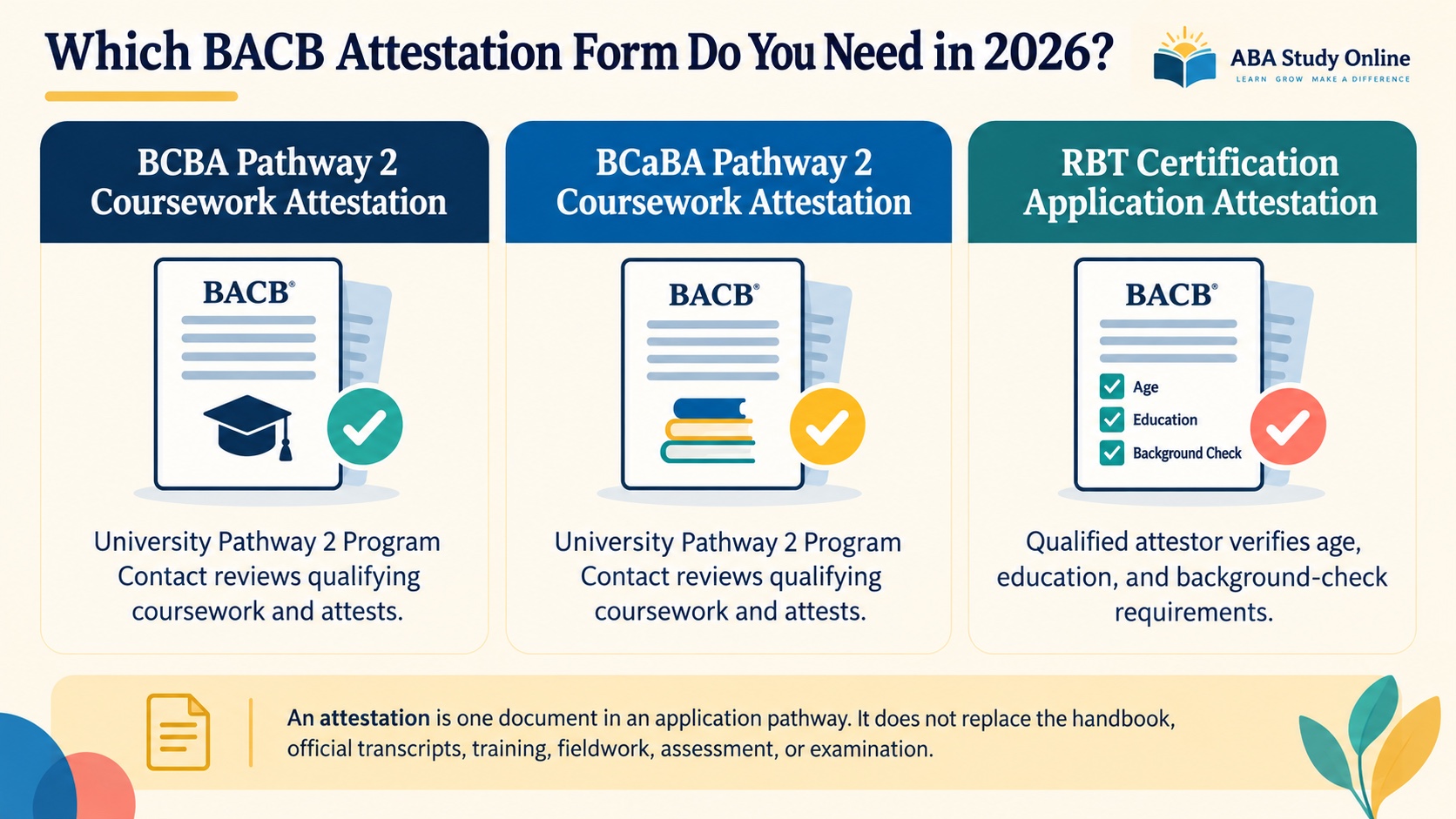
BCBA Pathway 2 coursework attestation
Beginning January 1, 2026, the BACB’s Pathway 2 Coursework Attestation System changed how qualifying coursework is confirmed for BCBA applicants. A designated Pathway 2 Program Contact at the university reviews the student’s coursework and, when appropriate, attests that the coursework requirements have been met.
The attestation is connected to the university and the program contact. It is not a form that a student can complete alone to make coursework qualify. The student still needs to follow the current BCBA pathway, submit official transcripts and other required evidence, and meet the remaining eligibility and application requirements. The BACB’s application-processing page lists the BCBA Pathway 2 Coursework Attestation as version 7/2026.
If your school previously used a Verified Course Sequence process, do not automatically copy an old workflow into 2026. The BACB’s university faculty guidance explains the new program-contact and attestation process, including the requirement that the attestation be in the applicant’s account before the Pathway 2 application can be completed. Ask the university’s designated contact which steps apply to your record.
BCaBA Pathway 2 coursework attestation
The BCaBA Pathway 2 Coursework Attestation serves a similar but separate function for BCaBA applicants. The program contact reviews the qualifying behavior-analytic coursework and submits the attestation when the student has completed the applicable requirements. The current application-processing page lists the BCaBA Pathway 2 Coursework Attestation as version 7/2026.
Do not use a BCBA form simply because the wording looks similar. Credential level, coursework expectations, handbook language, and application records can differ. If your university offers both tracks, confirm which attestation is being submitted to the BACB and which program contact is responsible for it.
The attestation also does not replace the BCaBA application, official transcript requirements, supervised fieldwork or other applicable eligibility evidence, examination, ethics requirements, or maintenance responsibilities. Think of it as a verified coursework checkpoint, not the whole certification pathway.
RBT Certification Application Attestation
The RBT form is different from the BCBA and BCaBA Pathway 2 coursework attestations. The RBT Certification Application Attestation is completed by a qualified attestor who verifies specific RBT application information, including age, education, and background-check requirements described in the RBT Handbook.
The BACB’s form states that the attesting certificant must hold an active BCaBA, BCBA, BCBA-D, or FL-CBA certification and have the required employment or contractual relationship with the organization employing the applicant. The form also states that it must be signed within 90 days of paying for the RBT certification application and that all fields must be completed.
The current processing page lists the RBT Certification Attestation Form as version 3/2025. That does not make it a “2026 form,” and the search year does not determine the document version. During a transition year, always open the current RBT page and processing instructions before using a saved PDF.
How to check the current version
Use a three-part check before downloading or uploading a form:
- Confirm the official page: begin at the BACB application-processing updates page or the relevant certification page, not a reposted file or screenshot.
- Read the document version: compare the version listed by the BACB with the version printed on the form or PDF filename.
- Confirm the pathway and signer: verify that the form matches BCBA Pathway 2, BCaBA Pathway 2, RBT application, or another specific process, and confirm who is allowed to sign.
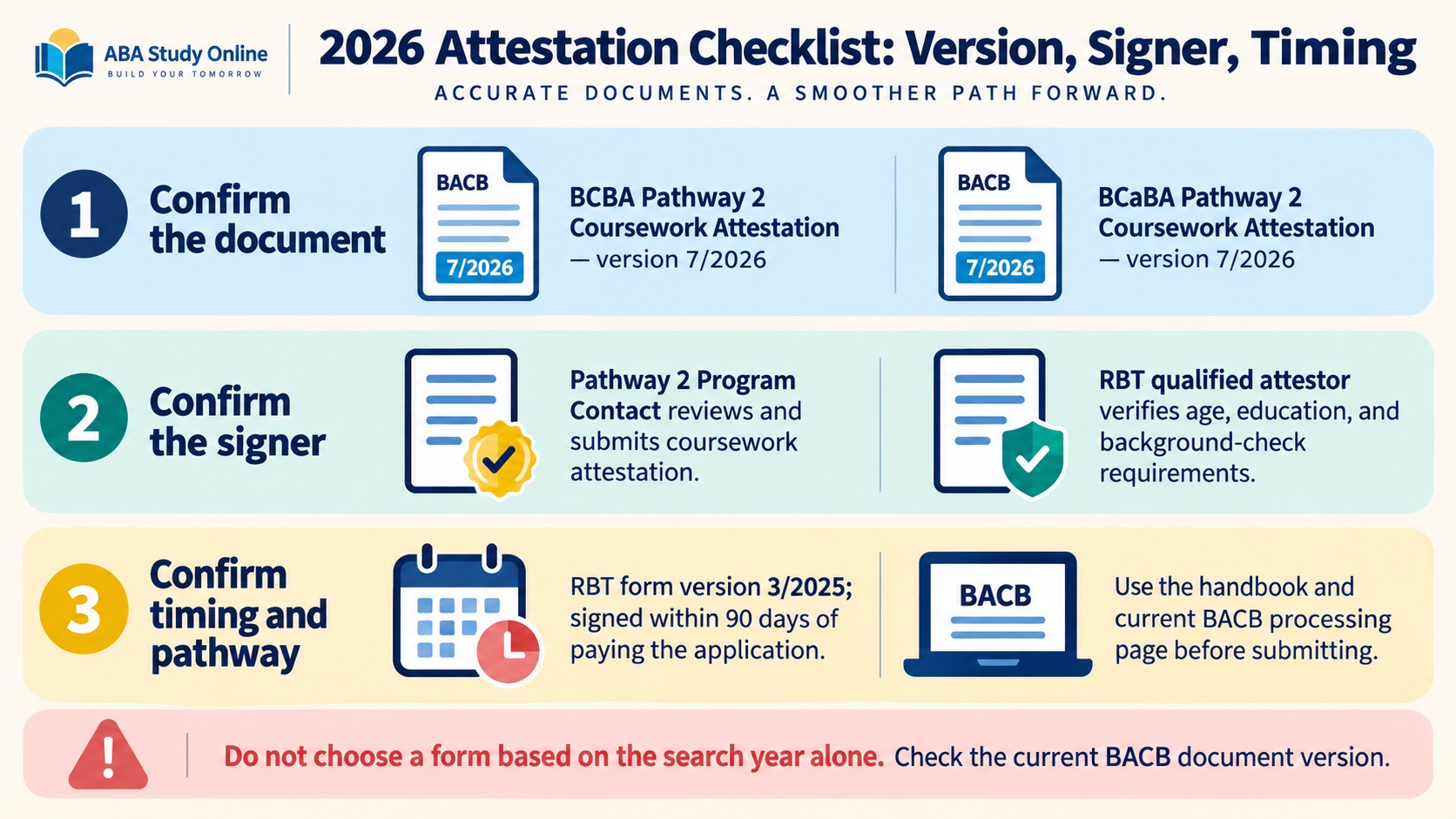
Dates matter in two different ways. A document version tells you which form language the BACB currently lists, while a signature or submission deadline tells you when that document can be used. Those are not the same question. For example, the RBT form can carry a 2025 version while being used during a 2026 application, and its signature timing still matters. Always check both the document version and the application clock.
If the attestation is missing or rejected
If the form does not appear in your account, first check whether the correct university contact, attestor, or application pathway has been used. A missing document is not automatically evidence that your coursework or eligibility has been denied. It may mean that the attestor has not submitted it, the BACB has not matched it to your account, the wrong BACB ID was entered, or the application stage is not ready for that document.
Keep the troubleshooting factual. Record the document name, version, date, signer or program contact, BACB ID, and any confirmation message. Then contact the university, supervisor, attestor, or BACB through the appropriate channel. Do not upload a second form with different information just to make the status change, and do not alter an official PDF to force it to match another pathway.
If an application is returned or a form is rejected, read the specific reason and compare it with the current handbook and processing page. A rejection may concern timing, a missing field, signer qualifications, an account mismatch, or a different eligibility document. The safest response is to correct the identified issue through the official process, preserve the original record, and ask a qualified person when the instructions are unclear.
Common mistakes
- Searching only by year: “2026” is not enough to identify a current form; one active form may carry a 2025 version.
- Using a student-created attestation for Pathway 2: the university’s designated program contact has the attestation responsibility.
- Using the RBT form for BCBA or BCaBA coursework: RBT attestation verifies different application facts.
- Forgetting the signer relationship: an otherwise complete form may fail if the attestor is not qualified or properly connected to the organization.
- Submitting an incomplete form: required fields, signatures, dates, and supporting records must be checked before submission.
- Treating an attestation as a certification: the form is one piece of an application and does not create eligibility by itself.
A before-submission checklist
- Write down the credential: BCBA, BCaBA, or RBT.
- Write down the pathway: Pathway 2 coursework, RBT initial application, or another process.
- Open the current BACB processing page and relevant handbook.
- Match the document name and version to the official listing.
- Confirm the person or program contact who must complete and submit it.
- Check dates, signature rules, account placement, and required attachments.
- Keep a copy of what was submitted and any confirmation in your application folder.
For concept review, the BCBA learning path, BCaBA learning path, RBT learning path, and ABA glossary can help you understand terminology. They do not replace the BACB’s application instructions or determine whether your documents qualify.
FAQ
Is there a BACB attestation form specifically called the 2026 form?
Not one universal form. The current listing includes BCBA and BCaBA Pathway 2 Coursework Attestations at version 7/2026, while the RBT Certification Attestation Form is listed as version 3/2025 for use in its RBT application process.
Who completes a BCBA Pathway 2 coursework attestation?
The designated Pathway 2 Program Contact at the university reviews the qualifying coursework and submits the attestation when appropriate. The student should follow the university’s process and the current BACB guidance.
Who signs the RBT attestation?
A qualified attesting certificant verifies the RBT applicant’s required information. Review the current RBT form and handbook for qualifications, relationship requirements, timing, and the complete application process.
Can an attestation replace my transcript or other documents?
No. An attestation confirms a specific part of an application. It does not automatically replace official transcripts, training, fieldwork, competency assessment, examination, or other required evidence.