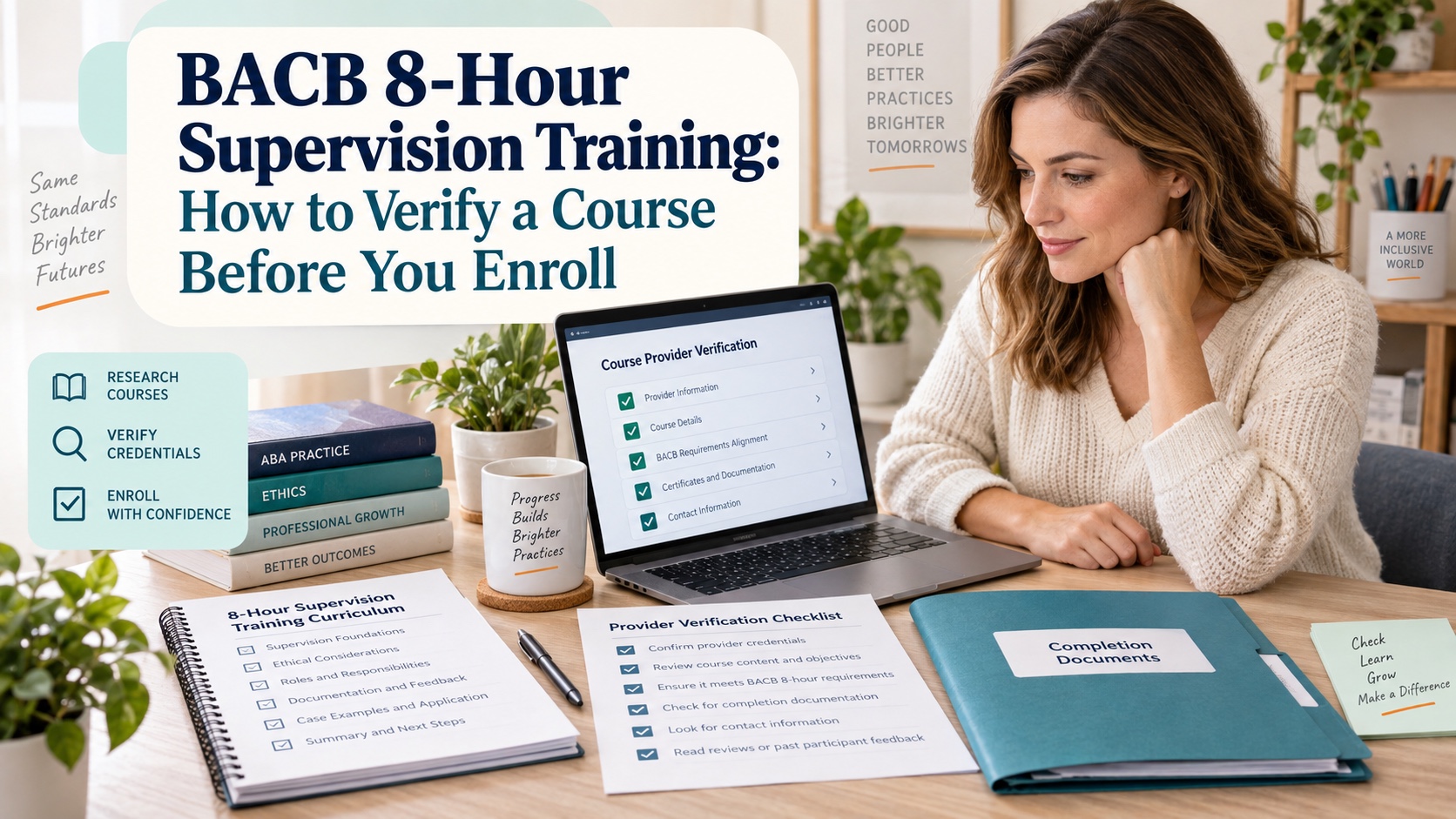
BACB 8-Hour Supervision Training: How to Verify a Course Before You Enroll
If you are searching for BACB 8-hour supervision training, you may be comparing online courses, checking whether a certificate will count, or trying to understand what “BACB-approved” means on a sales page. The safest starting point is not the course title. It is a short verification process that connects the offer to the current BACB supervision guidance, provider registry, curriculum outline, and documentation requirements.
This guide helps you decide what to check before enrolling. It does not endorse a commercial provider. It also keeps an important boundary visible: completing an eight-hour training is one evidence step in a supervision qualification process; it does not automatically make a person eligible to supervise every learner, worker, or client.
Quick answer: what a legitimate course should make clear
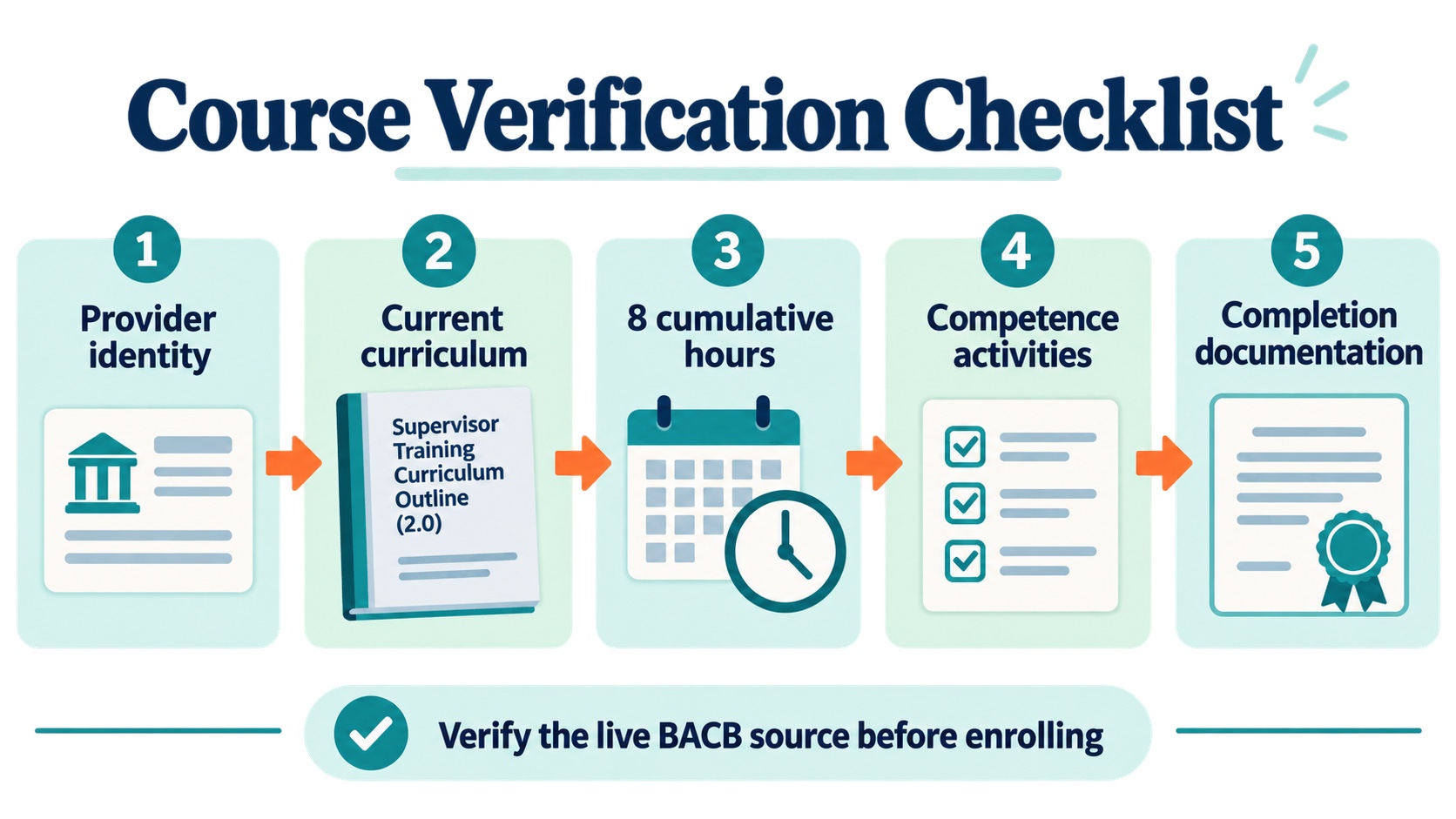
A course marketed for BACB 8-hour supervision training should clearly identify the provider, connect its content to the current Supervisor Training Curriculum Outline (2.0), state that the training reaches at least eight cumulative hours, explain how learners demonstrate verbal or practical competence, and describe the completion documentation. For the current provider route, verify the provider through BACB’s live Authorized Continuing Education Provider material and registry rather than trusting a logo or a phrase such as “BACB-approved.”
It should also tell you what it is not. A general ABA webinar, a certificate of attendance, a set of supervision CEUs, or a free video playlist may be useful learning, but those labels alone do not establish that the offering satisfies the current supervision-training path. If a sales page avoids the provider’s identity, current curriculum version, evidence of participation, or documentation process, pause before paying.
The five checks to make before enrollment
Use these five checks in order. They are intentionally simple: the goal is to spot missing information before price, convenience, or a countdown timer makes the decision for you.
- Provider identity: Who is responsible for the training, and can you confirm that status in the current BACB provider material or registry?
- Current curriculum: Does the page name the Supervisor Training Curriculum Outline (2.0) and identify the version or date it follows?
- Eight cumulative hours: Does the course explain how the hours are counted, including any modules, activities, assessments, or attendance requirements?
- Competence activities: Does the learning design give you opportunities to demonstrate verbal or practical competence, rather than only watching videos?
- Completion evidence: What document will you receive, who issues it, what does it say, and how is it used in the BACB process?
These checks protect you from two opposite mistakes. You might pay for a course that is educational but not the documentation route you need. Or you might reject a legitimate online option because it does not look like an in-person class. Delivery format is only one variable; the provider, content, demonstrations, and evidence matter together.
How to verify the provider and curriculum
Start with the live BACB source
Open the BACB supervision and training page, then follow its current provider instructions. Use the Authorized Continuing Education Provider page and the ACE Provider Verification Registry to check the provider’s identity and current status. Save the provider name, course name, and the date you checked. A screenshot of a marketing page is not the same as verification in the live registry.
Also check whether the course is being offered through a route described in current BACB material, such as an approved provider arrangement or an applicable verified course sequence. Do not infer eligibility from a provider’s use of BACB colors, a BACB acronym in the course name, or a claim that an instructor is a BCBA. Instructor credentials can be relevant, but they do not by themselves answer the provider question.
Look for the current outline, not a vague promise
The training should identify the Supervisor Training Curriculum Outline (2.0). The current outline is more than a list of supervision vocabulary. It addresses the purpose and risks of supervision, preparation, supervision structures, performance feedback, competence evaluation, behavioral skills training, documentation, ethics, boundaries, and ending the relationship responsibly.
Ask for the documentation path in writing
Before paying, ask the provider three plain questions: What exact completion document will I receive? Does it identify the current training and completion date? What do I do with it after the course? The current BACB material describes a completion document and an upload/approval process. That is different from a generic attendance certificate or a marketing badge.
Ask a fourth question if the provider uses the word “CEU”: Is the offering the required eight-hour supervision training, ongoing supervision continuing education, or both as separate activities? The BACB ACE material treats these as distinct categories. A course that issues learning credit is not automatically the same as a course that meets the prerequisite for covered supervision.
What online delivery can and cannot prove
The current curriculum outline allows online or in-person delivery. That means online access is not, by itself, a disqualifier. It also means “online” is not, by itself, proof of compliance. Evaluate the learning design behind the format.
| Course-page claim | What it tells you | What you still need to verify |
|---|---|---|
| Self-paced video access | You can control when you view the lessons. | Whether the provider, current curriculum, duration, participation, and competence evidence fit the required route. |
| Certificate of completion | The provider plans to issue a record. | Who issues it, what the record identifies, and whether it is the current required completion documentation. |
| CEUs available | Some continuing-education credit may be available. | Whether the activity is the 8-hour supervision training or separate maintenance education. |
| BCBA instructor | The instructor holds a relevant professional credential. | Provider authorization, curriculum alignment, competence activities, and the learner’s role-specific eligibility. |
A useful online course makes participation and evidence legible. The exact activity can vary, so ask how you demonstrate learning and how that demonstration is recorded.
What course completion does—and does not—prove
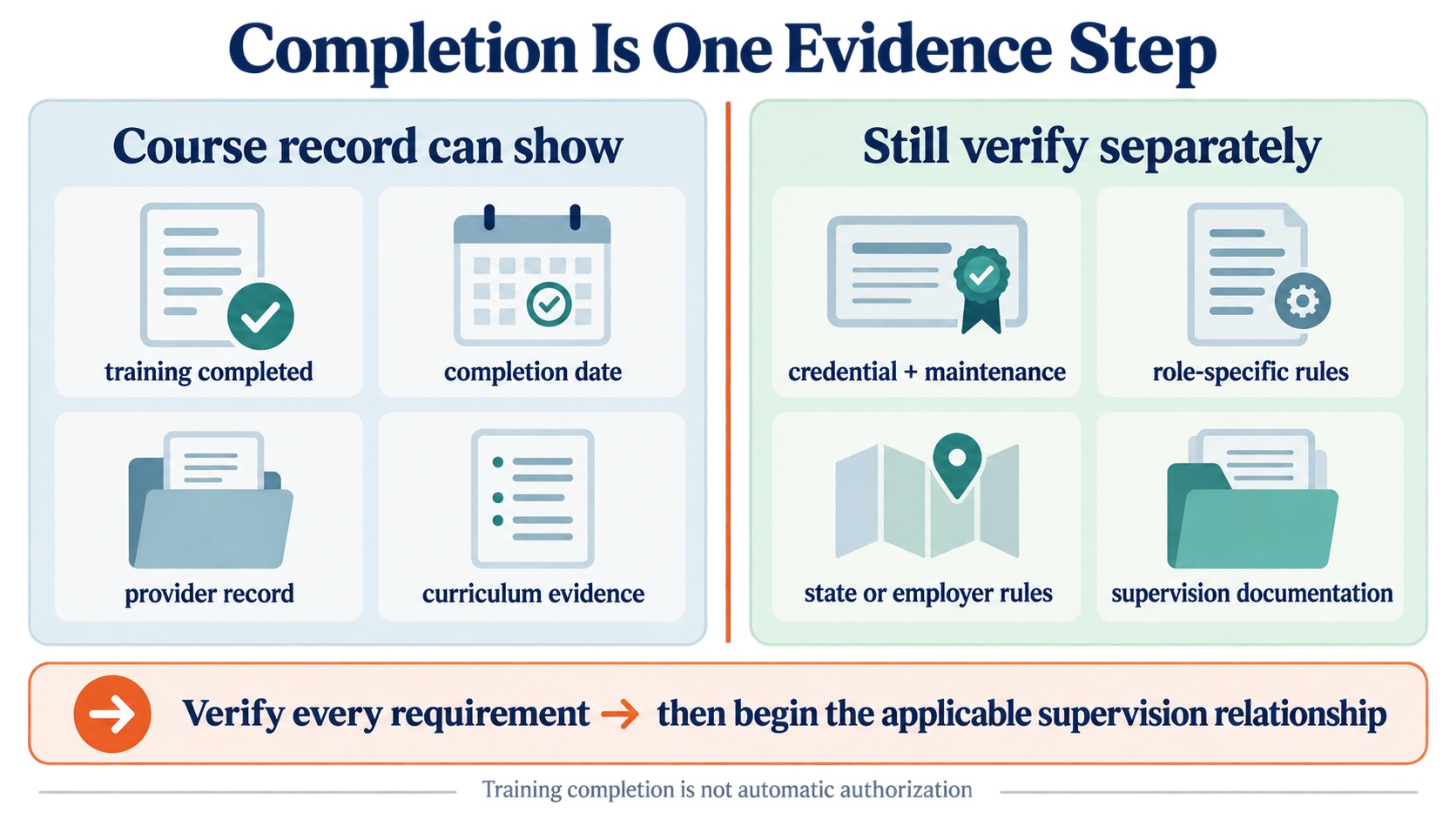
Finishing the course can give you an important record. It does not erase the rest of the supervision decision. The person, role, timing, credential, supervision relationship, and applicable BACB handbook still matter.
- It may document training: you completed the current course requirements and received the provider’s completion evidence.
- It does not create certification: the training does not replace the degree, coursework, fieldwork, application, examination, or maintenance requirements for BCBA or BCaBA certification.
- It does not create fieldwork: a training certificate does not give a trainee qualifying hours or make every workplace activity count.
- It does not replace supervision CE: ongoing maintenance education and initial supervision training must be tracked as separate categories.
- It does not replace state or employer rules: state licensure, organizational policy, client relationships, contracts, and documentation systems may add requirements.
- It does not authorize every role automatically: confirm whether you will supervise BCBA or BCaBA fieldwork, ongoing BCaBA supervision, RBT supervision, RBT assessment, or another activity with its own current rules.
The 2027 BACB transition is another reason to control the date and source version. The upcoming-changes page describes changes to BCBA and BCaBA eligibility and maintenance requirements beginning January 1, 2027. That does not make an older course page reliable for a future situation, and it does not mean a general summary can replace the live handbook. If your training, certification date, or supervision relationship crosses the transition, check the current BACB material again.
A pre-payment checklist
Copy these questions into an email or enrollment note. A clear provider should be able to answer them without asking you to guess what “BACB-approved” means.
- What is the legal or registered name of the provider, and where can I verify the current provider status?
- Which version of the Supervisor Training Curriculum Outline (2.0) does this course follow?
- How many cumulative hours are required, and how are modules, breaks, assessments, and participation counted?
- What activities let learners demonstrate verbal or practical competence?
- What exact completion document is issued, and does it identify the training, provider, learner, and completion date?
- Is this the required supervision training, supervision continuing education, or another educational product?
- What happens if the course or curriculum changes before I complete it?
- Which parts of my own supervisor eligibility must I verify separately?
Keep the answer, receipt, completion document, course version, and verification date together. Good recordkeeping will not turn an ineligible course into an eligible one, but it makes later questions easier to answer and helps you notice when a provider’s public information has changed.
Common red flags
- “BACB-approved” with no provider identity: ask for the registered provider name and verify it independently.
- Eight hours defined only as video runtime: ask how participation and competence demonstrations work.
- A certificate described as a license or authorization: a course record is not a credential or state license.
- CEUs and initial training blended together: request separate descriptions and separate records.
- An old outline or undated course page: ask which current version is used and check the live BACB source.
- A pass or supervision guarantee: no training provider can remove the role-specific, credential, state, employer, and documentation checks that remain.
FAQ
Is BACB itself the provider of every 8-hour course?
No. Do not treat the BACB name in a course title as proof that BACB is the provider. Use the current BACB supervision page and provider registry to verify who is responsible for the offering and what route the course uses.
Can BACB 8-hour supervision training be online?
The current Supervisor Training Curriculum Outline (2.0) allows online or in-person delivery. Online format still needs the applicable provider, curriculum, duration, competence, and documentation checks.
Does every eight-hour ABA course count?
No. The number of hours is not enough. The course must be connected to the applicable current training route and evidence requirements. A general ABA course can be useful for learning without being the formal supervision-training record you need.
Does completion automatically allow me to supervise?
No. Completion is one requirement or evidence step. Confirm the role-specific handbook, credential and maintenance status, timing, supervision relationship, documentation system, and state or employer rules before beginning.
Is ABA Study Online an ACE Provider for this training?
No. ABA Study Online is independent study support. It is not an ACE Provider and does not issue BACB supervision-training certificates or CEUs. Use the official BACB provider material for the training route, and use our learning resources only as supplementary study support.
Sources and next steps
Start with the current official sources, not a provider’s marketing summary:
- BACB Supervision, Assessment, Training, and Oversight
- BACB Authorized Continuing Education Providers
- BACB ACE Provider Verification Registry
- Supervisor Training Curriculum Outline (2.0), Version 05/2026
- BACB ACE Provider Handbook
- BACB Recent and Upcoming Changes to Requirements
- Competency-based, ethical, and socially valid supervision literature
- BCBA learning resources
- What the 8-hour supervision training requirement means
Want structured study support while you verify your training path?
Explore ABA Study Online’s free BCBA learning resources and app-based practice for independent review. ABA Study Online is not an ACE Provider and does not issue supervision-training certificates or CEUs; always verify the formal training route with the current BACB sources above.