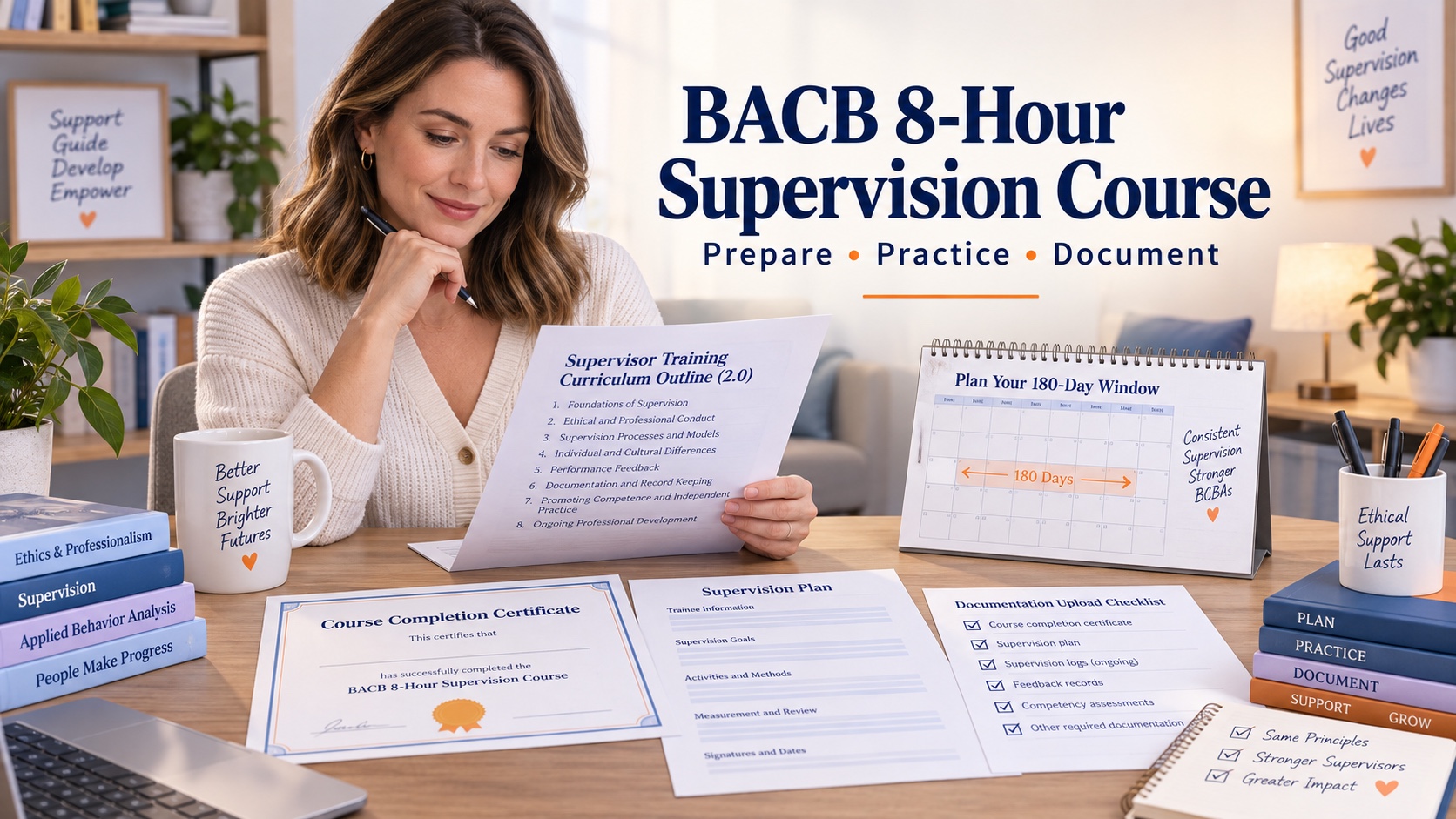
BACB 8-Hour Supervision Course: What the Training Must Cover
The BACB 8-hour supervision course is training based on the Supervisor Training Curriculum Outline (2.0). It is designed for people who will supervise BCBA or BCaBA fieldwork trainees and for people who will supervise current BCaBA or RBT certificants who require ongoing supervision. The training must be completed before providing the applicable supervision, but completing a course does not by itself answer every role, credential, state, employer, or client-specific requirement.
That last distinction matters when you compare course pages. A course may advertise “8-hour BACB supervision training,” but you still need to verify the provider route, the current curriculum version, the total duration, the learning activities, the documentation, and the timing. The BACB curriculum outline also requires the training materials to say that the program is based on the outline but offered independently of the BACB.
Table of Contents
What is the 8-hour supervision training for?
The purpose is to build the knowledge and practical judgment needed for an effective supervisory relationship. The current curriculum outline includes learning objectives, tasks, and considerations related to supervision. That can include creating clear communication, supporting procedural fidelity, teaching conceptual skills with applied examples, developing problem-solving and decision-making skills, modeling ethical and professional behavior, monitoring progress, and giving useful feedback.
This is broader than watching eight hours of slides. The outline says training activities must include opportunities for learners to demonstrate verbal or practical competence in the curriculum areas. A course that only gives passive video time and a completion button may not provide the same evidence as a course that asks you to practice feedback, discuss a supervision decision, analyze a case, or demonstrate a planning skill.
Who needs it before supervising?
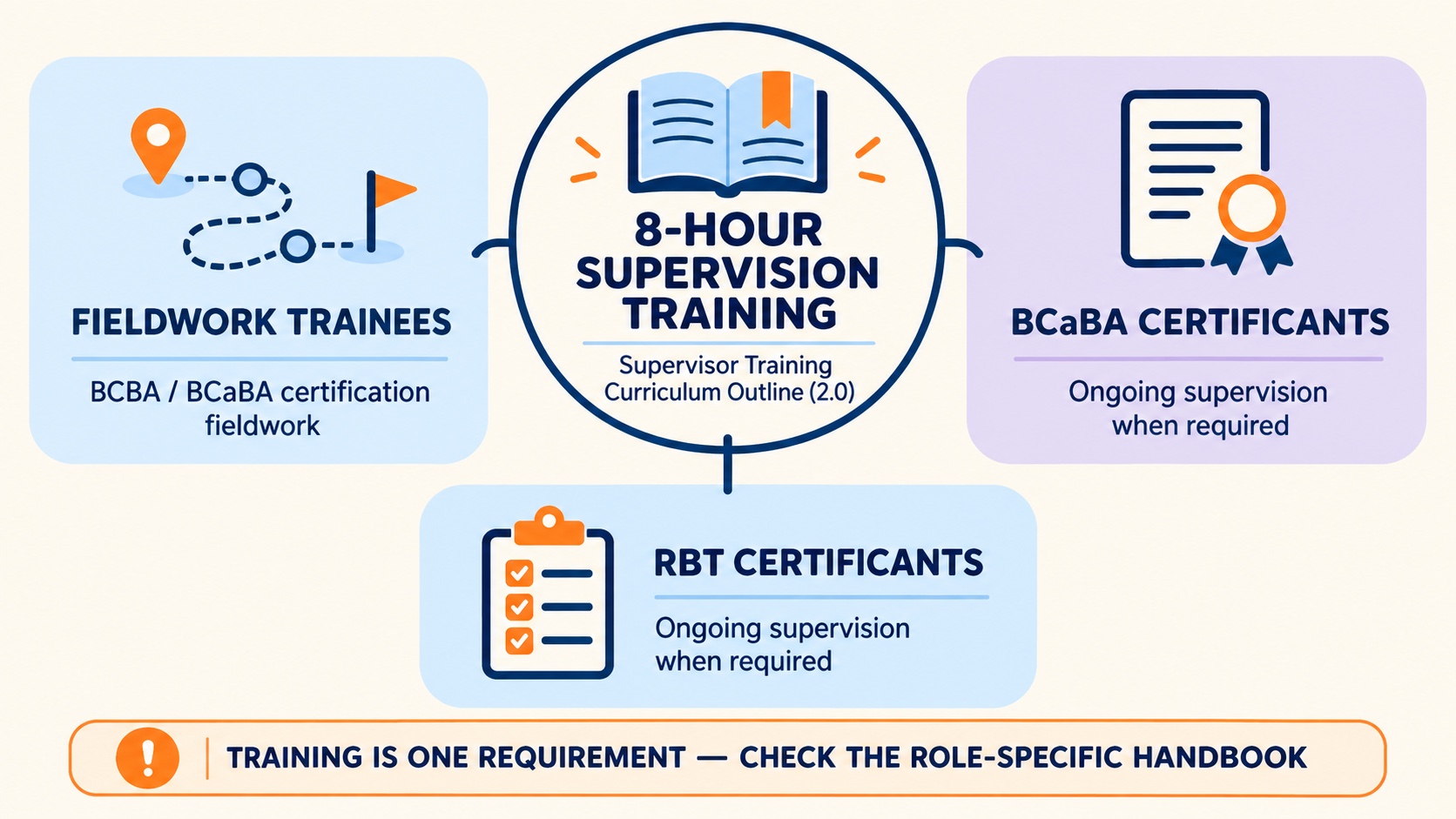
The BACB’s current supervision page describes several roles. The 8-hour supervision training is required before supervisors oversee:
- BCBA or BCaBA fieldwork trainees: people accruing supervised fieldwork toward certification;
- BCaBA certificants: when the supervision relationship is required under the BCaBA rules; and
- RBT certificants: when ongoing supervision is required under the RBT system.
Role qualifications still come from the relevant handbook. For example, the BACB supervision table identifies BCBA roles for supervising fieldwork, BCBA or BCaBA roles for some RBT responsibilities, and additional conditions for supervising BCaBAs. The course is one requirement in a larger system; it does not convert an otherwise unqualified person into a supervisor.
What must a qualifying course include?
Use the current curriculum outline as your course-selection checklist. The current outline says:
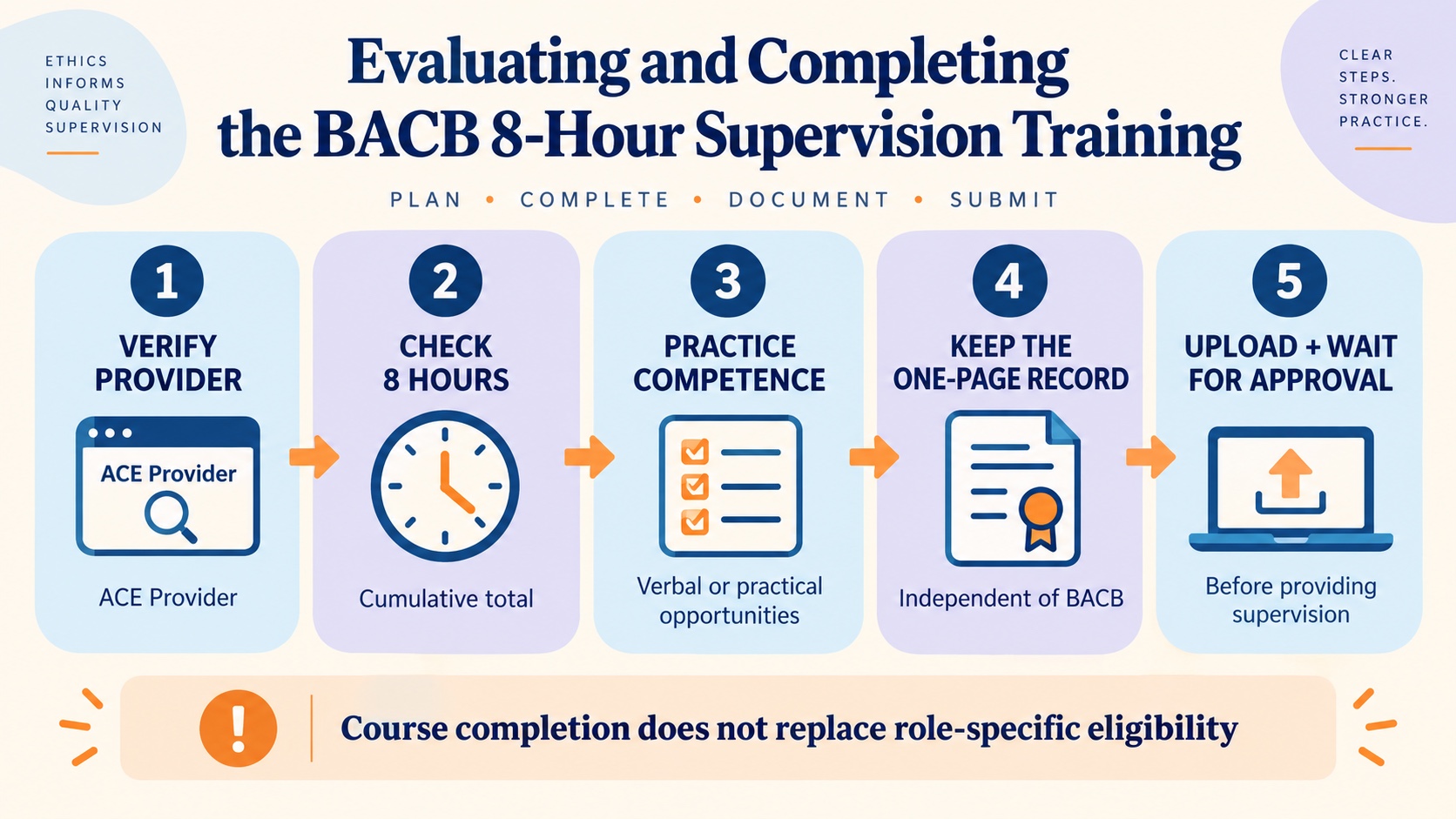
- At least eight cumulative hours: the total duration must be at least 8 hours, although the training may be offered in units as brief as 1 hour.
- Competence opportunities: activities must give learners opportunities to demonstrate verbal or practical competence in the curricular areas.
- A current curriculum link: the training must include a link to the Supervisor Training Curriculum Outline (2.0).
- Independent-training wording: the training materials and documentation must include the statement that the program is based on the outline but is offered independent of the BACB.
- Recognized provider route: the current outline says ACE Providers are eligible to offer supervision training based on it. Verify the provider in the current ACE Provider Verification Registry.
The required wording is important because it stops a course from implying that the BACB itself delivered or endorsed the program: “This training program is based on the BACB Supervisor Training Curriculum Outline (2.0) but is offered independent of the BACB.” A course may be excellent and still be independent of the BACB.
How should you compare course pages?
Put the course pages side by side and compare the details that affect your next action. Does the provider identify itself clearly? Can you find the provider in the ACE registry? Does the page name the current Supervisor Training Curriculum Outline (2.0), state at least eight cumulative hours, and explain how learners demonstrate verbal or practical competence? Does it tell you what you receive at completion and how the document is uploaded?
Also separate a course’s learning promise from its authorization promise. “Learn effective supervision” describes the educational value. “You may supervise immediately” is a compliance conclusion that the course provider may not be able to make for your individual credential and role. A careful course page tells you what it provides, what it documents, and which official BACB rules you must still check. That transparency is more useful than a badge or a broad claim that the course is “BACB approved.”
Can the course be online?
Yes. The current curriculum outline permits in-person or online delivery. Online does not mean “less official,” and in-person does not mean “automatically qualifying.” The question is whether the course meets the current duration, curriculum, competence-opportunity, provider, and documentation requirements.
Before registering for an online course, confirm whether it is live, asynchronous, or a combination; how the provider records participation; how verbal or practical competence is demonstrated; and what document you will receive. A course catalog that gives only a topic title and a number of hours is not enough information for a careful decision.
What documentation is required?
The current outline says an ACE Provider must give the learner a one-page document showing completion of the full training, consistent with the ACE Provider Handbook’s documentation requirements. The learner must upload that documentation into their BACB account. After the documentation is approved and all other supervision-eligibility requirements are met, the learner may begin providing supervision.
Keep the document with the course title, provider, completion date, total duration, and any details needed to identify the training. Save the curriculum link and the course description too. If the provider changes its website, your own record should still show what you completed and what version of the requirement you checked.
Can you supervise immediately after finishing?
Not automatically. Completion is not the same as approval in the BACB account, and approval is not the same as satisfying every role-specific supervision condition. The current outline says the documentation must be uploaded and approved before the learner may begin providing supervision. The relevant handbook may also require a particular credential, active status, a relationship with the organization or client, public identification in the BACB portal, or additional supervision CE.
The outline also says the training may be completed up to 180 days before the learner’s original BACB certification date. Because this timing language is sensitive to the learner’s credential and transition status, confirm the current outline and applicable handbook rather than treating “180 days” as a universal expiration rule. A course certificate does not replace the current BACB eligibility check.
What course-selection mistakes should you avoid?
- Searching only for “BACB-approved.” The current language is based on the BACB outline but offered independently. Do not rely on a marketing phrase that suggests BACB delivered or endorsed the course.
- Counting eight clock hours without competence practice. The outline requires opportunities for verbal or practical competence, not just passive viewing.
- Ignoring the provider check. Use the current ACE Provider Verification Registry and compare the listing with the course page and certificate.
- Assuming completion grants every supervision role. Read the BCBA, BCaBA, or RBT handbook that governs the supervisee and service relationship.
- Starting supervision before documentation approval. Upload the required document and confirm the rest of the eligibility conditions first.
- Using an old curriculum version without checking. The current 2.0 outline and live BACB supervision page control the workflow.
For related role study, use the ABA Study Online BCBA learning path, BCaBA learning path, and RBT learning path. These can support concept learning and preparation, but they are not a substitute for the required 8-hour training, BACB documentation, or individualized supervision guidance.
8-hour supervision course FAQ
Is the BACB 8-hour supervision course an official BACB course? No. The course is offered independently by an eligible provider and is based on the BACB Supervisor Training Curriculum Outline (2.0). The required course language should make that boundary clear.
Can I take it online? Yes, the current curriculum outline permits online or in-person delivery. Check how the provider demonstrates competence and documents completion.
Who needs the training? It is required before certain supervision roles involving BCBA/BCaBA fieldwork trainees and current BCaBA or RBT certificants who require ongoing supervision. Role-specific handbook requirements still apply.
Can I supervise as soon as I finish eight hours? Not automatically. Upload the required documentation, wait for approval, and confirm all other credential and role conditions before providing supervision.
Can the training be divided into shorter sessions? The current outline permits a cumulative total of at least 8 hours and says units may be as brief as 1 hour, provided the full training and competence opportunities are met.