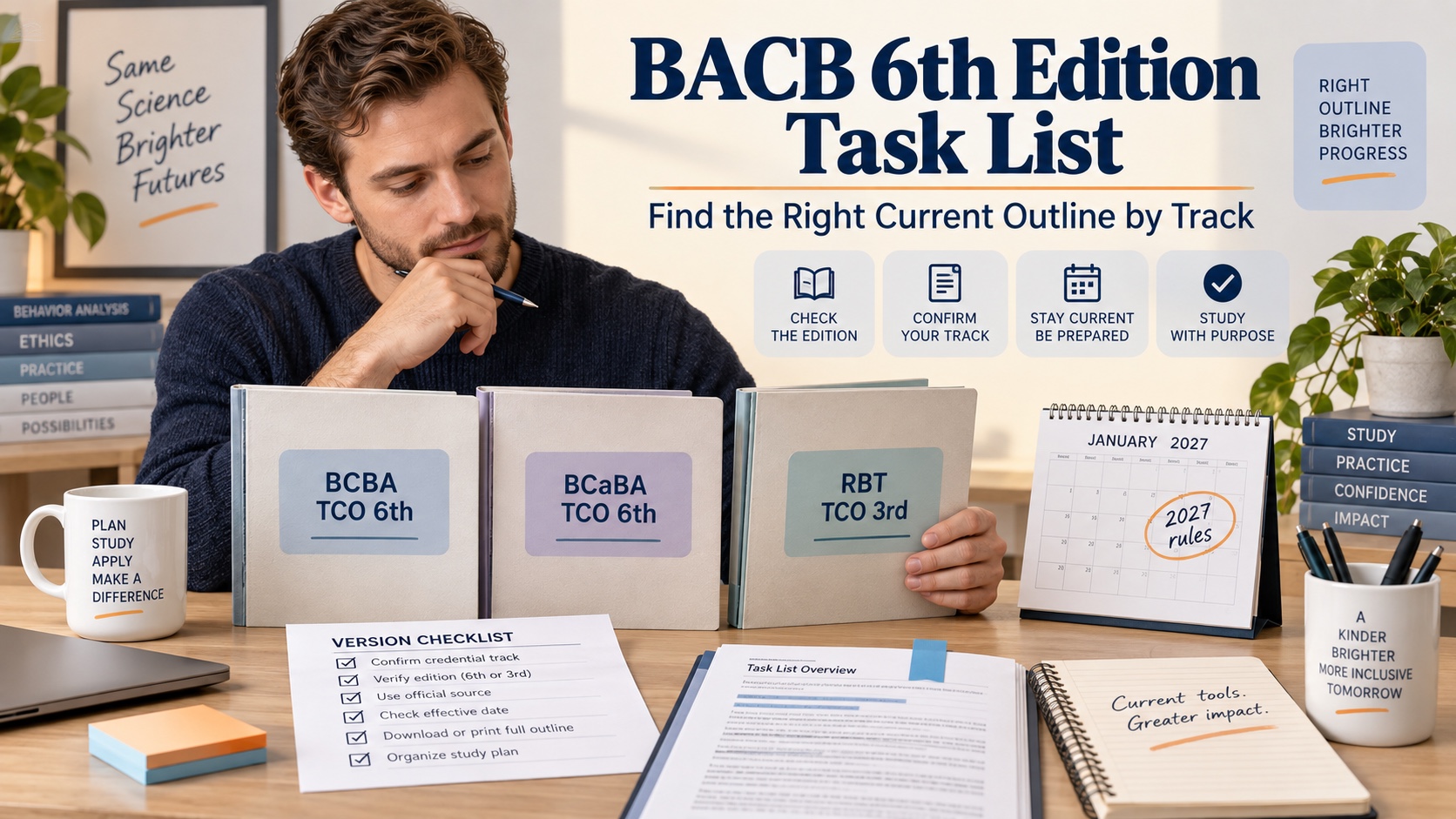
BACB 6th Edition Task List: Find the Right Current Outline by Track
If you searched for the BACB 6th edition task list, you may be looking for one official PDF to cover every BACB credential. That is the first thing to correct: there is not one universal document called the BACB 6th edition task list. The current BACB index organizes examination blueprints by credential, and the edition is different for RBT than it is for BCBA or BCaBA.
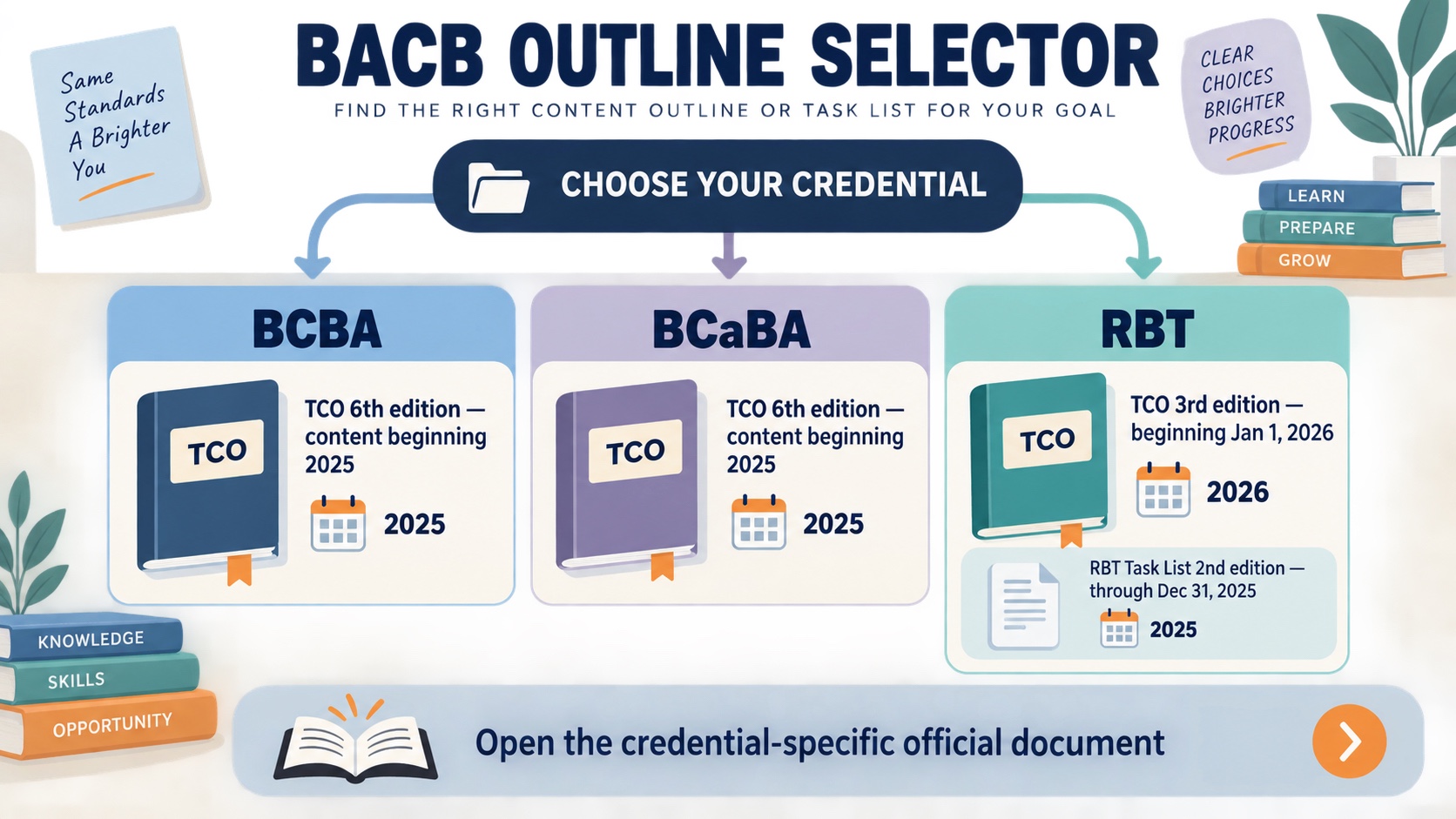
The quick version is simple. The current BCBA and BCaBA examination blueprints are Test Content Outlines (TCOs), 6th edition. The current RBT blueprint is the TCO, 3rd edition, beginning January 1, 2026. The older RBT Task List, 2nd edition, is listed through December 31, 2025. Choose your credential first, then open the matching source.
This guide helps you find and verify the right document before you study. It is independent educational information, not a BACB publication, an official question bank, an eligibility decision, or a promise of examination results.
Quick answer: Open the BACB’s Test Content Outlines for BACB Certifications page. Select RBT, BCaBA, or BCBA. Confirm that the credential and edition in the document title match your exam track, then check the beginning date before saving the file. If you are studying for BCBA or BCaBA, the current edition is 6th. If you are studying for RBT in 2026, the current edition is 3rd.
BACB outline selector
The word “task list” is still common in searches and in older study materials. The current official index uses Test Content Outline for the current examination blueprints. Think of the selector below as a version check, not as a substitute for opening the official document.
| Credential | Current official document | Beginning boundary |
|---|---|---|
| BCBA | BCBA TCO, 6th edition | Examination content beginning in 2025 |
| BCaBA | BCaBA TCO, 6th edition | Examination content beginning in 2025 |
| RBT | RBT TCO, 3rd edition | Beginning January 1, 2026 |
BCBA and BCaBA share the 6th-edition label, but they are separate documents with different tasks, role expectations, and examination maps. RBT is not a smaller copy of either one. The track-specific document is the source that should control your notes.
Task list, TCO, and handbook: what is different?
These phrases often appear next to one another in search results, but they are not interchangeable. A task list or TCO is primarily about examination content. It groups the knowledge and skills into domains and tasks so that a credentialing examination can be built around a current job-task analysis. A handbook is broader: it explains certification pathways, applications, examination appointments, maintenance, and the rules that apply to candidates or certificants.
The distinction matters when a page says “requirements.” If you want to know what topics the examination assesses, start with the TCO. If you want to know whether your education, fieldwork, application, or maintenance activity meets a current requirement, open the relevant handbook or official requirement page. A TCO cannot answer a personal eligibility question, and a handbook is not a replacement for the examination blueprint.
The same separation protects your study notes. Put the TCO link and edition on the first page of your exam notebook. Keep policy or application notes in a separate section with the date you checked them. When you later hear that a rule changed, you can update the correct section without rewriting your understanding of the exam domains.
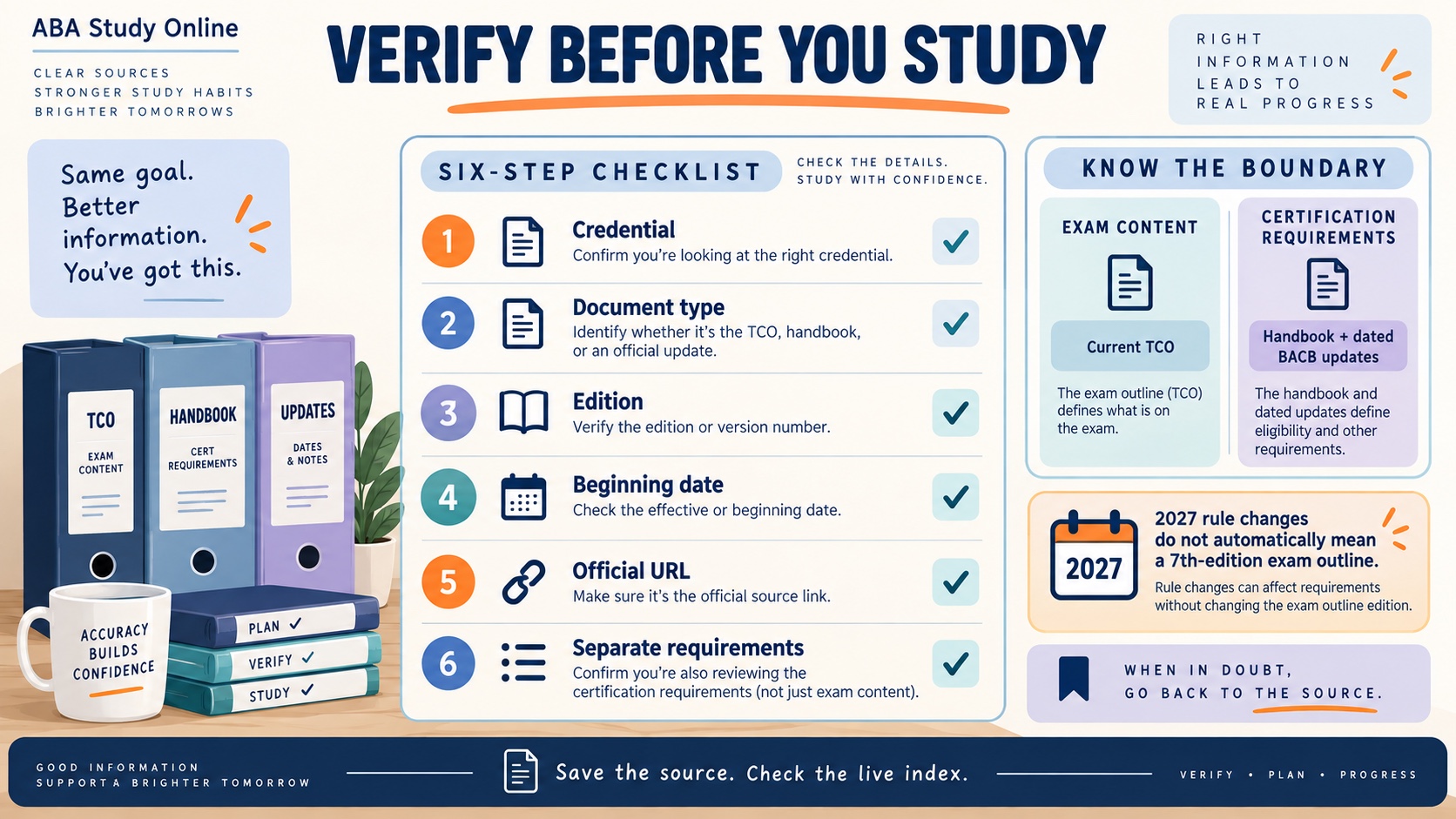
How to verify the document before you study
A PDF can look polished and still be the wrong version for your track. Before you build flashcards or buy a study resource, take one minute to check five details.
- Credential: Does the title say BCBA, BCaBA, or RBT? “BACB” by itself is not enough.
- Document type: Is it a Test Content Outline, a handbook, or a requirements page? These documents answer different questions.
- Edition: Does the edition match the current index? Do not copy an old task list into a new track folder.
- Beginning date: Does the document say when its examination content applies? Keep that date beside the file name.
- Source URL: Can you return to the official BACB page if a rule or version changes?
Use a simple file name such as BCaBA-TCO-6th-edition-check-2026.pdf or RBT-TCO-3rd-edition-beginning-2026.pdf. The point is not the exact file name. The point is to keep credential, edition, and date visible so an old download does not quietly become your study authority.
Then compare your saved file with the live index once in a while. The BACB notes on its current pages that documents and requirements can change. A saved PDF is useful for a study session, but the live official page is the better source when you are checking a current administrative rule.
How to use a TCO as a study source
A Test Content Outline is an exam map. It names content areas and tasks, but it does not teach every concept, provide official questions, or decide whether your coursework, fieldwork, or application meets certification requirements. Use it to organize learning, then bring in instruction, examples, practice, and feedback.
For example, if your BCaBA TCO includes a measurement task, do not stop after highlighting the task sentence. Turn it into a small study card with four parts:
- What behavior dimension or data feature is being described?
- Which measurement procedure fits the scenario?
- What can the resulting data support, and what can it not support?
- What would a plausible but incorrect answer confuse?
This method works across tracks, but the task wording and role boundary still come from the selected outline. A BCBA learner may be asked to design or evaluate a procedure, while a BCaBA or RBT learner may be working from a different task and supervision context. Shared vocabulary does not erase credential-specific expectations.
For a deeper comparison of the BCBA and BCaBA 6th-edition maps and the RBT transition, see the related BACB Task List 6th Edition guide. That page owns the broad cross-track explanation. This page is the document-finder: return here when you need to confirm which official file to open.
Build a one-page source record
Before you begin a large study project, make a one-page source record. Write the credential, document title, edition, beginning date, official URL, and the date you checked the page. Under that, add three short lines: “What this document covers,” “What it does not cover,” and “What I will use next.” For example, the first line might say “BCaBA examination content map”; the second might say “not eligibility approval or official questions”; and the third might point to a training chapter, an original practice set, or a supervision discussion.
This record is especially useful if you are comparing tracks or studying while requirements are changing. It creates a small audit trail for your own learning: you can see which edition guided a note, whether a source was official, and whether a later question belongs in the TCO folder or the requirements folder. That is a more reliable habit than downloading several files with similar names and hoping the newest one is obvious.
Where 2027 changes fit
Many learners are asking about 2027 because BACB eligibility, coursework, fieldwork, and maintenance information is changing. That is a requirements question, not automatically an exam-outline question. A new date in a certification requirement does not prove that a BCBA or BCaBA TCO has become a 7th edition.
Keep two separate folders in your notes:
- Exam content: the current TCO for your credential.
- Certification requirements: the current handbook, application instructions, fieldwork rules, maintenance information, and dated BACB change notices.
When a future BACB announcement changes the exam outline, update the first folder from the official TCO index. When it changes eligibility or maintenance, update the second folder. This separation prevents a 2027 requirement transition from being mislabeled as a 7th-edition content outline.
Common mistakes
- Searching only for “BACB 6th edition PDF.” Add the credential to the search and check the official index.
- Using BCBA materials for a BCaBA exam without checking tasks. Similar terms do not mean identical blueprints.
- Calling the current RBT outline 6th edition. RBT uses the 3rd-edition TCO beginning in 2026.
- Confusing a TCO with a handbook. The TCO maps exam content; the handbook explains certification and examination processes.
- Assuming a new 2027 rule equals a new exam edition. Look for a specific BACB examination-outline announcement.
- Treating a task list as a question bank. It is a blueprint, not a source of official or recalled questions.
FAQ
Is there one BACB 6th edition task list?
No. The current official index lists separate BCBA and BCaBA 6th-edition TCOs. RBT has a 3rd-edition TCO beginning in 2026.
Which 6th edition should I download?
Download the document whose title matches your credential. BCBA learners need the BCBA TCO; BCaBA learners need the BCaBA TCO. Do not choose based only on a search-result snippet.
Is the TCO enough to pass?
No. It is a content map. Use it with training materials, examples, original practice, feedback, and current BACB documents. It does not guarantee examination performance.
Where can I learn the full difference between tracks?
Start with the related cross-track TCO comparison, then use the relevant BCBA, BCaBA, or RBT learning path.