BACB 5th Edition Task List: What It Means and What to Use Now
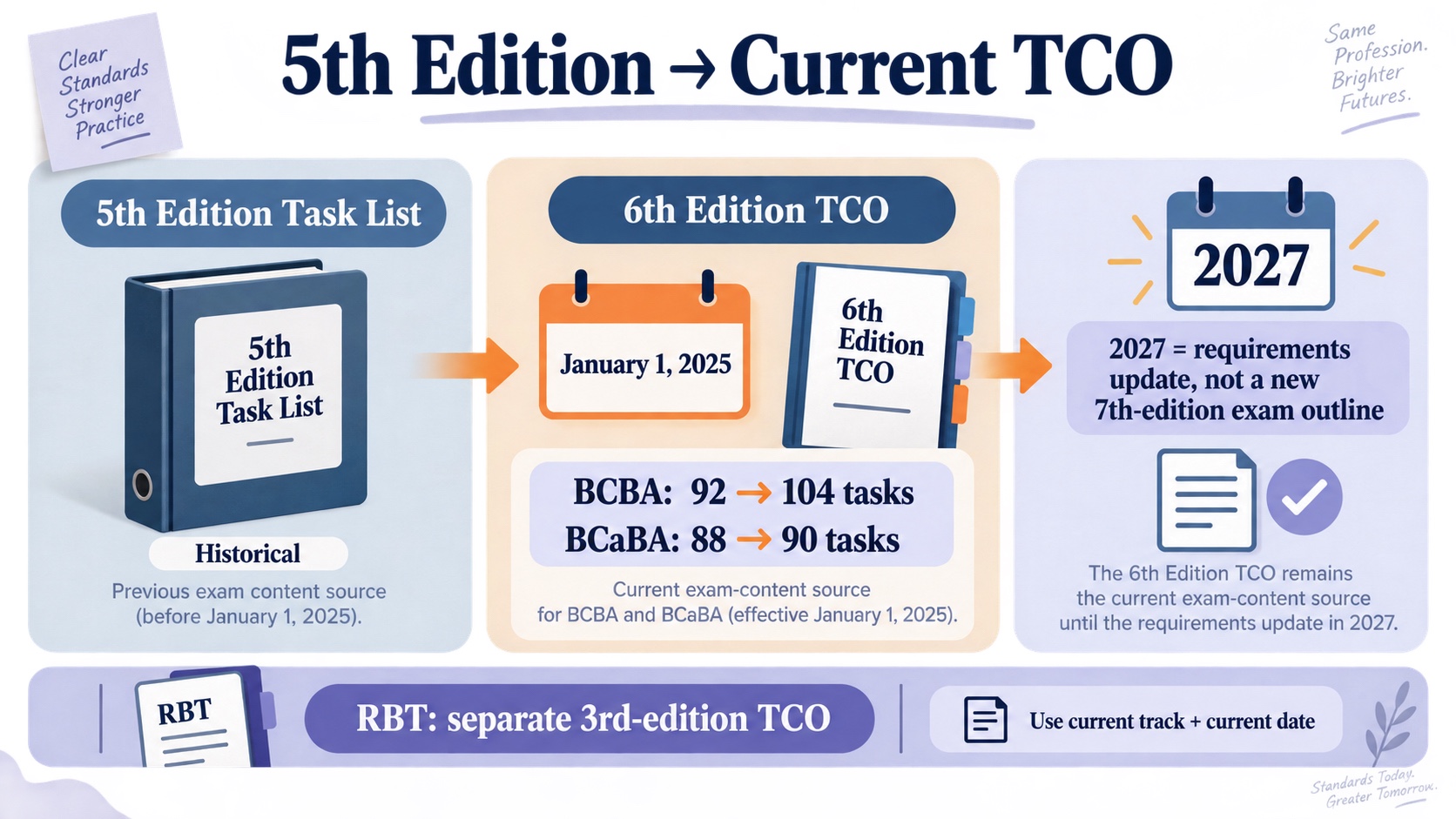
If you are searching for the BACB 5th Edition Task List, you may be looking at older class notes, a legacy supervision packet, or a study guide that has not been updated. The 5th edition matters because it was an important BACB exam-content source. It is not, however, the current BCBA or BCaBA examination outline in 2026. The BACB moved those examinations to the 6th Edition Test Content Outline (TCO) beginning January 1, 2025.
That does not mean every idea in an older book became useless overnight. It means you need a version check before you build a study plan, count a topic as covered, or buy a resource. This guide explains the historical label, the current replacement, the broad crosswalk, and the separate 2027 requirements issue.
Table of Contents
Is the 5th Edition Task List still current?
For current BCBA and BCaBA examination preparation, no. The BACB’s February 2022 newsletter states that the BCBA and BCaBA examinations began using their respective 6th-edition TCOs on January 1, 2025. The current BACB examination-information page links the BCBA and BCaBA 6th-edition TCOs. If you are preparing for an exam now, start with the TCO that matches your certification track and the examination information in effect for your application.
The 5th edition can still be relevant when you are reading an older transcript, comparing a legacy course, understanding a past fieldwork record, or translating old study notes. In those situations, treat it as historical context. Do not assume that an old task number, domain title, or question distribution is the current blueprint.
What the 5th edition was
The 5th Edition Task List described knowledge and skills associated with the BCBA and BCaBA certification examinations and related training. It used the familiar “Task List” label and organized content into domains such as concepts and principles, measurement, experimental design, ethics, assessment, behavior-change procedures, intervention, and supervision. The 5th-edition document is copyrighted BACB material, so a responsible study page should explain the version and link to official sources rather than reproduce its task statements.
One reason the phrase remains visible online is that many books, university syllabi, flashcards, and supervision forms were created while the 5th edition was the active reference. A page date or a product title does not tell you whether every explanation is obsolete. The safer question is: which parts are general ABA knowledge, and which parts depend on an old exam blueprint or old certification rule?
What changed in the 6th Edition TCO?
The BACB describes the 6th edition as a Test Content Outline rather than simply a Task List. The change is more than a new cover. The BACB newsletter explains that the content was reorganized, some statements were combined or separated, wording was revised, and the ethics content was made more specific. It also notes that diversity, equity, and inclusion content was integrated across multiple tasks.
| Track | 5th edition | 6th edition | Current exam boundary |
|---|---|---|---|
| BCBA | 92 tasks | 104 tasks | 6th-edition TCO beginning January 1, 2025 |
| BCaBA | 88 tasks | 90 tasks | 6th-edition TCO beginning January 1, 2025 |
| RBT | Separate track | Separate 3rd-edition TCO | Do not use the BCBA/BCaBA 6th edition for RBT study |
Task counts are a navigation clue, not a promise that a reader can convert one task into one exam question. The BACB also publishes the exam blueprint and uses scaled, equated forms. Use the current TCO and examination-information page for the content map, format, and scoring explanations.
How to use old notes safely
Old notes can be a starting point if you audit them instead of trusting the label. First, keep the general concepts that still make sense in current behavior-analytic training: measurement, data interpretation, experimental logic, assessment, behavior-change procedures, ethics, and supervision. Then mark every page that depends on a task number, domain title, question percentage, application pathway, or date.
Next, open the current TCO for your track and map your notes at the concept level. If a note says “Task G-12,” do not assume that the same number or wording appears in the 6th edition. Search for the concept, compare the current task statement, and check whether the topic moved to another domain. This is especially important for ethics, supervision, measurement, and intervention content.
Finally, replace the old exam blueprint and any old certification instructions. A 5th-edition study guide may explain an excellent example but still give you the wrong current task map, exam timing, or eligibility advice. Keep it as a supplemental explanation only after the current BACB sources are your controlling references.
How the 2027 changes fit in
The 2027 BACB updates are a separate issue. The BACB’s recent-and-upcoming-changes page describes revisions to BCBA and BCaBA eligibility and maintenance requirements effective January 1, 2027, including the discontinuation of pathways 3 and 4 for new BCBA applications. Those changes concern degrees, coursework, fieldwork, continuing education, supervision, and application planning. They do not mean that the BCBA exam has suddenly become a “7th Edition Task List.”
Keep four documents separate in your study folder: the current BCBA or BCaBA TCO, the examination-information page, the current certification handbook, and the 2027 requirements or transition guide if your application date crosses that boundary. The application rules and the exam-content outline answer different questions.
A current-version checklist
- Identify your track: BCBA, BCaBA, or RBT.
- Check the version date on every study guide, course outline, flashcard deck, and mock exam.
- Use the BACB current TCO directory to open the official outline for your track.
- Replace old task numbers and question distributions with current official information.
- Use a current handbook for eligibility, fieldwork, ethics, supervision, and maintenance rules.
- If you apply in or around 2027, read the transition guidance and record the application-date boundary.
- Do not copy or redistribute the copyrighted task list; use it through the official source and build your own concept notes.
For current study planning, the BCBA learning path, BCaBA learning path, and RBT learning path should be matched to the correct track. You can also use the ABA glossary for concept review, but neither a glossary nor an app replaces the current BACB source.
FAQ and official sources
Is the BACB 5th Edition Task List still used for the exam? It is a historical reference for current 2026 BCBA and BCaBA exam preparation. The BACB says those examinations began using their 6th-edition TCOs on January 1, 2025.
Is the 6th edition the same as a 7th edition? No. The 6th Edition TCO is the current BCBA/BCaBA exam-content version described by BACB sources. The 2027 changes are eligibility and maintenance updates, not an announced 7th-edition exam outline.
Can I still use a 5th-edition study guide? You can use it for general explanations after checking every version-dependent claim against the current TCO and handbook. Do not use its old task map or exam blueprint as your only current source.
Does the 5th-edition task list apply to RBT? Not as a BCBA/BCaBA exam outline. RBT is a separate certification track with its own current 3rd-edition TCO.
The simplest rule is: use the 5th edition to understand legacy materials, use the current track-specific TCO to study now, and use the 2027 transition documents for eligibility planning. That three-way separation keeps an old resource useful without letting it quietly control a current decision.