
BACB 2027 Fieldwork Requirements: BCBA and BCaBA Compared
The BACB 2027 fieldwork requirements are not one shared checklist for every behavior-analytic trainee. The numbers depend first on whether you are pursuing BCBA or BCaBA certification, and then on whether you use Supervised Fieldwork or Concentrated Supervised Fieldwork. The 2027 rules also change some supervision and documentation details, so an old tracker can quietly lead you to count the wrong thing.
This guide gives you the cross-track map: hours, supervision percentages, supervisory-period limits, client observations, individual supervision, unrestricted activity, and form selection. It is an educational overview, not a personal eligibility decision. The current BACB handbook, transition guidance, supervision contract, and application timing control your case.
Table of Contents
Short answer: what changes in 2027?
Beginning January 1, 2027, the BACB’s BCBA and BCaBA eligibility and maintenance requirements change. The fieldwork totals, supervision rates, monthly ranges, observations, unrestricted activity minimums, and verification forms must be read by credential track. The change is not just a new PDF layout.
For an applicant close to the transition, the date of the complete application matters. The BACB’s transition notice says complete applications, including payment and required documents, must be received by December 31, 2026 to be reviewed under the current 2022 requirements. If your records or application cross the boundary, do not decide which forms to use from a social-media summary or a tracker copied from another trainee.
The BCBA and BCaBA comparison
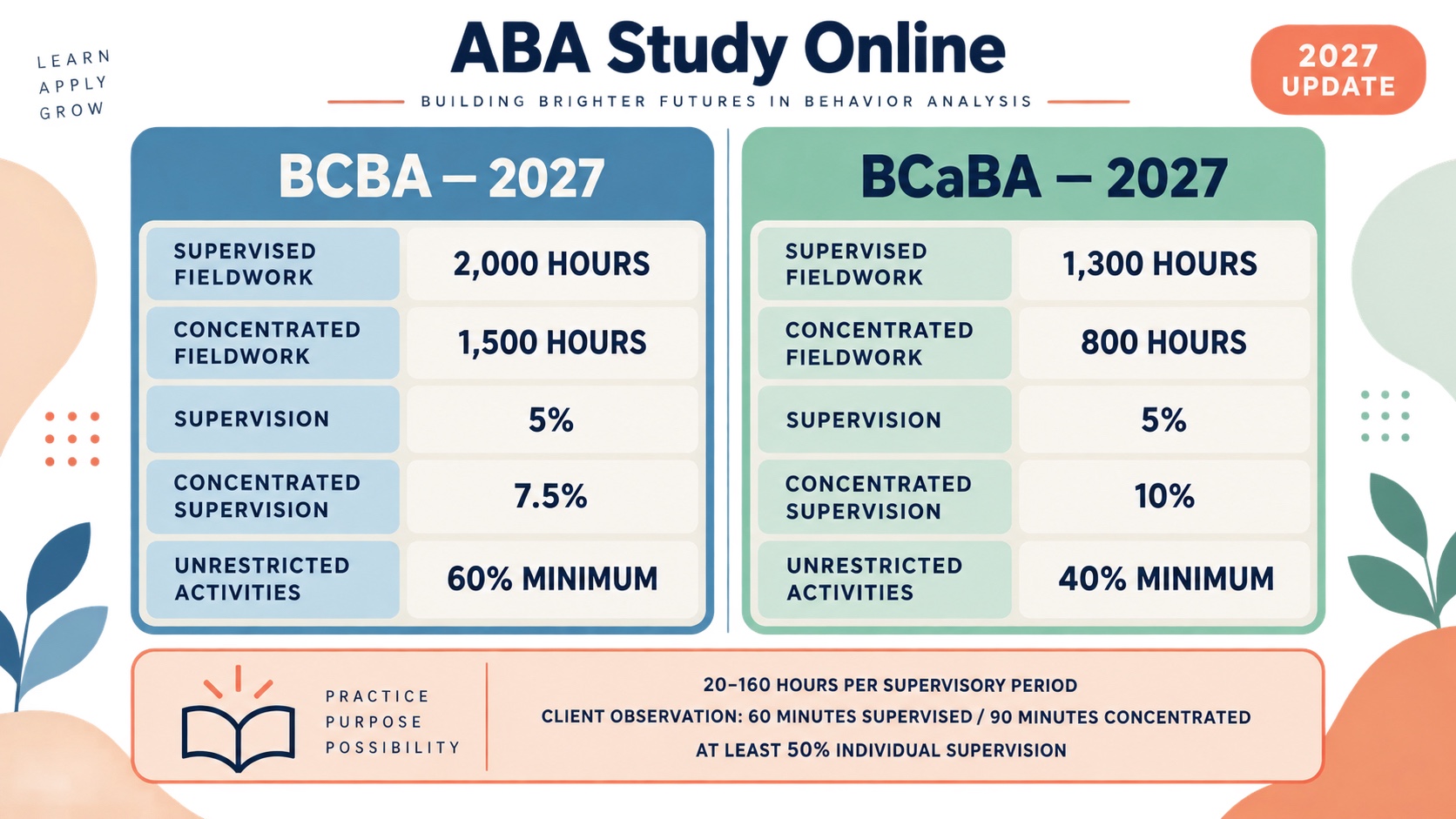
This table is the fastest way to see why the phrase “2027 fieldwork requirements” needs a track label:
| 2027 fieldwork item | BCBA | BCaBA |
|---|---|---|
| Supervised Fieldwork | 2,000 hours | 1,300 hours |
| Concentrated Supervised Fieldwork | 1,500 hours | 800 hours |
| Supervision rate | 5% supervised; 7.5% concentrated | 5% supervised; 10% concentrated |
| Hours per supervisory period | Minimum 20; maximum 160 | |
| Client observation | 60 minutes supervised; 90 minutes concentrated | 60 minutes supervised; 90 minutes concentrated |
| Individual supervision | At least 50% of supervised hours must be individual | |
| Unrestricted activities | At least 60% of total hours | At least 40% of total hours |
“Concentrated” is not simply a faster version of ordinary fieldwork. It is a separate fieldwork type with its own total-hour and supervision requirements. A trainee may use one or both fieldwork types when the applicable handbook allows it, but the calculation and documentation must remain clear.
2027 BCBA fieldwork requirements
For the 2027 BCBA eligibility requirements, the BACB overview lists 2,000 hours of Supervised Fieldwork or 1,500 hours of Concentrated Supervised Fieldwork. The supervision rate is 5% for Supervised Fieldwork and 7.5% for Concentrated Supervised Fieldwork. Each supervisory period must contain at least 20 hours and no more than 160 hours of fieldwork.
The supervisor must meet the applicable qualifications in the BCBA Handbook. The 2027 overview describes an active BCBA with no current disciplinary sanctions who has been certified for at least one year and meets the ongoing supervision CEU requirement, or an active BCBA certified for less than one year who receives monthly consultation from a qualified consulting supervisor.
Each supervisory period also includes a cumulative client observation: 60 minutes for Supervised Fieldwork or 90 minutes for Concentrated Supervised Fieldwork. At least half of the supervised hours must be individual supervision, and at least 60% of total supervised fieldwork hours must be unrestricted activities.
These figures do not answer every BCBA question. Degree pathway, behavior-analytic coursework, the examination, supervisor relationship, monthly documentation, and application timing remain separate requirements. Use the detailed BCBA fieldwork requirements guide for the BCBA-specific current and transition comparison.
2027 BCaBA fieldwork requirements
For the 2027 BCaBA eligibility requirements, the BACB overview lists 1,300 hours of Supervised Fieldwork or 800 hours of Concentrated Supervised Fieldwork. The supervision rate is 5% for Supervised Fieldwork and 10% for Concentrated Supervised Fieldwork. The same 20-hour minimum and 160-hour maximum apply to each supervisory period.
The 2027 BCaBA overview uses the same 60-minute cumulative client observation for Supervised Fieldwork and 90 minutes for Concentrated Supervised Fieldwork. At least 50% of supervised hours must be individual, and at least 40% of total supervised fieldwork hours must be unrestricted activities. The percentage is different from the 2027 BCBA percentage, which is why a shared spreadsheet formula can be dangerous.
The fieldwork numbers do not replace the BCaBA education or coursework pathway, application, examination, or maintenance rules. They also do not mean that BCaBA and BCBA fieldwork can be casually combined. Use the applicable BCaBA hours guide and BCaBA supervision resource alongside the current BCaBA Handbook.
Rules both tracks share
Although the numbers differ, the 2027 BCBA and BCaBA fieldwork frameworks share several planning habits:
- Use a qualified supervisor: confirm the supervisor’s certification, status, consultation condition when relevant, and role before counting hours.
- Stay inside the supervisory-period range: 20–160 hours is a monthly planning boundary, not permission to store unreviewed hours for later.
- Protect individual supervision: group supervision cannot exceed half of the supervised hours.
- Plan the client observation: the cumulative 60- or 90-minute requirement belongs to the applicable fieldwork type.
- Classify unrestricted work carefully: direct client activity is not automatically unrestricted, and a useful activity is not automatically eligible.
- Keep supporting records: a signed verification form is important, but an audit may also require the documentation system, supervision contract, logs, and other evidence.
Unrestricted activities are not defined only by the setting or job title. They are activities that build the kind of behavior-analytic work expected at the credential level, such as assessment-related work, data analysis, program development, caregiver or staff training, and other eligible activities described by the handbook. Ask the supervisor to review borderline entries before the month closes.
Which forms and handbook should you use?
For a 2027 application, use the 2027 Monthly and Final Fieldwork Verification Forms that correspond to your track and supervision structure. The BACB resources distinguish Individual Supervisor forms from Organization forms for multiple supervisors at one organization. The form family is not chosen just because it looks familiar; it should match the people, setting, and requirements that govern the fieldwork.
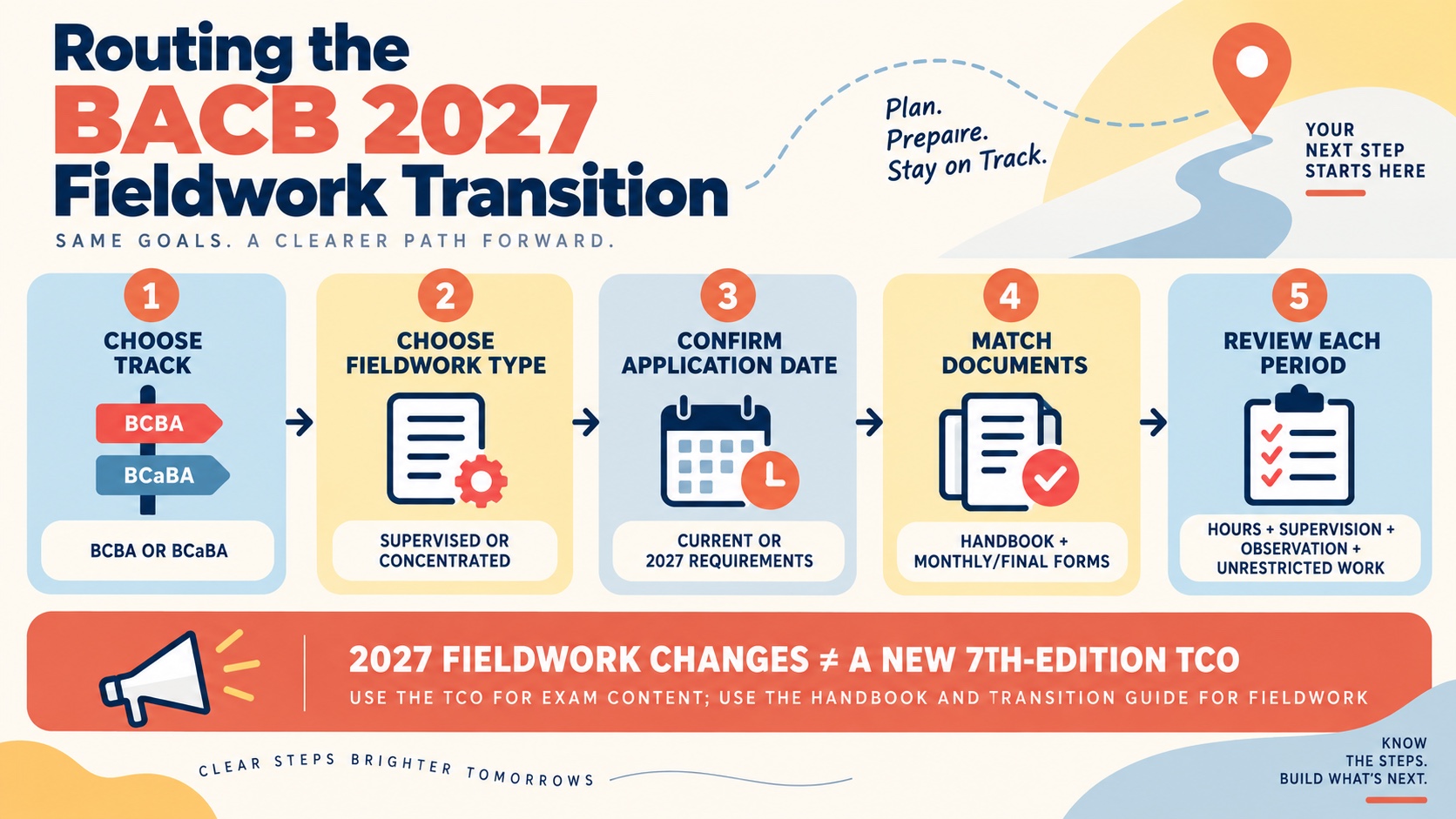
Use this document-routing sequence:
- Identify the credential: BCBA or BCaBA.
- Identify the fieldwork type: Supervised or Concentrated Supervised.
- Confirm the application transition: current 2022 rules or 2027 rules.
- Open the matching handbook and transition guide: do not use BCBA values for BCaBA or the reverse.
- Select the form family: Individual Supervisor or Organization, based on the actual supervision arrangement.
- Reconcile each supervisory period: hours, supervision rate, observation, individual supervision, unrestricted percentage, signatures, and supporting records.
The current 2027 monthly verification form guide can help you understand the paperwork boundary. It is still the BACB forms and handbook that control what you submit.
Is 2027 a new 7th-edition task list?
No. The 2027 fieldwork and certification changes should not automatically be described as a new “7th edition” examination outline. The official 2027 BCBA and BCaBA materials point to the BCBA and BCaBA Test Content Outline, 6th edition, for the examination content. Fieldwork eligibility and maintenance requirements are a separate rule set from the examination content outline.
That distinction matters for study planning. If you are studying for an exam, use the current TCO for your credential and exam date. If you are accruing fieldwork, use the applicable handbook, fieldwork requirements, transition guidance, forms, supervision contract, and documentation system. One source does not replace the other.
What if my fieldwork started before 2027?
Do not assume that starting fieldwork under one rule set automatically lets you finish under whichever rule set is more convenient. The BACB publishes transition guidance because application timing, completed records, and the requirements in effect at the time of application can interact. Your first task is to write down the date you expect to submit a complete application, including payment and required documents. Your second task is to identify whether your hours were accrued and verified under the current or 2027 structure. Your third task is to ask the supervisor to review the forms before you continue accumulating hours.
A transition review should compare more than the total. Check the fieldwork type, the supervisory-period range, supervision percentage, client observation minutes, individual-versus-group balance, unrestricted percentage, supervisor qualifications, and form version. Keep the old records intact; do not rewrite historical entries just to make a new spreadsheet total look clean. If the transition guidance does not resolve a personal question, use the BACB’s official contact process or the formal application review rather than guessing.
This is also why a track label belongs at the top of every tracker. “2027 fieldwork” is incomplete. Write “BCBA 2027 Supervised Fieldwork,” “BCBA 2027 Concentrated Supervised Fieldwork,” “BCaBA 2027 Supervised Fieldwork,” or the exact structure that applies. A precise label makes it harder to paste the 60% BCBA unrestricted target into a BCaBA sheet or the 10% BCaBA concentrated supervision rate into a BCBA sheet.
Common transition mistakes
- Using the BCBA table for BCaBA: the totals and unrestricted percentages differ.
- Using current 2022 forms for a 2027 application: confirm which requirements govern the application before collecting signatures.
- Assuming concentrated fieldwork means fewer supervision rules: it has its own supervision percentage and observation requirement.
- Counting 20–160 as a yearly range: it applies to the supervisory period described in the handbook.
- Calling every clinical task unrestricted: classification depends on the eligible activity and the applicable track.
- Calling 2027 the 7th edition: keep fieldwork requirements and examination content outlines separate.
- Waiting to reconcile records: missing observations, percentages, or signatures are harder to repair after the fact.
FAQ and official sources
How many BCBA fieldwork hours are required in 2027?
The 2027 overview lists 2,000 hours for Supervised Fieldwork or 1,500 hours for Concentrated Supervised Fieldwork, with different supervision percentages. The handbook and transition guidance control the details for your application.
How many BCaBA fieldwork hours are required in 2027?
The 2027 overview lists 1,300 hours for Supervised Fieldwork or 800 hours for Concentrated Supervised Fieldwork. BCaBA has its own supervision and unrestricted-activity requirements, so do not copy the BCBA table.
What percentage of fieldwork must be unrestricted?
The 2027 overview lists at least 60% for BCBA and at least 40% for BCaBA. Classify activities with the applicable handbook and supervisor rather than using the percentage alone.
What is the 2027 form change?
Applicants who fall under the 2027 requirements need the 2027 Monthly and Final Fieldwork Verification Forms that match the track and supervision structure. The BACB publishes Individual Supervisor and Organization versions.
Can one article or tracker decide if my hours count?
No. A website can explain the framework, but your supervisor, contract, records, handbook, transition guidance, and application review determine what you should count and submit.
Start with the official BCBA Handbook, BCaBA Handbook, 2027 BCBA Requirements, 2027 BCaBA Requirements, and the official transition notice. Then use ABA Study Online’s BCBA path or BCaBA path to organize study concepts without mixing the certification tracks.