Autistic RBT: Certification, Support, and Work Fit
Can an autistic person become an RBT? In the current BACB materials reviewed for this guide, autism is not listed as a general RBT eligibility requirement or as a blanket reason someone cannot pursue the credential. The more useful question is whether you can meet the current certification requirements, perform the essential duties of a particular job, receive effective supervision, and work in an environment that supports you without compromising client care.
That answer is intentionally more practical than a simple yes or no. Autism is not a single work profile. Some autistic RBTs may prefer predictable routines, written directions, or a quieter workspace; others may not need those supports or may need something different. The goal is not to guess what an autistic RBT can do. It is to identify the actual job demands and the conditions in which you can perform them well.
The quick answer
An autistic person may decide to pursue RBT certification if the person meets the current BACB requirements and can perform the role’s essential functions, with appropriate support when available and appropriate. A diagnosis by itself does not tell you whether a specific RBT position is a good fit. It also does not tell an employer whether you will be an effective technician.
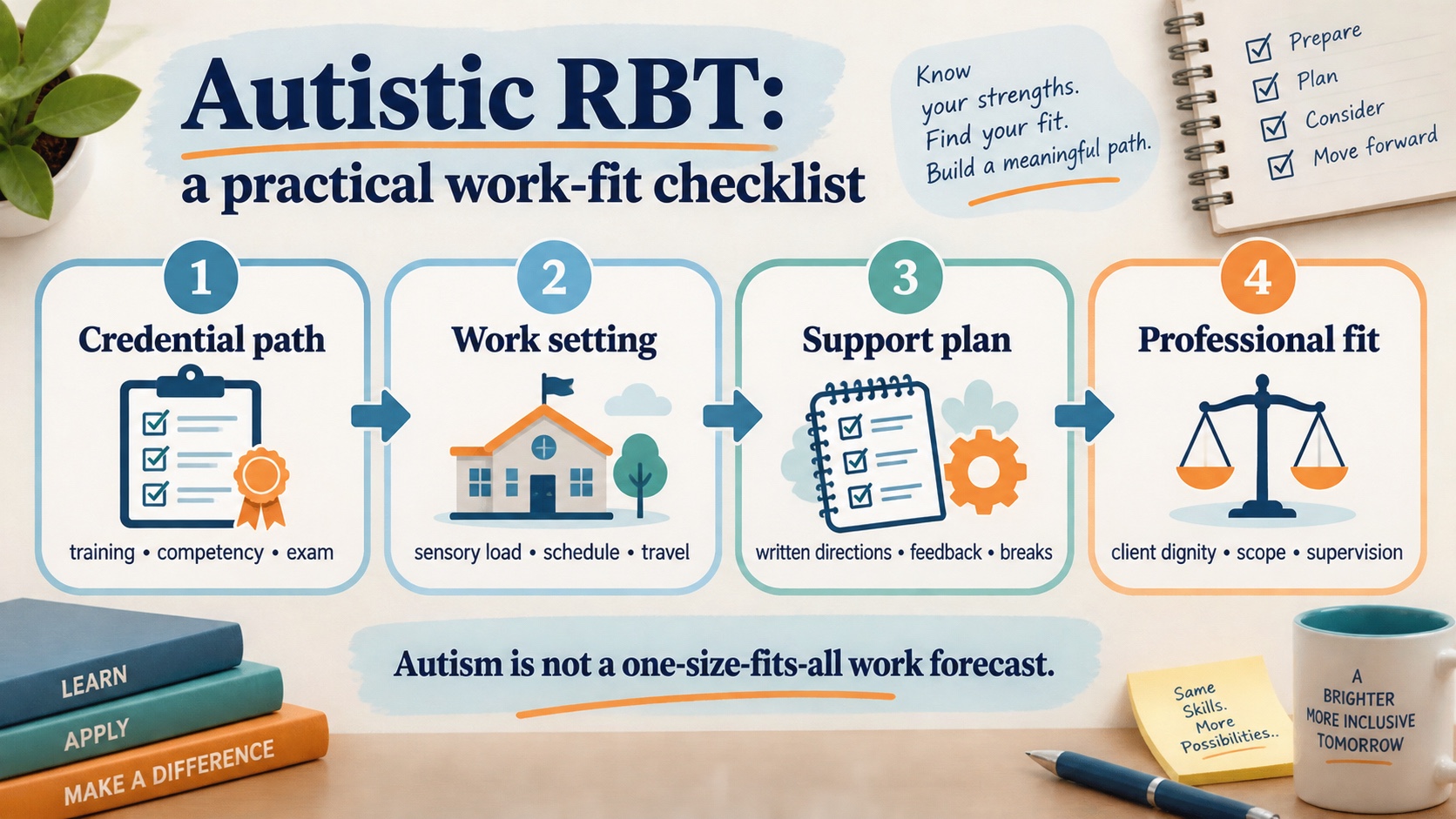
Separate three decisions that are often mixed together:
- Credential eligibility: Can you complete the training, competency assessment, application steps, background checks, and examination required by the current BACB pathway?
- Job performance: Can you carry out the assigned behavior-analytic duties, communicate important information, document sessions, and follow the behavior plan and safety procedures?
- Workplace fit: Does the employer offer supervision, scheduling, communication, and environmental conditions that make reliable performance realistic?
These questions are related, but they are not interchangeable. Passing an exam does not guarantee that a particular clinic, school, home-based schedule, or caseload will suit you. Conversely, needing a written instruction, predictable schedule, or another reasonable adjustment does not automatically mean you cannot do the job.
What the RBT credential actually requires
The BACB describes an RBT as a paraprofessional who delivers behavior-analytic services under the direction and close supervision of an RBT Supervisor and/or RBT Requirements Coordinator. The current handbook and RBT resource page are the right places to confirm the version of the requirements that applies to your application.
For a current applicant, the pathway generally includes meeting the stated eligibility conditions, completing the required training, completing the Initial Competency Assessment, applying, and passing the RBT examination. Certification also has ongoing responsibilities. The BACB handbook describes ongoing supervision and ethics responsibilities, and current maintenance requirements can change by certification or recertification date. Do not rely on an old blog post that treats a past transition rule as permanent.
None of these steps is replaced by personal experience, a strong interest in autism, or an assumption that an autistic applicant will naturally understand every autistic client. Those experiences may shape your perspective, but they do not substitute for training, competency, data collection, documentation, supervision, or ethical practice. They also should not be treated as a promise that you will be better or worse at the work.
How to evaluate work fit before applying
RBT jobs can look very different. One position may involve home sessions with changing locations and family communication. Another may be center-based, school-based, or focused on a more predictable schedule. Read the actual job description and ask what a typical week includes rather than evaluating the job title alone.
- Environment: What are the sound, light, crowding, movement, and transition demands? Is there a place to reset between sessions?
- Communication: Are instructions delivered verbally, in writing, through an electronic system, or in a mixture of formats? How is urgent information shared?
- Schedule: Are start times stable? How much travel, cancellation, or last-minute change is common?
- Clinical duties: Will you collect data, run teaching procedures, implement behavior-reduction procedures, write notes, and communicate concerns promptly?
- Safety: What training and support are provided for aggression, elopement, medical needs, or other risks in the assigned caseload?
- Feedback: Does the supervisor give specific, respectful feedback and allow you to ask for clarification?
A good fit is not a job with no difficulty. It is a job where the demands are clear, the supports are realistic, and you can maintain quality and safety over time. If a setting requires constant improvisation, rapid verbal switching, or extensive travel, that does not make the role “wrong” for every autistic RBT. It does mean you should evaluate those demands honestly before accepting the position.
Support, disclosure, and accommodations
You do not have to make a diagnosis the center of every job conversation. You can begin by identifying the work condition that affects performance and the adjustment that would help. For example, you might ask whether session instructions can be provided in writing, whether a stable schedule is possible, or how feedback is normally documented.
In the United States, the EEOC describes reasonable accommodation as a change or adjustment that can help a qualified applicant participate in the hiring process or perform essential job functions. The EEOC also explains that accommodations are individualized and do not remove essential functions. This is general employment information, not legal advice, and rules can differ by location, employer, and situation. If you need an accommodation, ask the employer about its process and seek qualified local guidance when necessary.
Think in terms of effective support rather than a fixed autism “package.” One person may benefit from written session priorities; another may need a predictable transition between clients; another may not need a formal adjustment at all. The support should help you meet the same professional standard: safe implementation, accurate data, timely communication, and respectful treatment of clients.
Ethics, supervision, and client dignity
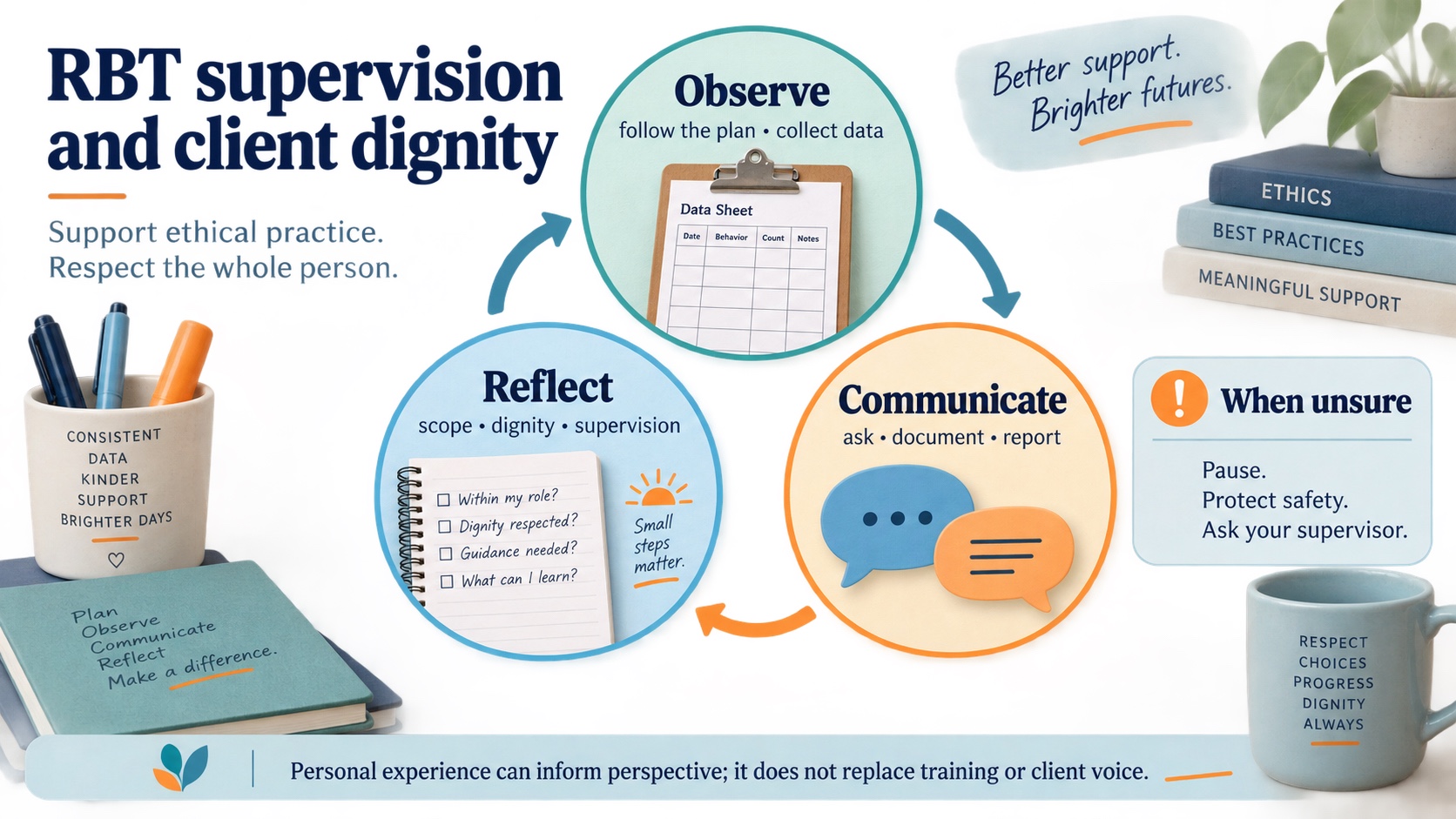
The BACB’s supervision materials matter because RBT practice is not independent practice. Your supervisor or requirements coordinator is responsible for the work you perform, and you need a clear way to receive direction, practice skills, report changes, and ask for help. Before accepting a role, ask who will supervise you, how often you will be observed, how feedback is delivered, and what happens when a case exceeds your current competence.
Your lived experience can help you notice questions about communication, sensory load, or respect that a team might otherwise overlook. It does not give you permission to speak for every autistic client, infer a client’s preferences, or replace the client’s own communication and assent. Follow the behavior plan and applicable ethics requirements, but also raise concerns when a goal, procedure, or interaction appears inconsistent with dignity, safety, or meaningful participation.
Also avoid the opposite mistake: believing you must hide every support need to prove professionalism. Reliable clinical work includes knowing your limits, requesting clarification, documenting accurately, and accepting supervision. Those are professional strengths, not weaknesses.
A practical application checklist
- Read the current BACB RBT page and handbook, then list the certification steps you still need to complete.
- Write down the essential duties of the position and compare them with your actual strengths, limits, and experience.
- Ask the employer about caseload, travel, schedule changes, documentation, safety training, and supervision.
- Identify any support that would make the work more predictable or accessible, and ask how requests are handled.
- Plan how you will communicate an urgent client concern, a data-collection problem, or a situation outside your competence.
- Review the RBT Ethics Code and use supervision to discuss client dignity, assent, privacy, boundaries, and scope.
For exam preparation, the ABA Study Online RBT learning route can help you organize concepts, while the RBT question library can help you practice discrimination between procedures. The app review loop is another optional study path. These resources support preparation; the BACB remains the authority for current certification requirements.
FAQ
Does autism prevent someone from becoming an RBT?
The current BACB resources reviewed for this article do not list autism as a general RBT disqualifier. You still need to meet the applicable requirements and perform the essential duties of the role.
Should an autistic RBT disclose autism to an employer?
Disclosure is an individual decision. If you need a workplace adjustment, ask about the employer’s accommodation process. You can focus the conversation on the functional support you need, and you may seek qualified local employment guidance.
Are autistic RBTs automatically better at working with autistic clients?
No. Shared identity can inform perspective, but it is not a substitute for training, supervision, communication, and respect for each client’s individual preferences.
What if a supervisor does not communicate in a way that works for me?
Ask for a concrete adjustment, such as written priorities or a scheduled feedback check-in, and explain how it supports accurate and safe work. If the problem affects client care or cannot be resolved, use the organization’s escalation process.
Sources and study links
- BACB Registered Behavior Technician resources
- BACB Registered Behavior Technician Handbook
- BACB Ethics Codes
- BACB supervision and training guidance
- EEOC: Employment rights as an individual with a disability
- EEOC: Disability discrimination and employment decisions
- ABA Study Online RBT learning route
- ABA Study Online RBT practice questions